CLASS 12-HUMANITIES . SOCIOLOGY . SOCIAL CHANGE AND DEVELOPMENT IN INDIA . CULTURAL CHANGE
Chapter 2 : Cultural Change
Ch 2
SOCIOLOGY
CLASS 12-HUMANITIES
Cultural Change
Cultural change refers to the transformation in the social behavior, norms, values, and practices within a society. In India, cultural change has been influenced by various factors including social reform movements, colonialism, and modernization processes. These changes have shaped Indian society by challenging traditional customs and introducing new ideas.
Social Reform Movements in the 19th and Early 20th Century
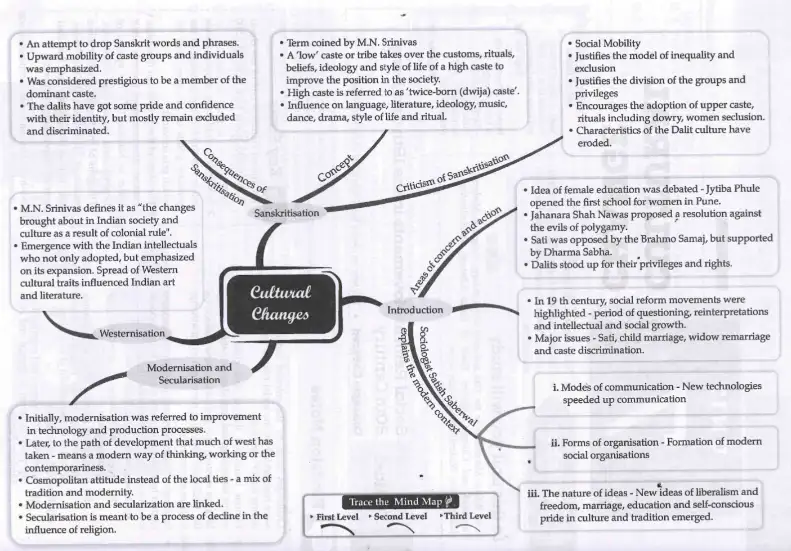
During the 19th century, colonial Indian society faced many challenges that were addressed by social reform movements. These movements focused on issues such as the abolition of sati, child marriage, promotion of widow remarriage, and combating caste discrimination. Influenced by Western liberal ideas and a new interpretation of traditional literature, reformers sought to modernize Indian society while retaining its cultural roots.
Sociologist Satish Saberwal identified three key aspects of change during this period:
- Modes of Communication: Introduction of new technologies like the printing press, microphones, and railways facilitated the spread of new ideas.
- Forms of Organisation: Formation of modern social organizations such as Brahmo Samaj and Arya Samaj, and the use of media and translation to disseminate reformist ideas.
- The Nature of Ideas: Emergence of liberal ideas about freedom, education, and cultural pride, along with new roles for women in society.
Reformers like Jyotiba Phule advocated for female education, opening the first school for women in Pune. Debates on social issues such as polygamy, caste oppression, and gender inequality were common, with various communities engaging in discussions about tradition and reform.
Exam Questions
Q1: What were the main issues addressed by social reform movements in 19th century India?
A1: The main issues included the abolition of sati, child marriage, promotion of widow remarriage, caste discrimination, and women's education.
Q2: How did new modes of communication contribute to social reform?
A2: New technologies like the printing press and railways helped spread reformist ideas widely, enabling social organizations to reach more people.
Different Kinds of Social Changes: Sanskritisation, Modernisation, Secularisation, and Westernisation
Social change in India involves multiple processes that often coexist and interact. These include Sanskritisation, Westernisation, Modernisation, and Secularisation, each influencing Indian society in distinct ways.
Sanskritisation
Coined by M.N. Srinivas, Sanskritisation is the process by which a lower caste or tribe adopts the customs, rituals, beliefs, and lifestyle of a higher caste, particularly the twice-born (dwija) castes. This process aims at social mobility and improving status within the caste hierarchy. It affects language, literature, ideology, music, dance, and rituals.
However, Sanskritisation has been criticized for reinforcing caste hierarchies and inequality, as it accepts the superiority of upper castes and can lead to the erosion of Dalit culture and identity.
Westernisation
Westernisation refers to the changes in Indian society and culture resulting from over 150 years of British colonial rule. It includes the adoption of Western technology, institutions, ideologies, and values. Indian intellectuals and upper castes often embraced Western education, art, and literature, leading to a westernised sub-cultural pattern.
Modernisation and Secularisation
Modernisation initially referred to technological and production improvements but later came to signify a broader path of social development modeled after Western societies. It involves adopting modern ways of thinking, working, and living.
Secularisation is the decline in the influence of religion in social and political life. In India, while caste operated within a religious framework traditionally, it now functions more as political pressure groups. Rituals may have secular social functions beyond religious goals.
Exam Questions
Q1: Define Sanskritisation and explain its social implications.
A1: Sanskritisation is the process where lower castes adopt upper caste customs to improve social status. It can reinforce caste hierarchies and lead to cultural erosion among lower castes.
Q2: What is the relationship between modernisation and secularisation?
A2: Modernisation involves adopting contemporary ways of life and thinking, often linked with secularisation, which is the reduction of religion's influence in society.
Key Terms
- Brahminisation: Early term for the upward mobility of low caste Hindus adopting upper caste practices.
- Culture: Socially established norms and patterns of behavior.
- Dominant Caste: A caste that owns significant land, has numerical strength, and holds a high local social position.
- Sanskritisation: Process of lower castes adopting customs of higher castes for social mobility.
- Twice-born Caste: Upper castes who undergo the sacred thread ceremony (dwija).
- Westernisation: Changes in Indian society due to British colonial influence, including technology, institutions, and values.
- Modernisation: Adoption of modern ways of thinking and living.
- Secularisation: Decline in the influence of religion in social and political life.
- Colonialism: Establishment of rule by one country over another.
Solved Examples
Example 1: Explain how social reform movements contributed to women's education in colonial India.
Solution: Reformers like Jyotiba Phule advocated for women's education, opening schools and arguing that educating women was essential for societal progress. These movements challenged traditional norms restricting women's roles.
Example 2: Describe the impact of Westernisation on Indian art and literature.
Solution: Westernisation introduced new artistic styles and literary forms, influencing Indian intellectuals and artists to blend Western and Indian traditions, leading to a cultural transformation.
Practice Set
Easy
- What is Sanskritisation?
- Name two social issues addressed by 19th-century reformers.
Moderate
- Explain the role of communication technologies in social reform movements.
- Discuss the criticism of Sanskritisation.
Challenging
- Analyze how modernisation and secularisation have influenced caste dynamics in India.
- Compare and contrast Sanskritisation and Westernisation as processes of cultural change.
Answer Key
- Easy 1: Sanskritisation is the process by which lower castes adopt customs of higher castes to improve social status.
- Easy 2: Issues such as abolition of sati and promotion of widow remarriage.
- Moderate 1: Technologies like printing press and railways helped spread reformist ideas widely.
- Moderate 2: Sanskritisation reinforces caste hierarchies and may erode lower caste cultures.
- Challenging 1: Modernisation and secularisation have shifted caste from religious to political frameworks, changing social interactions.
- Challenging 2: Sanskritisation involves adopting upper caste customs, while Westernisation involves adopting Western cultural traits; both affect social status and identity differently.
Quick Reference
- Social Reform Movements: 19th-century efforts to address social evils and promote education.
- Sanskritisation: Social mobility through adopting upper caste customs.
- Westernisation: Cultural changes due to British colonial influence.
- Modernisation: Adoption of contemporary ideas and technology.
- Secularisation: Decline of religion's influence in society.
Glossary
- Brahminisation
- Early term for low caste Hindus adopting upper caste practices.
- Culture
- Socially established norms and behaviors.
- Dominant Caste
- Caste with significant land, numbers, and social power locally.
- Sanskritisation
- Process of lower castes adopting upper caste customs.
- Twice-born Caste
- Upper caste undergoing sacred thread ceremony.
- Westernisation
- Changes in society due to British colonial rule.
- Modernisation
- Adoption of modern ways of thinking and living.
- Secularisation
- Decline in religion's social and political influence.
- Colonialism
- Rule of one country over another.
| Time Period / Year | Event / Change | Importance |
|---|---|---|
| 19th Century | Social Reform Movements | Addressed social evils like sati, child marriage, caste discrimination |
| Late 19th Century | Formation of Brahmo Samaj and Arya Samaj | Modern social organizations promoting reform |
| 1914 | All-India Muslim Ladies Conference founded | Women’s participation in social reform |
| 19th-20th Century | Spread of Western education and ideas | Influenced Indian intellectuals and social change |
| 20th Century | Growth of Sanskritisation and Westernisation | Processes shaping caste mobility and cultural change |