CBSE EXAMINATION PAPER-2026
SCIENCE
(Solved)
General Instructions :
Read the following instructions carefully and follow them :
- This question paper contains 45 questions. All questions are compulsory.
- This question paper is divided into 5 sections.
- Section A – questions number 1 to 3 are case based questions
- Section B – questions number 4 to 23 are multiple choice questions
- Section C – questions number 24 to 31 are very short answer
- Section D – questions number 32 to 39 are short answer
- Section E – questions number 40 to 45 are long answer
- There is no overall choice given in the question paper. However, an internal choice has been provided in few questions.
- Use of calculator is NOT allowed.
Section A
(1) Write the structure and function of Bowman’s capsule.
[1 Mark](2) Although kidneys filter a large amount (about 180 L daily) of fluids, still the excretion from the body is only about a litre or two. Why ?
[1 Mark](3) What is excretion ? Why is it necessary for any living organism ?
[2 Marks](1) Write structural formula and name of 4th member of alcohol homologous series.
[1 Mark](2) What happens when ethanol is heated with alkaline KMnO₄ ? Write chemical equation involved.
(3) Write the chemical equation of reaction of ethanol with ethanoic acid in the presence of concentrated H₂SO₄ . Write the name of this reaction.
[2 Marks]Three students Shweta, Ayesha and Samridhi were performing an experiment to understand the factors on which the resistance of a conductor depends. Each one of them completed electric circuit with the help of a cell, an ammeter, a plug key and wire.
Shweta put nichrome wire of length ‘l’ in the circuit and after plugging the key, noted current in the ammeter.
Ayesha put nichrome wire of same thickness but twice the length i.e. ‘2l’ in the circuit and after plugging the key, noted current in the ammeter.
Samridhi took copper wire of length ‘l’ and same thickness in the circuit and after plugging the key, noted current in the ammeter.
(1) If the ammeter reading is X ampere with nichrome wire of length ‘l’, then what will be the ammeter reading if the length of nichrome wire is doubled with same area of cross-section ?
[1 Mark](2) What happens to the ammeter reading if the area of cross-section of nichrome wire is doubled, keeping the length of wire ‘l’ the same ?
[1 Mark](3) Define ‘resistivity’. Write its SI unit. Compare the resistivity of an alloy with its constituents metals.
[2 Marks]Section B
Identify the part that controls the closing and opening of the stomatal pore in leaves of plants. 1 Select the correct option
Choose the equation of reaction that correctly represents anaerobic respiration in muscles :
-
(A)

-
(B)

-
(C)

-
(D)

In human beings, the implantation of fertilised egg takes place in which part of female reproductive system ?
When a human egg is fertilized by a sperm having ‘Y’ chromosome, the zygote has the following combination of chromosomes :
Which of the following is a non-biodegradable pollutant ?
In an ecosystem, the decomposers perform an important role. Select the option indicating the role of decomposers.
two statements – Assertion (A) and Reason (R). Answer these questions selecting the appropriate option from (A), (B), (C) and (D) given below :
Assertion (A) : Bacteria that can withstand heat have better chances of survival in a heat wave.
Reason (R) : Accumulation of variations in a species increases the chances of its survival in changing environment.
The volume ratio of hydrogen and oxygen gases liberated during electrolysis of water is :
Which of the following set of compounds does not belong to same homologous series ?
Which of the following is an amphoteric oxide ?
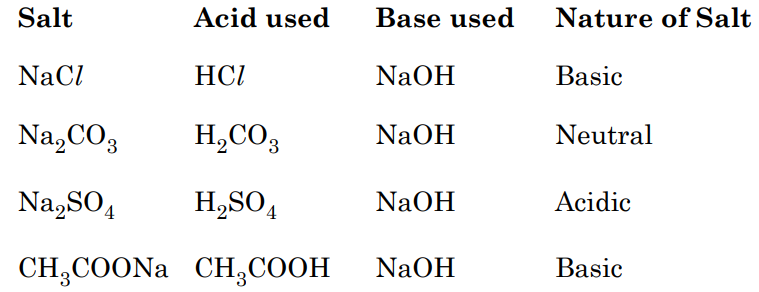
Study the following table and select the correct option :
Which of the following will not undergo addition reaction ?
Four solutions, namely fructose, ethanol, hydrochloric acid and sodium hydroxide filled in four separate beakers are connected one by one in an electric circuit with a bulb. The solutions in which the bulb will glow when current is passed are :
Which gas is evolved when magnesium metal reacts with very dilute HNO₃ ?
Rays from the sun converge at a point 25 cm behind a convex lens. The distance at which an object be placed in front of the lens to get a virtual image, is :
two statements are given – one labelled as Assertion (A) and the other labelled as Reason (R). Select the correct answer to this question from the codes (A), (B), (C) and (D) as given below : Assertion (A) : The needle of a magnetic compass kept in strong external magnetic field, always aligns itself in northsouth direction on the earth. Reason (R) : Behaviour of the needle of a compass is same as that of a freely suspended bar magnet.
Section C
Give a diagrammatic representation of nutrition in Amoeba.
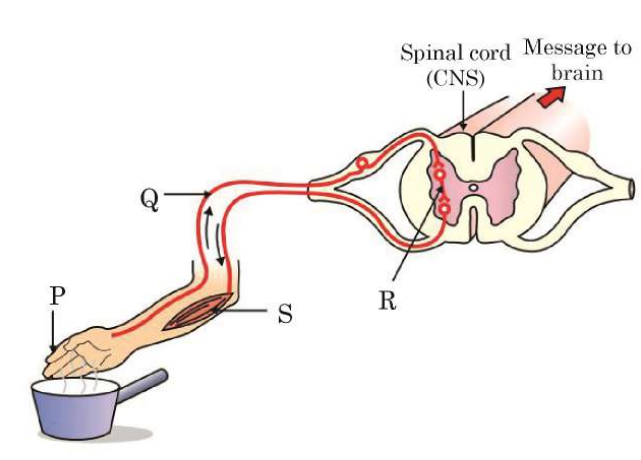
Observe the given figure and identify the labelled parts P, Q, R and S :
Which of the plant hormones are responsible for the following processes ?
(i) Promote cell division
(ii) Inhibition of growth
(iii) Detection of light
(iv) Wilting of leaves
Briefly mention the steps in double-circulation through human heart
Define the following terms :
(i) Olfactory indicator
(ii) Water of crystallization
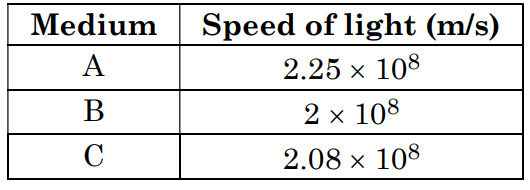
(a) Relate the speed of light in the given medium with its optical density.
(b) Using the information given in the table below, arrange the medium A, B and C in the ascending order of their optical density
(i) How does the change in curvature of the eye lens helps us in the process of seeing the nearby objects clearly ?
(ii) State the range of the power of accommodation of a normal human eye.
Draw a ray diagram to show the correction of eye defect of an old man who can not see an object placed closer than 1 m from his eye, clearly.
Section D
Based on Mendel’s experiment show the cross between round, yellow seeds of pea plant (RRYY) with wrinkled and green seeds of pea plant (rryy) upto F₂ generation. Write the number of seeds/plants with following genetic (Genotype) makeup in F₂ generation :
(i) RRYY
(ii) rry
(a) Mention any one harmful effect of using plastic bags on the environment. Suggest better alternatives to the usage of plastic bags.
(b) Paddy fields require a large amount of water. The pesticides and chemical fertilizers used are washed down into the soil or waterbodies. How do these chemicals reach our bodies ? What is this phenomenon known as ?
What happens when
(i) lead (II) nitrate is heated ?
(ii) iron (II) sulphate is heated ?
(iii) silver chloride is exposed to sunlight ? Write balanced chemical equations of the reactions involved in support of your answer.
(a) Give the chemical name and formula of Plaster of Paris.
(b) Write the chemical equation of its preparation.
(c) Give any two uses of it
(a) Name the acid present in ant’s sting.
(b) Give reason :
(i) While diluting an acid, it is recommended that the acid should be added to water.
(ii) Baking soda is used as an antacid.
(a) Draw the ray diagram for refraction of light through a glass prism and mark angle of refraction and angle of deviation.
(b) When the path of a light ray refracted through a glass prism is reversed how will the angle of deviation change ? Explain.
(a) A ray of light after reflection from a concave mirror becomes parallel to its principal axis. Draw a labelled ray diagram to show this.
(b) (i) Differentiate between the virtual images formed by a convex mirror and concave mirror.
(ii) “The value of magnification ‘m’ for a mirror is –2.” Calculate the height of object if the height of image is 20 cm.
(a) Why does an electric bulb become dim when an electric heater in parallel circuit is switched ON ?
(b) How to connect three resistors each of resistance 8Ω, so that the equivalent resistance of the combination is 12 Ω ? Draw diagram of the combination and justify your answer.
Section E
(i) In an angiospermic flower, fertilization is said to take place when male gametes carried in the pollen tube fuse with the female gamete, present in the embryo sac. This results in lot of changes in different parts of the flower. State the changes taking place in the following structures of flower post fertilization :
(a) Zygote
(b) Ovule
(c) Ovary
(d) Sepals
(ii) Define germinati
(i) Sugarcane does not produce seeds so name the process through which it will be able to reproduce.
(ii) List any two advantages of this method.
(iii) Besides sugarcane, give two more examples of plants that reproduce by this method.
(iv) Why regeneration is not possible in all the types of animals ?
(i) Give reasons for the following :
(I) Ionic compound have generally high melting points and boiling points.
(II) Solder, an alloy of lead and tin, is used for welding electrical wires.
(III) Carbon cannot reduce the oxides of Na or Mg.
(ii) The reaction of compound ‘X’ with aluminium is used to join railway tracks :
(I) Identify the compound ‘X’.
(II) Name the reaction.
(III) Write the balanced chemical equation of the reaction of compound ‘X’ with aluminium.
(i) Write the balanced chemical equations when :
(I) A mixture of Cu₂O and Cu₂S is heated.
(II) ZnS is heated in the presence of oxygen.
(ii) Give reasons for the following :
(I) The wires carrying current in homes have a coating of PVC.
(II) To make hot water tanks, copper is used and not steel.
(iii) Show the formation of ionic compound CaO with electron dot structure. [Atomic number : Ca = 20, O = 8]
(i) Draw a diagram showing the magnetic field lines around a bar magnet. Write any two characteristics of magnetic field lines.
(ii) Write the statement of Right hand thumb rule.
(iii) The concentric circles representing the magnetic field around a current carrying straight wire become larger and larger as we move away from the wire. How does magnetic field change on these concentric circles ?
(i) Draw a diagram, showing the magnetic field lines in and around the current carrying solenoid. Write any two salient features of these lines.
(ii) What is an electromagnet and how is it made ?
Other Years — Science