CBSE EXAMINATION PAPER-2026
SCIENCE
(Solved)
General Instructions :
Read the following instructions carefully and follow them :
- This question paper contains 44 questions. All questions are compulsory.
- This question paper is divided into 5 sections.
- Section A – questions number 1 to 3 are case based questions
- Section B – questions number 4 to 23 are multiple choice questions
- Section C – questions number 24 to 30 are very short answer
- Section D – questions number 31 to 38 are short answer
- Section E – questions number 39 to 44 are long answer
- There is no overall choice given in the question paper. However, an internal choice has been provided in few questions.
- Use of calculator is NOT allowed.
Section A
Read the following passage and answer the questions that follow :
Not all plants carry out photosynthesis by the same mechanism. In most plants, it depends directly on gaseous carbon dioxide that diffuses into the leaf. However, some plants can store carbon dioxide in the vacuole of the leaf cells as part of a complex carbon compound. This compound is transported to the chloroplast and releases carbon dioxide when required for photosynthesis. This special mechanism is believed to have evolved as an adaptation in such plants which do not open stomata during the daytime to conserve water for survival in dry conditions (desert conditions).
(1) Which process in these plants is minimised to help the plants survive in dry conditions ?
[2 Marks](2) Which part of the leaf is responsible for exchange of gases during photosynthesis ?
[2 Marks]Read the following passage and answer the questions that follow :
An electrochemical process is used for refining metals by selectively dissolving and depositing them through electrolysis. Electrolytic refining is used for metals like Copper, Zinc, Tin, Nickel, Silver and Gold.
(1) In electrolytic refining of copper, name the anode and the cathode.
[1 Mark](2) Define anode mud.
[1 Mark](3) With the help of chemical equations, show the extraction of copper from its ore Cu₂S.
[2 Marks]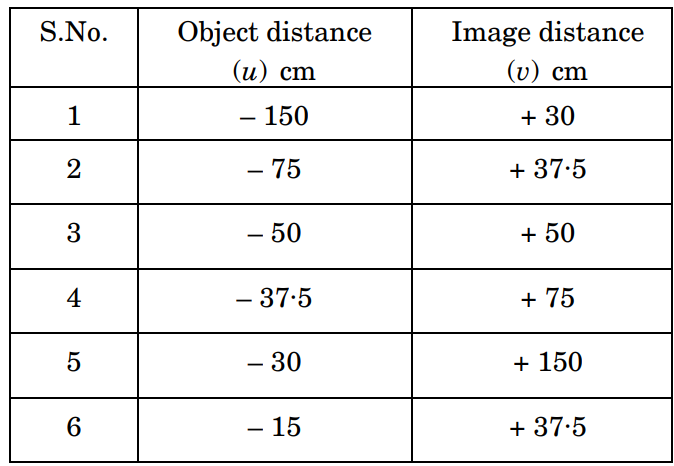
(1) Without calculation, find out the focal length of the given convex lens. Justify your answer.
[1 Mark](2) Which one of the observations given in the table is not correct and why ?
[1 Mark](3) Find out the value of magnification for u = – 30 cm. Write the nature of the image formed. Give reason for your answer.
[2 Marks]Section B
Pravin was given a list of characteristics associated with the process of anaerobic respiration in humans, in the table given below : Which of the above characteristics is/are related to the above process ?

Anaerobic respiration in humans occurs when oxygen supply is insufficient, such as during heavy exercise. During this process, glucose is broken down without oxygen, producing energy and lactic acid. Hence, characteristics related to the absence of oxygen (anaerobic conditions) and the production of lactic acid are correct. The given context explains that anaerobic respiration involves food breakdown without oxygen and formation of lactic acid, which corresponds to statements (i) and (iii).
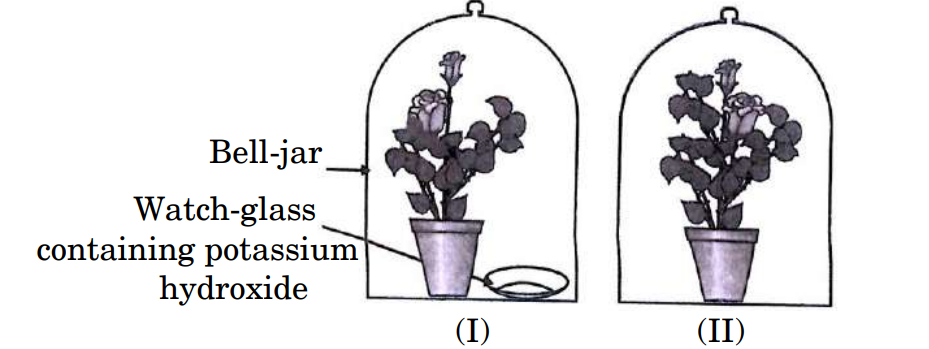
Observe the figure given below and identify the incorrect step for the activity set-up :
Walking in a straight line and riding a bicycle are activities which are possible due to coordination of which part of the brain ?
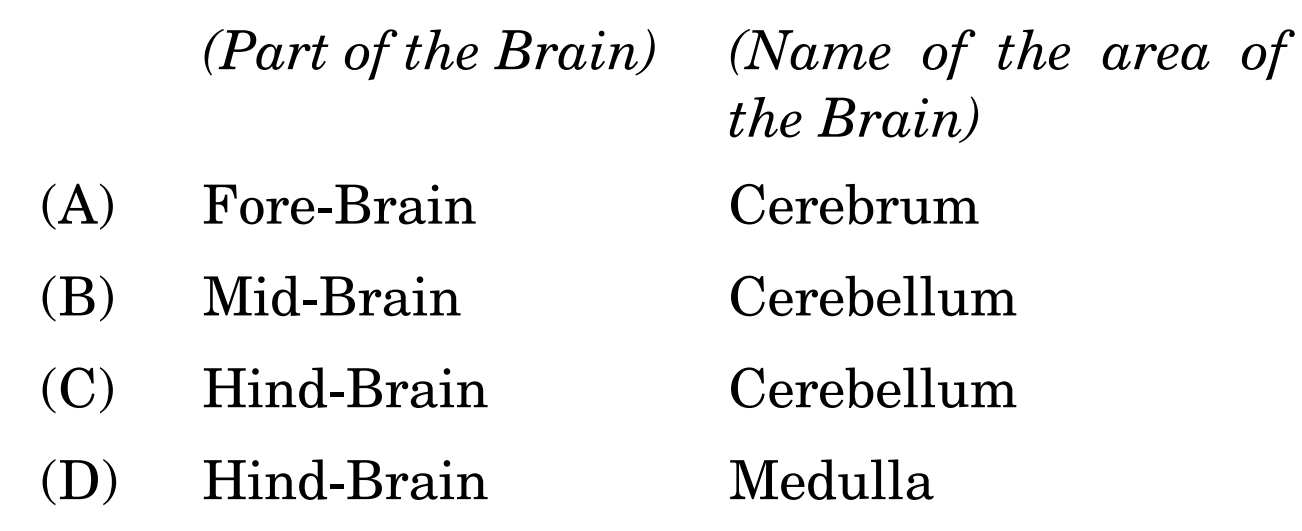
Activities like walking in a straight line and riding a bicycle require coordination, balance, and precision of voluntary actions. These functions are controlled by the cerebellum, which is a part of the hind-brain. The cerebellum maintains posture and balance, enabling smooth and coordinated movements for such activities.
In a synapse, the chemical signal is transmitted from :
According to the provided context, the electrical impulse travels along the axon to its end, where it triggers the release of chemicals. These chemicals cross the synapse and initiate an electrical impulse in the dendrite of the next neuron. Hence, the chemical signal is transmitted from the axonal end of one neuron to the dendritic end of another neuron.
In accumulation of toxic substances at higher trophic levels of an ecosystem through the food chain, which of the following organisms is affected the most ?
Toxic substances that are not degradable accumulate progressively at each trophic level in a food chain, a phenomenon called biological magnification. Since human beings occupy the top level in any food chain, they accumulate the maximum concentration of these toxic chemicals in their bodies, making them the most affected organisms.
The growth of tendrils in grapes plants is due to :
Tendrils are sensitive to touch. When they come in contact with a support, the cells of the tendril that touch the support grow slower compared to the cells away from the support. This differential growth causes the tendril to curl around the support and help the plant cling to it. Hence, the rapid growth occurs in the tendril cells away from the support.
Two statements are given — one labelled as Assertion (A) and the other labelled as Reason (R). Select the correct answer to these questions from the codes (A), (B), (C) and (D) as given below.
Assertion (A) : Natural replenishment of soil will not take place in absence of microbes.
Reason (R) : Microbes, comprising of bacteria and fungi, break down dead remains and waste products of organisms, and they go into the soil.
Two statements are given — one labelled as Assertion (A) and the other labelled as Reason (R). Select the correct answer to these questions from the codes (A), (B), (C) and (D) as given below.
Assertion (A) : The basic filtration unit in the kidneys, like in the lungs, is a cluster of very thin-walled blood capillaries.
Reason (R) : Each capillary cluster in the kidney is associated with the cup-shaped end of a coiled tube called Bowman’s capsule.
The basic filtration unit in the kidneys is a cluster of very thin-walled blood capillaries known as the glomerulus. This is similar to the lungs where capillary clusters facilitate exchange. Each cluster (glomerulus) is associated with the cup-shaped end of a coiled tube called Bowman’s capsule, which collects the filtrate from blood. Therefore, both the assertion and reason are true, and the reason correctly explains the assertion.
Which of the following is an example of a displacement reaction ?
A displacement reaction occurs when a more reactive metal displaces a less reactive metal from its compound or solution. According to the provided context, reactive metals reacting with dilute acid is an example of displacement reaction, where the metal displaces hydrogen from the acid. The other options such as electrolysis of water, combustion of natural gas, and the reaction of quick lime with water are not displacement reactions; they represent electrolysis, combustion, and combination reactions, respectively.
To a small amount of copper oxide in a beaker, when we add dilute hydrochloric acid slowly with stirring, the change in the colour of the solution is due to the formation of :
When dilute hydrochloric acid is added to copper oxide, the copper oxide dissolves and reacts to form copper(II) chloride. This salt imparts a blue-green colour to the solution. Copper oxide is black and is a basic oxide, and in reaction with the acid it forms the salt copper(II) chloride and water. Thus, the blue-green colour change is due to the formation of copper(II) chloride.
Consider the structures ‘X’ and ‘Y’ given below : Which of the following statements are correct ? (i) ‘X’ and ‘Y’ are homologues. (ii) ‘X’ and ‘Y’ have the same structural formula, but different molecular formula. (iii) ‘X’ and ‘Y’ have the same molecular formula, but different structural formula. (iv) ‘X’ and ‘Y’ are structural isomers.
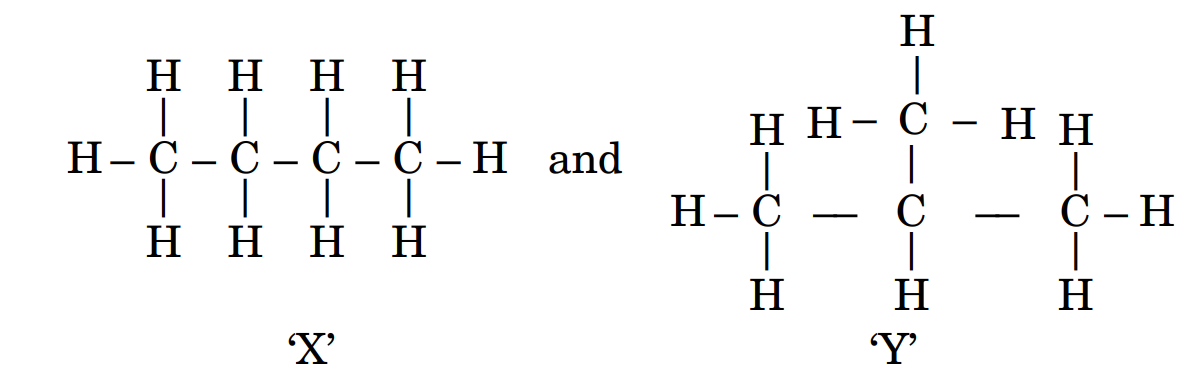
Structures ‘X’ and ‘Y’ both have the same molecular formula C4H10 but differ in their structural arrangement. Compounds with the same molecular formula but different structures are called structural isomers. Hence, statements (iii) and (iv) are correct. They are not homologues because homologous compounds differ by a CH2 unit and thus have different molecular formulas, so statement (i) is incorrect. Also, statement (ii) is incorrect because the molecular formula is the same, not different.
The reaction of calcium with cold water is :
Calcium reacts with cold water to form calcium hydroxide and hydrogen gas. The reaction is less violent compared to sodium or potassium, and although it is exothermic, the heat evolved is not enough to ignite the hydrogen gas. Therefore, the hydrogen does not catch fire during the reaction.
In which case/cases will the bulb glow considering that all other connections of electric circuit are complete and working ?
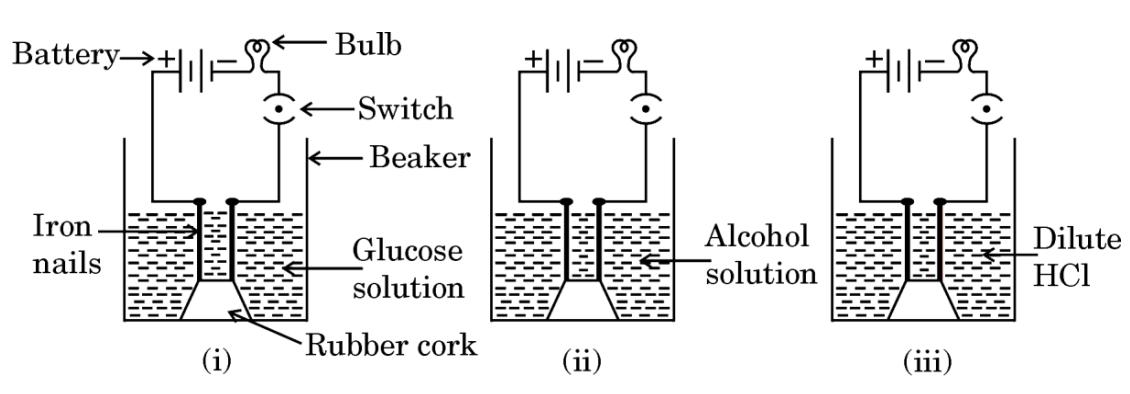
The bulb glows when the switch is ON and the electric circuit is complete, allowing current to flow through the bulb. In the given context, the bulb glows when the circuit is complete and current passes through it. Cases (ii) and (iii) both represent situations where the circuit is complete and conducting, so the bulb will glow. Case (i) does not allow current to flow, so the bulb will not glow.
When zinc reacts with NaOH, the product formed is :
When zinc reacts with sodium hydroxide (NaOH), sodium zincate (Na₂ZnO₂) is formed along with the release of hydrogen gas (H₂). This is shown by the reaction: 2NaOH (aq) + Zn (s) → Na₂ZnO₂ (s) + H₂ (g). Therefore, the correct product formed is sodium zincate (Na₂ZnO₂).
The correct way to connect an ammeter and a voltmeter in an electric circuit is :
An ammeter measures the current flowing through the circuit, so it must be connected in series to ensure all the current passes through it. A voltmeter measures the voltage across a component, so it must be connected in parallel to the component to measure the potential difference correctly. Connecting the ammeter in series and the voltmeter in parallel follows the correct method of measuring current and voltage in a circuit.
Observe the given ray diagram showing refraction through a prism and choose the correct option for colour of rays 1 and 2 :
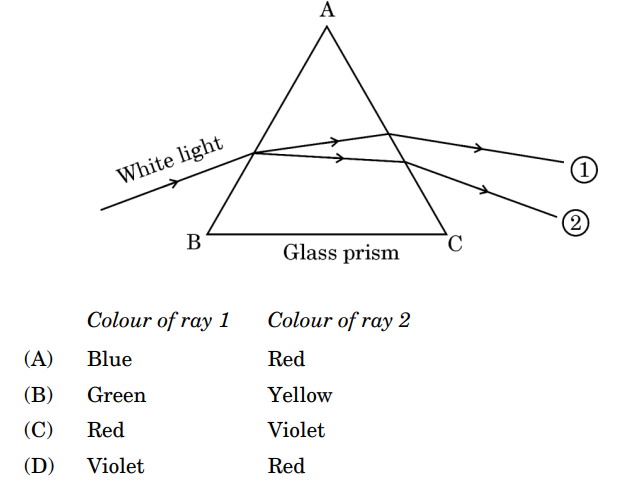
When white light passes through a prism, it disperses into its constituent colors due to different degrees of bending for each color. Violet light bends the most while red light bends the least. Therefore, in the ray diagram, ray 1 corresponds to violet (which bends the most), and ray 2 corresponds to red (which bends the least). This is consistent with the explanation that red appears near the top and violet near the bottom of the spectrum.
Two statements are given — one labelled as Assertion (A) and the other labelled as Reason (R). Select the correct answer to this question from the codes (A), (B), (C) and (D) as given below.
Assertion (A) : The needle of a compass, kept in an external magnetic field, always aligns itself in the North-South direction of the Earth.
Reason (R) : The behaviour of the needle of the compass is similar to the behaviour of a freely suspended bar magnet.
The compass needle is a tiny bar magnet that can freely rotate and aligns itself with the Earth's magnetic field, pointing towards the North-South direction. This behaviour is exactly like that of a freely suspended bar magnet which aligns itself along the magnetic field lines. Therefore, both the assertion and the reason are true, and the reason correctly explains the assertion.
Section C
(i) Chlorofluorocarbons (CFCs) have been linked to depletion of ozone layer. In 1987, the United Nations Environment Programme (UNEP) succeeded in making an agreement. State this agreement.
(ii) What is the role of ozone in our atmosphere ?
(ii) Ozone in the atmosphere plays a very important role by absorbing the harmful ultraviolet (UV) radiation from the Sun. This protects living organisms on Earth from dangerous UV rays which can cause skin cancer and other harmful effects.
What kind of respiration provides more energy and why ?
Separation of right side and left side of the heart is useful to keep oxygenated and deoxygenated blood from mixing. Various organisms have different types of heart.
(I) Fill in the blanks
(i) to (iii) correctly according to the type of organisms and their evolution in terms of blood circulation :
(II) Which type of circulation is most efficient ?
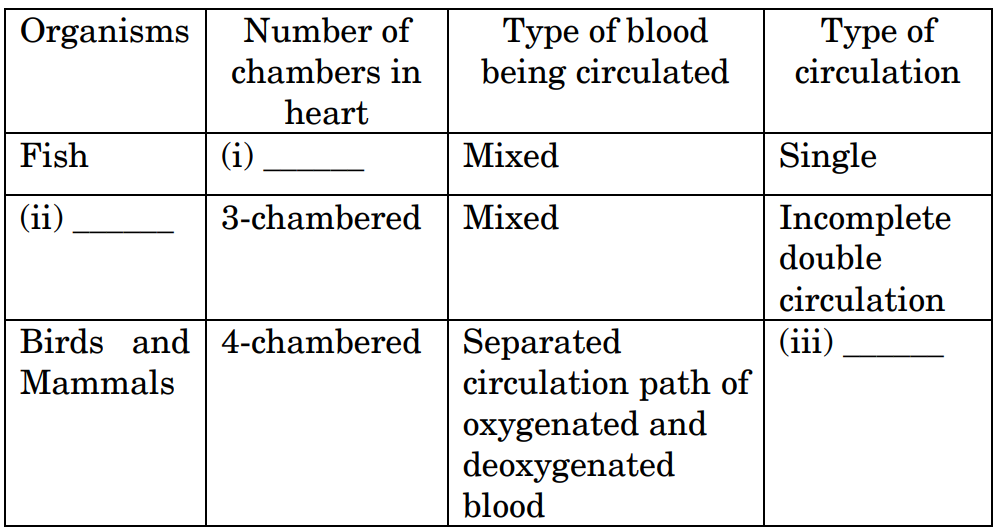
(i) Organisms with a two-chambered heart like fish have a single circulation.
(ii) Organisms like amphibians and reptiles with a three-chambered heart have incomplete double circulation.
(iii) Mammals and birds have a four-chambered heart and complete double circulation.
(II) Complete double circulation is the most efficient because it separates oxygenated and deoxygenated blood completely, ensuring that the body receives fully oxygenated blood for better energy supply.
Show the formation of the following ionic compounds by transfer of electrons between the combining atoms :
(i) Sodium oxide (Na₂O)
(ii) Magnesium chloride (MgCl₂ )
(Given : Atomic number : Na = 11, Mg = 12, O = 8, Cl = 17)
(ii) Magnesium chloride (MgCl2): Magnesium atom (Mg) loses 2 electrons to form Mg2+ (Mg: 2,8,2 → Mg2+: 2,8). Each chlorine atom (Cl) gains 1 electron to form Cl- (Cl: 2,8,7 → Cl-: 2,8,8). One Mg2+ ion combines with two Cl- ions to form MgCl2.
A ray of light enters into medium B from medium A as shown in the given figure :
(a) Which one of these two media is optically denser than the other medium ? Justify your answer.
(b) If the speed of light in medium A is V_A and in medium B is V_B , then what is the refractive index of medium B with respect to medium A ?
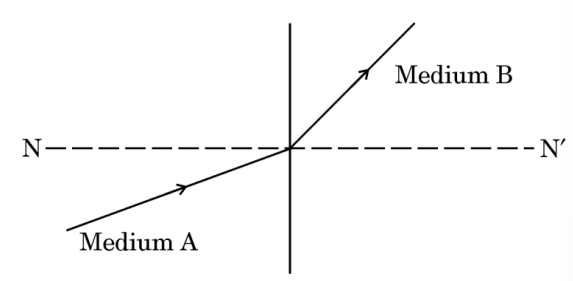
(b) The refractive index of medium B with respect to medium A is given by n = VA / VB. This means refractive index measures how much slower light travels in medium B compared to medium A.
What happens when light is scattered from (i) very fine particles and (ii) very large size particles of medium ? Justify your answer in each case.
(ii) When light is scattered from very large particles, all wavelengths are scattered almost equally, making the scattered light appear white. This happens because large particles scatter light of longer wavelengths too, which combines to give white light.
With the help of a ray diagram, explain any phenomenon of formation of spectrum in nature.
When white sunlight passes through a glass prism, it bends or refracts due to change in speed. Different colors in white light have different wavelengths, so they bend by different angles while passing through the prism. This causes the white light to split into its constituent colours forming a spectrum. The colors appear in the order: red, orange, yellow, green, blue, indigo, and violet.
Ray Diagram Explanation:
In the ray diagram, an incident ray of white light approaches the prism and refracts at the first surface. Inside the prism, light undergoes dispersion as different colours bend differently. After refraction at the second surface, a spectrum is formed.
This natural phenomenon is observed as a rainbow when sunlight passes through raindrops acting like tiny prisms, separating light into a spectrum.
Section D
In xylem tissue, vessels and tracheids of the roots, stems and leaves are interconnected to form a continuous system of water-conducting channels reaching all parts of the plant. Explain how this is achieved.
Structure: Vessels are long tubes made from cells joined end to end, with their end walls broken or perforated, allowing free flow of water. Tracheids are elongated cells with tapering ends and pores in their walls, permitting water to move laterally.
Interconnection: Vessels and tracheids in roots, stems and leaves are connected end-to-end and side-to-side via pits and perforations, forming an uninterrupted pipeline.
Function: This continuous network enables efficient upward movement of water from roots to leaves.
Water moves up through xylem vessels by capillary action and transpiration pull caused by evaporation from leaves, ensuring water reaches all parts of the plant.
Show the cross and observations made by Mendel when he crossed pure tall pea plant with a pure short pea plant to get F₁ progeny.
Cross: TT (tall) × tt (short) = All F₁ progeny are Tt (heterozygous tall).
Observations:
1. All F₁ plants were tall, showing that the tall trait is dominant.
2. No medium or short plants appeared in F₁ generation.
3. This shows that the short trait is recessive and masked in F₁.
4. Mendel concluded that each plant has two factors (genes) for a trait, one inherited from each parent.
2 g of green coloured crystals of ferrous sulphate are heated in a dry boiling tube. Name the type of chemical reaction taking place. Write the balanced chemical equation for the reaction. Is this an exothermic or an endothermic reaction ?
(b) Balanced chemical equation: 2FeSO4(s) --Heat--> Fe2O3(s) + SO2(g) + SO3(g)
(c) Nature of reaction: This is an endothermic reaction because heat energy is absorbed to break down ferrous sulphate into ferric oxide and sulphur oxides.
When green coloured ferrous sulphate crystals are strongly heated, they lose water and break down to form reddish brown ferric oxide and gases sulphur dioxide and sulphur trioxide, which have a characteristic smell of burning sulphur. This process requires continuous supply of heat, confirming it is endothermic.
Give reasons :
(i) For dilution of an acid, acid is added into water and not water into acid.
(ii) Dry HCl gas does not turn blue litmus red whereas dilute hydrochloric acid does.
(iii) Blue colour of Copper(II) sulphate crystals turns white on heating.
(ii) Dry HCl gas does not turn blue litmus red because it does not have free hydrogen ions (H+) in the absence of moisture, so it is not acidic in dry form. Dilute hydrochloric acid contains H+ ions which turn blue litmus paper red showing its acidic nature.
(iii) Blue copper(II) sulphate crystals turn white on heating because the water of crystallization is removed as water vapour. The blue colour is due to water molecules, and when these are lost, the remaining anhydrous copper sulphate is white or greyish-white.
Write the preparation of the following compounds with balanced chemical equation :
(i) NaOH by chlor-alkali process
(ii) Baking Soda
(iii) Plaster of Paris
The chlor-alkali process involves the electrolysis of aqueous sodium chloride (brine) solution to produce sodium hydroxide (NaOH), chlorine gas (Cl2), and hydrogen gas (H2).
Chemical equation: 2NaCl + 2H2O --electrolysis--> 2NaOH + Cl2 + H2
(b) Preparation of Baking Soda (Sodium bicarbonate):
Baking soda is prepared by the Solvay process where sodium chloride, ammonia, and carbon dioxide react in water.
Chemical equation: NaCl + NH3 + CO2 + H2O --> NaHCO3 + NH4Cl
(c) Preparation of Plaster of Paris:
Plaster of Paris (POP) is prepared by heating gypsum (calcium sulfate dihydrate) to about 150 deg Celsius which removes water of crystallization.
Chemical equation: CaSO4.2H2O --heat to 150 deg C--> CaSO4.1/2H2O + 1.5H2O
CaSO4.1/2H2O is Plaster of Paris (POP).
Study the given diagram and answer the questions that follow :
(a) Write the name of the eye defect shown in the diagram. Where is the image formed in this eye defect with respect to the retina of the eye ?
(b) List two causes of this eye defect.
(c) With the help of a diagram, show how this eye defect of vision is corrected.
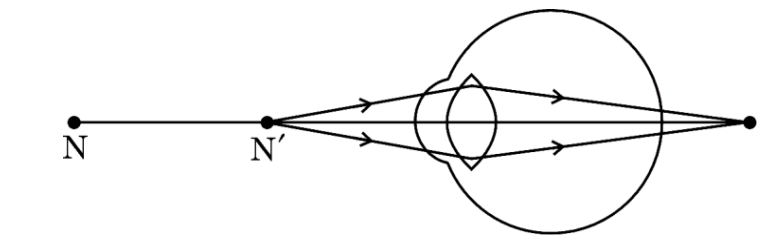
(b) Two causes of myopia are: (i) Excessive curvature of the eye lens which leads to increased refractive power, (ii) Elongation of the eyeball which increases the distance between the lens and the retina.
(c) Myopia can be corrected by using a concave lens of suitable power. The concave lens diverges the light rays before they enter the eye, so that the eye lens focuses the image exactly on the retina, restoring clear vision.
(a) Name a device which is used to :
(i) Maintain a constant potential difference in a circuit.
(ii) Change the electric current in an electric circuit.
(b) When the potential difference between the terminals of an electric heater is 110 V, a current of 5 A flows through it. What will be the value of current flowing through it when the potential difference is increased to 220 V ?
(b) Given, potential difference V1 = 110 V, current I1 = 5 A, and new potential difference V2 = 220 V. Assuming the resistance R of heater remains constant, using Ohm's law, I = V / R. First, find resistance R = V1 / I1 = 110 V / 5 A = 22 ohms. Now find new current I2 = V2 / R = 220 V / 22 ohms = 10 A.
Therefore, the current flowing through the heater when the potential difference is increased to 220 V is 10 A.
Consider the given electric circuit :
Calculate the following :
(a) Total resistance of the circuit
(b) The electric current drawn from the battery
(c) Potential difference between points P and Q
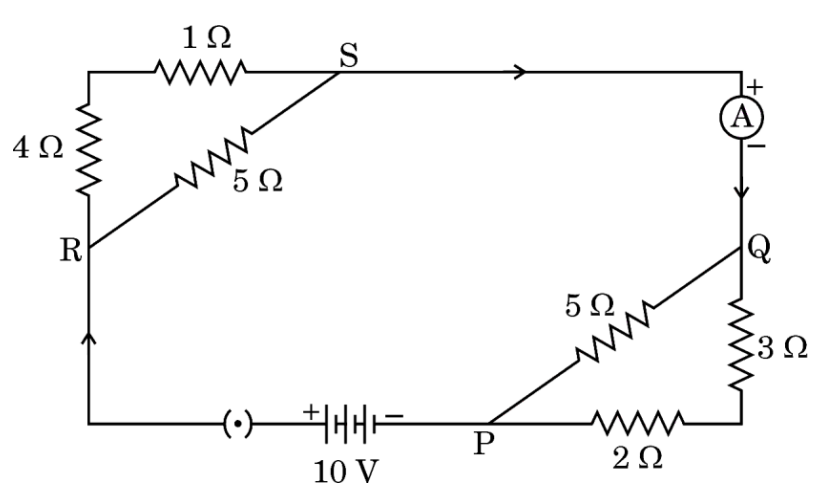
(b) The electric current drawn from the battery is found using Ohm's law: I = V / Rtotal, where V is the voltage of the battery.
(c) The potential difference between points P and Q depends on their position in the circuit. It can be calculated by finding the voltage drop across the resistors between P and Q using V = I * R for each resistor.
These steps will give the total resistance, current from the battery, and potential difference between points P and Q in the circuit.
Section E
Observe the given diagram and answer the questions that follow :
(i) Give the name of the structure and type of reproduction shown in the above diagram.
(ii) State one advantage and one disadvantage of the above mentioned method of reproduction.
(iii) Give reason : Asexual reproduction lacks genetic variation.
(iv) Why have higher organisms resorted to sexual reproduction in spite of its complexity ?
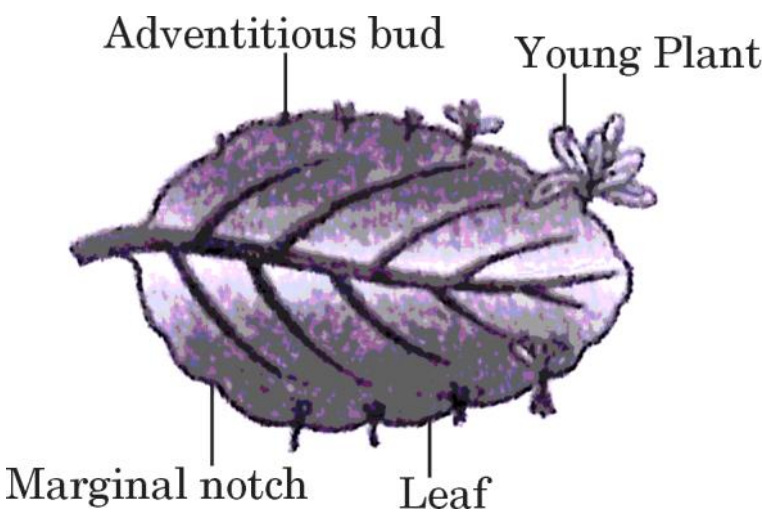
(b) Advantage: It is a quick process and does not require a mate, thus helps in rapid population increase.
Disadvantage: It produces genetically identical offspring, which may be harmful if the environment changes.
(c) Reason: Asexual reproduction involves only one parent and no fusion of gametes occurs, so the offspring are genetically identical to the parent, leading to lack of genetic variation.
(d) Higher organisms have resorted to sexual reproduction because it produces genetically varied offspring, which increases the chances of survival in changing environmental conditions and helps in evolution.
Observe the given diagram and answer the questions that follow :
(i) Give the name and type of reproduction shown in the above diagram.
(ii) Comment on the processes taking place in stage P.
(iii) Name an organism which reproduces by the above mentioned method.
(iv) Name the method that can be used to raise plants that have lost their capacity to produce seeds. List any two advantages of growing plants by such a method.
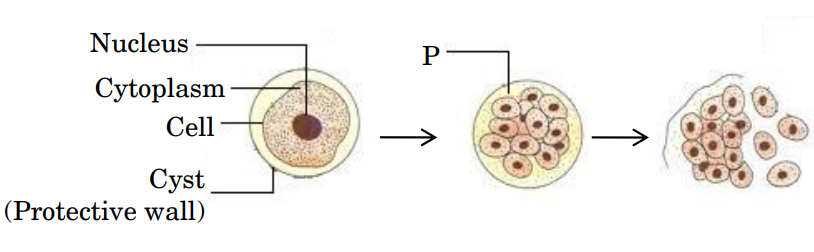
(b) In stage P, the process taking place is the development of new shoots and roots from the vegetative part of the plant like a stem cutting or runner. This stage involves cell division and differentiation that enable the formation of a new plant.
(c) An example of an organism that reproduces by vegetative propagation is grass (using runners) or potato (using tubers).
(d) The method used to raise plants that have lost the capacity to produce seeds is called tissue culture or micropropagation. Two advantages of growing plants by this method are:
1. Large number of plants can be produced in a short time.
2. Plants produced are free from diseases and are genetically identical to the parent plant.
(i) What is homologous series ? Which two of the following organic compounds belong to the same homologous series ? C2H4 , C4H10, C3H4 , C4H8
(ii) Write the product(s) in the following reactions :
(iii) Why does micelle formation take place when soap is added to water ?

(I) Name the following compounds :
(ii) Name the reaction which is commonly used in the conversion of vegetable oils to fats.
(iii) Why is the melting point of C₄H₁₀ higher than C₃H₈ ?
(iv) What happens when a piece of sodium is dropped into ethanol ?
(v) Write the products in the following reaction :
CH₃COOC₂H₅+ NaOH ⎯⎯→
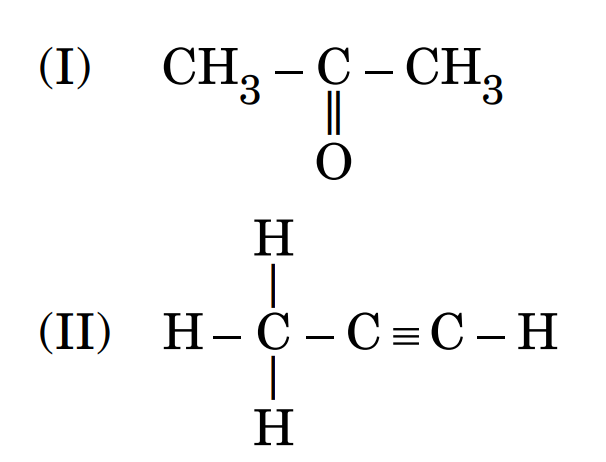
(ii) The reaction commonly used in the conversion of vegetable oils to fats is called Hydrogenation. It involves adding hydrogen to unsaturated fats to make them saturated, thus solidifying the oils.
(iii) The melting point of C₄H₁₀ (butane) is higher than C₃H₈ (propane) because butane has a larger molecular size and more surface area, leading to stronger Van der Waals forces (intermolecular forces), thus requiring more heat to melt.
(iv) When a piece of sodium is dropped into ethanol, it reacts to form sodium ethoxide and hydrogen gas is evolved. The reaction is:
2Na + 2C₂H₅OH → 2C₂H₅ONa + H₂
(v) In the reaction CH₃COOC₂H₅ + NaOH → , the products are ethanol (C₂H₅OH) and sodium acetate (CH₃COONa). This reaction is called saponification or base hydrolysis of ester.
The equation is:
CH₃COOC₂H₅ + NaOH → CH₃COONa + C₂H₅OH
(i) What is a solenoid ? Draw a diagram showing the magnetic field pattern due to a current-carrying solenoid (inside and outside).
(ii) Name any two factors on which the magnitude of the magnetic field due to a current-carrying solenoid depends.
(iii) A current-carrying solenoid is stretched and converted into a straight wire carrying current. Draw a diagram showing the magnetic field pattern around it and mark the direction of the magnetic field.
A solenoid is a long coil of insulated wire wound in many turns. When an electric current passes through it, it produces a magnetic field similar to that of a bar magnet. The magnetic field inside the solenoid is strong and uniform, and outside it, the field lines spread out and loop back from one end to the other.
Diagram: The magnetic field lines inside the solenoid are parallel and closely spaced, indicating a strong and uniform magnetic field. Outside the solenoid, the field lines curve around from one end to the other, showing the magnetic field pattern created by the current in the solenoid.
(ii) Two factors on which the magnitude of the magnetic field due to a current-carrying solenoid depends:
1. The magnitude of the electric current passing through the solenoid.
2. The number of turns (or loops) of the wire in the solenoid per unit length.
(iii) Magnetic field pattern around a straight current-carrying wire when the solenoid is stretched:
When the solenoid is stretched and converted into a straight wire carrying current, the magnetic field lines form concentric circles around the wire. The direction of the magnetic field can be found using the right-hand thumb rule: if the thumb points in the direction of current, the curled fingers show the direction of the magnetic field lines.
Diagram: Draw a straight wire with circular magnetic field lines around it. Show current direction with an arrow along the wire and use curved arrows around the wire to indicate magnetic field direction.
(i) With the help of a diagram, show that a current-carrying conductor placed in an external magnetic field, experiences a force. Indicate the direction of the field, current and force clearly.
(ii) The diagram given below shows an electron moving in a uniform magnetic field.
(I) What will be the direction of the force acting on the electron ?
(II) What will happen to the direction of the force acting on the electron, if the direction of the magnetic field as well as the direction of motion of the electron, both are reversed ?
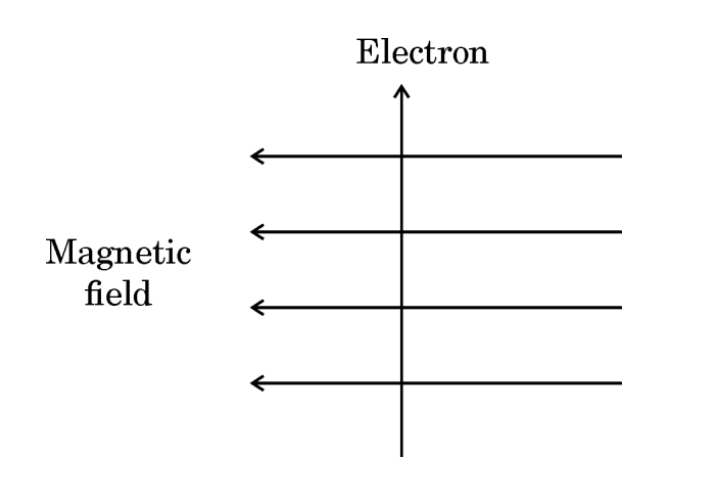
(ii)(I) For the electron moving in a uniform magnetic field, the force on it is given by the Lorentz force which is perpendicular to both the velocity of electron and magnetic field. Since electron charge is negative, the force direction is opposite to that given by Fleming's Left-Hand Rule for positive charges. If the electron moves downward and the magnetic field is to the right, then the force will be directed into the page (perpendicular to both).
(ii)(II) If both the direction of the magnetic field and the electron's velocity are reversed, then the direction of the force on the electron remains the same. This is because reversing both vectors reverses the direction twice, cancelling out the change in force direction. Therefore, the electron will continue to experience a force in the same direction as before.
Other Years — Science