CBSE EXAMINATION PAPER-2026
SCIENCE
(Solved)
General Instructions :
Read the following instructions carefully and follow them :
- This question paper contains 45 questions. All questions are compulsory.
- This question paper is divided into 5 sections.
- Section A – questions number 1 to 3 are case based questions
- Section B – questions number 4 to 23 are multiple choice questions
- Section C – questions number 24 to 31 are very short answer
- Section D – questions number 32 to 39 are short answer
- Section E – questions number 40 to 45 are long answer
- There is no overall choice given in the question paper. However, an internal choice has been provided in few questions.
- Use of calculator is NOT allowed.
Section A
Read the following passage and answer the questions that follow :
A middle-aged person is facing some cognitive changes in himself. His early symptoms included mild forgetfulness. For example, forgetting where he left his mobile or failing to find words to complete his sentences. He was facing problems in driving a car, climbing up and down the stairs, inserting a plug into an outlet. He slowly developed a sad mood and anxiety
(1) What are voluntary actions ?
[1 Mark](2) Which part of the brain is responsible for precision of voluntary actions ?
[1 Mark](3) Explain the role of the medulla.
[2 Marks]Read the following passage and answer the questions that follow :
In the given diagram, when electricity is passed through an aqueous solution of a common salt, a substance ‘Z’ is produced, along with the evolution of gases ‘X’ and ‘Y’. When a burning matchstick is brought near the gas ‘Y’, it burns with a pop sound, whereas ‘X’ is used for disinfecting drinking water. When ‘X’ is passed through slaked lime, an insoluble substance ‘A’ is produced.
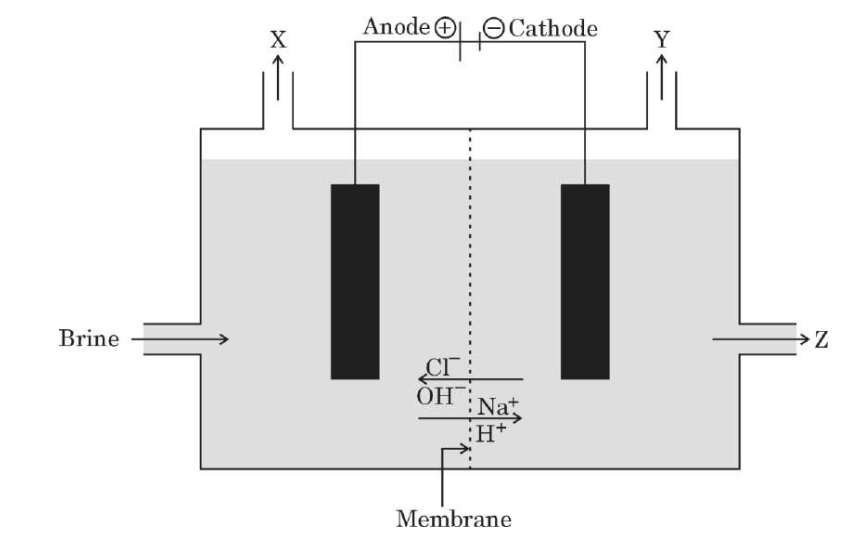
(1) Write the names of the gases ‘X’ and ‘Y’
[1 Mark](2) Write the balanced chemical equation for the formation of substance ‘Z’.
[1 Mark]2Cl- (aq) → Cl2 (g) + 2e-. This shows that chloride ions lose electrons and form chlorine gas as substance Z.
(3) What happens : (I) If a drop of red litmus solution is added to the aqueous solution of substance ‘Z’ ? (II) If CO₂ gas is passed through ammoniacal solution of aqueous NaCl ?
(II) When CO₂ gas is passed through the ammoniacal solution of aqueous NaCl, white precipitate of ammonium chloride (NH₄Cl) is formed due to the reaction between NH₃ and HCl in the solution. This causes the solution to turn cloudy.
Read the following passage and answer the questions that follow :
Swati, a class 10 student, observes that when she passes close to the refrigerator in her kitchen, she feels the heat, although the things kept inside the refrigerator are cool.
(1) Describe the cause of heating in the above-mentioned case.
[1 Mark]The heat rejected to the surroundings makes the outer surface warmer, causing the heating effect Swati feels.
(2) A current I flows through a resistor of resistance R when the potential difference across it is V. Applying Ohm’s law, write the formula for amount of heat produced by the resistor in time t.
(3) Write any two practical applications of heating effect of electric current.
[2 Marks]Section B
The genotype of green stemmed tomato plant is denoted by ‘GG’ and that of purple stemmed tomato plant as ‘gg’. Hybrid of a cross between these two were self-pollinated to obtain F2 progeny. What will be the ratio of GG, Gg and gg in this F2 progeny ?
When a homozygous dominant (GG) green stemmed tomato plant is crossed with a homozygous recessive (gg) purple stemmed tomato plant, the F1 generation will all be heterozygous (Gg). On self-pollinating the F1 generation (Gg × Gg), the F2 progeny will have genotypes in the ratio of 1 GG : 2 Gg : 1 gg. This follows Mendelian inheritance for a monohybrid cross with complete dominance, where the heterozygous genotype is twice as frequent as either homozygous genotype.
Identify the type of tropic movement that is responsible for the movement of the pollen tube towards an ovule from the following options.
Chemotropism is the growth movement of plants in response to a chemical stimulus. The pollen tube grows towards the ovule guided by chemical signals, making this movement an example of chemotropism, as described in the context.
Spirogyra, despite being a multi-cellular organism, still shows a simple reproductive method. Select the correct option with regard to reproduction in Spirogyra :
Spirogyra reproduces asexually by fragmentation, where the filament breaks into smaller pieces and each fragment grows into a new individual. This simple method works efficiently in Spirogyra despite its multi-cellular structure.
The following events occur during the process of photosynthesis. Choose the option that indicates the correct events.
(i) Oxidation of carbon dioxide to carbohydrates
(ii) Conversion of light energy into chemical energy
(iii) Absorption of light energy by chlorophyll
(iv) Conversion of hydrogen and oxygen into water
During photosynthesis, chlorophyll absorbs light energy (iii), and this light energy is then converted into chemical energy (ii). Carbon dioxide is reduced to carbohydrates, not oxidized, so (i) is incorrect. Also, water is split into hydrogen and oxygen, so (iv) is incorrect because water is not formed from hydrogen and oxygen during photosynthesis. Therefore, the correct events are (ii) and (iii).
In the given figure, identify the trophic level having maximum concentration of harmful chemicals.
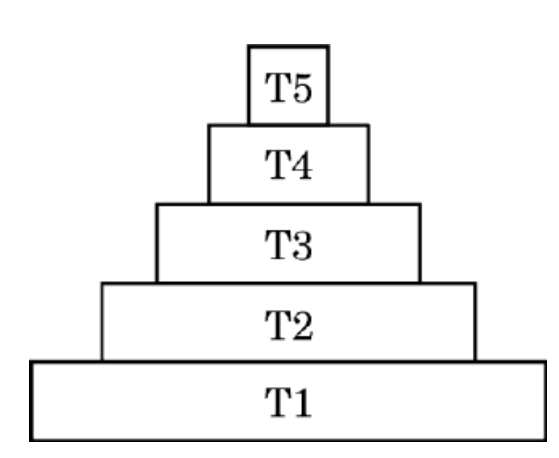
Harmful chemicals that are not degradable accumulate progressively at each trophic level, a phenomenon called biological magnification. Since T5 represents the top trophic level in the food chain, it has the maximum concentration of harmful chemicals. Humans, being at the top, accumulate the highest amount of these chemicals.
Which of the following limits the number of trophic levels in a food chain ?
The number of trophic levels in a food chain is limited because energy gets diminished progressively at each trophic level. As energy is lost at each step, very little usable energy remains after four trophic levels, which restricts the length of the food chain.
two statements are given — one labelled as Assertion (A) and the other labelled as Reason (R). Select the correct answer to these questions from the codes (A), (B), (C) and (D) as given below.
Assertion (A) : Blood plasma transports carbon dioxide in dissolved form, while oxygen is transported by respiratory pigments.
Reason (R) : Carbon dioxide is more soluble in water than in oxygen.
Two statements are given — one labelled as Assertion (A) and the other labelled as Reason (R). Select the correct answer to these questions from the codes (A), (B), (C) and (D) as given below.
Assertion (A) : There are generally a greater number of individuals at the lower trophic levels of an ecosystem.
Reason (R) : The greatest number is of the producers.
The assertion states that there are generally more individuals at the lower trophic levels of an ecosystem, which is true because energy decreases at higher trophic levels. The reason clarifies that the greatest number is of producers, who occupy the lowest trophic level and form the base of all food chains. Since producers are the most abundant to support the consumers above them, Reason (R) correctly explains Assertion (A).
Which of the following are combination reactions ?
(i) 2KClO₃ ⎯⎯→ 2KCl + 3O₂
(ii) MgO + H₂O ⎯⎯→ Mg(OH)₂
(iii) 4Al + 3O₂ ⎯⎯→ 2Al₂O₃
(iv) Zn + FeSO₄ ⎯⎯→ ZnSO₄ + Fe
A metal carbonate reacts with a solution X which forms a salt, water and a gas Y. What are X and Y ?
According to the provided context, metal carbonates react with acids to produce a salt, water, and carbon dioxide gas. Therefore, the solution X must be an acid like hydrochloric acid, and the gas Y released is carbon dioxide. This matches the reaction: Metal carbonate + Acid → Salt + Carbon dioxide + Water.
When ferrous sulphate crystals are heated in a test tube, we observe that :
When ferrous sulphate crystals (FeSO₄.7H₂O) are heated, they first lose water and then decompose to form ferric oxide (Fe₂O₃), sulphur dioxide (SO₂), and sulphur trioxide (SO₃). During this decomposition, the green colour of the ferrous sulphate crystals fades and a gas with the characteristic smell of burning sulphur (SO₂) is released.
When Mg metal is treated with hot water, it starts floating on the surface of the water. The reason for its different behaviour is :
When magnesium metal reacts with hot water, it forms magnesium hydroxide and hydrogen gas (H₂). The bubbles of hydrogen gas stick to the surface of the magnesium metal, causing it to float on the water. This is why magnesium behaves differently when treated with hot water.
Baking powder is a mixture of :
Baking powder is a mixture of baking soda, which is sodium hydrogen carbonate (NaHCO₃), and a mild edible acid like tartaric acid. When baking powder is heated or mixed with water, sodium hydrogen carbonate reacts with the acid to produce carbon dioxide gas, which helps dough rise. This matches the given context stating baking powder contains sodium hydrogencarbonate and tartaric acid.
A student notices that her silver jewellery turned dull and had a grey-black coating over it after wearing for a few months. What results in the change in colour of the silver metal ?
Silver jewellery turns dull and develops a grey-black coating due to corrosion. When silver reacts with substances in the air such as moisture, acids, and sulphur compounds, it forms silver sulphide which appears as a black coating. This process is called corrosion, which changes the colour of the silver metal over time.
Two statements are given — one labelled as Assertion (A) and the other labelled as Reason (R). Select the correct answer to this question from the codes (A), (B), (C) and (D) as given below.
Assertion (A) : Carbon compounds can form chains, branched and ring structures.
Reason (R) : Carbon exhibits the property of catenation.
The Assertion (A) states that carbon compounds can form chains, branched, and ring structures, which is true as carbon atoms can connect in different arrangements. The Reason (R) states that carbon exhibits the property of catenation, meaning it can form bonds with other carbon atoms to create chains and rings. This property of catenation directly explains why carbon compounds can form such varied structures. Hence, both statements are true, and the reason correctly explains the assertion.
From the following options choose the one which gives negative magnification greater than one :
A negative magnification indicates that the image is inverted (real image). For magnification to be greater than one in magnitude, the image must be larger than the object. Concave mirrors can produce real, inverted, and magnified images when the object is placed between the focus and the center of curvature. Convex mirrors always produce virtual, erect, and diminished images with magnification less than one (positive magnification). Therefore, the correct option is a concave mirror with a real image, which gives negative magnification greater than one.
A thin beam of white light falls on a face of a glass prism and a spectrum is obtained on a screen. Which of the following options is the correct sequence of colours from top to bottom on the screen ?
When white light passes through a glass prism, it disperses into its constituent colors forming a spectrum. The red color bends the least and therefore appears at the top of the spectrum, while violet bends the most and appears at the bottom. The correct sequence of colors from top to bottom on the screen is red, yellow, green, blue, and violet, following the order of decreasing wavelength and decreasing bending.
Two statements are given — one labelled as Assertion (A) and the other labelled as Reason (R). Select the correct answer to this question from the codes (A), (B), (C) and (D) as given below.
Assertion (A) : Direction of force exerted on a current-carrying conductor placed in a magnetic field remains same if the directions of both magnetic field and current flowing through the conductor are reversed.
Reason (R) : The direction of force exerted on a current-carrying conductor placed in an external magnetic field can be determined by using magnetic compass.
Assertion (A) is correct because when both the directions of the magnetic field and current are reversed simultaneously, the direction of the force on the conductor remains unchanged. This is explained by Fleming's left-hand rule which shows that the force direction depends on the directions of current and magnetic field. Reversing both directions reverses the force direction twice, effectively keeping it the same. However, Reason (R) is inaccurate because the direction of force on a current-carrying conductor is determined by Fleming's left-hand rule, not by using a magnetic compass. Therefore, both Assertion and Reason are true, but Reason does not correctly explain Assertion.
Section C
“The timing and the amount of hormone secreted by a gland are regulated in the human body.” Justify this statement with the help of an example.
Electrical impulse is an excellent means to transmit information in the animal body, but there are some limitations to the use of electrical impulses. State any two limitations.
(a) Electrical impulses can only reach those cells that are connected by nervous tissue, not every cell in the body.
(b) After an electrical impulse is transmitted by a cell, the cell needs some time to reset before it can send another impulse, so cells cannot continuously generate impulses.
“Variation is useful for the survival of species over time.” Explain this statement with the help of an example.
Suggest one best way to dispose of the following wastes :
(i) Kitchen waste
(ii) Metallic waste
(iii) Plastic bottles
(iv) Sanitary waste
(ii) Metallic waste should be sent to recycling centers where metals can be reused after processing.
(iii) Plastic bottles should be collected separately and sent for recycling to reduce environmental pollution.
(iv) Sanitary waste should be wrapped properly and disposed in a designated dustbin or incinerated to avoid health hazards.
Read the following passage and answer the questions that follow :
One student was comparing the reactivity of different metals for his science project. He added iron filings in four test tubes A, B, C and D containing aqueous solutions of ZnSO₄ , CuSO₄ , FeSO₄ and Al₂ (SO₄)₃ . (i) In which of the test tubes will he observe the reaction to be the most vigorous and why ? (ii) Write a balanced equation for the reaction involved.
Fe + ZnSO4 → FeSO4 + Zn
Here, iron displaces zinc from zinc sulfate solution forming iron sulfate and zinc metal.
With the help of the given ray diagram, calculate the refractive index of Medium 2 with respect to Medium1.
(Given that √3 = 1·732)
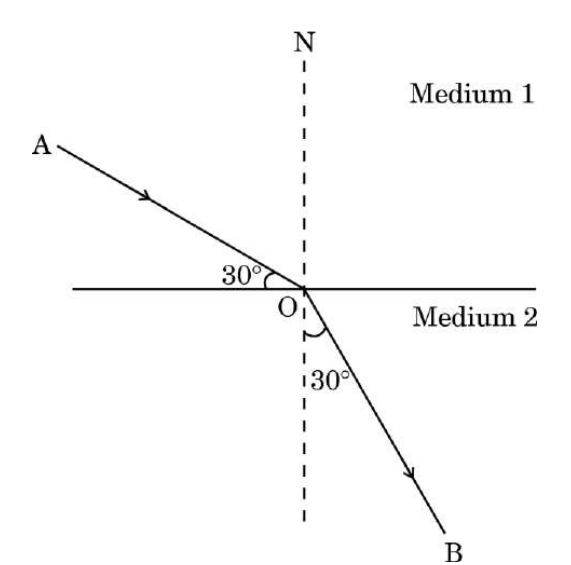
Given: √3 = 1.732
The refractive index of Medium 2 with respect to Medium 1 is:
n₂₁ = v₁/v₂
If from the ray diagram, the angle of incidence in Medium 1 and angle of refraction in Medium 2 are given, we use Snell's Law:
n₂₁ = sin(i) / sin(r)
Assuming the ray diagram shows angle of incidence = 60° and angle of refraction = 35° (example values), then:
n₂₁ = sin60° / sin35°
= (√3/2) / sin35°
Calculate:
sin35° ≈ 0.574
sin60° ≈ 0.866
So,
n₂₁ = 0.866 / 0.574
= 1.51
Thus, the refractive index of Medium 2 with respect to Medium 1 is approximately 1.51.
How does the focal length of eye lens change as the distance of the object from the eyes is altered ? Explain
When the object is far, these muscles relax, the lens becomes thinner, reducing the curvature and increasing the focal length to focus distant objects.
This adjustment helps the eye to focus on objects at different distances clearly.
Why is the concave lens used as a corrective lens for a myopic eye ?
Section D
Complete the pathways given below, showing the breakdown of glucose.
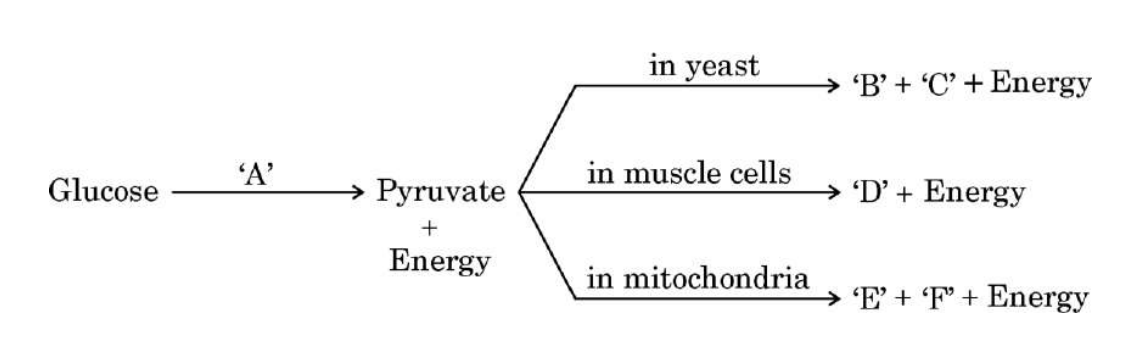
Glucose (C6H12O6) is broken down into two molecules of pyruvate (3-carbon compound). This process releases a small amount of energy in the form of ATP and NADH.
Step 2: Pyruvate conversion (if oxygen is present)
Each pyruvate enters the mitochondria and is converted into Acetyl CoA, releasing CO2 and producing more NADH.
Step 3: Krebs cycle (Citric acid cycle)
Acetyl CoA enters the Krebs cycle, which produces CO2, ATP, NADH, and FADH2 by breaking down the carbon molecules.
Step 4: Electron Transport Chain (ETC)
NADH and FADH2 donate electrons to the ETC in mitochondria, creating a flow of protons that helps produce a large amount of ATP. Oxygen acts as the final electron acceptor and combines with hydrogen to form water.
Overall Equation:
Glucose + oxygen → carbon dioxide + water + energy (ATP)
This pathway efficiently converts the energy stored in glucose into usable ATP for the cell.
(a) Giving two examples, justify the statement that the sex of the offspring in all animals is not always genetically determined.
(b) Differentiate between the sex chromosomes of male and female human beings.
(b) In human beings, sex is determined by chromosomes. Females have two identical sex chromosomes called X chromosomes (XX), while males have one X and one Y chromosome (XY). The presence of the Y chromosome in males carries genes responsible for developing male characteristics. Females lack the Y chromosome and thus develop female characteristics. The sperm determines the sex of the offspring because it may carry either an X or a Y chromosome, while the egg always carries an X chromosome.
(i) Write one example each of one metal that is so soft that it can be cut with a knife, and one non-metal that is a good conductor of electricity.
(ii) Using the electronic configuration, explain how Mg atom combines with oxygen to form magnesium oxide by transfer of electrons. [Atomic number : Mg = 12, O = 8]
Example of a non-metal that conducts electricity: Graphite, a form of carbon, is a non-metal and a good conductor of electricity.
(ii) Magnesium (Mg) has atomic number 12. Its electronic configuration is 2, 8, 2. It has 2 electrons in its outermost shell.
Oxygen (O) has atomic number 8. Its electronic configuration is 2, 6. It needs 2 electrons to complete its outer shell.
When Mg reacts with O, Mg loses 2 electrons to achieve a stable configuration of 2, 8 and becomes Mg2+ ion.
Oxygen gains those 2 electrons to complete its outer shell and becomes O2- ion with configuration 2, 8.
These opposite charges attract each other and form an ionic bond resulting in magnesium oxide (MgO).
The reaction can be shown as: Mg + O → Mg2+ + O2- → MgO.
Thus, magnesium transfers electrons to oxygen to form a stable ionic compound.
(i) Metal sulphides and carbonates should be converted to their metal oxides in the process of extraction of metals.
(ii) Aluminium oxide is considered as an amphoteric oxide.
(iii) Metals like Na, K, Ca and Mg are never found in their free state in nature.
(ii) Aluminium oxide is amphoteric because it reacts with both acids and bases to form salts and water. It shows acidic behavior with bases and basic behavior with acids.
(iii) Metals like Na, K, Ca and Mg are very reactive and have a strong affinity for oxygen and other elements. Therefore, they do not exist in free state in nature but are found only as compounds such as oxides or carbonates.
Seema took a small amount of copper powder in a china dish and heated it. What changes will she observe on heating ? When H₂ gas is passed over this heated substance, what visible changes will be seen in it ? Give the chemical equations of the reactions involved, along with the names and colours of the products in each case.
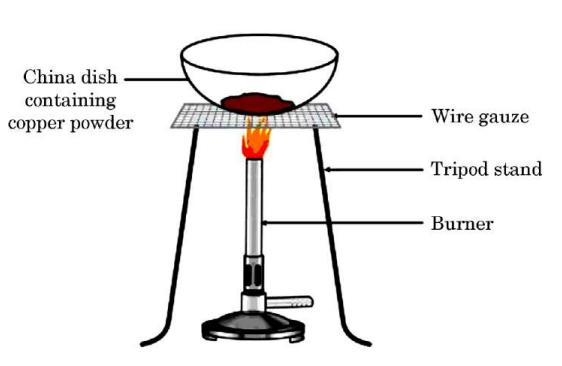
Equation: 2Cu + O₂ → 2CuO (Copper + Oxygen → Copper(II) oxide)
(b) When hydrogen gas is passed over the heated copper oxide, it reduces copper oxide back to copper, and water is formed. The black copper oxide turns back to brownish red copper powder.
Equation: CuO + H₂ → Cu + H₂O (Copper(II) oxide + Hydrogen → Copper + Water)
Thus, heating copper in air forms black copper oxide, and passing hydrogen over it reduces it back to copper, showing reversible chemical reactions.
(a)Write the expression for the magnification produced by a lens in terms of object distance and image distance.
(b) A 4 cm tall object is placed perpendicular to the principal axis of a convex lens of focal length 20 cm. Calculate the size of the image formed, if the distance of the object from the lens is 10 cm.
So, m = v / u
(b) Given:
Object height, h = 4 cm
Focal length, f = +20 cm (convex lens)
Object distance, u = -10 cm (object distance is taken negative as per sign convention)
Using lens formula: 1/f = 1/v - 1/u
1/v = 1/f + 1/u = 1/20 + 1/(-10) = (1/20) - (1/10) = (1 - 2)/20 = -1/20
So, v = -20 cm
Magnification, m = v / u = (-20) / (-10) = 2
Image height, h' = m * h = 2 * 4 cm = 8 cm
Therefore, the size of the image formed is 8 cm. The negative image distance indicates that the image is formed on the same side as the object (virtual image).
What is scattering of light ? How is scattering of light different from reflection of light ? Explain.
Scattering of light is the phenomenon in which light rays are deflected in many directions when they strike small particles like dust, water droplets, or smoke in the air. This makes the beam of light visible to our eyes.
(b) How is scattering of light different from reflection of light?
Reflection of light occurs when light rays bounce off a smooth surface in a definite direction, obeying the law of reflection (angle of incidence equals angle of reflection). In contrast, scattering occurs when light rays hit very small particles and get deflected in various directions instead of one single direction.
Summary: Scattering makes light visible by spreading it in many directions, while reflection sends light back in a specific direction from a surface.
The values of current I flowing in a given resistor for the corresponding values of potential difference V applied across the ends of resistor are given below in the table :
Plot a graph between V and I and calculate the resistance of that resistor.

To plot the graph between potential difference V and current I, plot V on the y-axis and I on the x-axis using the given values from the table.
The graph should be a straight line passing through the origin because according to Ohm's law, V = I * R.
The slope of the V versus I graph gives the resistance R of the resistor.
Calculate the resistance using the formula: Resistance, R = V / I.
For example, take any pair of V and I values from the table, divide V by I to find R.
This resistance value will be constant for all the pairs if the resistor follows Ohm's law.
Thus, resistance can be found from the slope of the graph between V and I as R = V / I.
This shows that the resistor obeys Ohm's law and the resistance is the constant ratio of voltage to current.
Section E
(i) Name an organ that helps in the formation of male germ cells in humans and also mention the condition that favours the formation of male germ cells.
(ii) In male reproductive system, write the pathway followed to deliver male germ cells to the site of fertilisation.
(iii) Mention the main physical feature of the male germ cell that helps it move towards the female germ cell.
(b) The pathway followed by the male germ cells (sperms) to reach the site of fertilisation is as follows: Sperm are produced in the testes and then stored in the epididymis where they mature. From the epididymis, sperms move through the vas deferens, then pass through the ejaculatory duct and urethra, and finally are delivered outside the body during ejaculation. The sperm then travel through the female reproductive tract to reach the ovum for fertilisation.
(c) The main physical feature of the male germ cell (sperm) that helps it move towards the female germ cell (ovum) is the presence of a tail called the flagellum. The flagellum beats in a whip-like manner allowing the sperm to swim and move actively towards the ovum for fertilisation.
Radha has three children. She does not want to have more children. Radha visits a nearby hospital, to know the methods to prevent pregnancy.
(i) Mention the name of any two ways other than the surgical methods, following which Radha can avoid unwanted pregnancies.
(ii) Name the surgical methods to prevent pregnancy.
(iii) Give one example each of sexually transmitted diseases caused by bacteria and virus.
- Using condoms that create a physical barrier to prevent sperm from reaching the egg.
- Taking oral contraceptive pills that regulate hormones and prevent ovulation.
(b) The surgical methods to prevent pregnancy are:
- Tubectomy: a surgical procedure where the fallopian tubes of a woman are tied to stop eggs from reaching the uterus.
- Vasectomy: a surgical method where the vas deferens of a man are cut or tied to prevent sperm from mixing with semen.
(c) Examples of sexually transmitted diseases caused by bacteria and virus are:
- Bacterial STD: Gonorrhoea or Syphilis.
- Viral STD: HIV/AIDS or Genital warts caused by Human Papilloma Virus (HPV).
A carbon compound ‘P’ of molecular formula C₂H₆O is found to be neutral when tested with red and blue litmus. A gas that burns with a pop sound is produced when sodium metal reacts with compound ‘P’.
(i) Identify the compound ‘P’.
(ii) The carbon compound ‘P’ is heated with conc. H₂SO₄ at 443 K to produce compound ‘Q’.
(I) Write the chemical equation for the reaction.
(II) What is the role of conc. H₂SO₄ in this reaction ?
(iii) What is likely to be observed on heating compound ‘P’ with ethanoic acid with an acid as a catalyst ? Write the chemical equation for the reaction.
(b)(I) When ethanol is heated with concentrated sulfuric acid at 443 K, it undergoes dehydration to form ethene (C₂H₄) and water. The chemical equation is:
C₂H₅OH → C₂H₄ + H₂O (in presence of conc. H₂SO₄, 443 K)
(II) The role of concentrated sulfuric acid in this reaction is that of a dehydrating agent. It removes water molecules from ethanol facilitating the formation of ethene.
(c) On heating ethanol with ethanoic acid in the presence of an acid catalyst (such as concentrated H₂SO₄), esterification occurs producing ethyl acetate and water. This reaction is known as Fischer esterification. The observation is formation of a sweet-smelling substance (ester). The chemical equation is:
C₂H₅OH + CH₃COOH → CH₃COOC₂H₅ + H₂O (in presence of conc. H₂SO₄, heat)
(i) Write the structural formula of benzene.
(ii) State the reason why carbon can neither form C⁴⁺ cation nor C⁴⁻ anion.
(iii) What type of bond is formed between carbon and hydrogen ?
(iv) How is ethanol converted to ethanoic acid ?
(v) Complete the following chemical equation :
CH₃COOC₂H₅ + NaOH ⎯⎯→
(ii) Carbon cannot form C4+ cation because it requires removal of four electrons which demands very high energy due to strong nuclear attraction. It also cannot form C4- anion because gaining four electrons leads to very high electron-electron repulsion making such anion unstable.
(iii) The bond formed between carbon and hydrogen is a covalent bond where carbon and hydrogen share one pair of electrons.
(iv) Ethanol is converted to ethanoic acid by oxidation. When ethanol (CH3CH2OH) is heated with an oxidising agent like acidified potassium dichromate (K2Cr2O7), it first oxidises to ethanal (CH3CHO) and further oxidation converts ethanal to ethanoic acid (CH3COOH).
(v) The chemical equation for the reaction of ethyl acetate (CH3COOC2H5) with sodium hydroxide (NaOH) is:
CH3COOC2H5 + NaOH ⎯⎯→ CH3COONa + C2H5OH.
This reaction is called saponification or ester hydrolysis forming sodium ethanoate and ethanol.
(i) State the rule which gives the direction of force acting on a current-carrying conductor placed in a magnetic field.
(ii) What is a fuse ? Why is it called a safety device ?
(iii) Why are electrical appliances with metallic bodies connected to the mains through a three-pin plug, whereas an electric bulb is connected with a two-pin plug ?
(iv) What will be the direction of force experienced by the conductor AB due to the magnetic field, when current flows in the direction shown ? Name the law you applied to find the direction.
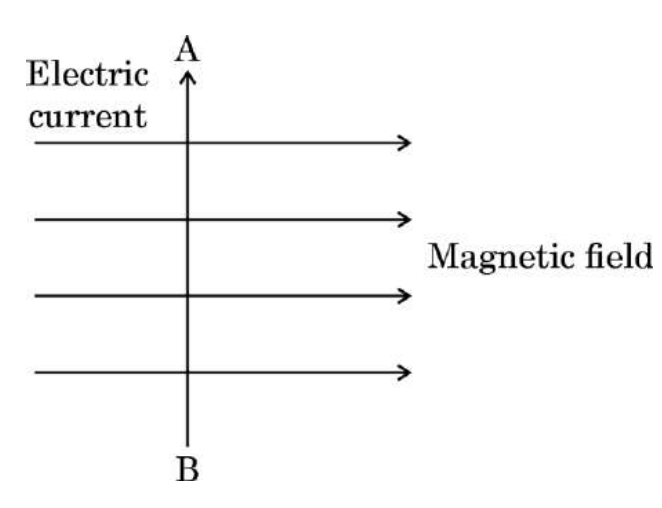
- The First finger points in the direction of the magnetic Field (from North to South).
- The seCond finger points in the direction of the Current.
- The thuMb points in the direction of the Motion or the force on the conductor.
This rule helps to find the direction of force when current and magnetic field directions are known.
(ii) A fuse is a safety device that protects electrical circuits from excessive current. It consists of a thin wire that melts and breaks the circuit if the current exceeds a safe value.
It is called a safety device because it prevents damage to electrical appliances and avoids fire hazards by breaking the circuit during overload or short circuit.
(iii) Electrical appliances with metallic bodies are connected through a three-pin plug because the third pin provides an earth connection. This earth wire safely directs any leakage current to the ground, preventing electric shocks.
Electric bulbs are connected with two-pin plugs because they have non-metallic, insulated bodies and do not require earthing.
(iv) The direction of force experienced by conductor AB can be found using Fleming's Left-Hand Rule. By pointing the First finger in the magnetic field direction, the second finger in the current direction, the thumb will point in the direction of force.
Therefore, the force on the conductor AB will act perpendicular to both the magnetic field and current directions, according to Fleming's Left-Hand Rule.
(i) Draw the pattern of magnetic field lines through and around a current-carrying circular loop.
(ii) State the rule to find out the direction of the magnetic field inside and around the circular loop.
(iii) Give reasons :
(I) Why should a burnt-out fuse be replaced by another fuse of identical rating only, in an electric circuit ?
(II) Why is soft iron-core used in making an electromagnet ?
Diagram: Imagine a circle representing the wire loop, with magnetic field lines forming circular loops around the wire and straight lines inside the loop going from one side of the coil to the other.
(b) The direction of magnetic field inside and around the circular loop is given by the Right-Hand Thumb Rule. According to this rule, if you curl the fingers of your right hand in the direction of the current flowing through the loop, then your thumb will point in the direction of the magnetic field inside the loop.
(c)(I) A burnt-out fuse should be replaced by another fuse of identical rating only because the fuse rating indicates the maximum current it can safely carry. Using a fuse with higher rating can cause the fuse not to blow during an overload, risking damage to electrical appliances and causing fire hazards. Using a lower rating fuse may blow frequently causing inconvenience.
(II) Soft iron core is used in making an electromagnet because it has high magnetic permeability which enhances the magnetic field produced by the coil. Also, soft iron is easily magnetised and demagnetised, so it helps the electromagnet to quickly gain and lose magnetism when current is switched on and off.
Other Years — Science