CLASS 12-HUMANITIES . POLITICAL SCIENCE . CONTEMPORARY WORLD POLITICS . THE END-OF-BIPOLARITY
Chapter 1 : THE END OF BIPOLARITY
Ch 1
POLITICAL SCIENCE
CLASS 12-HUMANITIES
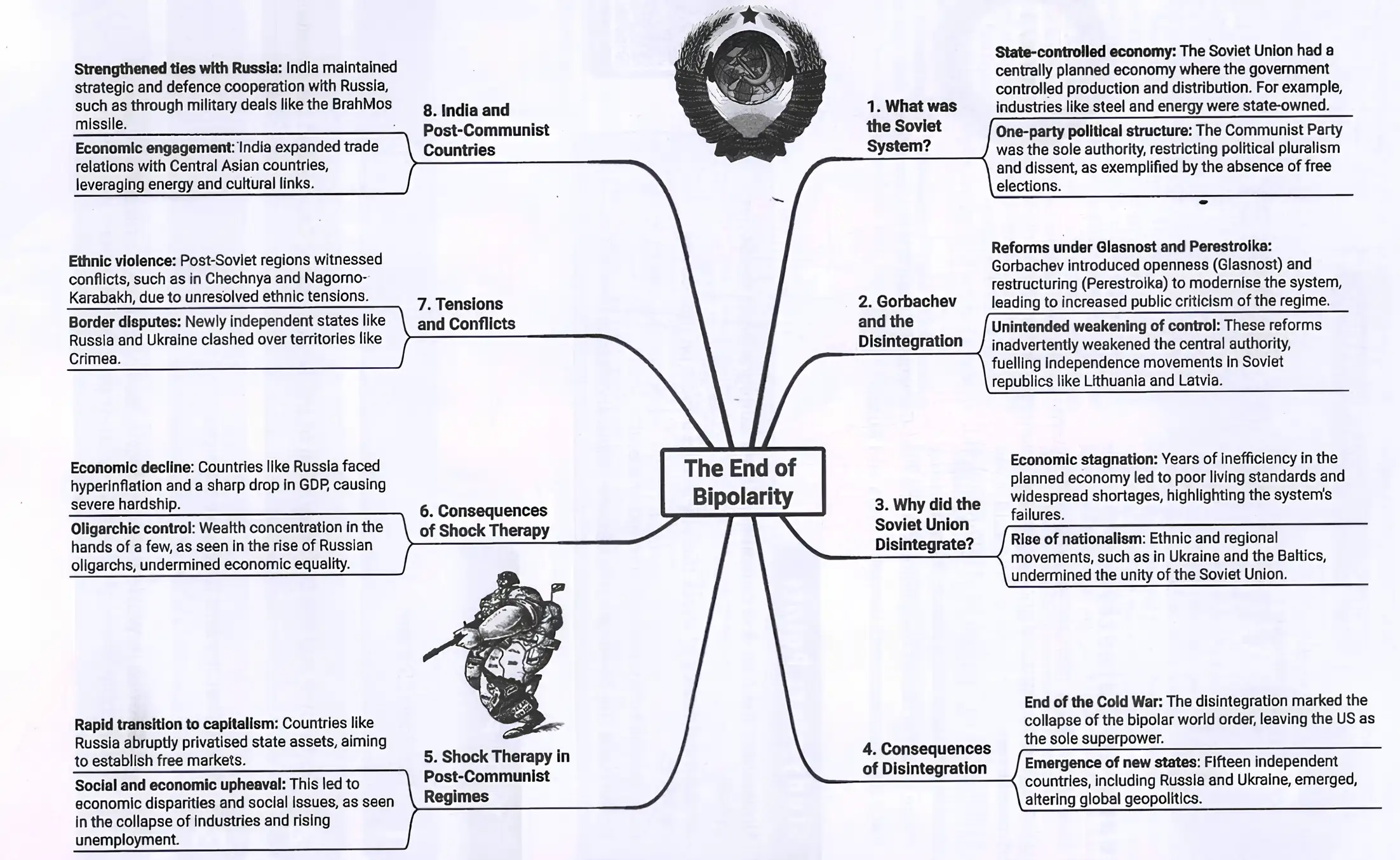
The Soviet System
The Soviet Union was established in 1917 following the Socialist Revolution in Russia, which aimed to create an egalitarian society by abolishing private property and promoting equality. The Soviet system was characterized by a one-party rule under the Communist Party, with no political opposition allowed. The economy was centrally planned and controlled by the state.
After World War II, Eastern European countries liberated from fascist forces came under Soviet influence, forming the socialist bloc or Second World, led by the USSR. The USSR promoted collective security through the Warsaw Pact, a military alliance ensuring mutual defense among member states.
The Soviet Union became a major global power with vast energy resources, including oil, iron, and steel, and a well-developed machinery and transport sector. The state guaranteed a minimum standard of living, subsidizing health, education, childcare, and welfare schemes. However, the system was bureaucratic and authoritarian, limiting freedoms and causing dissatisfaction among non-Russian republics.
Despite industrial and military strength, the Soviet Union lagged behind the West in technology and infrastructure. The economy was stagnant by the 1970s, with shortages of consumer goods and increasing reliance on imports. The Berlin Wall symbolized the division between the capitalist West and communist East until its fall in 1989, marking the decline of the communist bloc.
Exam Question
Explain the main features of the Soviet System and its impact on the citizens.
Answer: The Soviet System was a one-party communist state with a centrally planned economy. It aimed to create an egalitarian society by abolishing private property and providing basic needs like health and education. While it ensured a minimum standard of living and industrial growth, it was bureaucratic and authoritarian, limiting political freedoms and causing dissatisfaction among various republics.
Solved Example
Question: The Soviet economy was more developed than the rest of the world except for the United States. Explain.
Solution:
After World War II, the Soviet Union became a major power with a complex communications network, vast energy resources, and a strong machinery and transport sector. It produced a wide range of consumer goods, though their quality was lower than Western countries. The state ensured a minimum standard of living with subsidies for health, education, and welfare, and there was no unemployment.
Gorbachev and the Disintegration of the Soviet Union: Causes and Consequences
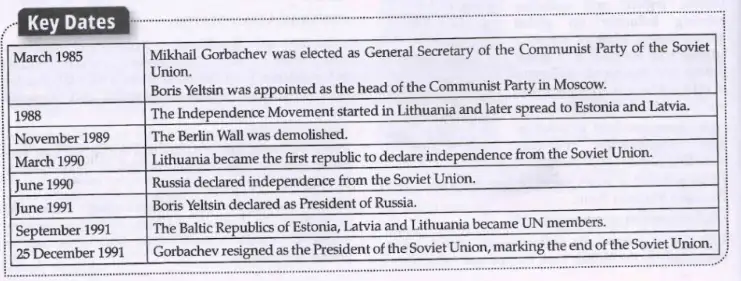
Mikhail Gorbachev became the General Secretary of the Communist Party in 1985 and introduced reforms like Perestroika (economic restructuring) and Glasnost (openness) to modernize the USSR. These reforms weakened central control and unintentionally fueled nationalist movements within Soviet republics demanding greater sovereignty.
In 1991, a coup by Communist hardliners failed due to popular opposition led by Boris Yeltsin. Subsequently, Russia, Ukraine, and Belarus declared the Soviet Union dissolved, leading to the formation of the Commonwealth of Independent States (CIS). The collapse ended the Cold War and established the United States as the sole superpower, creating a unipolar world.
The Soviet system's internal weaknesses, economic burdens from military spending, and rising nationalism contributed to its collapse. The end of the Soviet bloc resulted in many new countries and a shift in global power dynamics.
Exam Question
What were the main causes of the disintegration of the Soviet Union under Gorbachev?
Answer: The disintegration was caused by economic stagnation, heavy military spending, political stagnation, and the rise of nationalist movements within republics. Gorbachev's reforms of Perestroika and Glasnost weakened central control and encouraged demands for sovereignty, leading to the collapse of the USSR.
Solved Example
Question: Define a unipolar system and explain its emergence after the Soviet Union's collapse.
Solution: A unipolar system is an international order dominated by a single superpower. After the Soviet Union collapsed in 1991, the United States became the sole superpower, leading to a unipolar world where US influence was predominant in global affairs.
Shock Therapy and Its Consequences
Following the collapse of communism, many post-Soviet countries transitioned from authoritarian socialist systems to democratic capitalist economies through a process called Shock Therapy, influenced by the World Bank and IMF. This involved rapid privatization and economic liberalization.
Shock Therapy led to the collapse of large state-controlled industries, massive inflation, loss of savings, and increased poverty. The rapid sale of industries at undervalued prices was termed the "largest garage sale in history." Government subsidies were withdrawn, causing social hardships and economic disparities.
Exam Question
What is Shock Therapy, and what were its effects on post-Soviet countries?
Answer: Shock Therapy was a rapid transition from socialism to capitalism involving privatization and economic liberalization. It caused economic collapse, inflation, loss of savings, poverty, and social inequality in post-Soviet countries.
Solved Example
Question: Why is the post-Soviet privatization called the "largest garage sale in history"?
Solution: Because valuable Soviet industries were sold quickly and at very low prices to private individuals and companies, leading to the collapse of many industries and economic hardship.
New Entities in World Politics: Russia, Balkan States, Central Asian States, India’s Relations with Russia and Other Post-Communist Countries
Russia: After the Soviet Union's collapse, Russia faced internal conflicts, including secessionist movements in Chechnya and Dagestan. It emerged as a major power but struggled with establishing stable democracy and economic development. Russia has been involved in regional conflicts and maintains a permanent seat on the United Nations Security Council.
Balkan States: This region includes countries like Albania, Bosnia and Herzegovina, Bulgaria, Croatia, Greece, Kosovo, Montenegro, North Macedonia, Romania, Serbia, and Slovenia. Since the end of communism, these countries have faced political and economic challenges, including corruption and instability, while seeking integration into the European Union and NATO.
Central Asian States: Kazakhstan, Kyrgyzstan, Tajikistan, Turkmenistan, and Uzbekistan gained independence in 1991. They hold strategic importance due to their location and hydrocarbon resources but face issues like authoritarianism and poverty. These states maintain varying relations with Russia, China, and Western countries.
India-Russia Relations: India and Russia share a long history of diplomatic and military ties dating back to the Cold War. Post-Soviet economic cooperation includes energy, defense, and technology sectors. Cultural exchanges and scientific collaborations, especially in space and nuclear energy, strengthen their partnership. India also maintains growing relations with other post-communist countries in Central Asia, Eastern Europe, and the Balkans, focusing on trade, security, and connectivity.
Exam Question
Describe the significance of India-Russia relations after the collapse of the Soviet Union.
Answer: India-Russia relations remained strong after the Soviet Union's collapse, with continued cooperation in defense, energy, and technology. Russia supplies military equipment to India, and both collaborate on scientific projects. Economic and cultural ties have expanded, contributing to regional stability and mutual benefits.
Solved Example
Question: What challenges have the new states formed after the Soviet Union's collapse faced?
Solution: Many new states have faced conflicts, civil wars, secessionist movements, economic instability, corruption, and political divisions. Examples include civil wars in Tajikistan and Georgia, and secessionist conflicts in Nagorno-Karabakh and Chechnya.
Timeline of the End of Bipolarity
| Year | Event | Significance |
|---|---|---|
| 1917 | Russian Socialist Revolution | Establishment of the Soviet Union based on socialist principles |
| 1961 | Construction of the Berlin Wall | Symbolized division between capitalist West and communist East |
| 1985 | Mikhail Gorbachev becomes Soviet leader | Introduced reforms leading to the USSR's disintegration |
| 1989 | Fall of the Berlin Wall | Marked the beginning of the end of the communist bloc |
| 1991 | Dissolution of the Soviet Union | End of Cold War and emergence of a unipolar world |
Practice Set
Easy
- What was the main goal of the Russian Socialist Revolution?
- Define the term "unipolar system."
Moderate
- Explain the causes of the Soviet Union's disintegration.
- What were the main features of Shock Therapy?
Challenging
- Discuss the impact of Gorbachev's reforms on the Soviet Union's political structure.
- Analyze the significance of India-Russia relations in the post-Soviet era.
Answer Key
- The main goal was to establish an egalitarian society by abolishing private property.
- A unipolar system is an international order dominated by a single superpower.
- Causes include economic stagnation, political rigidity, military burdens, and rising nationalism.
- Shock Therapy involved rapid privatization and economic liberalization transitioning to capitalism.
- Gorbachev's reforms weakened central control, encouraged nationalism, and led to political instability.
- India-Russia relations have been significant for defense, energy cooperation, and regional stability.
Quick Reference
- Perestroika: Economic restructuring policy introduced by Gorbachev.
- Glasnost: Policy of openness and transparency in government.
- Shock Therapy: Rapid transition from socialism to capitalism in post-Soviet states.
- Warsaw Pact: Military alliance of socialist bloc countries led by the USSR.
- Commonwealth of Independent States (CIS): Organization formed after the Soviet Union's dissolution.
- Unipolar World: Global dominance by a single superpower, the United States post-1991.
Glossary
- Egalitarian Society
- A society where all individuals have equal rights and opportunities.
- Socialist Bloc
- The group of Eastern European countries aligned with the Soviet Union during the Cold War.
- Perestroika
- Economic restructuring policy aimed at reforming the Soviet economy.
- Glasnost
- Policy promoting openness and transparency in the Soviet government.
- Shock Therapy
- Rapid economic transition from socialism to capitalism in post-communist countries.
- Unipolar System
- International system dominated by a single superpower.