CLASS 12-HUMANITIES . POLITICAL SCIENCE . POLITICS IN INDIA SINCE INDEPENDENCE . CHALLENGES TO-AND-RESTORATION-OF-THE-CONGRESS-SYSTEM
Chapter 5 : Challenges to and Restoration of the Congress System
Ch 5
POLITICAL SCIENCE
CLASS 12-HUMANITIES
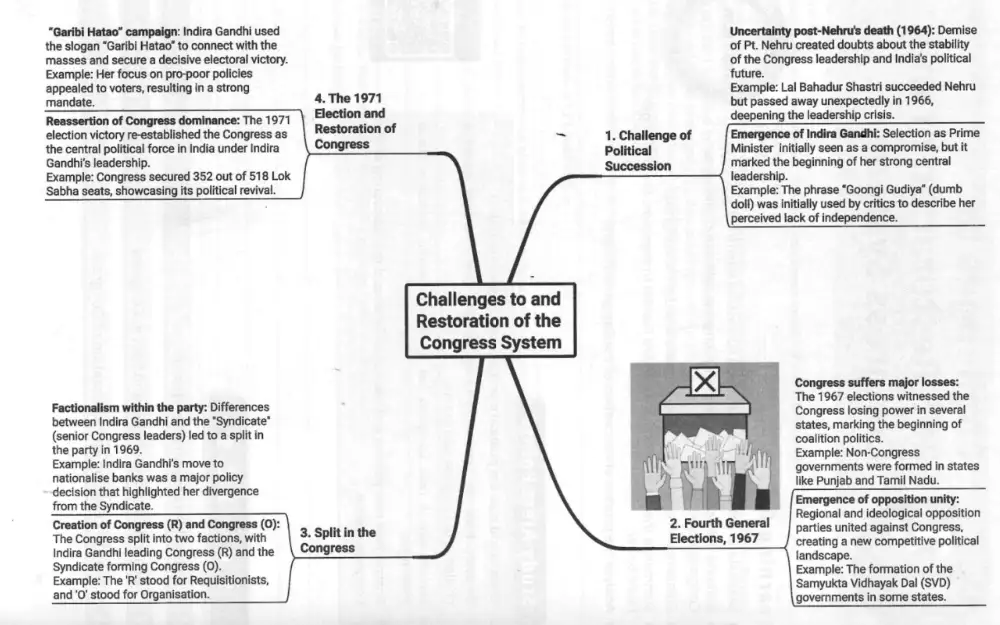
Political Succession after Nehru
Jawaharlal Nehru, India’s first Prime Minister, passed away in May 1964. This raised two critical questions: who would succeed him as Prime Minister, and whether India’s democratic system could survive without his leadership. Many feared political instability due to poverty, inequality, and regional divisions.
Nehru's Death and Succession
After Nehru's death, Lal Bahadur Shastri was chosen as his successor by consensus among Congress leaders. Shastri's tenure (1964-1966) faced economic difficulties caused by failed monsoons, drought, and food shortages, as well as the 1965 war with Pakistan. His slogan “Jai Jawan, Jai Kisan” symbolized India's determination during this period. Shastri died suddenly in January 1966 after signing a peace agreement with Pakistan.
From Shastri to Indira Gandhi
Following Shastri's death, a leadership contest emerged between Morarji Desai and Indira Gandhi. Indira Gandhi was elected Prime Minister through a secret ballot among Congress MPs, securing over two-thirds of the votes. This peaceful transition was seen as a sign of India's democratic maturity.
Indira Gandhi's Early Challenges
Though initially supported by senior Congress leaders who expected her to rely on them, Indira Gandhi soon asserted her authority. She faced the 1967 general elections amid worsening economic conditions and worked to strengthen her leadership and control over the party.
Exam Questions
Q1: Who succeeded Jawaharlal Nehru as Prime Minister of India?
A1: Lal Bahadur Shastri succeeded Nehru as Prime Minister in 1964.
Q2: How was Indira Gandhi chosen as Prime Minister?
A2: Indira Gandhi was elected through a secret ballot among Congress MPs, winning over two-thirds of the votes.
General Elections of 1967 and Split in Congress
The 1967 general elections marked a major turning point in Indian politics, challenging the Congress party's dominance for the first time since independence.
Context of the Elections
Political instability followed the deaths of Nehru and Shastri. Indira Gandhi's leadership was seen as inexperienced. India faced severe economic challenges including drought, food shortages, declining industrial output, and inflation worsened by the 1966 devaluation of the rupee.
Non-Congressism and Opposition Unity
Opposition parties united under the strategy of non-Congressism, initiated by Ram Manohar Lohia. Despite ideological differences, they formed alliances to challenge Congress's rule.
Electoral Outcome
Congress retained a majority in the Lok Sabha but with its lowest tally since 1952. It lost power in seven key states including Uttar Pradesh, Bihar, West Bengal, and Tamil Nadu. The Dravida Munnetra Kazhagam (DMK) formed the first non-Congress government in Tamil Nadu following anti-Hindi agitations.
Rise of Coalitions and Defections
Coalition politics emerged with Samyukt Vidhayak Dal (SVD) governments formed to keep Congress out of power. Defections destabilized governments in several states, leading to the phrase ‘Aya Ram, Gaya Ram’ symbolizing political instability.
Split in the Congress
After the 1967 elections, Congress retained power at the center but with a reduced majority. Internal conflicts grew between Indira Gandhi and the Syndicate, a group of powerful Congress leaders. Indira Gandhi asserted her authority, sidelining the Syndicate and launching left-oriented policies including a Ten Point Programme.
Presidential Election of 1969
The rivalry peaked during the 1969 presidential election. The Syndicate nominated N. Sanjeeva Reddy, but Indira Gandhi supported independent candidate V.V. Giri. Indira Gandhi called for a ‘conscience vote’ allowing MPs and MLAs to vote freely, resulting in Giri's victory and the defeat of the Syndicate's candidate.
Formal Split in Congress
Following the election, the Congress party split into two factions: Congress (Organisation) led by the Syndicate and Congress (Requisitionists) led by Indira Gandhi. Indira Gandhi portrayed the split as an ideological divide between pro-poor socialists and conservative pro-rich leaders.
Key Terms
Non-Congressism: A strategy where opposition parties united to oppose Congress.
Defection: Switching allegiance from one party to another.
Syndicate: A group of senior Congress leaders controlling the party in the 1960s.
Exam Questions
Q1: What was the significance of the 1967 general elections?
A1: It marked the first major challenge to Congress dominance, with losses in several states and the rise of coalition politics.
Q2: Who were the Syndicate and what was their role?
A2: The Syndicate was a group of senior Congress leaders who initially supported Indira Gandhi but later opposed her as she asserted independence.
The 1971 Election and Restoration of Congress
After the 1969 split, Indira Gandhi's Congress (R) governed with issue-based support but faced challenges from Congress (O) and a Grand Alliance of opposition parties.
Background
Indira Gandhi dissolved the Lok Sabha in December 1970 to seek a fresh mandate and strengthen Congress's position.
Electoral Contest
Congress (R) campaigned with the slogan “Garibi Hatao” (Remove Poverty), focusing on public sector growth, land ceiling legislation, income equality, and abolition of princely privileges. The opposition formed a Grand Alliance to challenge Congress.
Election Outcome
Congress (R) won a historic victory with 375 seats and 48.4% of votes. Indira Gandhi's faction secured 352 seats alone. Congress (O) won only 16 seats. The Grand Alliance was ineffective, winning fewer than 60 seats combined.
Transformation of Congress
Indira Gandhi's leadership revitalized Congress, relying on her personal popularity rather than organizational strength. The new Congress catered mainly to the poor, women, Dalits, Adivasis, and minorities. However, it was less capable of accommodating diverse opinions, leading to diminished democratic spaces and rising unrest.
Significance
The 1971 election restored Congress's dominance in Indian politics and enhanced Indira Gandhi's reputation, especially after the Indo-Pak War and creation of Bangladesh.
Exam Questions
Q1: What was the main slogan of Indira Gandhi’s 1971 election campaign?
A1: “Garibi Hatao” (Remove Poverty).
Q2: How did the 1971 election affect the Congress party?
A2: It restored Congress’s dominance and established Indira Gandhi as a powerful leader.
Solved Examples
Example 1: Explain the significance of the 1967 general elections.
Answer: The 1967 elections marked the first major challenge to Congress’s dominance, with losses in several states and the rise of coalition politics, signaling a shift in Indian political dynamics.
Example 2: Describe the causes and consequences of the split in the Congress party in 1969.
Answer: The split was caused by ideological and leadership conflicts between Indira Gandhi and the Syndicate. It resulted in two factions: Congress (O) and Congress (R), changing the political landscape and strengthening Indira Gandhi’s leadership.
Practice Set
Easy
- Who succeeded Jawaharlal Nehru as Prime Minister?
- What slogan did Indira Gandhi use in the 1971 election?
Moderate
- Explain the strategy of non-Congressism in the 1967 elections.
- What were the main features of Indira Gandhi’s Ten Point Programme?
Challenging
- Analyze the impact of the 1969 presidential election on the Congress party.
- Discuss how Indira Gandhi restored the Congress system after the 1971 elections.
Answer Key
- Easy 1: Lal Bahadur Shastri
- Easy 2: Garibi Hatao (Remove Poverty)
- Moderate 1: Non-Congressism was a strategy where opposition parties united to challenge Congress dominance.
- Moderate 2: The Ten Point Programme included social control of banks, nationalisation of insurance, land reforms, and public distribution of food grains.
- Challenging 1: The 1969 presidential election deepened the split in Congress, weakening the Syndicate and strengthening Indira Gandhi.
- Challenging 2: Indira Gandhi used populist policies and the slogan “Garibi Hatao” to regain public support and electoral dominance.
Quick Reference
- 1964: Nehru’s death; Lal Bahadur Shastri becomes Prime Minister.
- 1966: Shastri dies; Indira Gandhi becomes Prime Minister.
- 1967: General elections; Congress loses several states; rise of coalition politics.
- 1969: Split in Congress; Indira Gandhi leads Congress (R).
- 1971: Congress (R) wins general elections; restoration of Congress dominance.
Glossary
- Non-Congressism
- Strategy of opposition parties uniting to oppose Congress.
- Defection
- Switching allegiance from one political party to another.
- Syndicate
- Group of senior Congress leaders controlling the party in the 1960s.
- Privy Purse
- Payments made to former princely state rulers after independence, later abolished.
- Garibi Hatao
- Slogan meaning "Remove Poverty," used by Indira Gandhi in 1971 elections.