CLASS 12-HUMANITIES . POLITICAL SCIENCE . POLITICS IN INDIA SINCE INDEPENDENCE . ERA OF-ONE-PARTY-DOMINANCE
Chapter 2 : Era of one-party dominance
Ch 2
POLITICAL SCIENCE
CLASS 12-HUMANITIES
Era of One-Party Dominance
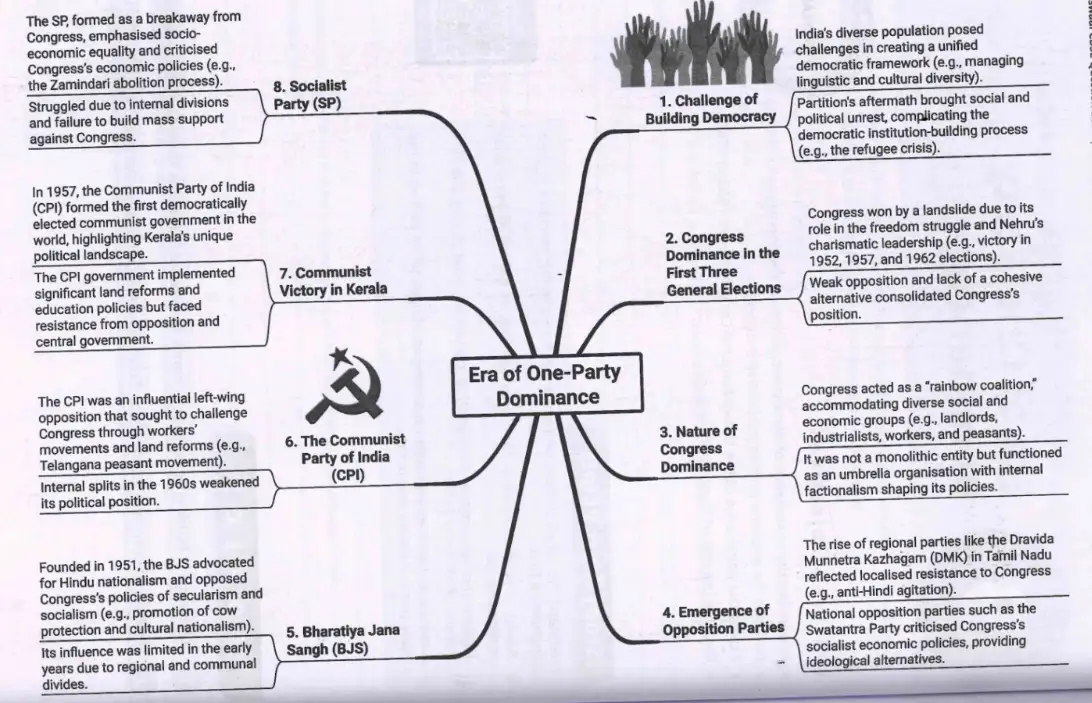
The era of one-party dominance in India refers to the period following independence when the Indian National Congress (INC) was the predominant political force. This period was marked by the establishment of a democratic system with free and fair elections, the dominance of the Congress Party in electoral politics, and the emergence of opposition parties that challenged Congress's policies and governance.
Exam Question
Q: What factors contributed to the dominance of the Congress Party in the early years of Indian democracy?
A: The Congress Party's dominance was due to its legacy from the freedom struggle, widespread organizational network, leadership under Jawaharlal Nehru, and the division among opposition parties.
Challenge of Building Democracy and Congress Dominance in the First Three General Elections
India faced significant challenges in building a democratic system after independence, including the effects of Partition, socio-economic difficulties, and low literacy rates. Despite these challenges, India adopted a democratic constitution that came into effect on 26 January 1950. The Election Commission was established to conduct the first general elections, which were held from 1951 to 1952.
The first general elections were a landmark event, demonstrating that democracy could succeed in a diverse and largely illiterate society. The Indian National Congress, led by Jawaharlal Nehru, won a decisive victory, securing 364 of 489 seats in the Lok Sabha. Congress maintained its dominance in the subsequent elections of 1957 and 1962, winning about three-fourths of the seats.
The first-past-the-post electoral system benefited Congress, as it won a majority of seats with less than half the total votes. Opposition parties were fragmented, which further consolidated Congress's position.
Exam Question
Q: How did the first-past-the-post electoral system affect the results of the early general elections in India?
A: The first-past-the-post system allowed the Congress Party to win a majority of seats with only about 45% of the votes, while opposition parties with significant vote shares won fewer seats, thus enhancing Congress's dominance.
Nature of Congress Dominance and Emergence of Opposition Parties
The Congress Party's dominance was unique because it occurred under democratic conditions with multiple parties contesting elections. Congress was a broad social and ideological coalition representing diverse groups across caste, class, religion, and language. It managed internal factions through tolerance and compromise, which strengthened the party and limited the effectiveness of opposition parties.
Opposition parties such as the Socialist Party, Communist Party of India (CPI), and Bharatiya Jana Sangh (BJS) emerged during this period. While they had limited electoral success initially, they played important roles in critiquing Congress policies and maintaining democratic checks and balances.
Exam Question
Q: What strategies did the Congress Party use to maintain its dominance despite internal differences?
A: Congress maintained dominance by accommodating diverse social groups and ideologies, managing internal factions through tolerance and compromise, and presenting itself as a broad coalition that included various interests.
Opposition Parties in Early Indian Democracy
The opposition parties during the early years of Indian democracy included:
- Socialist Party: Originated from the Congress Socialist Party, advocating democratic socialism and socio-economic equality but struggled electorally.
- Communist Party of India (CPI): Initially supported violent uprisings but later participated in elections, winning the Kerala government in 1957.
- Bharatiya Jana Sangh (BJS): Founded in 1951, promoting Hindu nationalism and opposing Congress's secular policies, with limited early electoral success.
These parties contributed to the political diversity and democratic debate in India, despite Congress's dominance.
Exam Question
Q: Describe the role of the Communist Party of India in the early years of Indian democracy.
A: The CPI was the largest opposition party in the 1952 elections, won the Kerala state government in 1957, and advocated land reforms and socialist policies, contributing to political diversity and opposition in India.
Solved Examples
Example 1: Explain why the Congress Party was able to maintain dominance in the first three general elections.
Solution: The Congress Party's dominance was due to its legacy from the freedom struggle, strong organizational network, leadership under Nehru, fragmented opposition, and the advantages of the first-past-the-post electoral system.
Example 2: What challenges did India face in conducting the first general elections?
Solution: Challenges included low literacy rates, vast and diverse population, delimitation of constituencies, preparation of electoral rolls, and training of election officials.
Practice Set
Easy
- What is universal adult franchise?
- Who was the first Chief Election Commissioner of India?
Moderate
- Explain the significance of the 1952 general elections in India.
- Describe the social composition of the Congress Party at the time of independence.
Challenging
- Analyze how the first-past-the-post system influenced the electoral success of the Congress Party.
- Discuss the role of opposition parties in maintaining democratic checks during the era of Congress dominance.
Answer Key
Easy
- Universal adult franchise is the right of all adult citizens to vote in elections regardless of gender, caste, or social status.
- Sukumar Sen was the first Chief Election Commissioner of India.
Moderate
- The 1952 general elections were significant as they were the first elections held under the new Constitution, demonstrating the success of democracy in a diverse and largely illiterate country.
- The Congress Party was a broad social coalition including urban elites, peasants, workers, and various caste and religious groups.
Challenging
- The first-past-the-post system allowed Congress to win a majority of seats with less than half the votes, while opposition parties with significant vote shares won fewer seats, enhancing Congress's dominance.
- Opposition parties provided criticism and alternative policies, preventing anti-democratic sentiments and helping maintain democratic accountability during Congress's dominance.
Quick Reference
- Universal Adult Franchise: Right of all adults to vote.
- First-past-the-post: Candidate with most votes wins.
- Congress System: Period of Congress dominance in Indian politics.
- Election Commission: Body conducting elections in India.
- Opposition Parties: Parties challenging the ruling government.
Glossary
- Coalition: An alliance of different groups or parties.
- Delimitation: The process of fixing boundaries of electoral constituencies.
- Faction: A group within a larger organization with distinct interests.
- Socialist Party: A political party advocating social ownership and democratic socialism.
- Communist Party of India: A left-wing political party advocating socialism and communism.
- Bharatiya Jana Sangh: A political party promoting Hindu nationalism, precursor to BJP.
Chronology of Key Events
| Year | Event | Significance |
|---|---|---|
| 1949 | Adoption of the Constitution | Established the legal framework for democracy in India. |
| 1950 | Constitution came into effect; Election Commission established | Laid foundation for democratic elections. |
| 1951-52 | First General Elections | Demonstrated successful implementation of universal adult franchise. |
| 1957 | Second General Elections; CPI forms Kerala government | Showed emergence of opposition success in some regions. |
| 1962 | Third General Elections | Congress maintained dominance despite growing opposition. |