Class 12 Humanities . Political Science . Politics In India Since Independence . Politics of Planned Development
Chapter 3: Politics Of Planned Development
Ch 3
Political Science
Class 12 Humanities
Chapter Overview
Economic Development as a Nation-Building Challenge
Economic development — The third major challenge after independence was to promote economic development and ensure the well-being of all.
The Development Challenge
- Earlier challenges: Leaders had already addressed nation-building and establishing democracy.
- Distinct path: As with those challenges, India’s leaders chose a path of development that was different and difficult.
- Scale of challenge: Progress was more limited because economic development was tougher and more enduring.
Political Choices about Development
Questions Explored in the Chapter
- Key debates: What choices and debates shaped India’s approach to development?
- Early strategy: Which development strategy did leaders adopt during the first two decades, and why?
- Assessment: What were the main achievements and limitations of that strategy?
- Later change: Why was the strategy abandoned in later years?
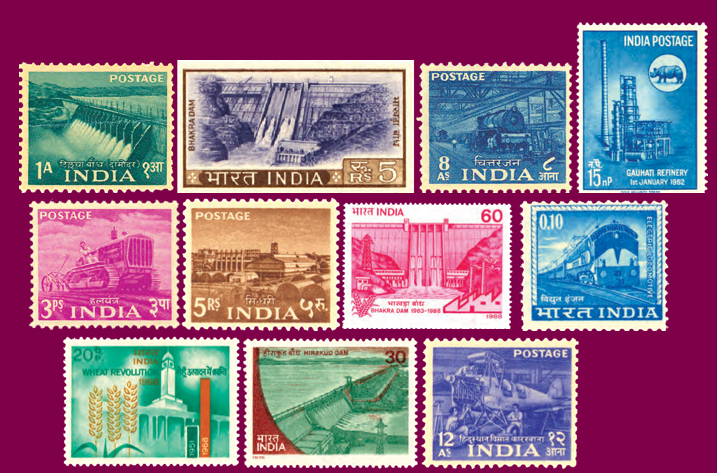
Stamp-era Vision of Planned Development
- Mostly 1955–1968Postage stamps depicted planned development through projects and advances in dams, industry, transport and agriculture.
Quick recap
- Independent India faced economic development as its third major challenge, alongside nation-building and democracy.
- The leaders chose a distinct and difficult path to pursue development and public well-being.
- The challenge was tougher and more enduring, and success was more limited.
- The chapter examines development debates, the early strategy and its reasons, its outcomes, and why it was later abandoned.
- Stamps from mostly 1955–1968 represented planned development across dams, industry, transport and agriculture, including the Wheat Revolution.
Political contestation & Ideas of development
Development and Competing Interests
POSCO-India Protest
- Location: People facing displacement by the proposed plant in Jagatsinghpur district protested outside the company’s office in Bhubaneswar.
- Demand: More than 100 villagers from Dhinkia, Nuagaon and Gadakujanga demanded cancellation of the MoU between POSCO-India and the Orissa government.
- Protest: Police prevented the demonstrators from entering the office premises; the protest was organised by Rashtriya Yuva Sangathan and Nabanirman Samiti.
- Core conflict: Protesters opposed a plant they believed threatened their lives and livelihoods.
Political Contestation
Post-Independence Development Consensus and Debate
- Shared vision: Development should combine economic growth with social and economic justice.
- Government’s role: Development and redistribution should not be left only to businessmen, industrialists and farmers; government should play a key part.
- Continuing disagreement: People debated how much the state should plan, whether it should run key industries, and how to balance justice against growth.
- Different priorities: Some favoured industrialisation; others prioritised agriculture and reducing rural poverty.
| Point | Left | Right |
|---|---|---|
| Social change and redistribution | Generally favours social change and a state role in economic redistribution | Generally favours less state direction of the economy and relies more on market forces |
| Economic approach | Favours state control of the economy and state regulation over free competition | Favours free competition and a market economy |
| Role of government | Supports an active state role in the economy | Opposes unnecessary government intervention |
Ideas of Development
Modernisation and the Western Model
- Western standard: The industrialised West was often treated as the measure of development; becoming modern was associated with becoming more like Western countries.
- Modernisation theory: Countries were expected to follow a similar path: traditional social structures break down, while capitalism and liberalism rise.
- Associated ideas: Modernisation was linked with growth, material progress and scientific rationality.
- Labels: This framework encouraged countries to be described as developed, developing or underdeveloped.
| Point | Liberal-capitalist model | Socialist model |
|---|---|---|
| Associated examples | Europe and the United States | The USSR |
| Support in India | Had relatively few supporters | Influenced Communist Party and Socialist Party leaders, and Congress leaders such as Nehru |
National Movement and Development Priorities
- Government responsibility: Nationalist leaders believed free India’s government should address poverty and social and economic redistribution, beyond the colonial government’s narrow commercial role.
- Debate within the consensus: Leaders agreed on government responsibility but differed on whether industrialisation or agricultural development and rural poverty alleviation should receive priority.
Planning
The Planning Commission
Planning Commission: Key Aims
- Livelihood: Secure an adequate means of livelihood for all citizens, women and men equally.
- Common good: Distribute ownership and control of community resources so they best serve the common good.
- Prevent concentration: Ensure the economic system does not concentrate wealth and means of production to the common detriment.
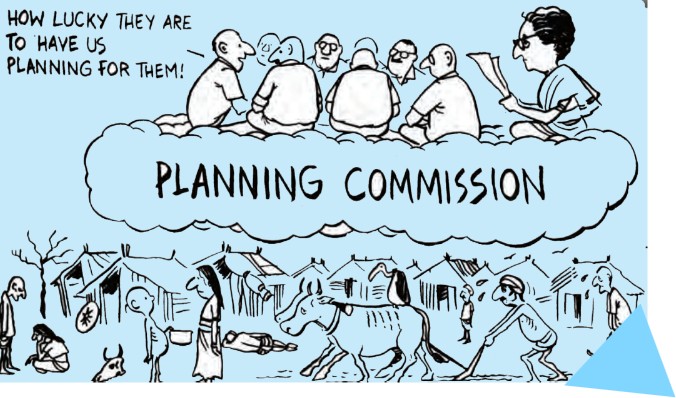
NITI Aayog
Key Dates
- 1944Major industrialists drafted the Bombay Plan, proposing major state investment in a planned economy.
- March 1950The Government of India established the Planning Commission by resolution.
- 1 January 2015NITI Aayog replaced the Planning Commission.
Why are major development decisions political decisions?
What were the key aims guiding the Planning Commission?
Quick recap
- Development choices distribute costs and benefits differently, so groups can disagree over what counts as progress.
- Democratic decisions need expert advice but ultimately require political judgement and public approval.
- Left and right refer to positions on social change and economic redistribution, as well as state control versus market competition.
- Development models at Independence included liberal capitalism and socialism; India also debated industry versus agriculture and rural poverty relief.
- Planning gained wide support, including from industrialists who proposed the Bombay Plan in 1944.
- Planning Commission was a non-constitutional advisory body established in March 1950 and chaired by the Prime Minister.
- NITI Aayog replaced the Planning Commission on 1 January 2015.
The Early Initiative
Five-Year Plans and Planning
Early Public Response and a Plan Holiday
The First Five-Year Plan
National Income, Savings and Investment
Rapid Industrialisation: The Second Plan
Industrialisation: Costs and Criticisms
- Plan budget
- Five-year expenditure assigned to priorities in the plan.
- Non-plan budget
- Yearly expenditure on routine government activities.
- Land reform
- Changes to land distribution intended to address a barrier to agricultural growth.
- Socialist pattern of society
- The goal declared by the Congress at Avadi and reflected in the Second Plan.
- Urban bias
- A perceived preference for urban and industrial development over rural and agricultural needs.
What were the main priorities of the First Five-Year Plan?
How did the Second Plan promote industrialisation?
What problems and criticisms accompanied the industrial push?
Quick recap
- Five-year plans set long-term priorities; plan spending differed from routine yearly non-plan spending.
- The First Plan (1951–1956) prioritised agriculture, irrigation, dams and land reform.
- K. N. Raj urged gradual development, warning that excessive speed might threaten democracy.
- The Second Plan, led by P. C. Mahalanobis, promoted heavy industry and a socialist pattern of society.
- Industrialisation supported domestic industry but required imported technology and risked neglecting agriculture.
- By 1966, economic crisis led to a plan holiday; critics had also challenged the plans’ priorities and process.
Political Science — ALL CHAPTERS
1
THE END OF BIPOLARITY
2
CONTEMPORARY CENTRES OF POWER
3
CONTEMPORARY SOUTH ASIA
4
INTERNATIONAL ORGANISATIONS
5
SECURITY IN THE CONTEMPORARY WORLD
6
ENVIRONMENT AND NATURAL RESOURCES
7
GLOBALISATION
1
Challenges of Nation Building
2
Era of one-party dominance
3
Politics Of Planned Development
4
India’s external relations
5
Challenges to and Restoration of the Congress System
6
The Crisis of Democratic Order
7
Regional Aspirations
8
Recent Developments in Indian Politics