SOLUTIONS
2026 BOARD EXAM
CBSE Class 12 Humanities Economics Board Paper 2026 — Set 3 Solutions
2026
Economics
Class 12 Humanities
CBSE EXAMINATION PAPER-2026
ECONOMICS
(Solved)
General Instructions :
Read the following instructions carefully and follow them :
- This question paper contains 41 questions. All questions are compulsory.
- This question paper is divided into 4 sections.
- Section A – questions number 1 to 20 are multiple choice questions
- Section B – questions number 21 to 26 are short answer type i
- Section C – questions number 27 to 35 are short answer type ii
- Section D – questions number 36 to 41 are long answer
- There is no overall choice given in the question paper. However, an internal choice has been provided in few questions.
- Use of calculator is NOT allowed.
Section A
Read the following statements : Assertion (A) and Reason (R). Choose the correct option from those given below :
Assertion (A) : Borrowing requirements of the government include interest obligations on debt as well. Reason (R) :The goal of measuring primary deficit is to correct the prevailing fiscal imbalances.
The borrowing requirement of the government does include interest obligations on accumulated debt, which makes Assertion (A) true. The goal of measuring primary deficit is to focus on present fiscal imbalances by excluding interest payments, which makes Reason (R) true as well. However, Reason (R) does not explain why borrowing requirements include interest obligations; instead, it explains why primary deficit is measured separately. Therefore, both statements are true, but Reason (R) is not the correct explanation of Assertion (A).
Identify the variable(s) which may add to the future productive capacity of an economy :
I Raw material
II. Fixed investment
III. Inventories with producers
On the basis of the given table, estimate the value added by the Baker
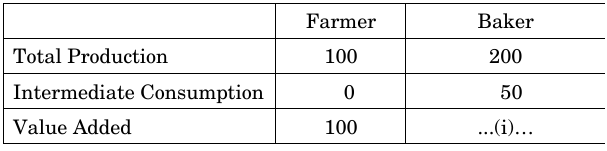
Value added by the Baker is calculated by subtracting the value of intermediate goods used from the total production value. According to the context, the Baker's total production is 200 and the intermediate goods used (wheat from the Farmer) is 50. Therefore, value added = 200 - 50 = 150. Hence, the correct option is 150.
Select the correct formula to calculate the value of Marginal Propensity to Save (MPS) : I.Change in Savings (ΔS)/Change in Consumption (ΔC)
II Change in Savings (ΔS)/Change in Income (ΔY)
III.1−Marginal Propensity to Consume (MPC)
IV.Change in Income (ΔY)/Change in Savings (ΔS)
Marginal Propensity to Save (MPS) is defined as the change in savings divided by the change in income, i.e., MPS = ΔS / ΔY (option II). It is also related to the Marginal Propensity to Consume (MPC) by the equation MPS = 1 - MPC (option III), since income is either consumed or saved. Therefore, both options II and III correctly represent the formula to calculate MPS. Options I and IV are incorrect because MPS is not the ratio of change in savings to change in consumption, nor the inverse ratio of income change to savings change.
Read the following statements carefully :
Statement I : Trade in services includes both factor income and non-factor income transactions. Statement II : Current Account includes transactions related to goods, services and unilateral transfers.
In the light of the given statements, choose the correct option from the following :
Statement I is true because trade in services covers both factor income (earnings from factors of production like labour and capital abroad) and non-factor income (net sale of service products such as shipping, banking, tourism, software services). Statement II is also true as the Current Account includes transactions related to goods, services, and unilateral transfers (transfer payments like gifts, remittances, and grants). Therefore, both statements are correct based on the components of the Current Account.
Suppose in a hypothetical economy, Y = 50 + 0·8Y + 100, where Y = National Income. The value of Investment Multiplier (K) would be ___________.
(Choose the correct option to fill in the blank)
From the given equation Y = 50 + 0.8Y + 100, rearranging we get Y - 0.8Y = 150, which implies 0.2Y = 150, and hence Y = 150 / 0.2 = 750. The marginal propensity to consume (mpc) here is 0.8. Using the formula for investment multiplier K = 1 / (1 - mpc), we substitute mpc = 0.8. So, K = 1 / (1 - 0.8) = 1 / 0.2 = 5. Therefore, the value of the investment multiplier is 5.
“Consumption of a good by a person does not reduce the amount available for consumption by others. Consumers consuming such goods are known as free-riders.”
Identify the type of goods indicated in the above text.
The goods described are public goods because their consumption by one person does not reduce the availability for others, which is a characteristic of non-rivalrous consumption. Additionally, consumers who benefit without paying are called free-riders, which occurs in the context of public goods. Public goods are non-excludable and non-rivalrous, such as national defence and roads.
Read the following statements carefully :
Statement I : At the break-even level of income, the value of slope of the consumption curve is zero.
Statement II : Marginal Propensity to Consume (MPC) refers to the change in consumption per unit change in income. In the light of the given statements, choose the correct option from the following :
Statement I is false because the slope of the consumption curve represents the marginal propensity to consume (MPC), which is not zero at the break-even level of income. The slope (MPC) is the rate of change of consumption with respect to income and remains positive (between 0 and 1) generally. Statement II is true because Marginal Propensity to Consume (MPC) is defined as the change in consumption per unit change in income, i.e., it measures how much consumption changes when income increases by one unit.
Read the following statements carefully :
Statement I : Inland waterways proved to be uneconomical as in the case of Coast Canal on the Orissa coast.
Statement II : British government followed an effective and efficient administrative set-up leaving a legacy of effective work culture.
In the light of the given statements, choose the correct option from the following :
Statement I is true because the inland waterways, specifically the Coast Canal on the Orissa coast, proved uneconomical as it failed to compete with railways and was eventually abandoned. Statement II is false as the British government measures were far from satisfactory, indicating that they did not leave a legacy of effective and efficient administrative work culture.
Arrange the following events of Pakistan in correct chronological order
I. Nationalisation of capital goods industries
II. Establishment of Pakistan
III. Introduction of economic reforms
IV. Announcement of First Five Year Plan
The correct chronological order is: II. Establishment of Pakistan (1947), IV. Announcement of First Five Year Plan (1956), I. Nationalisation of capital goods industries (1970s), and III. Introduction of economic reforms (late 1970s and 1980s). Pakistan was established first, then announced its First Five Year Plan in 1956. Nationalisation happened in the 1970s, and later economic reforms were introduced in the late 1970s and 1980s to encourage privatisation and private sector growth.
Read the following statements : Assertion (A) and Reason (R). Choose the correct option from those given below :
Read them carefully and select the correct option :
Assertion (A) : The unemployment problem in India is multifaceted. Reason (R) : Some individuals work round the year, while others work only a few months in a year.
Minimum Support Price is fixed by the Government to safeguard the interests of the ___________.
(Choose the correct option to fill in the blank)
The Minimum Support Price (MSP) is fixed by the government as a part of its agricultural price support programme to protect the income of farmers. It sets a floor price, usually higher than the market price, to prevent the price of agricultural products from falling below a certain level due to excess supply. This intervention ensures that farmers receive a fair price for their produce, safeguarding their interests against exploitation by private traders like moneylenders and merchants.
The primary outcome of the efforts initiated by the Indian Government (Liberalisation and Privatisation) under the New Economic Policy of 1991 was __________.
The New Economic Policy of 1991 focused on liberalisation, privatisation, and globalisation. While fiscal and monetary reforms took place, the major outcome was globalization, which means the integration of India's economy with the world economy. This was achieved by reducing restrictions, disinvestment, import liberalisation, and foreign exchange deregulations, opening the country to international trade and investment.
Read the following text carefully :
“Between 1966 – 67, Mao introduced this movement under which professionals and students were asked to work and learn from the countryside of China.”
Identify the correct option with reference to the aforesaid text.
The correct answer is the Great Proletarian Cultural Revolution because, according to the context, this movement was introduced by Mao between 1966 and 1967, during which students and professionals were sent to work and learn from the countryside. The other options do not fit the description given: the Commune System relates to collective farming started during the Great Leap Forward around 1958; the Open Door Policy refers to economic reforms initiated later; and the Great Leap Forward was an earlier campaign aimed at industrialization, not specifically about sending students and professionals to rural areas.
Read the following statements carefully
Statement I : Livestock provides alternative livelihood options to small and marginal farmers.
Statement II : In rural areas, animal husbandry provides stable employment opportunities throughout the year.
In the light of the given statements, choose the correct option from the following :
Statement I is true because livestock production provides alternative livelihood options to over 70 million small and marginal farmers, including landless labourers, as mentioned in the context. Statement II is also true because animal husbandry in rural areas contributes to diversification and provides stable employment opportunities throughout the year by involving various allied activities like livestock, poultry, and fisheries. Thus, both statements are correct.
The steep Indian education pyramid indicates _____________.
The context explains that the Indian education pyramid is steep, which means a lesser number of people reach the higher education level. This indicates that only a small proportion of the population continues to higher education, resulting in the pyramid shape. Therefore, the correct option is 'Few/less number of people reaching higher education'.
Identify, which of the following is an income indicator.
GDP per capita represents the average income per person by dividing the total value of goods and services produced in a country by its population. It reflects the economic well-being and income level of people, whereas mortality rate, malnourishment, and morbidity rate are indicators related to health and nutrition, not income.
Section B
State the meaning and any two components of Gross Domestic Capital formation.
Two components of Gross Domestic Capital Formation are:
1. Gross Fixed Capital Formation: Investment in physical assets like machinery, buildings, infrastructure, which are used for production.
2. Change in Stocks: Increase or decrease in the inventory of raw materials, semi-finished goods, and finished goods held by producers and traders.
“It is not the nature of a good, rather the economic nature of its use, which determines whether it is a final good or not.”
Justify the given statement with valid arguments.
The statement means that whether a good is called a final good depends not on the physical nature of the good but on how it is used economically.
A final good is one that is meant for final use and does not pass through any further stages of production or transformation.
For example, a wheat crop can be an intermediate good if used by a miller to produce flour, but when wheat is purchased by a consumer for direct use, it becomes a final good.
Similarly, a machine can be a capital good if used in production, but if sold to a consumer for direct use, it is a final good.
This shows that the classification depends on the purpose or economic use, not on the physical nature.
Also, final goods pass out of the active economic flow once sold and do not undergo further production.
Thus, it is the economic nature of use that determines whether a good is final, not the nature of the good itself.
This is important in national income accounting to avoid double counting.
In brief, the use defines the classification of the good.
US administration has recently imposed tariff to the magnitude of 50%.”
In the light of given statement, explain the likely impact of this step on the exports of India.
The imposition of a 50% tariff by the US on imports will increase the price of Indian goods in the US market. As a result, Indian products become more expensive for American buyers, which generally reduces demand for these exports from India.
This decrease in demand will likely lead to a fall in the volume of exports from India to the US.
Consequently, Indian exporters may face reduced sales and revenue from the US market.
However, the overall impact depends on how sensitive American consumers are to price changes (elasticity of demand). If demand is inelastic, exports might not decline much.
Moreover, Indian exporters may look for alternative markets or reduce prices to remain competitive.
In summary, the tariff increase by the US is likely to decrease India’s exports to the US, negatively affecting Indian exporters unless compensated by other factors.
Describe the role which India has played as an important member of World Trade Organisation (WTO).
India has played a significant role as an important member of the World Trade Organisation by actively participating in framing fair global trade rules and regulations. It has consistently advocated for the interests of developing countries, ensuring their concerns are addressed in international trade negotiations. India has honoured its commitments towards trade liberalisation by removing quantitative restrictions on imports and reducing tariff rates, which promotes fairer international trade. Moreover, India supports the objectives of WTO to enlarge production and trade of goods and services, ensure optimum utilisation of world resources, and protect the environment. Its participation has helped balance trade relations between developed and developing nations by seeking greater market access and removing trade barriers. Overall, India's role in WTO strengthens global trade fairness and represents the voice of developing economies effectively.
Critically appraise the Industrial Licensing policy initiated by the government during the planning period of India.
The Industrial Licensing Policy required entrepreneurs to obtain government permission before starting, closing, or expanding production of industrial units. This was aimed to regulate industrial growth and ensure balanced regional development.
Positive Aspects: It helped the government control key industries and avoid concentration of economic power in few hands. It promoted industrialization in backward regions by making licenses easier to get there. This policy ensured planned and balanced industrial growth aligned with national economic goals.
Negative Aspects: The policy led to excessive red tape and bureaucratic delays, discouraging private enterprise. It restricted entrepreneurial freedom and slowed industrial progress. Many entrepreneurs faced difficulties due to stringent licensing norms, which hampered innovation and efficiency.
Conclusion: While the policy helped in protecting nascent industries and achieving regional balance, it also created obstacles for vibrant private sector growth, leading to calls for liberalization in later years.
“Some economists argue that once a technology proves to be profitable and becomes widely adopted, subsidies should be gradually withdrawn.”
Defend or refute the given statement with valid arguments.
Refutation of the statement: In some cases, technology adoption still requires support due to risks, externalities, or market failures. Subsidies can help small farmers or disadvantaged groups continue using the technology safely. Sudden removal may cause hardship and reduce innovation incentives.
Conclusion: Subsidies should be gradually reduced and targeted, ensuring they support those who still need assistance while encouraging market efficiency and innovation.
Section C
Distinguish between Revenue Expenditure and Capital Expenditure with the help of suitable examples.
Capital Expenditure: It is the expenditure incurred to acquire or improve long-term assets that will benefit the business or government for many years. It creates assets or increases their value. Examples include purchase of machinery, buildings, and land.
Summary: Revenue Expenditure is for current expenses and does not create assets, whereas Capital Expenditure is for buying or improving fixed assets and benefits are received for the long term.
Using suitable examples, distinguish between Revenue Receipts and Capital Receipts.
Capital Receipts: These receipts either create liability or reduce assets of the government. They include loans raised by the government, recoveries of loans given out earlier, and money received from the sale of government assets or disinvestment in Public Sector Undertakings.
Example of Revenue Receipt: Income tax collected from citizens.
Example of Capital Receipt: Loan taken from the Reserve Bank of India or sale of government land.
Difference: Revenue receipts are recurring and do not create liability, whereas capital receipts are non-recurring and either create liability or reduce assets.
Estimate the value of incremental investment if, equilibrium level of income increases by ₹ 50,000 crore and half of additional income is always saved in the economy.
Step 1: Calculate Marginal Propensity to Consume (MPC). MPC = 1 - Saving rate = 1 - 0.5 = 0.5.
Step 2: Calculate the investment multiplier (k). Multiplier k = 1 / (1 - MPC) = 1 / (1 - 0.5) = 1 / 0.5 = 2.
Step 3: Use the multiplier formula ΔY = k * ΔI to find the incremental investment (ΔI).
Rearranged: ΔI = ΔY / k = 50,000 / 2 = 25,000 crore.
Answer: The value of incremental investment required for the given increase in equilibrium income is ₹ 25,000 crore.
The Reserve Bank of India (RBI) has decided to increase the loan amount to 90% of the security value, from the prior rate of 80%.”
In the light of above statement, identify the type of monetary measure exercised by the Reserve Bank of India (RBI) and its likely impacts on the Aggregate Demand of the economy.
Impact on Aggregate Demand: By allowing banks to lend more against security, more credit becomes available in the economy, encouraging investment and consumption. This increase in credit availability leads to higher aggregate demand as businesses and consumers have greater access to funds for spending and investment. Therefore, aggregate demand in the economy is likely to increase, which can stimulate economic growth.
Conclusion: The RBI's measure helps to increase money supply and credit flow, thereby increasing aggregate demand and promoting economic activity.
Describe the role of government in improving the efficiency of human capital formation in India.
The government plays a crucial role in enhancing human capital formation by investing in key areas such as education and health, which are essential for people's all-round development. It allocates substantial financial resources to develop schools, colleges, universities, and healthcare facilities across the country. The government also implements policies to ensure equal access to quality education and healthcare for all sections of society, promoting economic growth and social equity. It runs various schemes for skill development, vocational training, and literacy programs to improve the skills and productivity of the workforce. Moreover, the government collaborates with state and local governments to reach remote and underprivileged areas, thus expanding the reach of human capital development. By focusing on scientific and technical education, the government helps build a skilled labor force that can contribute effectively to the economy. Despite a reduction in direct economic roles recently, the government continues to facilitate capacity building through planning and support services, ensuring sustainable development and improved quality of life.
“Traditional knowledge and practices are still applicable in ensuring sustainable development.”
Do you agree with the given statement ? Support your answer with valid reasons.
Yes, I agree that traditional knowledge and practices are still applicable in ensuring sustainable development.
Firstly, traditional practices are based on local natural resources and have been developed over centuries to conserve the environment. They promote the sustainable use of resources without harming nature.
Secondly, such practices often emphasize balance and harmony between humans and nature, helping maintain biodiversity and ecological stability.
Thirdly, many traditional agricultural techniques focus on soil fertility, water conservation, and crop diversity which reduce dependency on chemical fertilizers and pesticides, leading to environmental protection.
Finally, using traditional knowledge can help avoid environmental risks and ensure resources are available for future generations.
Therefore, integrating traditional knowledge with modern technology can lead to eco-friendly and sustainable development, benefiting both present and future society.
On the basis of the given data, comment on trends of output growth in different sectors (1980 – 2018), between India and Pakistan.

Study the given image carefully and answer the questions that follow
(i) Identify the artificial waterway during colonial rule that served as a highway between India and Britain.
(ii) In which year was this artificial maritime route officially opened for international navigation ?
(iii) Describe the economic significance of artificial waterways between the Mediterranean and the Red Sea.
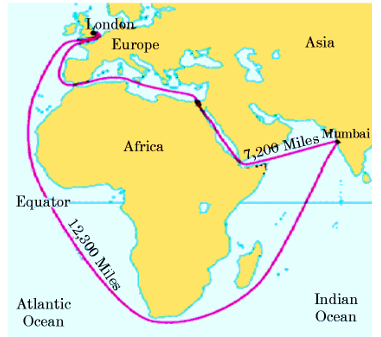
(ii) The Suez Canal was officially opened for international navigation in 1869.
(iii) The economic significance of these artificial waterways, especially the Suez Canal, lies in providing a direct sea route between the Mediterranean Sea and the Red Sea. This route greatly shortened the travel distance for ships sailing between Europe and South Asia, avoiding the long and dangerous journey around the southern tip of Africa. It facilitated faster and cheaper trade, boosting economic exchanges between continents. This canal also enhanced the strategic and commercial importance of the regions it connected and increased global trade efficiency.
“The real motive behind infrastructural development under the British rule was not to provide basic amenities to the people of India, but to subserve various colonial interests.”
Do you agree with the given statement ? Give valid reasons in support of your answer.
Reasons: (1) Roads and railways linked production centers to ports for export, not to improve local connectivity.
(2) Railways helped in mobilizing British troops rapidly.
(3) Infrastructure developments boosted colonial profits by facilitating resource extraction.
(4) Indian industries suffered due to focus on raw material exports. Thus, infrastructural development was selfish and served colonial interests rather than public welfare.
Section D
(i) Distinguish between Real Gross Domestic Product and Nominal Gross Domestic Product using a numerical example.
(ii) Define the concept of ‘Externalities’.
Nominal GDP is the value of all final goods and services produced within a country in a given year measured at current prices, whereas Real GDP is the value of all final goods and services produced within a country measured at constant prices (base year prices), which removes the effect of inflation.
Example:
Suppose a country produces 100 units of a product priced at 10 in base year and 12 in current year.
Nominal GDP = 100 units * 12 = 1200
Real GDP = 100 units * 10 (base year price) = 1000
This shows that Nominal GDP can increase due to price rise even if production remains the same, whereas Real GDP reflects the actual production change.
(ii) Definition of Externalities:
Externalities are the positive or negative effects of economic activities on third parties who are not directly involved in the transaction. For example, pollution from a factory causes negative externalities affecting the health of nearby residents, while education creates positive externalities by benefiting society as a whole beyond the individual learner.
Calculate the values of Operating Surplus and Gross Domestic Product at Market Price (GDP_ MP) from the following data :
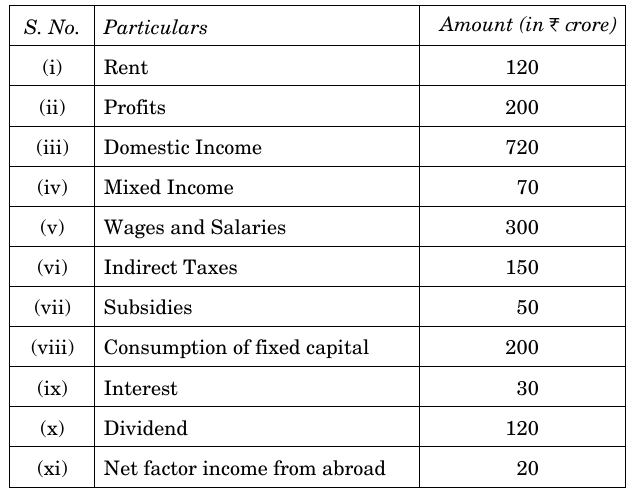
Let us assume the given data includes figures such as Net Domestic Product at Market Prices (NDPMP) and Depreciation (DeP) or any other required components to calculate Operating Surplus and GDPMP. To calculate Operating Surplus and GDPMP, follow these steps:
(a) Calculate Gross Domestic Product at Market Prices (GDPMP):
GDPMP = NDPMP + Depreciation
This is because NDPMP is the net value which excludes depreciation, so adding depreciation back will give GDPMP.
(b) Calculate Operating Surplus:
Operating Surplus is the part of GDP which remains after paying wages and taxes less subsidies. It can be calculated as:
Operating Surplus = GDPMP - Compensation of Employees - Net Indirect Taxes
In summary,
1. Find GDPMP by adding depreciation to NDPMP.
2. Subtract wages and net indirect taxes from GDPMP to get the Operating Surplus.
These calculations help determine the income generated from production activities including profits, rents, and interests, represented by Operating Surplus, and the total value of goods and services produced within the country, represented by GDP at Market Prices.
Read the following passage carefully :
Any institution which accepts deposits from the public and advances loans is a bank. Banks are broadly categorised into :
• Commercial Banks, and
• Central Bank.
Commercial banks accept deposits from public and use these deposits for giving loans. Banks keep a fraction of deposits as reserves. Generally, all depositors do not demand their money at the same time. The Central Bank of a country is responsible for controlling credit creation. The Reserve Bank of India (RBI) regulates the money supply in India through its monetary policy.
On the basis of the above passage and common understanding, answer the following questions :
(i) State the meaning of a Bank.
(ii) Mention any two traits that distinguish Central Bank from Commercial Banks.
(iii) “Open market operation is the tool used by Reserve Bank of India (RBI) to regulate money supply in the economy.”
Justify the given statement with valid arguments.
(ii) Two traits that distinguish Central Bank from Commercial Banks are:
1. The Central Bank issues currency notes and controls the money supply in the country, while Commercial Banks do not issue currency.
2. The Central Bank regulates and supervises Commercial Banks and acts as a banker to the government, whereas Commercial Banks deal mainly with the public and businesses.
(iii) Open Market Operation (OMO) is a tool used by RBI to regulate the money supply in the economy. OMO involves the buying and selling of government securities in the open market by the RBI. When RBI buys government bonds, it pays money to the sellers, increasing the money supply in the economy. Conversely, when RBI sells government bonds, it takes money out of circulation, reducing the money supply. This way, RBI can either encourage spending and investment by increasing money supply or control inflation by reducing money supply through OMO. Thus, OMO is an effective method used by RBI to maintain economic stability.
(i) “Information Technology plays a very significant role in achieving sustainable development and food security.”
Justify the given statement with valid arguments.
(ii) State the meaning of ‘self-employed worker’ with suitable example.
(ii) A 'self-employed worker' is a person who works for themselves and does not work as an employee for any employer. They run their own business or trade and earn income directly from their activities. For example, a tailor who makes and sells clothes independently is a self-employed worker. They are responsible for their own work and income without any fixed salary from an employer.
(i) Distinguish between formal and informal sector with suitable examples.
(ii) Define worker population ratio with its significance.
The formal sector consists of all public sector establishments and private sector enterprises that employ 10 or more hired workers. These establishments are registered and follow government rules and regulations. Workers in this sector get job security, regular wages, and social benefits like provident fund and pension. Example: Government offices, large factories.
The informal sector includes all other enterprises and workers that are not covered under the formal sector. These are mostly small, unregistered businesses and home-based industries. Workers here do not have job security or social benefits. Example: Street vendors, domestic workers.
(ii) Worker Population Ratio:
The worker population ratio is defined as the percentage of the total workers to the total population aged 15 and above. It is calculated as: (Total Workers / Total Population aged 15+) * 100. This ratio indicates the proportion of working people in the population and helps in understanding the economic activity and employment level in a country. Higher worker population ratio means more people are engaged in productive work which is good for economic growth.
Read the following passage carefully :
In the present times, green investment and sustainability are priorities in public policy. India has emerged as a global leader at the front of the climate change.
India has pledged to seek solutions for the future. The government has contributed to maintain economic growth by implementing various policies and measures relating to sustainable development. Pradhan Mantri Ujjwala Scheme has actively contributed to cleaner air. The Jal Jeevan Mission was launched with the objective of achieving water security.
The greenhouse effect is a natural process that warms the Earth’s surface, where certain atmospheric gases, known as greenhouse gases, trap heat from the sun and re-emit it, keeping the planet warm enough to support life. In the present times, the issue of greenhouse gases and rising temperature of the Earth are a global concern.
On basis of the above passage and common understanding, answer the following questions :
(a) Discuss any two steps involved in attaining sustainable development in India.
(b) Mention any two factors which challenged the carrying capacity of the environment.
(c) Define Greenhouse effect.
1. Pradhan Mantri Ujjwala Scheme: This scheme aims to provide clean cooking fuel like LPG to women in poor households, which helps in reducing indoor air pollution and contributes to cleaner air.
2. Jal Jeevan Mission: This mission focuses on providing safe and adequate drinking water through individual household tap connections by 2024, which ensures water security in rural areas and promotes sustainable water management.
(b) Two factors that have challenged the carrying capacity of the environment are:
1. Increased population pressure which leads to over-consumption of natural resources causing resource depletion.
2. Pollution from industrialisation and urbanisation which degrades air, water and soil quality, affecting environmental health.
(c) Greenhouse effect is a natural process by which certain atmospheric gases called greenhouse gases trap the heat radiated from the Earth's surface and re-radiate it back, keeping the planet warm enough to support life. However, excessive greenhouse gases due to human activities increase the Earth's temperature leading to global warming and climate change.
Paper Details
CBSE Board Exam 2026
Class
Class 12 Humanities
Subject
Economics
Year
2026
Set
Set 3
Other Years — Economics