SOLUTIONS
2026 BOARD EXAM
CBSE Class 12 Humanities Economics Board Paper 2026 — Set 2 Solutions
2026
Economics
Class 12 Humanities
CBSE EXAMINATION PAPER-2026
ECONOMICS
(Solved)
General Instructions :
Read the following instructions carefully and follow them :
- This question paper contains 42 questions. All questions are compulsory.
- This question paper is divided into 4 sections.
- Section A – questions number 1 to 22 are multiple choice questions
- Section B – questions number 23 to 28 are short answer type i
- Section C – questions number 29 to 36 are short answer type ii
- Section D – questions number 37 to 42 are long answer
- There is no overall choice given in the question paper. However, an internal choice has been provided in few questions.
- Use of calculator is NOT allowed.
Section A
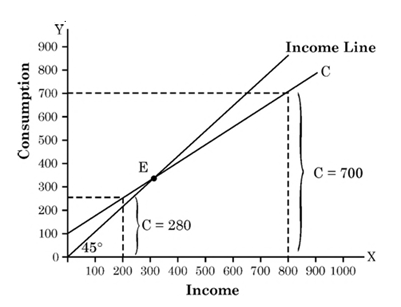
Choose the correct consumption function from the options given below with reference to the illustrated given diagram.
If the value of Marginal Propensity to Consume (MPC) is 0.6 and dissaving's are 100, the relevant saving function would be :
The saving function is derived from the income and consumption function. Given MPC (c) = 0.6, the Marginal Propensity to Save (MPS) = 1 - MPC = 0.4. Dissaving of 100 means autonomous saving is -100 (negative saving). The saving function is S = - autonomous consumption + MPS × Income, which results in S = –100 + 0.4Y.
Income generated from Aircrafts of Air India operating between Canada and England would be added to the domestic income (NDP_ FC) of ________.
The income generated from Air India's aircrafts is considered part of India's domestic income (NDP at factor cost) because the aircrafts are owned by an Indian company and the earnings from its operations, even on international routes, accrue to India. Domestic income includes income earned by the country's factors of production, regardless of where they operate. Therefore, the income is added to India’s domestic income and not to Canada or England.
Identify, that function of money, which has effectively solved the problem of ‘double coincidence of wants’ in a transaction.
The function of money that solves the problem of 'double coincidence of wants' is the medium of exchange. This means money is used as an intermediary to facilitate transactions between buyers and sellers, eliminating the need for both parties to want exactly what the other has at the same time. The context explains that the principal function of money is to facilitate exchanges, which addresses this issue.
Read the following statements carefully :
Statement 1 : Under the flexible exchange rate system, a deficit / surplus in the Balance of Payments is automatically corrected.
Statement 2 : Under the flexible exchange rate system, there is always a possibility of over/under valuation of currency.
In the light of the above given statements, choose the correct option from the following :
Read the following Flow chart carefully and choose the correct option :
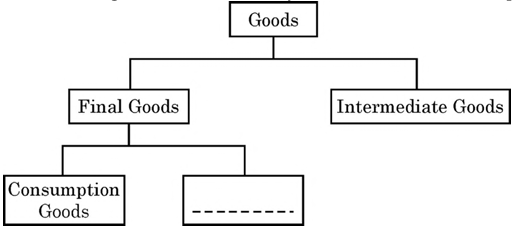
Capital goods are physical assets used in production, such as machinery and tools. They are not consumed immediately and do not wear out in a short period. The context explains that capital goods are goods bought not for immediate consumption but for producing other goods, which matches the description in the flow chart.
The Aggregate Demand (AD) curve lies parallel to consumption curve, indicating that both have _________.(Choose the correct option to fill in the blank)
The Aggregate Demand (AD) curve is obtained by vertically adding the consumption and investment functions, and it is stated that both the AD curve and the consumption curve have the same slope (c). This means that their slope is identical, reflecting how changes in income (Y) affect demand and consumption proportionately.
Statement 1 : Brokerage earned by a dealer of second hand cars is included in the estimation of National Income. Statement 2 : Imputed value of production for self-consumption is included in National Income. In the light of the above given statements, choose the correct option from the following :
Brokerage earned by a dealer of second hand cars is not included in National Income because the sale of second hand goods does not represent new production that contributes to National Income; it is merely a transfer of existing goods. However, brokerage itself is a service rendered and usually included if it represents new value added, but specifically, the question's context typically excludes second hand transactions from National Income calculations. On the other hand, the imputed value of production for self-consumption is included in National Income because it represents the value of goods and services produced and consumed within the same household, which contributes to the economy's total production even if no market transaction occurs.
Sumit deposited ₹10 lakh in his savings account. The deposits made by him is a part of ________ in the M₁ measure of money supply.
M1 measure of money supply includes currency held by the public and demand deposits with commercial banks. Demand deposits refer to deposits that can be withdrawn by the account holder on demand, such as savings and current account deposits. Since Sumit's ₹10 lakh is deposited in his savings account, it is considered a demand deposit. Term deposits and interbank deposits are not part of M1, and deposits with the RBI are reserves, not part of M1.
Read the following statements – Assertion (A) and Reason (R). Choose the
correct option from those given below :
Assertion (A) : Increase in exchange rate implies that the price of foreign currency in terms of domestic currency has increased. Reason (R) : Balance of trade records the inflows and outflows of foreign exchange.
The Assertion (A) is true because an increase in exchange rate means that more units of domestic currency are required to buy one unit of foreign currency, which implies that the price of foreign currency in terms of domestic currency has increased. The Reason (R) is also true because the balance of trade records the inflows and outflows of foreign exchange, reflecting exports and imports. However, the Reason (R) does not directly explain why the exchange rate increases, so it is not the correct explanation for the Assertion (A).
Identify, which one of the following is not a function of Reserve Bank of India as a bank, agent and advisor to the government.
The Reserve Bank of India (RBI) acts as a banker, agent, and advisor to the government by managing national debt, carrying out banking business of the government, and advising on financial matters. However, conducting periodic inspections is primarily a regulatory function related to supervising and regulating banks and financial institutions, which is not categorized under its role as a bank, agent, or advisor to the government.
“In the formative stages of reforms development of credit markets, administrative intervention in interest rates is both necessary and desirable.”
Identify the sector under which the aforesaid reform was introduced.
The reform mentioned pertains to the development of credit markets and the regulation of interest rates, which fall under the domain of financial institutions such as banks. According to the context, financial sector reforms aim to improve financial institutions including commercial banks and involve reducing the regulatory role of the RBI. Hence, administrative intervention in interest rates during early reforms relates to financial sector reforms.
Assertion (A) : The dynamic sub-sectors like agro-processing industries, food processing industries, etc. have potential to create alternative employment opportunities. Reason (R) : Men usually seek non-farm jobs, but recently, women have also started looking for such jobs.
The assertion is true because dynamic sub-sectors such as agro-processing and food processing industries have potential to generate alternative employment in rural areas, helping to supplement farm incomes and reduce poverty. The reason is also true as men generally seek non-farm jobs, and recently women have started looking for such jobs too. However, the reason does not explain why these dynamic sub-sectors create employment opportunities; it only explains the trend of job-seeking among men and women. Therefore, the reason is true but not the correct explanation of the assertion.
The steep Indian education pyramid indicates _________.
A steep Indian education pyramid means that as we move higher up the levels of education, fewer people continue or reach that stage. The context clearly states that the Indian education pyramid is steep, indicating a lesser and lesser number of people reaching the higher education level.
_________ estimates India’s national and per capita income during the colonial era was considered very significant. (Choose the correct option to fill in the blank)
Among the notable estimators of India's national and per capita income during the colonial period, it was V.K.R.V. Rao whose estimates were considered very significant. This is because colonial government efforts were insincere and inconsistent, but Rao's work stood out for its importance and reliability.
From the types of unemployment/employment given in Column-I and corresponding features given in Column-II, choose the correct pair :
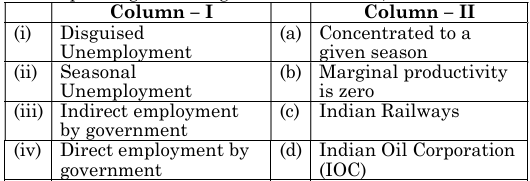
The correct pairs match the types of unemployment/employment in Column-I with their defining features in Column-II. The context explains different types of unemployment such as open and disguised unemployment, and categorizes employment sectors (primary, secondary, and service). Option (ii) - (b) correctly pairs a specific type with its feature, as do (i) - (a), (iii) - (c), and (iv) - (d). This shows an accurate understanding of the classification from the context provided.
Identify that strategy given in the image that can be utilised for sustainable development.
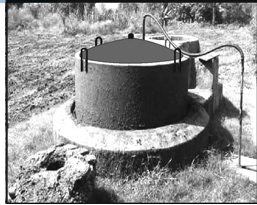
Gobar Gas, produced from animal waste, is a renewable and clean source of energy that helps reduce pollution and efficiently manages animal waste. It supports sustainable development by providing a reliable and cheap energy source for rural households, improving livelihoods while protecting the environment.
If a nation fails to enforce the regulations of the Montreal Protocol, the likely long term environmental and biological consequence of this will be _________.
(i) Rapid deforestation
(ii) Increased possibility of skin cancer
(iii) Greenhouse effect causing rise in global temperature
(iv) Possibility of acid rain
The Montreal Protocol aims to reduce and eliminate the use of ozone-depleting substances such as chlorofluorocarbons (CFCs). Failure to enforce the protocol would lead to depletion of the ozone layer, which protects living beings from harmful ultraviolet (UV) radiation. Increased UV radiation results in a higher possibility of skin cancer (ii). Additionally, ozone depletion affects atmospheric conditions and can contribute to the greenhouse effect, causing a rise in global temperatures (iii). Rapid deforestation (i) and acid rain (iv) are not directly linked to the Montreal Protocol. Therefore, the correct consequences related to failure in enforcing the Montreal Protocol are (ii) Increased possibility of skin cancer and (iii) Greenhouse effect causing rise in global temperature.
Read the following statements carefully :
Statement 1 : The option for producing off-season crops are quite restricted in organic farming. Statement 2 : Organic agriculture helps in substituting costlier agricultural inputs with locally produced organic inputs.
In the light of the above statements, choose the correct option from the following :
According to the provided context, organic farming has limited options for producing off-season crops. This makes Statement 1 true. Additionally, organic agriculture helps in substituting costlier agricultural inputs with locally produced organic inputs, making Statement 2 also true. Therefore, the correct option is that both statements 1 and 2 are true.
Education provides _________. (Choose the correct option to fill in the blank)
(i) Scientific advancements
(ii) Facilitate inventions and innovations
(iii) Adapting to new technology
Education provides knowledge to understand changes in society and scientific advancements. It facilitates inventions and innovations by providing the necessary knowledge and skills. Similarly, an educated labour force helps in adapting to new technologies. However, scientific advancements themselves are the outcome of scientific research and development, not directly provided by education. Therefore, the correct options are (ii) Facilitate inventions and innovations and (iii) Adapting to new technology.
Section B
Calculate compensation of employees from the data given below :
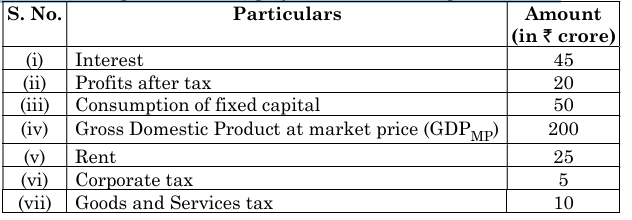
- 50 employees earn between Rs 800 and Rs 899.
- 100 employees earn between Rs 900 and Rs 999.
- 200 employees earn between Rs 1000 and Rs 1099.
- 150 employees earn between Rs 1100 and Rs 1199.
- 40 employees earn between Rs 1200 and Rs 1299.
- 10 employees earn between Rs 1300 and Rs 1399.
Step 2: Find the mid-point of each income range (compensation for each group).
For example, for Rs 800 to Rs 899, mid-point = (800 + 899) / 2 = 849.5 Rs
Similarly, calculate mid-points:
- 849.5
- 949.5
- 1049.5
- 1149.5
- 1249.5
- 1349.5
Step 3: Calculate total compensation for each group by multiplying mid-point by number of employees.
- 849.5 * 50 = 42,475 Rs
- 949.5 * 100 = 94,950 Rs
- 1049.5 * 200 = 209,900 Rs
- 1149.5 * 150 = 172,425 Rs
- 1249.5 * 40 = 49,980 Rs
- 1349.5 * 10 = 13,495 Rs
Step 4: Add all these to get total compensation of all employees.
Total = 42,475 + 94,950 + 209,900 + 172,425 + 49,980 + 13,495 = 583,225 Rs
Therefore, the total compensation of 550 employees is Rs 583,225.
“When initial deposits in the credit creation process remains same, the total amount of credit created rises as the value of money multiplier increases.”
Defend or refute the above statement with the help of hypothetical numerical example.
The statement is true. The money multiplier shows how much total credit the banking system can create from an initial deposit. It is calculated as 1 / Reserve Ratio.
For example, suppose the initial deposit is Rs 100 and the reserve ratio is 0.20 (20%). Then, money multiplier = 1 / 0.20 = 5. Total credit created = Rs 100 * 5 = Rs 500.
If the reserve ratio falls to 0.10 (10%), money multiplier becomes 1 / 0.10 = 10. Then, total credit created = Rs 100 * 10 = Rs 1000.
Here, the initial deposit remained Rs 100 but total credit increased from Rs 500 to Rs 1000 when money multiplier increased from 5 to 10. Thus, higher money multiplier leads to higher total credit for the same initial deposit.
This happens because a lower reserve ratio means banks keep less money as reserve and lend more, increasing credit creation in the economy.
“The Central Bank maintains reserves of all commercial banks and use to settle interbank claims.”
Do you agree with the given statement ? Give valid explanation in support of your answer.
“In the late 1970s and 1980s, Pakistan experienced significant changes in its policies, incentives and new investments.”
Do you agree with the above statement ? Justify your answer with valid arguments.
Yes, I agree with the statement that Pakistan experienced significant changes in its policies, incentives and new investments during the late 1970s and 1980s.
Firstly, Pakistan shifted its economic policy from nationalisation in the 1970s to denationalisation in the late 1970s and 1980s. The government encouraged the private sector, which created a positive environment for business and investment.
Secondly, Pakistan received financial support from western nations and increased remittances from emigrants working in the Middle-east. This inflow of funds helped stimulate economic growth.
Thirdly, the government introduced various incentives for private sector investment, which led to a conducive climate for new investments in the country.
Finally, in 1988, reforms were initiated to further improve the economic conditions and encourage development.
Thus, these changes in policies, incentives and investments played an important role in Pakistan's economic growth during that period.
Distinguish between formal and informal sector of employment with the help of suitable examples.
Informal Sector Employment: The informal sector consists of all other enterprises and workers not officially registered or regulated by the government. Jobs here lack job security, fixed wages, and benefits. Examples include street vendors, home-based workers, and small family businesses. In India, about 6% of workers are in the formal sector, while the remaining 94% work in the informal sector.
Discuss the long term implications of increased demand for environmental resources exceeding their natural regenerative capacity.
When the demand for environmental resources such as water, forests, and minerals exceeds their natural regeneration rate, several adverse effects occur in the long term. First, resource depletion happens, leading to scarcity of essential materials needed for survival and economic development. Second, overuse causes habitat destruction and loss of biodiversity as natural ecosystems fail to recover. Third, the environment's absorptive capacity diminishes, resulting in increased pollution and waste accumulation, which further degrades environmental quality.
Moreover, this imbalance leads to an environmental crisis where the environment can no longer sustain life properly. Soil fertility reduces, water bodies become contaminated, and air quality deteriorates. These changes pose threats to human health and livelihoods, especially for future generations. Finally, economic activities dependent on these resources face disruptions, affecting development and increasing social inequalities.
Therefore, sustainable resource management and reducing demand are critical to maintaining ecological balance and ensuring environmental stability for the long term.
Section C
Read the following text carefully :
“A country’s total National Income (NI) at the end of the year is ₹ 80,000 crore. During the same year, the Gross Domestic Product (GDP) increased by ₹ 10,000 crore. The depreciation on capital goods was ₹ 2,000 crore and National savings at the end of year is ₹ 15,000 crore. Additionally, country invested ₹ 8,000 crore in new capital goods industries.”
In the light of above text, categorise the items as ‘stock’ or ‘flow’ variables with valid arguments.
The variables can be categorised as follows:
Stock variables: These are measured at a specific point of time and represent quantities that exist at that time.
- National Income (NI) of ₹ 80,000 crore is a stock variable as it represents the total income stock at the end of the year.
- National savings of ₹ 15,000 crore is a stock variable because it shows the amount saved at that point in time.
Flow variables: These are measured over a period of time and represent activities or changes.
- Increase in GDP by ₹ 10,000 crore is a flow variable as it shows the change in economic activity over the year.
- Depreciation of ₹ 2,000 crore is a flow variable because it measures the amount of capital consumed during the year.
- Investment of ₹ 8,000 crore in new capital goods is a flow variable since it shows expenditure over the year.
In summary, stock variables denote quantities at a point in time, whereas flow variables record events over a period of time.
The value of Nominal Gross National Product (GNP) of an economy was ₹ 2,500 crore in a particular year. The value of Gross National Product (GNP) of that country during the same year, estimated at the prices of base year was ₹ 3,000 crore.
(i) Estimate the value of Gross National Product (GNP) deflator (in percentage).
(ii) “The price level has risen between the base year and the year under consideration.” Defend or refute the statement with suitable argument
Given Nominal GNP = ₹ 2,500 crore, Real GNP = ₹ 3,000 crore.
GNP deflator = (2500 / 3000) * 100 = 83.33%.
(ii) The GNP deflator is less than 100%, which means the price level has fallen compared to the base year. Therefore, the statement that 'The price level has risen between the base year and the year under consideration' is refuted. A GNP deflator below 100% indicates that prices have decreased relative to the base year.
(a) Explain the likely impacts of the ‘Make in India’ policy initiated by Government of India on the Balance of Payments (BoP) of India (assuming all other factors constant).
(b) State the meaning of Balance of Payment (BoP) surplus and deficit.
(b) BoP surplus means the overall receipts from foreign countries are more than payments, leading to an overall positive balance. Reserve change is negative indicating reserves are used less. BoP deficit means payments exceed receipts, causing an overall negative balance and reserve change is positive as reserves are used to meet the deficit. A balanced BoP means receipts and payments are equal with no change in reserves.
Read the following text carefully :
“The Reserve Bank of India (RBI) announced a 50 basis point Repo Rate cut to 5.50% from 6%.”
In the light of the given text and common understanding, answer the following questions :
(i) Identify the economic issue indicated in the above text.
(ii) Explain the likely causes and consequences of this step of RBI on the economy.
(ii) The likely cause for reducing the Repo Rate is to stimulate economic growth by making borrowing cheaper for commercial banks. When banks borrow at a lower rate, they can lend money to businesses and consumers at lower interest rates. This encourages spending and investment, leading to economic growth. The consequences include increased liquidity in the market, higher demand for goods and services, and potentially more employment opportunities. However, if the rate is cut too much, it might lead to higher inflation. Overall, the RBI uses this step to balance growth and inflation in the economy effectively.
The Restrictive policies under the colonial government adversely affected the structure, composition and volume of India’s foreign trade.” Justify the above statement with valid explanation.
The colonial government implemented restrictive policies on Indian foreign trade which affected its structure, composition and volume adversely.
First, the British imposed control over India’s exports and imports, allowing more than half of the trade only with Britain and some restricted countries, limiting India’s trading partners.
Second, India became a supplier of raw materials like raw silk, cotton, wool, sugar, indigo and jute, while Britain exported finished goods to India. This changed the composition of trade and hindered industrial growth in India.
Third, the volume of trade was controlled to benefit Britain. For example, after the opening of the Suez Canal, British monopoly over Indian trade intensified.
Lastly, the colonial economic policies prioritized Britain’s interests, causing India to export essential commodities while importing manufactured goods, leading to a trade surplus that harmed India’s economy.
Thus, the restrictive policies disrupted the balance and growth of India’s foreign trade and harmed the Indian economy.
Explain the main objectives and impacts of land settlement policies implemented under the British government rule.
1. To fix and collect land revenue efficiently from farmers.
2. To establish a land ownership system beneficial to the British government.
3. To increase government revenue systematically by introducing permanent or regular revenue settlements.
Impacts of Land Settlement Policies:
1. Farmers became permanent taxpayers and landowners in some cases, especially under the Permanent Settlement, but many others faced high revenue demands.
2. The policies led to the exploitation of farmers due to high taxes and rigid revenue demands.
3. Many farmers lost their lands when they failed to pay revenue, leading to increased landlessness.
4. Agricultural stagnation occurred as farmers focused on revenue payment rather than investment or improvement.
5. The traditional village community and social structure were disrupted.
Overall, land settlement policies were designed to benefit British economic interests while adversely affecting Indian agriculture and farmers' livelihoods.
(a) Refer the given image carefully :
Compared to 1970’s, there has hardly been any change in the distribution of workforce across various industries.” Defend or refute the above statement with valid explanation.
(b) State the meaning of worker-population ratio.
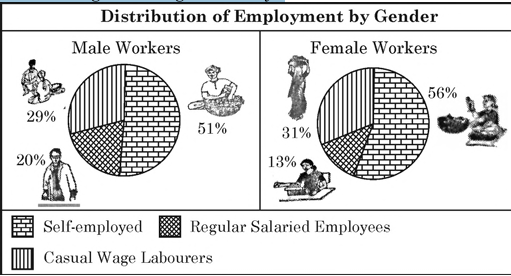
(b) The Worker-Population Ratio is the percentage of workers out of the total population in a particular group. It shows how many people are working compared to the total number of people in that group. It is calculated by dividing the total number of workers by the total population and then multiplying by 100. This ratio helps us understand the employment level in a population.
(i) State the meaning of ‘Commune system’.
(ii) Explain any two reasons for the slow economic growth in Pakistan.
(ii) Two reasons for slow economic growth in Pakistan are:
1. Political instability: Frequent changes in government and lack of consistent policies have created an uncertain environment, discouraging investment and economic progress.
2. Over-dependence on remittances and foreign aid: Pakistan's economy relies heavily on external financial assistance instead of strong internal growth sources, which makes the economy vulnerable to external shocks and limits sustainable development.
Section D
(I) Complete the following table :
(II) Identify the monetary measures being referred to in the following statements. Discuss whether the tool would be used during a situation of excess demand or deficient demand.
(i) Selling off government securities (G-Sec) to public by the central bank.
(ii) Encourage commercial banks to park their surplus funds with the Reserve Bank of India (RBI).
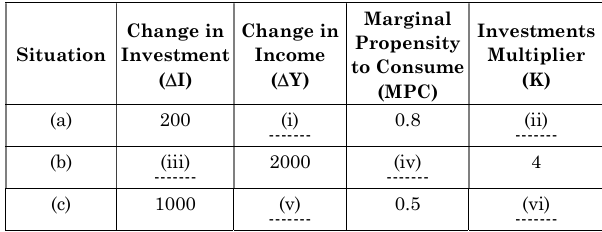
(ii) The measure described is the 'Cash Reserve Ratio' (CRR) or more specifically, it relates to encouraging banks to keep more funds with the RBI which can be through the CRR or Reserve Bank's deposit schemes. By making banks park surplus funds with the RBI, it reduces the amount banks can lend, thus decreasing money supply. This tool is also used in a situation of excess demand to reduce inflationary pressures by contracting money supply.
Read the following text carefully :
The government has allocated Rs 15.27 lakh crore for major sectors, ranging from defence to rural development to social welfare to commerce and so on. Government expenditure goes to paying states’ share of taxes and duties. Around 19% is spent on interest payments and 16% on central sector schemes, with subsidies, pension and other payments contributing 19%. Government revenue is divided between borrowings and other liabilities, which account for massive 27% of the incoming cash, Income tax revenue of around 19% Goods and Services Taxes (GST) and other taxes of around 18%; Corporation taxes account for around 17%.
The next highest provision on this list is 2.66 lakh crore for rural development. This will include expenditure on rural infrastructure project and increased outlay for the popular MGNREGA scheme.
On the basis of given text and common understanding, answer the following questions :
(i) Identify the major sources of government revenue and state what percentage does each one of them contribute.
(ii) Discuss the need to allocate funds among different sectors of the economy.
1. Borrowings and other liabilities contribute about 27% of government revenue. This includes money borrowed by the government to meet its expenditure.
2. Income tax contributes around 19%, which is the tax paid by individuals and entities on their income.
3. Goods and Services Tax (GST) and other taxes contribute around 18%. GST is a comprehensive indirect tax on the manufacture, sale and consumption of goods and services.
4. Corporation taxes contribute around 17%, which is the tax paid by companies on their profits.
(ii) Need to allocate funds among different sectors :
Allocating funds among different sectors such as defence, rural development, social welfare, and commerce is essential for balanced economic growth and development. Different sectors have different roles in society and the economy. For instance, defence expenditure ensures national security, rural development improves the livelihood and infrastructure for rural areas, social welfare supports vulnerable populations, and commerce drives economic activities and trade.
Proper allocation helps address priority areas, reduces regional disparities, and ensures effective utilization of resources. It also supports sustainable development by balancing economic, social and environmental needs. Furthermore, schemes like MGNREGA under rural development create employment and social security for rural people.
Thus, fund allocation is crucial to achieve overall economic growth, social equity and national stability.
Read the following text carefully and answer the questions given below :
“In India, high-yielding seed varieties were initially brought to the State of Punjab, Haryana and portions of western Uttar Pradesh
(i) Identify the approach initiated by Indian Government in 1966.
(ii) State the primary goal of this approach.
(iii) Describe any two impacts of this approach.
(b) The primary goal of this approach was to increase agricultural production in India to achieve self-sufficiency in food grains and to reduce dependence on food imports.
(c) Two impacts of the Green Revolution are: 1. It led to a significant increase in the production of food grains, particularly wheat, making India self-sufficient in food production. 2. The benefits of this approach were initially limited to certain regions such as Punjab, Haryana and western Uttar Pradesh, which created regional disparities in agricultural development and income among farmers.
Read the following text carefully and answer the questions given below :
“It is an arrangement in which a firm hires some specialized firm(s) to carry out some of its activities (which were earlier being performed by itself). These service hirings could be from local / international markets.”
(i) Identify the indicated outcome of the globalisation process.
(ii) State any two factors responsible for making India as an important source of these activities
(iii) Explain examples of services that have expanded due to advancements in information technology.
(b) Two factors responsible for making India an important source of outsourcing activities are:
1. Availability of skilled manpower: India has a large pool of educated and skilled workers, especially in IT and service sectors.
2. Low wage rates: Labour cost in India is lower compared to many developed countries, making it cost effective for companies to outsource their work to India.
(c) Examples of services that have expanded due to advancements in information technology include:
- Information Technology Enabled Services (ITES): Such as customer support, technical support, and call center services.
- Software development and maintenance: Companies outsource software programming and maintenance to Indian firms.
- Data processing and analysis: Services like data entry, data analysis have expanded.
- Financial and accounting services: Many firms outsource their accounting and financial tasks.
Advancements in IT have made communication easier and faster, which helps in managing these services efficiently from different parts of the world.
Read the following text carefully :
The Union Budget 2025-26 proposed a significant package for rural India allocating Rs.1.88 lakh crore to drive comprehensive development. The budget emphasises on boosting employment, women employment, education and infrastructure in rural areas, reflecting the governments’ commitment for a stronger, self-reliant rural economy. The extension of Jal-Jeevan Mission until 2028, with focus on achieving 100% rural water supply coverage and enhancing infrastructure maintenance. Broadband connectivity is set to expand under the Bharatnet project, providing internet access to all rural government secondary schools and primary health care centres.
Also, the budget highlights major rural schemes like the Pradhan Mantri Gram Sadak Yojana which has provided all-weather roads to rural areas. The Pradhan Mantri Grameen Awaas Yojana, which has delivered housing to economically weaker sections. The Mahatma Gandhi National Rural Employment Guarantee Scheme (MGNREGS) continues to secure rural livelihoods with an allocation of Rs.86,000 crore in FY 2024-25. On the basis of the above text and common understanding, answer the following questions
(i) Explain the significance of rural development.
(ii) Discuss any two policies initiated by government of India for rural development. ___________
(ii) Two policies initiated by Government of India for rural development :
1. Pradhan Mantri Gram Sadak Yojana (PMGSY) : This scheme focuses on providing all-weather road connectivity to unconnected rural areas which helps improve transportation and access to markets, schools, and hospitals.
2. Mahatma Gandhi National Rural Employment Guarantee Scheme (MGNREGS) : It guarantees 100 days of wage employment to rural households to enhance livelihood security, reduce poverty and create rural assets. The scheme promotes social inclusion and sustainable rural development.
(I) Estimate the value of subsistence level of consumption expenditure from the following data about an economy which is in equilibrium :
(i) National Income (Y) = ₹ 1,200 crore
(ii) Marginal Propensity to Save (MPS) = 0.20
(iii) Investment Expenditure (I̅) = ₹ 100 crore
(II) “An economy facing an increase in unintended accumulation of inventories would try to reduce Aggregate Demand.” Defend or refute the above statement with valid argument
Given MPS = 0.20, so MPC = 1 – MPS = 0.80
Investment expenditure I̅ = ₹100 crore, and economy is in equilibrium, so aggregate demand = national income.
Aggregate demand AD = Consumption + Investment = C + I̅ = a + cY + I̅
At equilibrium, Y = AD therefore,
1200 = a + 0.80 * 1200 + 100
1200 = a + 960 + 100
a = 1200 – 1060 = 140 crore
Hence, subsistence level of consumption expenditure is ₹140 crore.
(II) The statement "An economy facing an increase in unintended accumulation of inventories would try to reduce Aggregate Demand" is correct and supported by valid arguments.
When producers observe that inventories are increasing unintentionally, it means they are producing more than what is being purchased. This leads to excess supply.
To restore equilibrium, firms reduce production which results in lower income and employment.
Lower income causes reduced consumption and therefore, Aggregate Demand falls.
Hence, the economy reduces aggregate demand through lower production and spending to bring supply and demand back in balance.
This shows that an increase in unintended inventories effectively causes a decrease in aggregate demand until the equilibrium is restored.
Paper Details
CBSE Board Exam 2026
Class
Class 12 Humanities
Subject
Economics
Year
2026
Set
Set 2
Other Years — Economics