SOLUTIONS
2026 BOARD EXAM
CBSE Class 12 Commerce Economics Board Paper 2026 — Set 5 Solutions
2026
Economics
Class 12 Commerce
CBSE EXAMINATION PAPER-2026
ECONOMICS
(Solved)
General Instructions :
Read the following instructions carefully and follow them :
- This question paper contains 42 questions. All questions are compulsory.
- This question paper is divided into 4 sections.
- Section A – questions number 1 to 21 are multiple choice questions
- Section B – questions number 22 to 27 are short answer type i
- Section C – questions number 28 to 36 are short answer type ii
- Section D – questions number 37 to 42 are long answer
- There is no overall choice given in the question paper. However, an internal choice has been provided in few questions.
- Use of calculator is NOT allowed.
Section A
The Ministry of Statistics and Programme Implementation (MoSPI) is underway to revise the base year of Gross Domestic Product (GDP). The base year is revised periodically to better capture the structural changes happening in the economy. The proposed new base year for the GDP is 2022 – 23.’’
The step taken by the Government of India is for revision of ___________ Gross Domestic Product (GDP), as it is measured at ___________ prices.
(Choose the correct option to fill in the blanks)
The Government revises the base year for Real GDP, which is measured at constant prices. Real GDP is calculated using the prices of the base year to remove the effect of inflation, allowing a better comparison of economic output across years. Nominal GDP, on the other hand, is measured at current prices and is not adjusted for inflation. Therefore, revising the base year relates to Real GDP measured at constant prices.
___________ refers to that consumption, which is independent of the level of income.
(Choose the correct option to fill in the blank)
Autonomous consumption is the level of consumption that occurs even when income is zero, meaning it does not depend on the income level. This is because people need to consume certain basic goods and services regardless of their income. Therefore, it is called autonomous consumption, as opposed to induced consumption which varies with income.
Money supply is a ___________ variable, as it refers to the total volume of money held by the ___________ at a particular point of time.
(Choose the correct option to fill in the blanks)
Money supply is a stock variable because it measures the total stock of money in circulation at a specific point in time. It is held by the public, not just banks, as it refers to the total volume of money available to the public at that moment.
With reference to the given diagram, OL indicates ___________ .
(i) Autonomous Consumption
(ii) Autonomous Investment
(iii) Induced Consumption
(iv) Induced Investment
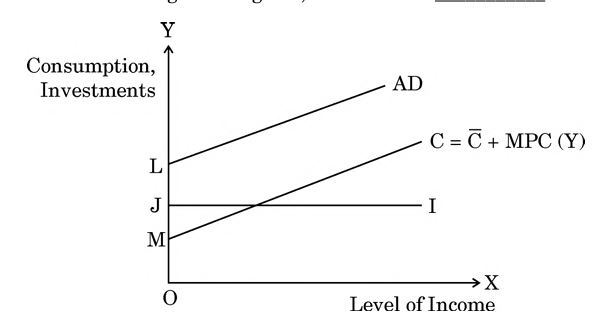
OL represents the sum of autonomous consumption and autonomous investment. Autonomous consumption is the consumption level that occurs even when income is zero, while autonomous investment is fixed and does not depend on income. Since OL indicates total autonomous expenditure (A = C + I), it is the sum of autonomous consumption (i) and autonomous investment (ii). Induced consumption and induced investment depend on income level, so options (iii) and (iv) are incorrect.
Under the flexible exchange rate system, the exchange rate is determined by the ___________ .
(i) Government
(ii) Demand and supply
(iii) Intervention of the Central Bank
(Choose the correct option to fill in the blank)
Under the flexible exchange rate system, the exchange rate is determined solely by the forces of demand and supply in the foreign exchange market without central bank intervention. The government or central bank does not fix or intervene to influence the exchange rate in this system. Therefore, the correct answer is Only (ii).
Following are the steps to measure National Income (NNPFC) by Value Added method :
(i) Calculate Domestic Income (NDP_FC) by subtracting Depreciation and Net Indirect Taxes from GDPMP.
(ii) Estimate GDP_MP by adding GVA of each firm.
(iii) Estimate and add Net Factor Income from Abroad to NDP_FC to arrive at NNP_FC.
(iv) Identify and classify the production units into primary, secondary and tertiary sector.
The correct order of arrangement of steps would be :
(Choose the correct option)
An economy may operate at a level below full employment due to a deficiency in Aggregate Demand (AD) leading to a/an ___________ employment equilibrium.
(i) Full
(ii) Over
(iii) Under
(Choose the correct option to fill in the blank)
When aggregate demand is deficient, the economy does not produce at full employment output. This means that not all factors of production are fully employed, leading to an equilibrium with unemployment. Therefore, the economy operates at an under employment equilibrium. This is because the equilibrium output is less than the full employment output level.
Read the following statements carefully :
Statement I : Positive externalities refer to the benefits a firm/an individual provides to another for which they are paid.
Statement II : In case of positive externalities, Gross Domestic Product (GDP) of an economy might lead to an overestimation of the actual welfare.
In the light of the given statements, choose the correct option from the following :
Read the following statements : Assertion (A) and Reason (R). Choose the correct option from those given below :
Assertion (A) : Transfers from Abroad (remittances) are to be recorded on the credit side of capital account of Balance of Payments (BoP).
Reason (R) : All the transactions that lead to inflow of foreign currency from the rest of the world are recorded on the credit side of Balance of Payments (BoP).
Transfers from abroad, such as remittances, are recorded in the current account of the Balance of Payments (BoP), not the capital account. The capital account mainly records capital inflows and outflows like loans, investments, and sales of assets. However, the Reason (R) is correct because all transactions that cause inflow of foreign currency are recorded on the credit side of the BoP. Thus, while the Reason is true, the Assertion is false.
Liabilities for any firm are its debt/what it owes to others. Contrary to that, for a bank ___________ are the main liability.
(Choose the correct option to fill in the blank)
For any firm, liabilities represent what it owes to others in general terms. Specifically for a bank, the main liability is the deposits made by customers. These deposits represent money that the bank owes back to the customers. Hence, deposits are the main liability of a bank as per the given context.
Working persons engaged in various industrial divisions can be classified into three major sectors — Primary sector, secondary sector and tertiary sector.
Identify, which of the following option demonstrates the primary sector.
The primary sector deals with natural resources and includes activities like agriculture, forestry, fishing, mining, and quarrying. According to the provided context, agriculture, mining and quarrying form part of the primary sector, whereas transport and storage, electricity, gas and water supply belong to other sectors. Therefore, 'Agriculture, mining and quarrying' is the correct representation of the primary sector.
Read the following statements carefully :
Statement I : The colonial government had dual objectives behind the systematic deindustrialization of India.
Statement II : The British reduced India to a mere importer of raw materials for the its modern industries. In the light of the given statements, choose the correct option from the following :
The colonial government aimed at two main objectives: first, to reduce India to a raw material supplier for British industries; and second, to make India a market for British finished goods. This systematically deindustrialized India by collapsing its handicraft industries and preventing the rise of a modern Indian industrial base. Consequently, India became a mere importer of finished goods and exporter of raw materials. Thus, both statements reflect the true intentions and outcomes of British colonial policies.
The following table shows the distribution of population and workers in a village :

According to the given context, under the Rural location for males, the main workers are 17 crore and marginal workers are 3 crore, totaling 20 crore workers. Since villages are rural areas, the number of workers in the village corresponds to the total workers in rural areas, which is 20 crore. Therefore, option '20' is correct.
Identify, which of the following is not a strategy of sustainable development.
Use of coal to produce electricity is not a strategy of sustainable development because coal is a conventional, non-renewable source of energy that causes environmental pollution and degradation. Sustainable development focuses on the use of non-conventional, renewable, and environment-friendly energy sources such as solar panels, bio-pests, and mini-hydel plants, which minimize environmental harm and promote long-term ecological balance.
In the rural areas, diversification towards new areas such as livestock, fisheries and other non-agricultural activities is necessary to __________.
(i) Reduce the risk from agricultural sector
(ii) Provide unsustainable livelihood options
(iii) Provide supplementary employment
(Choose the correct option to fill in the blank)
Diversification in rural areas towards livestock, fisheries, and non-agricultural activities is necessary to reduce the risk associated with depending exclusively on the agricultural sector (statement i). Additionally, it helps provide supplementary employment opportunities to rural people (statement iii). However, diversification aims to provide sustainable livelihood options, so statement (ii) about providing unsustainable livelihood options is incorrect. Therefore, the correct answers are (i) and (iii).
Self-Help Groups (SHGs) have emerged to fill the gap in the formal credit system as they ____________. (Choose the correct option to fill in the blank)
___________ was set up by the Government of India in 1950 to formulate plans for the most effective and balanced utilisation of resources.
(Choose the correct option to fill in the blank)
The Planning Commission was established by the Government of India in 1950 with the Prime Minister as its Chairperson. Its role was to formulate plans for the effective and balanced utilisation of the nation's resources, marking the beginning of the era of five year plans in India. This information aligns with the context provided, which mentions the Planning Commission's establishment and functions.
The export surplus during the colonial rule was used by the Britishers to _________.
(i) Bring gold and silver to India
(ii) Incur expenses on war
(iii) Import invisible items
The export surplus during the colonial period did not result in any flow of gold or silver into India. Instead, it was used by the British to pay for expenses incurred by the colonial government in Britain, including expenses on wars fought by the British government and the import of invisible items (such as services and administrative costs). Therefore, only statements (ii) and (iii) are correct.
Read the following statements : Assertion (A) and Reason (R). Choose the correct option from those given below :
Assertion (A) : India is a member of various regional and economic groupings such as BRICS, G20, etc. Reason (R) : Membership of economic and regional groupings helps a nation to understand their strengths and weaknesses in comparison to other nations.
India is indeed a member of several regional and economic groupings like BRICS and G20. Such memberships allow India to collaborate with other nations and analyze economic trends, which helps in understanding its own strengths and weaknesses compared to other countries. This understanding supports economic planning and development. Therefore, both the assertion and reason are true, and the reason correctly explains the assertion.
. In 2009, the Government of India came up with the ________ to make free education, a fundamental right for all children in the age group of 6 – 14 years.
(Choose the correct option to fill in the blank)
In 2009, the Government of India enacted the Right of Children to Free and Compulsory Education Act to make free education a fundamental right for all children aged 6-14 years. This is clearly stated in the context provided, which emphasizes the role of the Right to Education Act in ensuring free and compulsory education for children in this age group.
Section B
“Repo Rate and Bank Rate are two different measures, but a change in either of them may have the similar implication on the money supply in an economy.”
Defend or refute the given statement, giving valid explanation in support of your answer.
Bank rate is the rate at which the RBI lends funds to commercial banks without any security or collateral, usually for the long term. If the RBI increases the bank rate, borrowing from RBI becomes expensive for banks, leading them to increase lending rates to the public. This reduces borrowing and decreases the money supply.
Repo rate is the rate at which banks borrow short-term money from the RBI against government securities. An increase in repo rate makes borrowing costlier for banks, which reduces their lending, thus decreasing the money supply.
Therefore, although bank rate and repo rate differ in terms of duration and terms of lending, any increase in these rates makes borrowing costlier for banks, which reduces credit creation and thus decreases money supply. Similarly, a decrease in these rates increases money supply. Hence, the statement that a change in either rate leads to a similar implication on money supply is correct.
“The Reserve Bank of India (RBI) is the sole authority for issuing currency notes in India, with an exception of ₹ 1 denomination that is issued by the Ministry of Finance.”
Do you agree with the given statement ? Explain the rationale behind the monopoly enjoyed by the Reserve Bank of India (RBI) on this front.
Estimate the value of ‘Income from Property and Entrepreneurship’ on the basis of the given data :
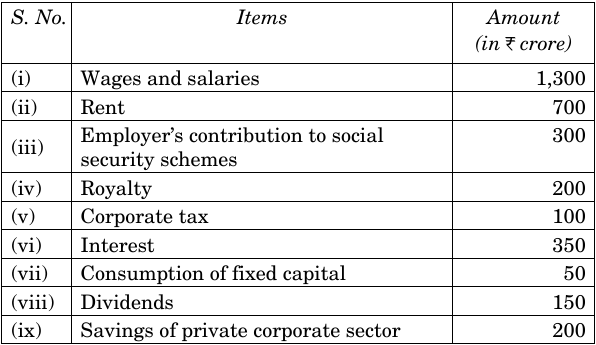
| Income Range (000 Rs) | Frequency |
|----------------------|-----------|
| 0 - 15 | 4 |
| 15 - 20 | 8 |
| 20 - 25 | 18 |
Here frequencies are determined as: Income 20-25: 30 - 12 = 18; Income 15-20: 12 - 4 = 8; Income less than 15: 4.
To estimate, we calculate the modal income using the formula for mode in grouped data:
Mode = l + [(f1 - f0) / (2f1 - f0 - f2)] * h
Where:
l = lower limit of modal class = 20
f1 = frequency of modal class = 18
f0 = frequency of class before modal class = 8
f2 = frequency of class after modal class = 4
h = class width = 5
Substituting values:
Mode = 20 + [(18 - 8) / (2*18 - 8 - 4)] * 5 = 20 + (10 / (36 - 12)) * 5 = 20 + (10 / 24) * 5 = 20 + (0.4167)* 5 = 20 + 2.0835 = 22.08 thousand Rs.
Therefore, the estimated Income from Property and Entrepreneurship is approximately 22.08 thousand Rs.
Explain the Planning objective of “Growth with Equity”.
Growth refers to the expansion of the economy by producing more goods and services, providing more employment and increasing income.
Equity means fairness in the distribution of wealth and income so that all citizens can meet their basic needs like food, housing, education, and healthcare.
This objective aims to reduce economic inequalities through measures like taxation and government spending on social welfare programs.
Thus, growth without equity may increase wealth but also increase inequalities; growth with equity ensures balanced development benefiting all sections of society.
At the time of independence, both India and Pakistan inherited similar colonial economic structures. Both the nations adopted many similar economic planning strategies.’’
Explain any two such similarities in the developmental path of India and Pakistan.
(a) Large Public Sector Development: Both countries focused on expanding the public sector in their economies. They believed that government control and ownership of key industries would help in rapid industrialization and reduce dependence on private capital.
(b) Emphasis on Social Development Spending: India and Pakistan raised public expenditure on social sectors like health, education, and welfare to improve the living standards of their populations and create human capital needed for economic growth. This strategy aimed at equitable growth and poverty reduction.
Thus, both nations aimed to build strong state-led economies with focus on social development during their initial years of independence.
‘‘In 1958, China launched the Great Leap Forward (GLF) campaign with a definite aim.’’
(i) State the rationale behind the introduction of the Great Leap Forward (GLF) campaign.
(ii) State any two failures of the Great Leap Forward (GLF) campaign.
(ii) Two failures of the Great Leap Forward campaign are:
- It led to a severe famine causing the death of about 30 million people due to poor planning, natural disasters like drought, and unrealistic production targets.
- The withdrawal of Soviet experts after conflicts with China caused lack of technical knowledge and slowed down industrial progress, resulting in many industries failing to meet their targets.
Section C
(a) Define Balance of Payments (BoP) Account.
(b) Differentiate between autonomous transactions and accommodating transactions in Balance of Payments (BoP).
(b) Autonomous transactions are independent transactions resulting from normal trade, investment, or loans which affect the current and capital accounts and occur due to economic motives. Accommodating transactions are official reserve transactions by the government or central bank to balance any deficits or surpluses in autonomous transactions and keep the BoP equilibrium.
A company named Tech Info Ltd. manufactures printers. The company purchases machinery from Germany to manufacture printers. These printers are sold in the domestic and foreign markets to households and dealers. The machinery purchased and printers manufactured, both can be classified as final goods. Do you agree with the given statement ? Give valid arguments in support of your answer.
Yes, I agree with the given statement that both the machinery purchased and the printers manufactured are final goods.
1. Machinery purchased as final goods: The machinery bought from Germany is a capital good. It is not used up in the production process but helps in producing other goods, so it is classified as a final good because it is bought for investment purposes and adds to the future productive capacity of the company.
2. Printers manufactured as final goods: The printers made by Tech Info Ltd. are sold directly to households and dealers for use. These printers do not undergo any further processing or transformation, so they are final goods as they are meant for final consumption or resale.
Thus, both machinery (investment good) and printers (consumer goods or final products) are correctly classified as final goods because they do not require any more processing and are ready for use or consumption.
This classification helps in measuring the economic activity and national income accurately, avoiding double counting of intermediate goods.
(i) Define Gross Investments.
(ii) Identify any two components of Gross Investments indicated in the given image.
(iii) Briefly explain any one component of Gross Investments.
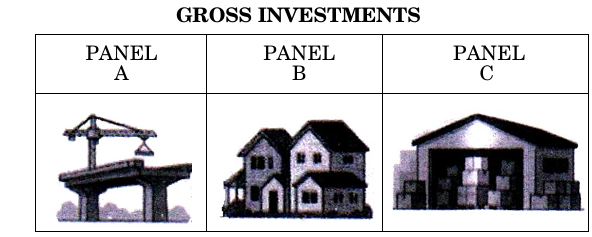
(ii) Two components of Gross Investments are: Direct Investment and Foreign Institutional Investment (FII).
(iii) Direct Investment refers to foreign investors buying a significant stake or lasting interest in a business or property in another country. This kind of investment usually involves control or management influence in the business.
Read the following text carefully :
“With an objective to improve the growth momentum by stimulating domestic private consumption and investment, the Reserve Bank of India (RBI) announced a reduction in Cash Reserve Ratio (CRR) by 100 basis points (1%).”
Based on the above text and common understanding, answer the following questions :
(i) Explain the likely cause behind the step taken by the Reserve Bank of India (RBI).
(ii) Briefly explain the impact of the step taken by the Reserve Bank of India (RBI) on the Aggregate Demand (AD).
(ii) As banks lend more, the money supply increases leading to higher spending by consumers and investment by firms. This rise in consumption and investment increases the Aggregate Demand (AD) in the economy. An increase in AD can help in economic growth by encouraging production and employment.
Study the following image carefully :
Interpret the given image and comment upon the phenomenon of environmental crisis as a result of changed production and consumption patterns.
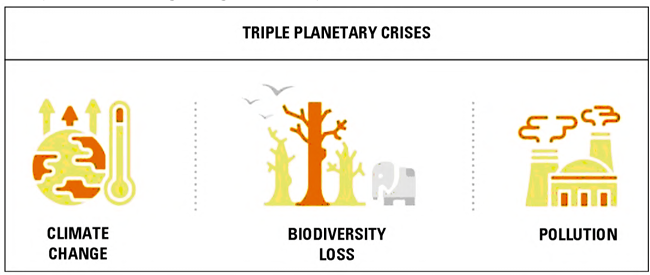
The image shows heavy industrial pollution affecting the Damodar river, turning it into an ecological disaster. This indicates that rapid industrial growth and increased production have led to the release of harmful pollutants into the environment including chemicals and gases which contaminate air and water.
Environmental Crisis due to Changed Production and Consumption Patterns:
Population explosion and increased affluence have caused a rise in demand for goods and services, leading to overproduction and overconsumption. This has put enormous pressure on natural resources beyond their regeneration capacity. As a result, waste generation and pollution levels have increased drastically.
This disruption has reversed the supply-demand balance of environmental resources: while demand for clean air, water, and land has increased, their supply has diminished due to overuse and misuse. Consequently, the natural environment suffers severe damage affecting plants, animals, and humans, manifesting as ecological disasters, loss of biodiversity, and health problems.
In conclusion, the changed production and consumption patterns have created environmental crises due to unsustainable use of resources and pollution thereby threatening ecological balance and human well-being.
Environmental crisis is a recent phenomenon, which is a result of changing production and consumption patterns.” Justify the statement giving valid arguments.
The increase in population and industrialisation has led to higher demand for environmental resources such as water, air, and land. Earlier, when population and industrial activities were low, the demand for these resources was less than their supply, and the environment could regenerate them naturally.
However, due to rapid population growth and affluent consumption especially in developed countries, the demand has exceeded the environment's ability to replenish these resources. Production processes have become more wasteful and polluting, generating wastes beyond the environment's absorptive capacity.
This has resulted in depletion of natural resources, pollution of air, water and soil, and loss of biodiversity. Thus, changing production and consumption patterns cause overuse and misuse of resources, leading to the current environmental crisis.
Hence, the statement is justified as the environmental crisis is mainly caused by unsustainable growth in production and consumption that strains natural resources and environmental balance.
On the basis of the given data, comment upon the annual growth of Gross Domestic Product (GDP) of India and China.
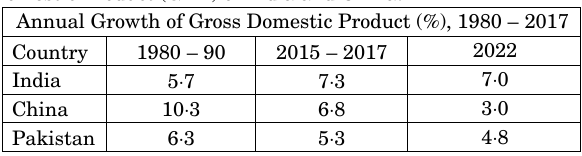
From the data, India’s annual GDP growth rate increased from 5.7% during 1980–1990 to 7.3% during 2015–2017. This indicates that India's economy has accelerated over time. In contrast, China’s growth rate slowed down from a very high 10.3% in 1980–1990 to 6.8% in 2015–2017. Despite the slowdown, China’s rate remains high compared to most countries. In the 1980s, China had double-digit growth which was much higher than India’s, but India improved its growth rate over the years. Overall, China experienced very rapid growth initially, but India’s growth rate improved and narrowed the gap in recent years.
Rayansh works as a teacher in a school. He receives a fixed monthly salary, social security benefits, paid leave and medical allowances. His friend Mohan works at a small toy shop. He has very little income, he does not have access to provident fund, paid leave or health insurance.
Classify the types of sectors Rayansh and Mohan are working in and highlight the distinction between the two sectors.
(b) Distinction between Formal and Informal Sectors:
- Workers in the formal sector have fixed employment, regular income, job security, and social security benefits.
- Workers in the informal sector have low or irregular income, no job security, and no access to social security.
- Formal sector workers get paid leaves, health insurance, provident fund, and other benefits, which informal sector workers do not have.
- The formal sector is regulated by the government, while the informal sector is not well regulated.
This difference explains why Rayansh receives several benefits while Mohan does not.
(i) Define ‘Human Capital Formation’.
(ii) Explain ‘Expenditure on migration’ as a source of human capital formation
(ii) Expenditure on migration is a source of human capital formation because people invest money to move from one place to another seeking better opportunities. The costs of migration include expenses like travel, accommodation, and resettlement. However, the increase in earnings and improved life standards at the new place compensate for these costs. Hence, spending on migration helps in developing human capital by providing individuals with better jobs and skills.
Section D
(a) Assume, for a hypothetical economy, the following data is given :
(i) Calculate the missing values in the given schedule.
(ii) Define the term ‘Effective Demand’.
(iii) On the basis of the given data, it can be said that the equilibrium level of income is 200.
Do you agree ? If not, explain the adjustment mechanism that may take place to attain equilibrium level of income.
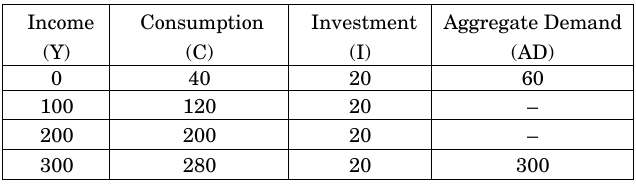
(ii) Effective Demand is the total demand for goods and services in the economy at a given level of income during a particular period. It is the point where aggregate demand equals aggregate supply, determining the equilibrium level of income.
(iii) The equilibrium level of income is where aggregate demand equals actual output. If at income 200, aggregate demand is not equal to 200, it is not the equilibrium. The economy will adjust through changes in income: if AD > Y, output and income will rise; if AD < Y, output and income will fall. This process continues until aggregate demand equals income, achieving equilibrium.
Suppose, in an economy, every ₹ 1 increase in investment expenditure leads to an increase of ₹ 4 in the National Income.
Calculate the following :
(i) Value of Investment Multiplier (K).
(ii) Change in consumption expenditure, if the income changes from ₹ 400 to ₹ 500.
(iii) “Sum of Marginal Propensity to Consume (MPC) and Marginal Propensity to Save (MPS) is always equal to one.”
Justify the given statement with the help of a suitable argument.
The investment multiplier (K) is defined as the ratio of change in National Income to the change in investment expenditure.
Given, change in income = ₹ 4 (for every ₹ 1 increase in investment)
Change in investment expenditure = ₹ 1
So, K = change in income / change in investment = 4 / 1 = 4
(b) Change in consumption expenditure:
Given, income changes from ₹ 400 to ₹ 500, so change in income (ΔY) = 500 - 400 = ₹ 100
Since K = 4, we can find MPC by formula: K = 1 / (1 - MPC)
=> 4 = 1 / (1 - MPC)
=> 1 - MPC = 1 / 4 = 0.25
=> MPC = 1 - 0.25 = 0.75
Change in consumption expenditure (ΔC) = MPC * ΔY = 0.75 * 100 = ₹ 75
(c) Justification of the statement “Sum of MPC and MPS is always equal to one”:
Marginal Propensity to Consume (MPC) is the fraction of additional income that is spent on consumption.
Marginal Propensity to Save (MPS) is the fraction of additional income that is saved.
Since income is either used for consumption or saving, the total of these fractions must add up to the total additional income.
Therefore, MPC + MPS = 1
This means that whenever income increases by one unit, some part of that income is consumed (MPC) and the rest is saved (MPS), together adding up to the whole income increment.
Read the following passage carefully :
According to the Economic Survey 2024 – 25, the government’s budget projections for the fiscal year 2025 – 26 indicate that gross direct tax revenue will rise by 12.7%, while gross indirect tax collections are expected to grow by 8.3% relative to FY 2024 – 25.
Direct taxes include income tax and corporate tax, reflecting earnings and profits of households and firms. It plays a key role in revenue growth of the government. Indirect taxes encompass Goods and Service Tax (GST), custom duties and other transaction-based levies.
Higher growth rate projected for direct taxes suggests a push to enhance tax buoyancy through improved compliance and reforms. On the other hand, indirect taxes are expected to benefit from consumption trends and Goods and Services Tax (GST) administration improvements. The balance tax strategy aims to mobilise resources while supporting fiscal consolidation and sustainable economic growth.
On the basis of the above passage and common understanding, answer the following questions :
(i) Differentiate between the two types of taxes indicated in the above text, with suitable examples.
(ii) Elaborate the likely consequences of the tax projections made by the government.
Direct taxes are taxes paid directly by individuals or firms to the government. Examples include income tax paid by individuals on their earnings and corporate tax paid by companies on their profits. Direct taxes are progressive in nature, meaning the tax rate increases with the income level. Indirect taxes are levied on goods and services and are collected by intermediaries from consumers. Examples include Goods and Services Tax (GST), custom duties, and other transaction-based taxes. Indirect taxes are regressive as they affect all consumers equally regardless of income.
(ii) Likely consequences of the tax projections:
The projected rise of 12.7% in direct tax revenue indicates the government’s focus on improving tax compliance and implementing reforms to increase tax buoyancy. This could lead to higher government revenue from incomes and corporate profits, enabling better funding for development and welfare schemes. The 8.3% growth in indirect taxes suggests an expectation of increased consumption and better GST administration, which may also stabilize tax revenues. Together, these projections reflect a balanced tax strategy aimed at mobilising resources efficiently while supporting fiscal consolidation and sustainable economic growth. Increased direct tax collection might encourage more formal economic activity and reduce tax evasion, whereas improved indirect tax revenues may encourage a more efficient tax system benefiting overall economic health.
(i) “The Industrial Policy Resolution (IPR), 1956 classified all the industries based on state ownership and control in various categories.”
Do you agree with the above statement ? Give valid reasons in support of your answer.
(ii) “The economic reforms of 1991 adversely affected the Indian agriculture sector.”
Do you agree with the above statement ? Give valid reasons in support of your answer.
(ii) No, I do not fully agree that the economic reforms of 1991 adversely affected the Indian agriculture sector. The reforms focused mainly on liberalizing the industry and finance sectors to encourage growth and attract foreign investment. However, agriculture was not the immediate focus of reforms and continued to receive government support in the form of subsidies, irrigation projects, and technology spread. Nevertheless, some farmers faced challenges due to reduced subsidies and exposure to global market competition without adequate protection. Overall, while some sections of agriculture saw difficulties, the reforms helped diversify the economy and increase overall productivity, indirectly benefiting agriculture in the long run.
(i) “The Government of India may further divest its stake in Life Insurance Corporation (LIC) in the current financial year.” In the light of economic reforms since 1991, identify the policy and define the step taken by the government
(ii) ‘‘India adopted an inward-looking trade strategy during the planning period.’’
(I) State any two reasons behind the adoption of this policy.
(II) Briefly describe any two ways in which the government implemented this policy.
(b)(i) Two reasons for adopting an inward-looking trade strategy during the planning period are: 1. To protect domestic industries from foreign competition and encourage local production. 2. To achieve self-reliance by limiting dependence on imports and controlling foreign trade tightly.
(b)(ii) Two ways the government implemented this policy are: 1. Imposing high import tariffs and quantitative restrictions on imports to reduce foreign goods entering the market. 2. Licensing system for imports and foreign investment, where imports and business operations required government approval, controlling the type and quantity of goods imported and investments coming into the country.
Read the following passage carefully :
Paramparagat Krishi Vikas Yojana (PKVY)
Paramparagat Krishi Vikas Yojana (PKVY) aims at promoting organic farming, in turn resulting in improvement of soil health. It promotes Participatory Guarantee System – India (PGS – India), a simple certification system, where farmers and consumers participate directly in the process.
The scheme proposes to cover additional 6,00,000 hectare area under organic farming till 2025 – 26. The objective is to produce agricultural products free from chemicals and pesticide residues by adopting eco-friendly, low-cost technologies.
Key focus areas of Paramparagat Krishi Vikas Yojana (PKVY) :
• Promote natural resource based integrated and climate resilient sustainable farming systems that ensure maintenance and increase of soil fertility, natural resource conservation, on farm nutrients recycling and minimising dependence on external inputs.
• Reduce farming costs and increase farmers’ income through sustainable organic practices.
• Chemical-free and nutritious food for human consumption.
• Protect the environment by using low-cost, traditional and farmer-friendly technologies.
• Help farmers become entrepreneurs through direct market linkages with local and national markets.
On the basis of the above passage and common understanding, answer the following questions :
(i) Define Organic Farming. Explain any two merits of organic farming.
(ii) Explain any two thrust areas of Paramparagat Krishi Vikas Yojana (PKVY) in organic farming.
Two merits of Organic Farming:
1. Environmental Friendly: Organic farming helps in improving soil health by increasing soil fertility and maintaining biodiversity. It avoids harmful chemicals that pollute soil and water.
2. Healthy Produce: The crops produced are free from pesticide residues and are safer and healthier for human consumption.
(ii) Two thrust areas of Paramparagat Krishi Vikas Yojana (PKVY):
1. Promotion of Climate Resilient Farming: PKVY promotes natural resource based integrated and sustainable farming systems that improve soil fertility, conserve natural resources, recycle on-farm nutrients, and reduce dependence on external inputs.
2. Enhancing Farmers’ Income: The scheme aims to reduce farming costs and increase farmers’ income by encouraging sustainable organic practices and creating direct market linkages for better price realization.
These initiatives help in producing chemical-free food and protect the environment by using low-cost, traditional and farmer-friendly technologies.
Paper Details
CBSE Board Exam 2026
Class
Class 12 Commerce
Subject
Economics
Year
2026
Set
Set 5
Other Years — Economics