SOLUTIONS
2026 BOARD EXAM
CBSE Class 12 Commerce Economics Board Paper 2026 — Set 4 Solutions
2026
Economics
Class 12 Commerce
CBSE EXAMINATION PAPER-2026
ECONOMICS
(Solved)
General Instructions :
Read the following instructions carefully and follow them :
- This question paper contains 41 questions. All questions are compulsory.
- This question paper is divided into 4 sections.
- Section A – questions number 1 to 21 are multiple choice questions
- Section B – questions number 22 to 28 are short answer type i
- Section C – questions number 29 to 35 are short answer type ii
- Section D – questions number 36 to 41 are long answer
- There is no overall choice given in the question paper. However, an internal choice has been provided in few questions.
- Use of calculator is NOT allowed.
Section A
Assuming for an imaginary economy, consumption at zero level of income and break-even level of income is ₹ 50 and ₹ 200 respectively.
Choose the correct value of Marginal Propensity to Consume (MPC), from the following :
Marginal Propensity to Consume (MPC) is the change in consumption per unit change in income. Here, consumption at zero income (autonomous consumption) is ₹ 50, and consumption at break-even income is ₹ 200. The break-even income means income level at which consumption equals income. So, change in consumption = 200 - 50 = 150 and change in income = 200 (since at zero income consumption is 50). MPC = change in consumption / change in income = 150 / 200 = 0.75. Therefore, the correct value of MPC is 0.75, which lies between 0 and 1 as expected.
Statement I : The measurement of value makes it easier to compare the relative worth of two commodities. Statement II : Money facilitates the act of sale and purchase of goods and services.
In the light of the given statements, choose the correct option from the following :
Statement I is true because money acts as a unit of account which means it is used as a common measure to compare the value of different commodities, making it easier to understand their relative worth. Statement II is also true because money facilitates exchange by serving as a medium that enables the sale and purchase of goods and services efficiently.
To arrive at the value of National Income (NNP_FC), ___________ must be added to ___________ at factor cost.(Choose the correct option to fill in the blanks)
National Income (NNP at Factor Cost) is calculated by adding Net Factor Income from Abroad to Net Domestic Product. This is because Net Domestic Product accounts for the value of goods and services produced within the country, and adding Net Factor Income from Abroad adjusts this measure to include income earned by residents from abroad, thus arriving at National Income.
Under ___________ exchange rate system, the competent authority may devalue currency to increase exports. (Choose the correct option to fill in the blank)
In a fixed exchange rate system, the government fixes the exchange rate at a particular level. When the government takes action to increase the exchange rate by making the domestic currency cheaper, this is called devaluation, which is done to increase exports. Therefore, devaluation occurs under the fixed exchange rate system.
Investment is defined as addition to the ___________.
(i) Stock of physical capital
(ii) Changes in the inventory
(iii) Consumption.
Investment is defined as the addition to the stock of physical capital such as machines, buildings, roads etc., and also includes changes in the inventory or stock of finished goods of a producer. Consumption is not part of investment. Therefore, the correct answer includes both (i) Stock of physical capital and (ii) Changes in the inventory.
Suppose, a banking system received primary deposits of ₹ 1,000 and as a result commercial banks created credit worth ₹ 5,000.
The value of Reserve Ratio in the given situation would be ___________ percent.
(Choose the correct option to fill in the blank)
The reserve ratio is the fraction of deposits which banks keep as reserves and do not lend out. The money multiplier is given by 1 divided by the reserve ratio. Given that primary deposits are ₹ 1,000 and total credit created is ₹ 5,000, the money multiplier is 5000 / 1000 = 5. According to the formula money multiplier = 1 / Reserve Ratio, we get Reserve Ratio = 1 / 5 = 0.20 or 20%. Therefore, the reserve ratio is 20%.
Study the given image carefully :
The line LK represents _________ curve.
(Choose the correct option to fill in the blank)
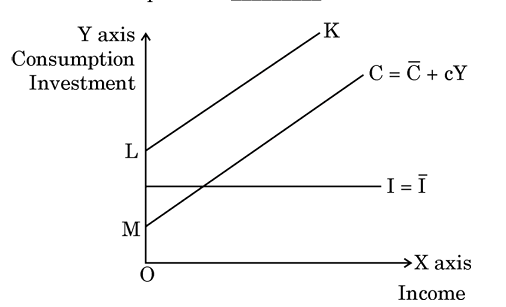
The line LK is the sum of the consumption function and the investment, i.e., Aggregate Demand = Consumption + Investment. It lies above the consumption curve by the amount of fixed investment, showing total demand at each income level. Hence, the LK line represents the Aggregate Demand curve.
Reserve Bank of India (RBI) performs the function of Banker to the Banks by acting as a :
(i) Clearing House
(ii) Custodian of Cash Reserves
(iii) Lender to the Government
(iv) Periodic inspection of Banks
The RBI acts as a banker to the banks by performing the function of a Clearing House (i) and as custodian of cash reserves (ii) that commercial banks keep with it. These reserves are similar to deposits banks hold with RBI. While the RBI does lend to the government (iii), this is a function of RBI as banker to the government, not to the banks. Periodic inspection of banks (iv) is a regulatory function but not directly related to RBI being banker to the banks.
Purchase of a property by an Indian resident abroad can be recorded on the ___________ side of ___________ account of Balance of Payments.
(Choose the correct option to fill in the blanks)
Purchase of assets such as property abroad by an Indian resident leads to an outflow of foreign exchange from India. According to the context, purchase of assets is recorded as a debit item on the capital account in the Balance of Payments. Therefore, the correct option is Debit on the Capital account.
Read the following statements carefully :
Statement I : Worker Population Ratio is used for analyzing the overall employment situation of a country. Statement II : A garment company has hired two workers on daily wage basis. Such a situation is considered as a formal sector employment.
In the light of the given statements, choose the correct option from the following :
Statement I is correct because the Worker Population Ratio is indeed a measure used to analyze the overall employment situation of a country by indicating the proportion of workers to the total population. Statement II is incorrect because workers hired on a daily wage basis, like casual wage laborers with no fixed contract, are considered part of the informal sector employment, not the formal sector.
Identify the incorrect statement from the following.
The statement that the expansion and promotion of the rural banking sector has taken a backseat after the economic reforms is incorrect. In reality, economic reforms have included efforts to strengthen rural banking and credit facilities to support farmers. The other statements are correct: selling produce directly to consumers often increases farmers' profitability; farmers with information on prevailing prices sometimes still sell at low prices due to lack of bargaining power; and expansion of rural credit has helped farmers to increase production and productivity.
Read the following statements : Assertion (A) and Reason (R). Choose the
correct option from those given below :
Assertion (A) : Education is one of the important factors for economic growth of a country.
Reason (R) ; A healthy person could provide uninterrupted labour supply for a longer period of time.
Education is an important factor for economic growth because it increases the quality and adaptability of the labour force, enabling the use of new technologies and contributing more effectively to economic development. A healthy person providing uninterrupted labour supply supports economic growth as health is another important factor, but it does not explain why education specifically leads to economic growth. Therefore, both Assertion and Reason are true, but Reason is not the correct explanation of Assertion.
Which of the following is not an advantage of Green Revolution ?
The Green Revolution led to an increased marketed surplus, self-sufficiency in food grains, and the creation of buffer stock. However, it caused a decline in the prices of food grains relative to other items of consumption, benefiting low-income groups. Therefore, an increase in prices of food grains is not an advantage of the Green Revolution.
Based on the given image, choose the incorrect option

The context provided does not mention that an enterprise in the informal sector hires 10 or fewer workers as a defining characteristic. Instead, it focuses on the vulnerability of workers, the role of the International Labour Organization (ILO) in initiating modernization and social security measures, and that information about employment in the formal sector is collected by the Union Ministry of Labour. Therefore, the option about the enterprise hiring 10 or fewer workers is incorrect.
Read the following statements carefully :
Statement I : Diversification in agriculture relates to change in cropping pattern and shift in workforce to allied activities.
Statement II : Agricultural marketing is a process that involves the assembling, storage, processing, transportation, packaging, grading and distribution of agro-products.
In the light of the given statements, choose the correct option from the following :
Both statements accurately reflect the concepts described in the context. Statement I is correct because diversification in agriculture involves changing cropping patterns and shifting the workforce to allied activities such as livestock, poultry, and fisheries to reduce dependency on farming alone. Statement II correctly defines agricultural marketing as the process comprising assembling, storage, processing, transportation, packaging, grading, and distribution of agricultural products.
Human Development is based on the idea that ___________ and ___________ are integral to human wellbeing. (Choose the correct option to fill in the blanks)
Human development emphasizes that education and health are fundamental to human well-being because only when people are educated and healthy, can they make meaningful choices in life. Education enables individuals to read and write, while health ensures a long and productive life. Hence, both education and health are integral to improving human welfare.
Identify the correct option with reference to the following statement :
“Farmers and industrial units were required to transact fixed quantities of raw materials and finished goods on the basis of prices fixed by the government, while the rest were purchased and sold at market price.”
The correct option is 'Dual Pricing Policy' because this policy involved fixing two types of prices: a government-fixed price for certain quantities of raw materials and finished goods that farmers and industrial units had to buy or sell, and market prices for the remaining quantities. This is clearly described in the provided context, where the reforms included dual pricing, meaning fixed prices for specific transactions and market prices for others.
__________ was the successor organisation to General Agreement on Trade and Tariff (GATT)
(Choose the correct option to fill in the blank)
The World Trade Organisation (WTO) was founded in 1995 as the successor organisation to the General Agreement on Trade and Tariff (GATT). WTO continues and expands the role of GATT in administering multilateral trade agreements and establishing a rule-based trading regime. Other options like RBI, IBRD, and IMF are different international financial institutions and are not related to GATT.
Read the following statements carefully :
Statement I : Population explosion, affluent consumption and production have placed a huge stress on the environment. Statement II : Carrying capacity is the largest size of a density-dependent population for which the population growth rate is zero.
In the light of the given statements, choose the correct option from the following :
Statement I is true because the rising population along with affluent consumption and production significantly increase the demand for resources and generate wastes, which strain the environment's ability to regenerate and absorb them. This is supported by the context that mentions the large stress on the environment due to these factors. Statement II is true because carrying capacity is defined as the maximum number of individuals of a population that the environment can sustainably support without population growth (i.e., where the growth rate is zero). Hence, both statements are correct.
Section B
Explain any two precautions to be kept in mind while estimating National Income by the Income method.
(a) Avoid Double Counting: While calculating the national income by the income method, care must be taken to avoid double counting of incomes. Only the incomes earned from the production of final goods and services should be included. Intermediate goods incomes should not be counted to prevent overestimation.
(b) Include Only Factor Incomes: Only factor incomes like wages, rent, interest, and profits earned from current production should be included. Transfer incomes such as pensions, scholarships, or gifts should be excluded as they do not relate to production activity.
These precautions help in obtaining an accurate measure of total national income without any error or repetition.
(a) Define Money Supply.
(b) Explain any one component of money supply.
(b) One important component of money supply is M1, also known as narrow money. It includes currency notes and coins with the public, demand deposits with the banks, and other deposits which can be used for making payments directly. M1 is the most liquid form of money as it can be used immediately for transactions.
(a) Define Accommodating Items under Balance of Payments (BoP).
(b) “Economic transactions that are recorded in the current account can be classified in two parts — merchandise and invisibles. Net inflows from both the transactions are referred to as Trade Surplus.”
Do you agree with the given statement ? Give valid arguments in support of your answer.
(b) The statement is not correct. Economic transactions in the current account are indeed classified into merchandise (goods) and invisibles (services, incomes, and transfers). However, trade surplus refers only to the net inflow from merchandise trade (exports minus imports of goods). Net inflows from invisibles are recorded separately and contribute to the overall current account balance but are not included in the definition of trade surplus. Hence, trade surplus is specifically the surplus from goods trade alone, not including invisibles.
On the basis of the given data, estimate the value of Gross Domestic Product at Factor Cost (GDP_FC) :
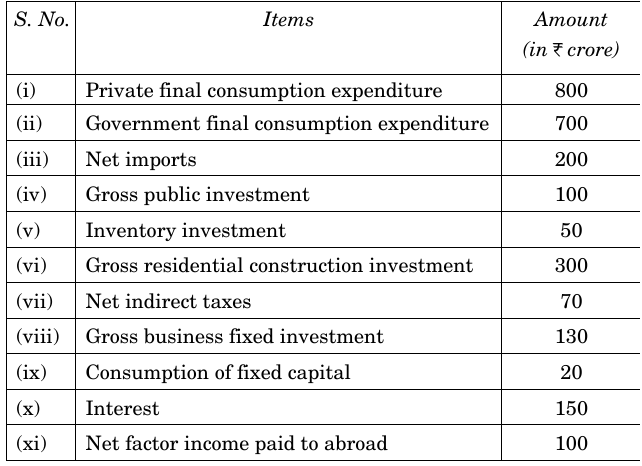
GDP at factor cost is the total market value of all final goods and services produced within a country in a given period, valued at factor cost. To estimate GDP at factor cost, use the formula:
GDP at Factor Cost = GDP at Market Price - Net Indirect Taxes
Here, Net Indirect Taxes = Indirect Taxes - Subsidies
Step 1: Find GDP at Market Price (GDP_MP) from the data.
Step 2: Calculate Net Indirect Taxes using given tax and subsidy values.
Step 3: Subtract Net Indirect Taxes from GDP_MP to get GDP_FC.
This measure shows the income earned by factors of production within the country and excludes the effect of taxes and subsidies on products.
Define Liberty Indicator and mention its significance.
Significance: Liberty indicators are important for assessing the quality of democracy and human development in a country. They ensure that citizens enjoy political freedom and legal protections. Although some liberty indicators have been introduced, such as measuring democratic participation, many crucial aspects like judicial independence and constitutional rights protection are yet to be fully incorporated into development assessments. These indicators help provide a more comprehensive understanding of societal progress beyond economic and social measures.
Anaya and Rohan owned separate farms. Anaya focused on learning modern farming techniques, training workers in crop rotation, soil management, and pest control.
On the other hand, Rohan invested in advanced machinery, irrigation systems, HYV seeds.
“Both Anaya and Rohan invested in human capital.”
Do you agree with the given statement ? Give valid argument in support of your answer
“Expenditure on preventive medicine, curative and social medicine helps in building human capital and economic development.”
Do you agree with the given statement ? Give valid argument in support of your answer.
Explanation:
1. Preventive medicine like vaccination helps in reducing the incidence of diseases and keeps people healthy.
2. Curative medicine provides treatment during illness, which helps sick people recover quickly and return to work.
3. Social medicine spreads health literacy and awareness about sanitation and hygiene, which prevents the spread of contagious diseases.
Healthy people can work better and contribute more productively to the economy, leading to higher income and economic growth.
Moreover, good health improves labour productivity and reduces absenteeism.
Investment in health creates human capital which benefits individuals and society by improving the quality of life and enabling people to participate effectively in economic activities.
Therefore, expenditure on all forms of medicine is crucial for building human capital and promoting sustainable economic development.
Section C
Explain the adjustment mechanism, if in an economy, ex-ante Aggregate Demand (AD) is more than ex-ante Aggregate Supply (AS).
When ex-ante Aggregate Demand (AD) exceeds ex-ante Aggregate Supply (AS), it means planned spending or demand for goods and services is greater than the total output firms intend to supply.
In this situation, firms face higher demand and start to sell more than expected inventory, so inventories fall.
To meet increased demand, firms increase production, which raises output and income (Y).
Higher income encourages more consumption, further increasing AD.
This process continues until the economy reaches a new equilibrium where AD equals AS.
Thus, the imbalance between AD and AS leads to changes in output and income, bringing the economy back to equilibrium.
This mechanism shows how autonomous increases in spending can shift aggregate demand and increase the overall economic output level.
Explain the process of working of Investment Multiplier, for a hypothetical economy with Marginal Propensity to Consume (MPC) as 0.8 and Incremental Investment as ₹ 2,000 crore.
The formula for Investment Multiplier (k) is k = 1 / (1 - MPC) = 1 / (1 - 0.8) = 5.
This means that every rupee invested leads to 5 rupees increase in income.
Step 1: Initial investment increases aggregate demand by ₹ 2,000 crore.
Step 2: As MPC is 0.8, people spend 80% of the additional income, so consumption increases by 0.8 * 2,000 = ₹ 1,600 crore.
Step 3: This additional consumption generates further income, of which 80% is again spent.
This process continues in rounds, with each round spending 80% of the previous income.
As a result, the total increase in income = Investment * Multiplier = 2,000 * 5 = ₹ 10,000 crore.
Hence, the Investment Multiplier effect shows how an incremental investment of ₹ 2,000 crore leads to a total increase of ₹ 10,000 crore in income through repeated rounds of spending.
Read the following passage carefully :
“ The Reserve Bank of India (RBI) Governor announced a 50 basis points reduction in the Cash Reserve Ratio (CRR) to 4% during the Monetary Policy Committee (MPC) address on December 6. The Governor noted that this move reflects a balanced approach towards managing liquidity while ensuring economic stability.”
Based on the above passage and common understanding, answer the following questions :
(i) ( Explain the rationale and the likely impact of the decision taken by the Monetary Policy Committee (MPC) of Reserve Bank of India (RBI).
(ii) Define Cash Reserve Ratio (CRR).
“Infrastructural upliftment of India was one of the key features of the British rule in India.”
State and discuss any two such developments, in the light of the given statement, with self-serving interests of the British.
(a) Railways: The British introduced railways in 1850 to connect important ports and raw material producing areas with industrial centers in Britain. Although railways improved transportation, their main purpose was to ease extraction and export of raw materials like cotton and coal, and to facilitate movement of British manufactured goods into Indian markets. Railways also helped in quick deployment of British troops to quell any uprisings, serving colonial control.
(b) Roads: The British constructed roads linking major administrative centers and commercial towns. These roads were primarily designed to support the movement of British troops, administrative officials, and the transport of goods for trade benefiting British industries. The road network helped integrate the Indian economy into the global colonial trade system but did not aim to improve local welfare or connectivity for Indian people.
Thus, while infrastructural upliftment occurred, it mainly served British economic and political interests rather than the development of India’s own economy or society.
“In the post-independence era, India adopted a protective tariff policy.”
Do you agree with the given statement ? Justify your answer with any two valid arguments.
(a) The government imposed high tariffs on imported goods to protect domestic industries from foreign competition. This helped Indian industries to grow and develop without being overwhelmed by cheaper imported products.
(b) Protective tariffs encouraged the use of local resources and production of goods within the country, which promoted self-reliance and reduced dependency on foreign countries. This policy also aimed to promote efficiency and adoption of modern technology in Indian industries.
Elaborate, how the efforts of various governments in India have helped in generation of employment, directly or indirectly, in the nation.
Direct efforts: The government employs people in various departments for administration. It also runs public sector industries, hotels, and transport companies providing jobs directly to many workers. Employment generation programmes are also implemented to create jobs, especially in rural areas.
Indirect efforts: The government promotes the growth of industries, agriculture, infrastructure development and small-scale enterprises. These initiatives help create more job opportunities in the private sector and boost the overall economy. Schemes like MGNREGA provide guaranteed employment, which indirectly supports livelihoods. Poverty alleviation programmes that focus on skill development and entrepreneurship also help increase employment.
Thus, the combined efforts of various governments through policies, schemes, and developmental activities have helped increase employment opportunities in India both directly and indirectly.
On the basis of the given data, outline and compare the share of Employment and Gross Value Added (GVA) of the sector that emerges to be a prospective employer in India and China.
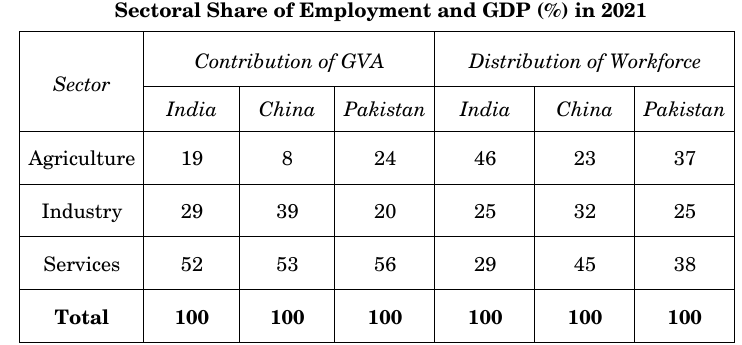
The sector that emerges as a prospective employer in both India and China is the Service sector. In India, the Service sector contributes 54% to the Gross Value Added (GVA) and employs about 31% of the workforce. In China, the Service sector contributes 52% to the GVA and employs 45% of the workforce. This comparison shows that although the Service sector contributes slightly more to India's GVA, it employs a larger share of the workforce in China, indicating China has a more service-oriented employment structure. The Industry sector contributes 41% to GVA and employs 28% of the workforce in China, while in India it contributes less to employment and GVA. The Agriculture sector employs the largest workforce in India but contributes less to GVA compared to Services. Hence, the Service sector is a growing employer and contributor to economic value in both countries, with China showing a higher employment share in this sector, making it a key prospective employer for the future.
Section D
(i) “The Credit Linked Subsidy Scheme (CLSS) is a key component of the Pradhan Mantri Awas Yojana (PMAY), aimed at providing affordable housing for the Economically Weaker Sections (EWS), Lower-income Groups (LIG), and Middle-income Groups (MIG) in India.” Identify and explain the government budget objective highlighted in the above statement.
(ii) Differentiate between the two types of tax revenue sources of the government.
(ii) The two types of tax revenue sources of the government are:
Direct Taxes: These are taxes paid directly by individuals or organizations to the government, such as Income Tax and Corporate Tax. Direct taxes are progressive and help reduce income inequality.
Indirect Taxes: These are taxes levied on goods and services, which are collected by intermediaries like retailers and then paid to the government, for example, GST and excise duty. Indirect taxes are regressive and affect consumers at various levels.
Thus, direct taxes are imposed on income or wealth whereas indirect taxes are imposed on consumption.
(i) Medha, an economics student, was studying about the expenditure on defence incurred by the government in the form of acquiring new platforms (jets, submarines etc.), and salaries and pensions of armed forces personnel. She classified both the expenditures as capital expenditure.
Do you agree with Medha’s views ? Give valid explanation in support of your answer.
(ii) If, for an economy, Primary Deficit is ₹ 1,000 crore and interest payments are 20% of total borrowings of the government, then calculate the value of fiscal deficit.
(ii) Given: Primary Deficit = 1,000 crore, Interest payments = 20% of total borrowings. Fiscal Deficit = Primary Deficit + Interest payments. Since interest payments are 20% of total borrowings, and total borrowings represent the fiscal deficit, let fiscal deficit be x. Then, Interest payments = 0.20 * x. Also, Primary Deficit = Fiscal Deficit - Interest payments, so 1,000 = x - 0.20x = 0.80x. Therefore, x = 1,000 / 0.80 = 1,250 crore. Hence, the fiscal deficit is 1,250 crore.
Read the following passage carefully :
The domestic product measures the value of all goods and services arising out of economic activity within a country over a specific period, while National Income is the sum total of income earned by all factors of production as a result of the economic activities during a period of time. National Income includes only those incomes which are derived directly from the current production of goods and services, which are called Factor Incomes.
When National Income is measured at current prices over a number of years, the changes in National Income would include the effect of the changes in production along with the changes in prices. This estimate compared over the period would not be an accurate measure of the overall real increase in production of the country or the economic welfare of the people of the economy.
Therefore, it would be necessary to eliminate the effect of prices, in other words, to recompute the whole series at given prices of one particular base year. National Income, thus computed, is termed as National Income at constant prices.
On the basis of the above passage and common understanding, answer the following questions :
(i) Differentiate between Domestic Product and National Product.
(ii) National Income measured at constant prices is a better measure of the overall real increase in production of the country.’ Justify the given statement with valid arguments
Domestic Product refers to the total value of goods and services produced within the geographical boundaries of a country during a specific period. It includes production by both domestic and foreign factors of production inside the country.
National Product, on the other hand, measures the total value of goods and services produced by the factors of production owned by the residents of a country, regardless of whether the production takes place within the country or abroad. It includes net income from abroad.
(ii) Why National Income measured at constant prices is a better measure of real increase in production:
When National Income is measured at current prices, changes over time reflect both changes in production and changes in prices due to inflation or deflation. This makes it difficult to know whether the increase is because more goods and services are produced or simply because prices have increased.
To get an accurate measure of the real increase in production and economic welfare, it is necessary to remove the effect of price changes. This is done by measuring National Income at constant prices, i.e., using prices from a base year.
This method shows the true growth in production by reflecting only the changes in quantities produced, providing a better understanding of the country’s economic progress and welfare of its people.
(i) “As per a few scholars, fertilizer subsidies should now be phased out, as they have served their purpose.”
Do you agree with the given statement ? Justify your answer with valid arguments.
(ii) State any two ways by which the government can execute the step of disinvestment.
Instead of removing subsidies completely, the government should reform subsidy policies to benefit only needy small and marginal farmers by better targeting and use of Direct Benefit Transfer (DBT). This will eliminate misuse and ensure the subsidy reaches the intended beneficiaries. Moreover, subsidies put a financial burden on the government; hence, gradual rationalization and promotion of organic fertilizers can be alternative solutions.
(ii) Two ways by which the government can execute disinvestment are:
1. Sale of Government Shares in Public Sector Enterprises (PSEs): The government can sell its shares partially or fully in public sector companies to private investors through market mechanisms.
2. Strategic Sale: The government can sell a major stake in a PSE to a private company, thereby transferring management control and ownership, to improve efficiency and reduce financial burden on the government.
(i) “During the 1991 economic reforms, the Government undertook a range of financial sector reforms which made a significant impact in the years to follow.”
Justify the given statement with valid arguments.
(ii) State the name of any one Maharatna and any one Navratna company.
(ii) One Maharatna company is Indian Oil Corporation Limited. One Navratna company is Hindustan Aeronautics Limited.
Read the following text carefully :
According to the 2021 World Air Quality Report, India is home to 63 of the 100 most polluted cities. The study also found that PM 2.5 concentration (tiny particles in the air that are 2.5 micrometres or smaller in length) in 48% of the country’s cities are more than 10 times higher than the WHO’s air quality guidelines level. Undoubtedly, this has made air pollution as one of the most pressing environmental issues in India.
Vehicular emission, industrial waste, cooking smoke, the construction sector, crop burning and power generation are among the biggest sources of air pollution in India. The country’s dependence on coal, oil and gas due to rampant electrification makes it the world’s the largest polluter, contributing over 2.65 billion metric tonnes of carbon to the atmosphere every year. In 2021, India was among the world’s most polluted countries, second only to Bangladesh. The annual average PM 2.5 level in India was about 58.1 μg/m³ in 2021.
Scientists have linked persistent exposure to PM 2.5 to many long-term health issues including heart and lung disease, as well as 7.5 million premature deaths each year.
On the basis of the above passage and common understanding, answer the following questions :
(a) State any four sources of air pollution in India.
(b) Discuss briefly the adverse impacts of rising levels of PM 2.5 particles in the air.
(c) State the full form of CPCB.
(b) Rising levels of PM 2.5 particles in the air have serious adverse impacts on human health and the environment. These tiny particles can penetrate deep into the lungs and bloodstream causing respiratory and cardiovascular diseases such as asthma, bronchitis, heart attacks, and lung cancer. Long-term exposure to high PM 2.5 levels leads to millions of premature deaths each year. It also reduces air quality, causing smog and haze that affect visibility and harm plants and animals.
(c) The full form of CPCB is Central Pollution Control Board.
Paper Details
CBSE Board Exam 2026
Class
Class 12 Commerce
Subject
Economics
Year
2026
Set
Set 4
Other Years — Economics