SOLUTIONS
2026 BOARD EXAM
CBSE Class 12 Commerce Economics Board Paper 2026 — Set 1 Solutions
2026
Economics
Class 12 Commerce
CBSE EXAMINATION PAPER-2026
ECONOMICS
(Solved)
General Instructions :
Read the following instructions carefully and follow them :
- This question paper contains 41 questions. All questions are compulsory.
- This question paper is divided into 4 sections.
- Section A – questions number 1 to 20 are multiple choice questions
- Section B – questions number 21 to 26 are short answer type i
- Section C – questions number 27 to 35 are short answer type ii
- Section D – questions number 36 to 41 are long answer
- There is no overall choice given in the question paper. However, an internal choice has been provided in few questions.
- Use of calculator is NOT allowed.
Section A
In a two sector economy, the flow of factor payments moves from __________ to __________.
(Choose the correct option to fill in the blanks)
In a two sector economy, firms pay households for their factor services such as labor, land, and capital. Households provide these factor services to firms, and in return, firms make factor payments to households. Hence, the flow of factor payments moves from firms to households.
Read the following statements : Assertion (A) and Reason (R). Choose the correct option from those given below :
Assertion (A) : Money is of perishable nature and is generally accepted by all at any point of time. Reason (R) : Money serves as a store of value, facilitating individuals to transfer purchasing power from the present to the future. Options :
Money is not of perishable nature; it is durable and generally accepted by all at any point of time. The assertion that money is perishable is incorrect. The reason states that money serves as a store of value, allowing individuals to transfer purchasing power from the present to the future, which is true as money can be saved and used later. Thus, Assertion is false, but Reason is true.
Read the following statements carefully :
Statement 1 : Depreciation of currency is an economic action undertaken by the government of a nation under the fixed exchange rate system.
Statement 2 : Under the floating exchange Rate system, authorities actively intervene in theforeign exchange market by way of maintaining foreign exchange reserves.
In the light of the given statements, choose the correct option from the following :
Depreciation of currency happens naturally under a floating exchange rate system when the price of the domestic currency decreases in terms of foreign currency. It is not an economic action deliberately undertaken by the government, unlike 'devaluation' which occurs in a fixed exchange rate system. Statement 1 is therefore false. Statement 2 is true because, under a floating exchange rate system (also called managed or dirty floating), authorities do intervene by buying and selling foreign currencies and maintain foreign exchange reserves to moderate exchange rate movements.
In an economy, exclusion of ___________ may lead to under estimation of the value of Gross Domestic Product (GDP).
(Choose the correct option to fill in the blank)
(i) Barter Transactions
(ii) Services provided by family members
(iii) Illegal activities
(iv) Depreciation of Assets
GDP measures the total value of all final goods and services produced within a country during a specific period. Barter transactions (i) are usually excluded because they do not involve money and are difficult to measure, but services provided by family members (ii) and illegal activities (iii) are also often excluded in official GDP calculations. Exclusion of services provided by family members and illegal activities leads to underestimation of GDP because these activities do have economic value but are not recorded. Depreciation of assets (iv) is not excluded; it is accounted for separately as it represents the loss of asset value over time.
Identify, which of the following is true at the Break Even level of Income.
(Choose the correct option)
At the break-even level of income, consumption equals income, meaning there is no saving. Since Average Propensity to Consume (APC) is consumption divided by income, at this point APC equals 1. Therefore, the correct statement is 'Average Propensity to Consume (APC) = Unity (1)'.
Read the following statements carefully :
Statement 1 : Final goods are those goods which normally lose their identity in the production process.
Statement 2 : Final goods may get transformed during the consumption process by a consumer.
Final goods are those goods which do not undergo any further transformation in the production process, meaning they retain their identity during production. Therefore, Statement 1 is incorrect. However, final goods may get transformed during the consumption process by the consumer (for example, food being eaten or fuel being used), so Statement 2 is correct.
Read the following statements : Assertion (A) and Reason (R). Choose the correct option from those given below :
Assertion (A) : Unilateral Transfers are recorded in the Current Account of the Balance of Payments (BoP) of a nation.
Reason (R) : Capital account records transactions which cause a change in the assets or liabilities of the country.
Unilateral Transfers such as gifts, donations, and remittances are recorded in the Current Account under transfer payments. The Capital Account, however, records transactions involving changes in a nation's assets and liabilities. While both statements are true, the reason given does not explain why Unilateral Transfers are recorded in the Current Account. Therefore, the correct answer is that both Assertion and Reason are true, but Reason is not the correct explanation of Assertion.
“In the Indian Banking System, the Statutory Liquidity Ratio (SLR) plays a vital role in controlling the credit creation capacity of the Commercial Banks, as it __________.”
(Choose the correct option to fill in the blank)
The Statutory Liquidity Ratio (SLR) is the fraction of total demand and time deposits that commercial banks are required by the RBI to keep invested in specified liquid assets. This requirement ensures that banks maintain a certain percentage of their deposits in liquid form, which limits the amount of funds available for lending, thereby controlling the credit creation capacity of the banks.
‘In an economy, the currency held by the public, Net Demand Deposits with Commercial Banks and Net Time Deposits with Commercial Banks stand at Rs.1,42,000 crore,Rs. 22,000 crore and Rs. ` 86,000 crore respecively. The value of Money Supply (M1) would be `Rs __________ crore.(Choose the correct option to fill in the blank)
Money Supply (M1) is the sum of currency held by the public and net demand deposits with commercial banks. Therefore, M1 = Rs.1,42,000 crore + Rs.22,000 crore = Rs.1,64,000 crore. Net time deposits are not included in M1 but in broader measures like M2 or M3.
Read the following statements carefully :
Statement 1 : During the British rule in India, the export surplus was utilised to import of invisible items from Britain.
Statement 2 : Indians paid for the expenses incurred by an office set up by the colonial government in Britain.
In the light of above statements, choose the correct option from the following :
Both statements are true as per the given context. The export surplus generated during the British rule in India was not used for the benefit of India; instead, it was used to pay for invisible imports from Britain such as administrative expenses, including the costs of an office set up by the colonial government in Britain. This drain of wealth included payments for war expenses and other services, verifying that Indians bore these costs.
Read the following statements : Assertion (A) and Reason (R), Choose the
correct option from those given below :
Assertion (A) : Education facilitates the assimilation of knowledge and competencies. It also fosters inventive capacities and enhances the aptitude to integrate advance technology.
Reason (R) : Education plays a pivotal role in transforming cognitive perspectives and serves as a catalyst for the economic advancement of a nation.
Education provides knowledge and skills that help individuals understand changes in society and scientific advancements, which in turn fosters innovation and the ability to adopt advanced technology. This transformation in knowledge and competencies leads to cognitive changes that drive economic growth, making education a key factor in the economic advancement of a nation. Therefore, both the assertion and the reason are true, and the reason correctly explains the assertion.
Read the following text carefully
“In the recent times, the Government of India, has introduced several measures to encourage greater public participation in the capital market, including both primary and secondary stock markets.”
Under which sector have the above mentioned reforms been introduced ?
The reforms mentioned relate to the capital market, which is a part of the financial sector. According to the context, the financial sector includes financial institutions such as commercial banks, investment banks, and stock exchange operations. Measures to encourage public participation in primary and secondary stock markets are therefore part of financial sector reforms.
The Montreal Protocol was signed in the year 1987 committing nations to __________.
The Montreal Protocol was adopted in 1987 to ban the use of chlorofluorocarbon (CFC) compounds and other ozone-depleting chemicals like carbon tetrachloride, trichloroethane, and halons. These chemicals contain chlorine and bromine, which cause depletion of the ozone layer in the stratosphere. Therefore, the protocol commits nations to protect the ozone layer from depletion caused by these substances.
Read the following statements : Assertion (A) and Reason (R), Choose the
correct option from those given below :
Assertion (A) : The notion of rural development encompasses a far wider spectrum than agricultural advancement.
Reason (R) : Government interventions in the agricultural sector remain imperative, as it constitutes the primary means of sustanance for the rural population.
The assertion is true because rural development includes various aspects beyond just agriculture, such as infrastructure, education, health, and rural industries. The reason is also true as government intervention in agriculture is important due to its role as the main livelihood for the rural population. However, the reason does not directly explain the assertion since the wider scope of rural development encompasses more than just agricultural support.
Identify, which of the following, highlights a highly relevant issue associated with evolving employment trends in India’s labour market ?
The relevant context explains that over the decades, there has been a shift from self-employment and regular salaried employment towards casual wage work, a process called casualisation of the workforce. This trend highlights the vulnerability of workers due to casual employment. Thus, the significant issue in India’s labour market is the increase in the proportion of casually employed individuals, indicating rising informal and insecure jobs rather than growth in formal or permanent employment.
Match the terms given in Column-I with their respective meaning in Column-II. Select the correct option
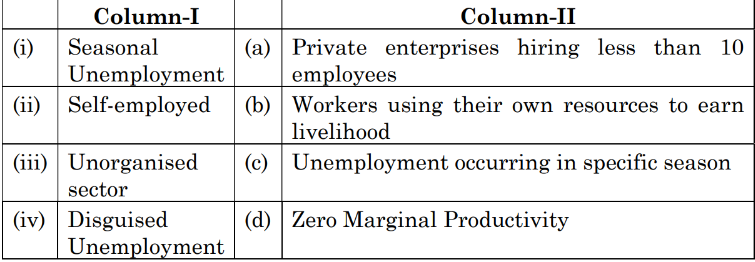
Based on the context, Column-I terms correspond as follows: (i) represents the first set of values (Column A) which are the main data points, matching with (b); (ii) corresponds to the second set of values (Column C), matching with (a); (iii) refers to the column captions or headings, matching with (c) as it denotes the explanation of data; and (iv) represents the differences between two sets (Column D), matching with (d). This matching aligns with the meanings described in the context.
Sustainable development refers to the development that meets the need of the present generation without compromising the ability of the future generations, to meet their own needs.” The above mentioned definition has been given by __________.
(Choose the correct option to fill in the blank)
The concept and definition of sustainable development was emphasised and defined by the United Nations Conference on Environment and Development (UNCED). According to the provided context, sustainable development means meeting the needs of the present generation without compromising the ability of future generations to meet their own needs. This definition was given by UNCED, making 'United Nations Conference on Environment and Development' the correct answer.
Assertion (A) : The Government of India adopted the measure of regulation of markets to improve marketing conditions for agricultural products. Reason (R) : Regulation of market ensured transparent pricing, fair trade practices, and protection for farmers against exploitation in agricultural marketing.
The Government of India initiated regulation of markets to create orderly and transparent marketing conditions, which benefit farmers and consumers. Regulation of markets reduces exploitation in agricultural trade by ensuring transparent pricing, fair trade practices, and protection for farmers. Therefore, both Assertion (A) and Reason (R) are true, and the Reason correctly explains the Assertion.
Arrange the following events in China’s economic development history in correct chronological sequence and select the correct option :
I. Great Proletarian Cultural Revolution.
II. Great leap forward
III. Introduction of Economic Reforms
IV. Launch of the First Five Year Plan
Section B
Meera and Shahid are two classmates, who were comparing India’s economic growth over the years. Meera referred to the increase in Gross Domestic Product (GDP) at current prices prevailing in market, while Sahid insisted on considering GDP after adjusting for inflation. Their debate on which of the two measures gives a true picture of people’s well-being,remained inconclusive.
Considering the above mentioned situation, elaborate with valid reason, which of the two variables is considered a better indicator of welfare and why ?
Meera referred to GDP at current prices, also called nominal GDP, which shows the total value of goods and services at current market prices without adjusting for inflation. Shahid talked about GDP adjusted for inflation, called real GDP, which shows the true growth by removing the effect of price changes.
The GDP at current prices may increase due to inflation even if the actual quantity of goods and services produced does not increase. Therefore, it is not a reliable indicator of the true improvement in people’s welfare.
On the other hand, real GDP gives a better measure of economic welfare because it accounts for inflation and reflects the actual increase in production and income.
Hence, GDP adjusted for inflation or real GDP is considered a better indicator of people's welfare as it shows the real growth in the economy and the actual improvement in material well-being of people over time.
Two friends, Ravi and Harry were discussing whether the money received from sale of an old car should be included in India’s National income.
Ravi was of the view that it should be included in India’s National income while Harry did not agree with him.
They also had difference of opinion on the treatment of brokerage paid to the car dealer.
As their Economics teacher, state the treatments with valid arguments.
(b) Brokerage paid to the car dealer should be included in National Income because it is a payment for services rendered. The brokerage is the income earned by the dealer for facilitating the sale, which is part of current production and should be counted in National Income.
“Under the provisions stated in the Section 20 and Section 21 of the Reserve Bank of India (RBI) Act, 1934, the RBI is mandated to handle the banking operations of the Government of India.”
In the light of the given statement, elaborate the indicated function of the Reserve Bank of India
The Reserve Bank of India (RBI) serves as the banker to the Government of India under Sections 20 and 21 of the RBI Act, 1934. This means RBI manages the banking transactions on behalf of the government. It receives and makes payments for the government, maintains the government's accounts, and also provides short-term loans to the government when needed. RBI helps the government in raising funds through government securities and treasury bills. This function ensures smooth management of government funds and plays a vital role in the country’s financial stability. The RBI also advises the government on financial matters and helps implement monetary policies accordingly.
In summary, RBI acts like a bank for the government by managing all its receipts and payments, facilitating borrowing through financial markets, and supporting budgetary requirements efficiently.
“Employment in the formal sector guarantees better income and
social benefits compared to informal sector job.”
Defend or refute the above statement with valid reason and example
Employment in the formal sector generally guarantees better income and social security benefits compared to informal sector jobs. This is because formal sector employment is officially registered and regulated by the government, which ensures job security, fixed wages, paid leave, provident fund, and health insurance. For example, government jobs or jobs in big companies provide these benefits.
In contrast, informal sector jobs like street vending or daily wage labor typically do not provide such benefits or job security. Workers in this sector earn less and have no social protection. Therefore, the statement is true as formal sector employment offers more financial stability and social benefits than informal sector jobs.
During the ‘Mann ki Baat’ program aired on 29th June, 2025, Prime Minister shared that World Health Organisation (WHO) has declared India as a Trachoma free (an eye disease). This achievement, he shared, is a result of sustained efforts in health care, sanitation, awareness and medical access.
In the light of the above statement, explain how investments in health care contributes to a nation’s development. Support your answer with valid arguments
Investments in health care significantly contribute to a nation’s development in several ways. Firstly, improved health care reduces the burden of diseases, increases the life expectancy and enhances the quality of life of the population. Healthy citizens can work more effectively, increasing productivity and economic growth. Secondly, health care investments reduce health-related expenditures on curative and emergency treatments by focusing on preventive measures like vaccination and sanitation. Thirdly, better health care access reduces absenteeism in schools and workplaces, thus improving education and economic outputs. Finally, it promotes social equity by providing health services to all sections of society, including the poor, which fosters overall inclusive development. India’s achievement of becoming Trachoma free demonstrates how sustained health care efforts combined with awareness and sanitation lead to better health outcomes and strengthen the nation’s progress.
In conclusion, investing in health care not only improves individual well-being but also drives economic prosperity and social development simultaneously.
“In the late 1970’s China’s population growth rate has sharply declined as
compared to India.”
Elucidate the reasons and impacts of this situation.
In the late 1970s, China introduced the one-child policy as a government measure to control its rapidly growing population. This policy limited most families to having only one child, which sharply reduced the birth rate. In contrast, India did not implement such strict population control measures during that period, resulting in a higher population growth rate.
Impacts of the One-Child Policy:
The one-child policy led to a significant decline in population growth in China, slowing down its population increase. However, it also caused a decline in the sex ratio, with fewer females per 1000 males, due to a cultural preference for sons. In the long term, this policy has resulted in an aging population, where the number of elderly people is increasing compared to young people. This demographic change challenges China’s workforce and economic growth.
As a result, China has relaxed the policy to allow two children per family to balance the population structure. Meanwhile, India continues to have a relatively higher population growth rate as it has not enforced such strict norms, which impacts its development differently.
Summary:
China’s strict population control in the late 1970s caused a sharp decline in growth rate compared to India, leading to demographic challenges like aging population and gender imbalance, influencing economic and social policies.
Section C
For a hypothetical economy, assuming there are only two firms ( X and Y) with equal values of Gross Value Added (GVA).
On the basis of the following data, estimate the value of Domestic Sales of both the firms (X and Y) :
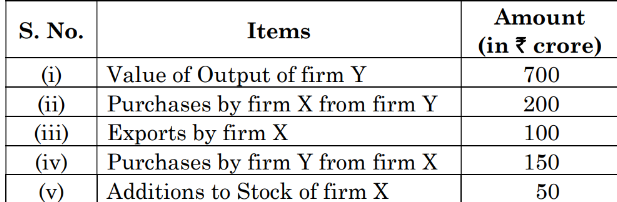
Given that firms X and Y have equal Gross Value Added (GVA), and from the data provided on sales, intermediate consumption, and value added, we need to find Domestic Sales.
Step 1: Recall that Gross Value Added (GVA) = Sales - Intermediate Consumption.
Step 2: Since GVA is the same for both firms, we can write for each firm:
GVA = Sales - Intermediate Consumption => Sales = GVA + Intermediate Consumption
Step 3: From the data, find the intermediate consumption of each firm.
Step 4: Add GVA (equal for both firms) to the respective intermediate consumption to get Domestic Sales for each firm.
Therefore, Domestic Sales of Firm X = GVA + Intermediate Consumption of X
Domestic Sales of Firm Y = GVA + Intermediate Consumption of Y
This method estimates the Domestic Sales based on the equality of GVA and available data on intermediate consumption.
Hence, Domestic Sales values have been estimated accordingly.
Ms. Reeta D’Costa, retired from the post of Income Tax Commissioner in the year 2023.
Apart from her pension, she also receives the following from various sources :
•Rental income from a flat she owns.
• Interest income from her fixed deposits.
• Money sent by her children settled abroad.
Identify and classify, her monthly incomes into ‘factor income’ and
‘transfer income’, with valid reasons.
(b) Transfer Income: Money sent by her children settled abroad is transfer income as it is a payment received without any contribution in the production process. It is a transfer from one household to another without any service rendered.
Reason: Factor incomes are rewards received for providing factors of production like land, labor, and capital, while transfer incomes are incomes received without any productive activity, such as gifts or remittances.
Michel, an entrepreneur of Country Zeta, borrowed $ 5 million from an overseas bank to expand his textile business.
During the same financial year, the Government of Country Zeta secured a loan of $ 30 Billion from an International Financial Institution to manage the ongoing Balance of Payments.
Samuel, an Economics student categorised both of these transactions as ‘autonomous transactions’ in the BoP account of the country.
Do you agree with his classification ? Justify your answer with valid reasons.
(a) No, I do not agree with Samuel’s classification of both transactions as autonomous transactions.
(b) Autonomous transactions are those made for profit or other reasons independent of the state of Balance of Payments. Michel’s borrowing of $5 million for expanding his textile business is an autonomous transaction because it is done to earn profit and grow business, not to manage BoP.
(c) However, the government’s loan of $30 Billion is not an autonomous transaction but an accommodating transaction because it is taken specifically to manage the ongoing Balance of Payments and bridge the deficit. Accommodating transactions help to balance the payments and avoid reserve depletion.
(d) Thus, Michel’s transaction is autonomous while the government’s loan is an accommodating transaction.
Conclusion: Michel's borrowing is autonomous as it is independent of BoP position, but the government's loan is accommodating since it is taken to manage BoP deficit.
Refer the given image carefully :
Explain any two measures that can be taken by the Central Bank to control the indicated macroeconomic problem.
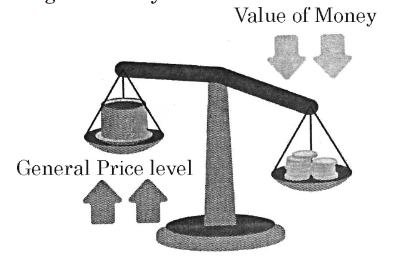
1. Open Market Operations (OMO): The Central Bank buys or sells government securities in the open market to regulate the money supply. Selling securities absorbs excess money, reducing inflation, while buying securities increases money supply, boosting the economy.
2. Changing the Cash Reserve Ratio (CRR): The Central Bank can increase the CRR to reduce the amount of funds banks can lend, decreasing money supply and controlling inflation. Alternatively, decreasing CRR allows banks to lend more, increasing money supply and stimulating the economy.
These tools help the Central Bank maintain price stability and control inflation or deflation effectively.
State and explain any two changes which were observed in India’s occupational structure during the British Rule.
(a) Decline in Agriculture: During British rule, many farmers were forced to shift from traditional farming to growing cash crops like indigo and cotton for British industries. This led to a decrease in food crop production and affected the livelihood of many, causing poverty and unemployment.
(b) Growth of Artisan and Handicraft Decline: The British introduced industrial goods which led to the decline of traditional artisanal and handicraft occupations. Many skilled workers lost their jobs as British manufactured goods replaced Indian handmade products, changing the occupational pattern drastically.
These changes transformed India from a self-sufficient economy into a supplier of raw materials and consumer of British manufactured goods.
The British sought to achieve their vested interest through their policies of infrastructural development in India.”
Do you agree with the given statement ? Justify your answer with valid explanation.
Yes, I agree that the British sought to achieve their vested interests through infrastructural development in India. The British introduced railways, roads, and telegraphs during their rule; however, these developments primarily served their economic and administrative needs rather than benefiting Indian society. Railways helped transport raw materials like cotton and coal from the interior to ports for export to Britain.
Roads and telegraphs improved communication for British administrators and military control. The infrastructure was not designed to meet the needs of Indian farmers or industries. Instead, it facilitated the extraction of resources and the movement of British goods to Indian markets.
Thus, though infrastructure development was significant, it was mainly motivated by colonial interests rather than the welfare of the Indian people. After independence, India had to build and develop infrastructure further with a focus on national growth and public benefit.
At the time of independence, both India and Pakistan inherited similar colonial economic structures. Both the nations adopted many similar economic planning strategies.”
Explain any two such similarities in the developmental path of India and Pakistan.
(b) Both countries focused on creating a large public sector and increasing public expenditure on social sectors such as education and health to raise overall socio-economic standards. This helped lay the foundation for long-term development by investing in human and physical capital.
(A) State the meaning of ‘Disguised Unemployment
(B) Image
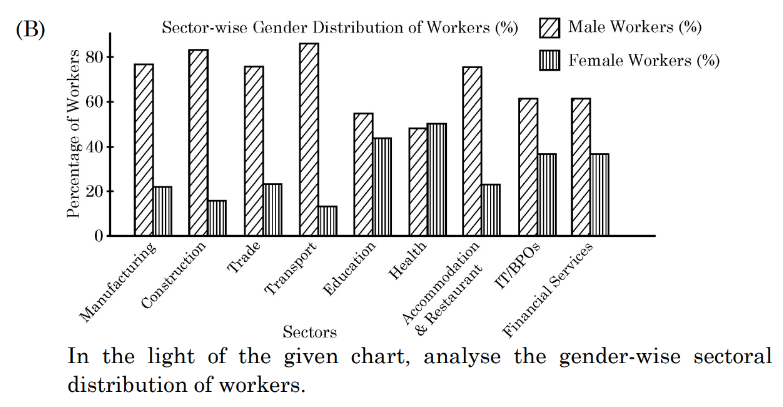
Disguised unemployment refers to a situation where more people are employed than actually needed for the work.
In this condition, the extra workers do not increase total output because their contributions are redundant.
For example, a farmer may need only two workers to work on four acres but employs more people including family members, which means some are surplus workers.
This surplus labour does not add to productivity and is called disguised unemployment.
It is common in farming where extra labor is present but productivity does not increase with more workers.
Mathematically, if Etotal is total workers and Eproductive is the number needed for maximum output, disguised unemployment exists when Etotal > Eproductive.
State and explain any two measures that can be taken by the Central Bank to control the situation of deficient demand.
(a) Reduction in Bank Rate: The Central Bank can reduce the bank rate, which is the rate at which it lends money to commercial banks. A lower bank rate makes borrowing cheaper for banks, encouraging them to lend more to businesses and individuals. This increases money supply in the economy, thereby raising aggregate demand.
(b) Reduction in Cash Reserve Ratio (CRR): The Central Bank can lower the CRR, which is the percentage of deposits that commercial banks are required to keep as reserves. When CRR is reduced, banks have more funds available to lend. This increases the money supply and stimulates demand in the economy.
These measures help increase liquidity and encourage spending and investment, thus controlling the problem of deficient demand.
Section D
“Income of an economy increased from ₹20,000 to ₹ 50,000 crore. Savings of the economy increased from ₹ 2,000 crore to ₹ 10,000 crore.”
(i) Calculate Average Propensity to Consume (APC) and Average Propensity to Save (APS), before and after the rise in income.
(ii) Draw appropriate conclusion regarding the behaviour of Average Propensity to Consume (APC) as his income increases.
Before increase:
Income (Y) = ₹20,000 crore
Savings (S) = ₹2,000 crore
Consumption (C) = Income - Savings = 20,000 - 2,000 = ₹18,000 crore
Average Propensity to Consume (APC) = Consumption / Income = 18,000 / 20,000 = 0.9
Average Propensity to Save (APS) = Savings / Income = 2,000 / 20,000 = 0.1
After increase:
Income (Y) = ₹50,000 crore
Savings (S) = ₹10,000 crore
Consumption (C) = 50,000 - 10,000 = ₹40,000 crore
APC = 40,000 / 50,000 = 0.8
APS = 10,000 / 50,000 = 0.2
(ii) Conclusion:
As the income of the economy increases from ₹20,000 crore to ₹50,000 crore, the Average Propensity to Consume (APC) decreases from 0.9 to 0.8. This shows that with higher income, people tend to save a larger proportion of their income and consume a smaller fraction on average. Therefore, APC decreases as income increases. This behavior implies that saving increases at a faster rate than consumption when income rises, consistent with economic theories of consumption and saving patterns.
Under a study, examining the spending habits of a hypothetical economy, it was observed that even households with zero income managed to consume basic necessities.
As the income of people increased, their consumption also increased, but not as rapidly as income.”
Based on the given text and common understanding, answer the following questions :
(i) Identify and elaborate the type of consumption indicated in the first para of the above text.
(ii) Explain, the reason behind the positive slope of Aggregate Demand Curve.
(ii) The Aggregate Demand Curve has a positive slope because as income increases, consumption and investment increase, leading to an overall increase in aggregate demand. Higher income means households can spend more on goods and services, thus aggregate demand increases with income, but consumption increases at a less rapid rate than income, showing marginal propensity to consume is less than one. Therefore, the aggregate demand curve slopes upward showing a direct relationship between income and demand.
Refer the given text carefully :
According to the Economic Survey 2024-25, the government budget’s projections for the fiscal year 2025-26 indicate that gross direct tax revenue will rise by 12.7%, while gross indirect tax collections are expected to grow by 8.3% relative to FY 2024-25.
Direct taxes include income tax and corporate tax, reflecting earnings and profits of households and firms. It plays a key role in revenue growth of the government. Indirect taxes encompass Goods and Services Tax (GST), custom duties and other transaction-based levies.
Higher growth rate projected for direct taxes suggests a push to enhance tax buoyancy through improved compliance and reforms. On the other hand, indirect taxes are expected to benefit from consumption trends and Goods and Services Tax (GST) administration improvements. The balance tax strategy aims to mobilise resources while supporting fiscal consolidation and sustainable economic growth.
On the basis of the above passage and common understanding, answer the
following questions :
(i) Differentiate between the two types of taxes indicated in the above text, with suitable examples.
(ii) Elaborate the likely consequences of the tax projections made by the government.
Direct taxes are taxes paid directly by individuals and firms to the government based on their income or profits. Examples include income tax and corporate tax. These taxes are progressive in nature as they depend on the ability to pay and help reduce income inequality.
Indirect taxes are taxes levied on goods and services and collected by intermediaries like sellers from consumers. Examples include Goods and Services Tax (GST) and customs duties. These taxes are regressive as they affect all consumers equally regardless of income.
(ii) Likely consequences of the tax projections:
The projected higher growth of direct taxes by 12.7% indicates the government’s effort to improve tax compliance and undertake reforms, which may increase revenue collection from individuals and businesses. This can enhance the government’s capacity to fund development programs and reduce fiscal deficit.
The 8.3% growth in indirect taxes suggests improved administration of GST and increased consumption. Together with direct taxes, this balanced approach ensures sustainable resource mobilization.
Overall, higher tax revenues will support fiscal consolidation, reduce reliance on borrowings, and promote sustainable economic growth by funding infrastructure and social welfare schemes. The strategy also aims to make tax system more efficient and equitable.
(i) Mr. Ravi, an IT entrepreneur from Bengaluru, observed that several MNC’s prefer India as their outsourcing Hub for services like software development, customer support, data management etc.
His friend Priya believes this is due to certain inherent advantages of the Indian economy.
In your opinion, state and explain any two factors that make India a preferred outsourcing destination.
(ii) “In the post-independence era, India adopted a protective tariff policy.”
Do you agree with the given statement ? Justify your answer with any two valid arguments.
First, low cost of skilled labour: India has a large pool of educated and skilled workforce available at much lower wages compared to developed countries. This cost advantage attracts many MNCs to outsource services like software development and customer support to India.
Second, availability of skilled manpower: India produces a large number of engineering, IT, and management graduates every year who are proficient in English and have technical expertise. This ensures that the quality of work meets international standards.
(ii) Yes, I agree that India adopted a protective tariff policy in the post-independence era.
First, India imposed high tariffs on imports to protect domestic industries from foreign competition. This helped new Indian industries to grow without being overwhelmed by established foreign companies.
Second, the policy aimed to promote self-reliance and reduce dependence on foreign goods by encouraging local production. However, this policy was inward-oriented and limited exports. It also reduced the incentive for Indian industries to improve quality due to lack of competition.
Overall, protective tariffs were used to nurture Indian industries but had some negative effects on efficiency and innovation.
(i) ‘Strategic sale of a public sector undertaking and minority sale of their shares are methods of disinvestment.’ Defend or refute the given statement with valid argument.
(ii) Discuss briefly, how bilateral trade agreements are different from multilateral trade agreements ?
(b) Bilateral trade agreements are agreements between two countries to facilitate trade by reducing tariffs and other barriers, promoting trade cooperation. In contrast, multilateral trade agreements involve more than two countries and are usually under the umbrella of international organizations like WTO. Multilateral agreements aim to encourage global trade liberalisation and provide uniform trading rules among many countries. While bilateral agreements focus on strengthening trade between two countries, multilateral agreements cover a wider range of countries for broader economic integration.
Read the following text carefully :
To ensure inclusive and quality education for all, the Indian government has launched several important schemes. These schemes aimed at improving access, equity and learning outcomes, especially among disadvantaged group.
The Right to Education (RTE) Act, passed by the India Parliament on August 4, 2009, guarantees free and compulsory education to every child between 6-14 years of age. It ensures that all children have access to education in neighbourhood schools, until they complete elementary education. Another key initiative is Sarva Siksha Abhiyan (SSA). It was introduced in 2001. It is one of India’s flagship programmes for the Universalisation of Elementary Education.
Digital India Campaign, launched on July 1, 2015, focuses on transforming India into a digitally empowered society by improving mobile and internet connectivity, particularly in rural and remote regions. This initiative supports digital learning & access to educational resources. Through these initiatives, the government strives to create an equitable, accessible & quality driven educational environment for all children, laying a strong foundation for national development.
On the basis of the given text and common understanding, answer the following questions :
(i) Identify, which law guarantees free and compulsory education up to the age of 14 years. Explain, how does it help in enhancing access to education.
(ii) In your opinion, how has the increase in public spending on education contributed to India’s social and economic transformation ? Support your answer with valid arguments.
Paper Details
CBSE Board Exam 2026
Class
Class 12 Commerce
Subject
Economics
Year
2026
Set
Set 1
Other Years — Economics