QUESTION PAPER
2026 BOARD EXAM
CBSE Class 12 Commerce Economics Board Paper 2026 — Set 3
2026
Economics
Class 12 Commerce
CBSE EXAMINATION PAPER-2026
ECONOMICS
(Solved)
General Instructions :
Read the following instructions carefully and follow them :
- This question paper contains 41 questions. All questions are compulsory.
- This question paper is divided into 4 sections.
- Section A – questions number 1 to 20 are multiple choice questions
- Section B – questions number 21 to 26 are short answer type i
- Section C – questions number 27 to 35 are short answer type ii
- Section D – questions number 36 to 41 are long answer
- There is no overall choice given in the question paper. However, an internal choice has been provided in few questions.
- Use of calculator is NOT allowed.
Section A
Read the following statements : Assertion (A) and Reason (R). Choose the correct option from those given below :
Assertion (A) : Borrowing requirements of the government include interest obligations on debt as well. Reason (R) :The goal of measuring primary deficit is to correct the prevailing fiscal imbalances.
Identify the variable(s) which may add to the future productive capacity of an economy :
I Raw material
II. Fixed investment
III. Inventories with producers
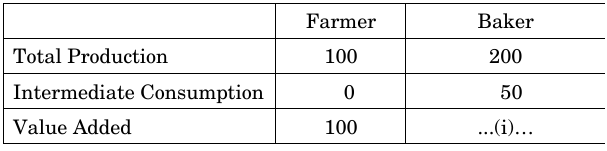
On the basis of the given table, estimate the value added by the Baker
Select the correct formula to calculate the value of Marginal Propensity to Save (MPS) : I.Change in Savings (ΔS)/Change in Consumption (ΔC)
II Change in Savings (ΔS)/Change in Income (ΔY)
III.1−Marginal Propensity to Consume (MPC)
IV.Change in Income (ΔY)/Change in Savings (ΔS)
Read the following statements carefully :
Statement I : Trade in services includes both factor income and non-factor income transactions. Statement II : Current Account includes transactions related to goods, services and unilateral transfers.
In the light of the given statements, choose the correct option from the following :
Suppose in a hypothetical economy, Y = 50 + 0·8Y + 100, where Y = National Income. The value of Investment Multiplier (K) would be ___________.
(Choose the correct option to fill in the blank)
“Consumption of a good by a person does not reduce the amount available for consumption by others. Consumers consuming such goods are known as free-riders.”
Identify the type of goods indicated in the above text.
Read the following statements carefully :
Statement I : At the break-even level of income, the value of slope of the consumption curve is zero.
Statement II : Marginal Propensity to Consume (MPC) refers to the change in consumption per unit change in income. In the light of the given statements, choose the correct option from the following :
Read the following statements carefully :
Statement I : Inland waterways proved to be uneconomical as in the case of Coast Canal on the Orissa coast.
Statement II : British government followed an effective and efficient administrative set-up leaving a legacy of effective work culture.
In the light of the given statements, choose the correct option from the following :
Arrange the following events of Pakistan in correct chronological order
I. Nationalisation of capital goods industries
II. Establishment of Pakistan
III. Introduction of economic reforms
IV. Announcement of First Five Year Plan
Read the following statements : Assertion (A) and Reason (R). Choose the correct option from those given below :
Read them carefully and select the correct option :
Assertion (A) : The unemployment problem in India is multifaceted. Reason (R) : Some individuals work round the year, while others work only a few months in a year.
Minimum Support Price is fixed by the Government to safeguard the interests of the ___________.
(Choose the correct option to fill in the blank)
The primary outcome of the efforts initiated by the Indian Government (Liberalisation and Privatisation) under the New Economic Policy of 1991 was __________.
Read the following text carefully :
“Between 1966 – 67, Mao introduced this movement under which professionals and students were asked to work and learn from the countryside of China.”
Identify the correct option with reference to the aforesaid text.
Read the following statements carefully
Statement I : Livestock provides alternative livelihood options to small and marginal farmers.
Statement II : In rural areas, animal husbandry provides stable employment opportunities throughout the year.
In the light of the given statements, choose the correct option from the following :
The steep Indian education pyramid indicates _____________.
Identify, which of the following is an income indicator.
Section B
State the meaning and any two components of Gross Domestic Capital formation.
“It is not the nature of a good, rather the economic nature of its use, which determines whether it is a final good or not.”
Justify the given statement with valid arguments.
US administration has recently imposed tariff to the magnitude of 50%.”
In the light of given statement, explain the likely impact of this step on the exports of India.
Describe the role which India has played as an important member of World Trade Organisation (WTO).
Critically appraise the Industrial Licensing policy initiated by the government during the planning period of India.
“Some economists argue that once a technology proves to be profitable and becomes widely adopted, subsidies should be gradually withdrawn.”
Defend or refute the given statement with valid arguments.
Section C
Distinguish between Revenue Expenditure and Capital Expenditure with the help of suitable examples.
Using suitable examples, distinguish between Revenue Receipts and Capital Receipts.
Estimate the value of incremental investment if, equilibrium level of income increases by ₹ 50,000 crore and half of additional income is always saved in the economy.
The Reserve Bank of India (RBI) has decided to increase the loan amount to 90% of the security value, from the prior rate of 80%.”
In the light of above statement, identify the type of monetary measure exercised by the Reserve Bank of India (RBI) and its likely impacts on the Aggregate Demand of the economy.
Describe the role of government in improving the efficiency of human capital formation in India.
“Traditional knowledge and practices are still applicable in ensuring sustainable development.”
Do you agree with the given statement ? Support your answer with valid reasons.
On the basis of the given data, comment on trends of output growth in different sectors (1980 – 2018), between India and Pakistan.

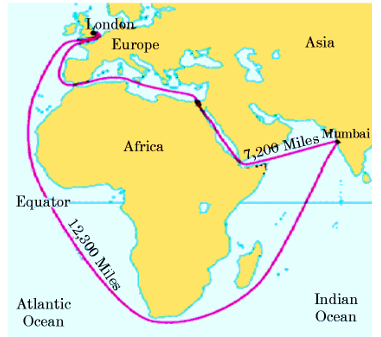
Study the given image carefully and answer the questions that follow
(i) Identify the artificial waterway during colonial rule that served as a highway between India and Britain.
(ii) In which year was this artificial maritime route officially opened for international navigation ?
(iii) Describe the economic significance of artificial waterways between the Mediterranean and the Red Sea.
“The real motive behind infrastructural development under the British rule was not to provide basic amenities to the people of India, but to subserve various colonial interests.”
Do you agree with the given statement ? Give valid reasons in support of your answer.
Section D
(i) Distinguish between Real Gross Domestic Product and Nominal Gross Domestic Product using a numerical example.
(ii) Define the concept of ‘Externalities’.
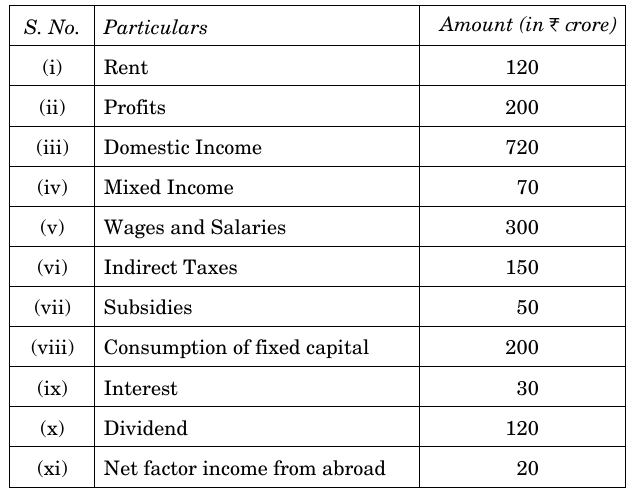
Calculate the values of Operating Surplus and Gross Domestic Product at Market Price (GDP_ MP) from the following data :
Read the following passage carefully :
Any institution which accepts deposits from the public and advances loans is a bank. Banks are broadly categorised into :
• Commercial Banks, and
• Central Bank.
Commercial banks accept deposits from public and use these deposits for giving loans. Banks keep a fraction of deposits as reserves. Generally, all depositors do not demand their money at the same time. The Central Bank of a country is responsible for controlling credit creation. The Reserve Bank of India (RBI) regulates the money supply in India through its monetary policy.
On the basis of the above passage and common understanding, answer the following questions :
(i) State the meaning of a Bank.
(ii) Mention any two traits that distinguish Central Bank from Commercial Banks.
(iii) “Open market operation is the tool used by Reserve Bank of India (RBI) to regulate money supply in the economy.”
Justify the given statement with valid arguments.
(i) “Information Technology plays a very significant role in achieving sustainable development and food security.”
Justify the given statement with valid arguments.
(ii) State the meaning of ‘self-employed worker’ with suitable example.
(i) Distinguish between formal and informal sector with suitable examples.
(ii) Define worker population ratio with its significance.
Read the following passage carefully :
In the present times, green investment and sustainability are priorities in public policy. India has emerged as a global leader at the front of the climate change.
India has pledged to seek solutions for the future. The government has contributed to maintain economic growth by implementing various policies and measures relating to sustainable development. Pradhan Mantri Ujjwala Scheme has actively contributed to cleaner air. The Jal Jeevan Mission was launched with the objective of achieving water security.
The greenhouse effect is a natural process that warms the Earth’s surface, where certain atmospheric gases, known as greenhouse gases, trap heat from the sun and re-emit it, keeping the planet warm enough to support life. In the present times, the issue of greenhouse gases and rising temperature of the Earth are a global concern.
On basis of the above passage and common understanding, answer the following questions :
(a) Discuss any two steps involved in attaining sustainable development in India.
(b) Mention any two factors which challenged the carrying capacity of the environment.
(c) Define Greenhouse effect.
Paper Details
CBSE Board Exam 2026
Class
Class 12 Commerce
Subject
Economics
Year
2026
Set
Set 3
Other Years — Economics