Class 6 . Mathematics . Ganita Prakash . Perimeter and Area
Chapter 6: Perimeter And Area
Ch 6
Mathematics
Class 6
Perimeter Part-1
Perimeter of a Closed Figure
Perimeter — The perimeter of a closed plane figure is the distance travelled along its boundary once.
Key idea
- Polygon: A closed figure made of line segments.
- Finding perimeter: Add the lengths of all sides; this gives the total distance around the outer boundary.
- Units: Perimeter is measured in units of length, such as cm or m.
Add the lengths of every side.
Find a Polygon's Perimeter
- Write down the length of each side.
- Add all the side lengths.$$P=s_1+s_2+\cdots+s_n$$
- State the answer with the correct length unit.
Find the perimeter of a triangle with side lengths \(5\) cm, \(4\) cm and \(3\) cm.
- A triangle has sides of lengths \(5\) cm, \(4\) cm and \(3\) cm. Add its side lengths.$$P=5+4+3=12\text{ cm}$$
Perimeter of a Rectangle
Rectangle perimeter — The perimeter of a rectangle is the sum of its four side lengths.
Key properties
- Opposite sides: They are equal in length.
- Shortcut: Add the length and breadth, then double the sum.
Here, \(l\) is the length and \(b\) is the breadth.
Find a Rectangle's Perimeter
- Identify the rectangle's length and breadth.
- Add them and multiply the sum by \(2\).$$P=2(l+b)$$
- Write the result in the same length unit as the sides.
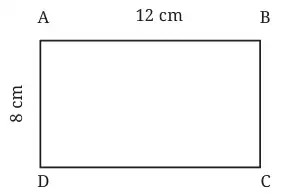
Find the perimeter of a rectangle with length \(12\) cm and breadth \(8\) cm.
- Use \(l=12\) cm and \(b=8\) cm in the rectangle formula.$$P=2(l+b)$$
- Add the length and breadth, then multiply by \(2\).$$P=2(12+8)=2(20)=40\text{ cm}$$
Perimeter of a Square
Square perimeter — The perimeter of a square is the sum of its four equal side lengths.
Key property
- All sides equal: Multiply the length of one side by \(4\) to find the perimeter.
- Practical use: The perimeter gives the length needed to go all around a square, such as tape around a frame.
Here, \(s\) is the length of one side.
Find a Square's Perimeter
- Find the length of one side.
- Multiply that length by \(4\).$$P=4s$$
- State the result in the side's length unit.
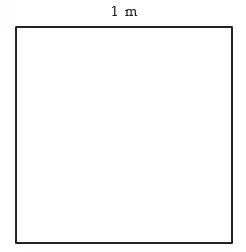
How much tape is needed to go all around a square photo frame with side length \(1\) m?
- A square photo frame has side length \(1\) m. Multiply the side by \(4\).$$P=4s=4\times1=4\text{ m}$$
Do not find area when asked for perimeter: perimeter adds boundary lengths and uses units such as cm or m, not square units.
Find the perimeter of a triangle with side lengths \(7\) cm, \(6\) cm and \(5\) cm.
Find the perimeter of a rectangle with length \(9\) cm and breadth \(4\) cm.
Find the perimeter of a square with side length \(6\) m.
Quick recap
- Perimeter is the distance around a closed figure once.
- For a polygon, add the lengths of all its sides.
- Rectangle perimeter: \(P=2(l+b)\).
- A rectangle has equal opposite sides.
- Square perimeter: \(P=4s\) because all four sides are equal.
- Perimeter is expressed in length units, such as cm or m.
Perimeter Part-2
Perimeter of a Triangle
Perimeter of a triangle — The perimeter of a triangle is the sum of the lengths of its three sides.
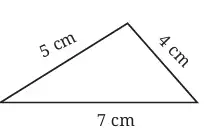
Find the perimeter of a triangle with side lengths \(4\text{ cm}\), \(5\text{ cm}\), and \(7\text{ cm}\).
- Add the three side lengths.$$P=4+5+7$$
- Evaluate the sum.$$P=16\text{ cm}$$
Perimeter of Rectangles and Squares
Key properties
- Rectangle: Opposite sides are equal, so its perimeter is twice the sum of its length and breadth.
- Square: All four sides are equal, so its perimeter is four times one side.
- Reverse calculation: Use the perimeter formula to find a missing length, breadth, or side.
- Boundary uses: The perimeter gives the length of lace or fencing needed to go once around a shape.
Use these formulas for one complete boundary.
How much lace is needed to go all around a rectangular tablecloth measuring \(3\text{ m}\) by \(2\text{ m}\)?
- A tablecloth is \(3\text{ m}\) long and \(2\text{ m}\) wide. Substitute these dimensions into the rectangle formula.$$P=2(l+b)=2(3+2)$$
- Simplify to find the lace length needed around the tablecloth.$$P=2\times5=10\text{ m}$$
If \(P=2(l+b)\), then \(l=\frac{P}{2}-b\) or \(b=\frac{P}{2}-l\). For a square, \(s=\frac{P}{4}\).
Perimeter for Repeated Rounds and Equal-Sided Shapes
Distance for repeated rounds — For complete laps of a track, total distance equals the track perimeter multiplied by the number of rounds.
For a shape with equal sides, multiply the side length by the number of sides.
How far does Usha travel in three rounds of a square park with side length \(75\text{ m}\)?
- A square park has side length \(75\text{ m}\). Find the perimeter for one round.$$P=4\times75=300\text{ m}$$
- Multiply the one-round distance by the three rounds.$$D=3\times300=900\text{ m}$$
Applying perimeter
- Wire reshaping: The wire length stays the same, so the original shape's perimeter equals the new shape's perimeter.
- Equal-sided shapes: A \(36\text{ cm}\) string makes a square with side \(9\text{ cm}\), an equilateral triangle with side \(12\text{ cm}\), or a regular hexagon with side \(6\text{ cm}\).
- Fencing cost: First find the perimeter, then multiply by the cost per metre.
- Multiple fence rounds: Multiply the perimeter by the number of rounds of fencing.
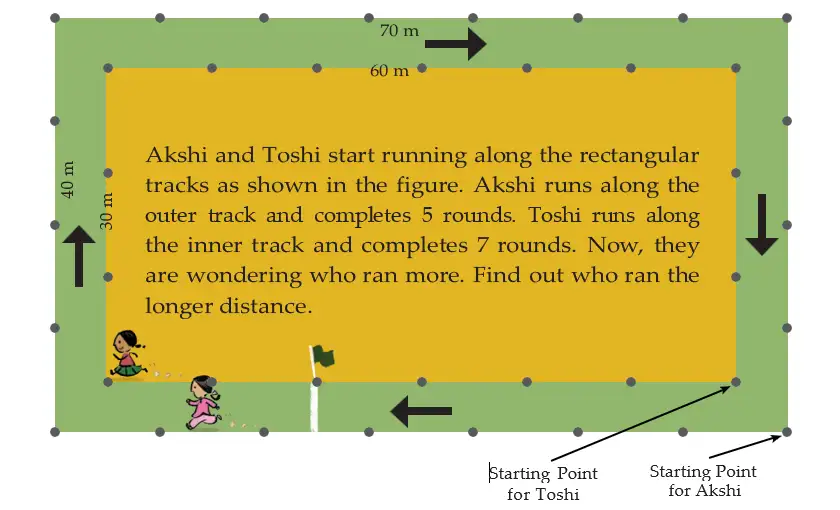
Track calculations
- Akshi's track: Dimensions are \(70\text{ m}\) by \(40\text{ m}\); one round is \(2(70+40)=220\text{ m}\), so five rounds cover \(1{,}100\text{ m}\).
- Toshi's track: One round is \(180\text{ m}\), so seven rounds cover \(1{,}260\text{ m}\); Toshi runs farther.
- Position after a distance: Divide the distance by the track perimeter; the quotient gives full rounds and the remainder gives the distance into the next round.
- After \(1{,}000\text{ m}\): Akshi completes \(4\) rounds with \(120\text{ m}\) left; Toshi completes \(5\) rounds with \(100\text{ m}\) left.
A triangle has perimeter \(55\text{ cm}\). Two sides are \(20\text{ cm}\) and \(14\text{ cm}\). Find the third side.
A rectangular park is \(150\text{ m}\) long and \(120\text{ m}\) wide. Fencing costs Rs. \(40\) per metre. Find the total cost for one boundary.
A farmer fences a rectangular field measuring \(230\text{ m}\) by \(160\text{ m}\) with three rounds of rope. Find the rope length needed.
Do not multiply a perimeter by the number of rounds if the question asks for one boundary only; multiply only when multiple complete rounds are required.
Quick recap
- Triangle perimeter is the sum of its three sides.
- Rectangle perimeter is \(2(l+b)\); square perimeter is \(4s\).
- For repeated rounds, total distance equals perimeter multiplied by the number of rounds.
- For an equal-sided polygon, perimeter is the number of sides times one side length.
- Wire reshaping preserves perimeter; fencing cost equals perimeter times cost per metre.
- To find a track position after a distance, use the remainder after dividing by one-round distance.
Perimeter Part-3
Perimeter — The perimeter of a closed figure is the total length of its boundary.
Race tracks and a common finish line
Choosing starting points
- Same race distance: Runners on different tracks can start at different positions and still cover the same distance to a common finish line.
- Inner square track: With side length \(100\text{ m}\), the route from its start to the finish is \(100+100+100+50=350\text{ m}\).
- Outer square track: With side length \(150\text{ m}\), the route from its start to the finish is \(125+150+75=350\text{ m}\).
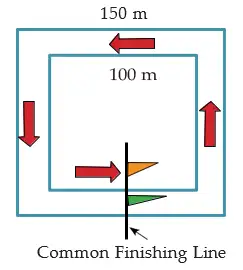
How far does each runner travel to the common finish line on the two square tracks?
- Find the distance from each stated starting point to the common finish line.
- Add the three full sides and the remaining half-side on the inner track.$$100+100+100+50=350\text{ m}$$
- Add the stated sections of the outer track.$$125+150+75=350\text{ m}$$
Straight and diagonal units
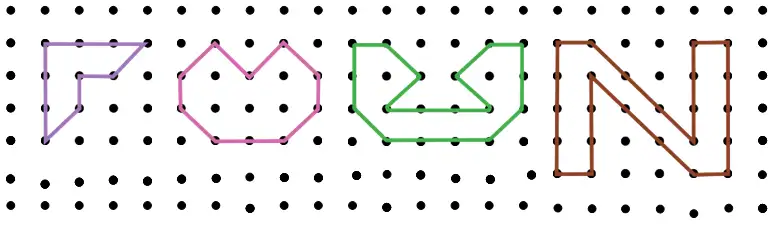
Straight and diagonal units — On a dot grid, straight units are horizontal or vertical segments, while diagonal units are slanting segments.
Expressing a dot-grid perimeter
- Different lengths: A diagonal of a square is longer than one of its sides, so a diagonal unit is longer than a straight unit.
- Triangle: The perimeter shown has \(6\) straight units and \(3\) diagonal units, written as \(6s+3d\) units.
- Comparison: Because \(d>s\), the triangle's perimeter is more than \(9\) straight units.
- Other figures: The given dot-grid perimeters are \(8s+2d\), \(4s+6d\), \(12s+6d\), and \(18s+6d\).
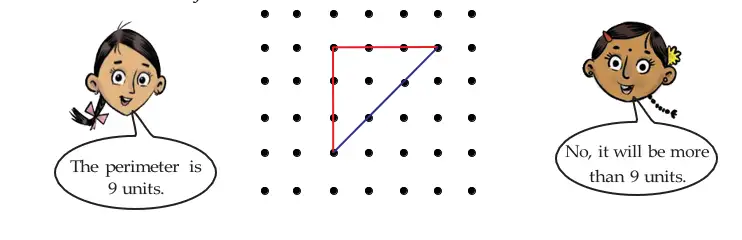
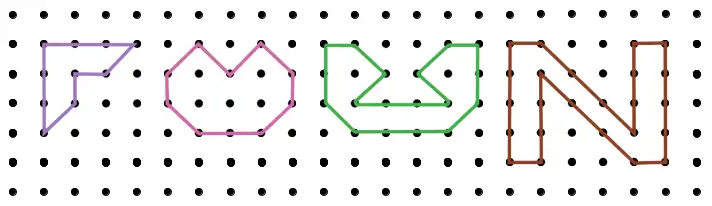
A dot-grid triangle has \(6\) straight units and \(3\) diagonal units. Is its perimeter \(9\) straight units?
Perimeter of regular polygons
Regular polygon — A regular polygon is a closed figure with all sides equal and all angles equal.
Examples and perimeter
- Equilateral triangle: It has three equal sides and three equal angles.
- Square: It has four equal sides and four equal angles.
- Regular pentagon: It has five equal sides and five equal angles.
- General rule: Add the equal side lengths, or multiply one side length by the number of sides.
Use when all sides have the same length.
An equilateral triangle has three sides of equal length.
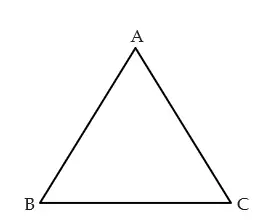
A regular polygon has \(n\) sides, each of length \(s\). Write its perimeter.
Split and rejoin
Perimeter after joining pieces — After pieces are joined, the perimeter is the length of the new outside boundary; edges joined inside the shape are not counted.
Rearranging the paper pieces
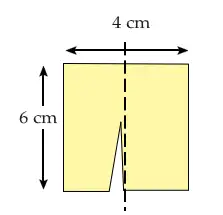
- Starting shape: A rectangular paper chit measures \(6\text{ cm}\times4\text{ cm}\) and is cut into two equal pieces.
- Rearrangement: Joining the same pieces in different ways can change the perimeter.
- Count the boundary: Add only the lengths around the outside of the new shape.
- Given arrangement: The arrangement shown as a rectangle measuring \(12\text{ cm}\times2\text{ cm}\) has perimeter \(28\text{ cm}\).
For the given rectangular arrangement, add the lengths of all four sides.
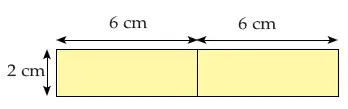
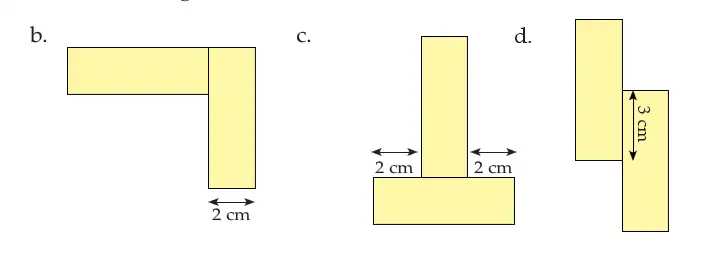
Target perimeter
- Challenge: Arrange the two pieces to make a figure whose outside boundary has a perimeter of \(22\text{ cm}\).
Quick recap
- Runners on different tracks can reach the same finish after travelling an equal race distance.
- On a dot grid, record straight and diagonal boundary units separately; diagonal units are longer.
- A regular polygon has equal sides and equal angles.
- For a regular polygon, perimeter equals number of sides multiplied by one side length.
- After joining pieces, count only the outside boundary; internal joined edges are excluded.
- The given \(12\text{ cm}\times2\text{ cm}\) arrangement has perimeter \(28\text{ cm}\).
Area Part-1
Area and Basic Formulas
A rectangular floor is \(5\text{ m}\) long and \(4\text{ m}\) wide. Find its area.
- Use the rectangle area formula.$$A=l\times w$$
- Substitute the floor's length and width.$$A=5\times4=20\text{ m}^2$$
Finding an Uncovered Area
A \(3\text{ m}\) square carpet is laid on a \(5\text{ m}\) by \(4\text{ m}\) floor. Find the floor area that is not carpeted.
- Find the floor area.$$5\times4=20\text{ m}^2$$
- Find the square carpet's area.$$3\times3=9\text{ m}^2$$
- Subtract the carpet area from the floor area.$$20-9=11\text{ m}^2$$
Composite Shapes and Area Applications
Four square flower beds, each with side \(4\text{ m}\), are placed in the corners of land measuring \(12\text{ m}\) by \(10\text{ m}\). Find the remaining land area.
- Find the area of the whole rectangular land.$$12\times10=120\text{ m}^2$$
- Find the total area of the four square beds.$$4\times(4\times4)=64\text{ m}^2$$
- Subtract the beds' area from the land area.$$120-64=56\text{ m}^2$$
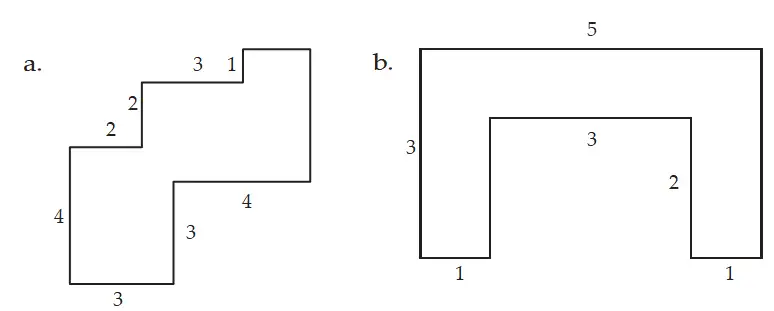
A rectangular garden has area \(300\text{ m}^2\) and length \(25\text{ m}\). Find its width.
A rectangular plot is \(500\text{ m}\) by \(200\text{ m}\). Tiling costs Rs. 8 per \(100\text{ m}^2\). Find the total cost.
A rectangular coconut grove is \(100\text{ m}\) by \(50\text{ m}\). Each tree needs \(25\text{ m}^2\). What is the maximum number of trees?
Tangram Piece Areas
If shapes C and E have equal area and together exactly cover shape D, express the area of D in terms of the area of C.
- Use the given equality of the areas of C and E.$$A_E=A_C$$
- Add the areas of C and E to obtain the area of D.$$A_D=A_C+A_E=A_C+A_C=2A_C$$
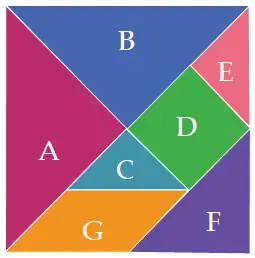
Do not assume that equal areas mean equal perimeters. Rearranged tangram pieces retain the same total area, but their outer boundary can change.
Quick recap
- Area measures the region enclosed by a closed figure and is expressed in square units.
- Rectangle area is length times width; square area is side times side.
- Remaining area equals whole area minus the area covered or occupied.
- Split composite figures into familiar shapes and add or subtract their areas.
- Rearranging tangram pieces preserves total area, but can change perimeter.
Area Part-2
Estimating the Area of Irregular Shapes
Area — Area is the amount of surface enclosed by a closed shape; it is measured in square units.
Grid estimation rules
- Unit square: A square measuring \(1\) unit by \(1\) unit has area \(1\) square unit.
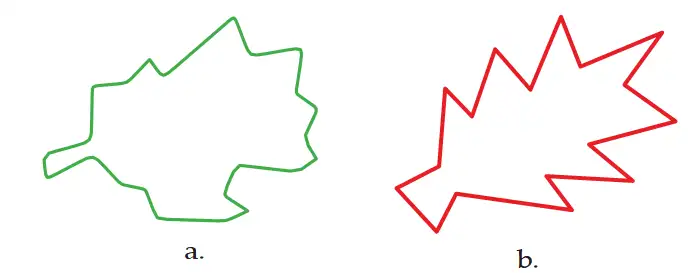
- Grid estimate: Use squared or graph paper to estimate the area of a shape without a simple formula.
- More than half: Count a part-square as \(1\) square unit.
- Exactly half: Count it as \(\frac{1}{2}\) square unit.
- Less than half: Ignore the part-square.
| Part of a square | Area counted |
|---|---|
| More than half | \(1\) square unit |
| Exactly half | \(\frac{1}{2}\) square unit |
| Less than half | Ignore |
Use this to estimate a shape’s area from a grid.
Estimate Area Using a Grid
- Count the complete unit squares inside the shape.
- Classify each partly covered square as more than half, exactly half, or less than half.
- Add full squares and more-than-half squares; count exactly half-squares as halves.$$A\approx F+M+\frac{1}{2}H$$
- State the estimate in square units.
A grid shape contains \(8\) full squares, \(3\) squares more than half full, \(2\) exactly half full, and \(4\) less than half full. Estimate its area.
- The grid shape has full squares and more-than-half squares; count each as one.$$8+3=11$$
- Count the exactly half-full squares as halves and ignore the less-than-half squares.$$11+2\times\frac{1}{2}=12$$
Why Squares Are Used as Area Units
Square unit — A square unit is a standard area unit that can cover a surface neatly with identical squares.
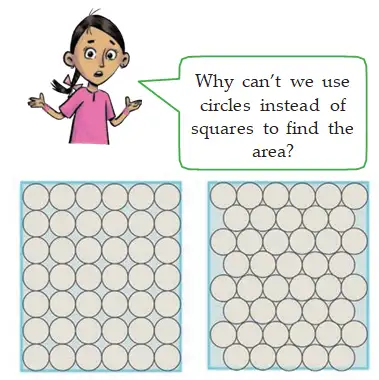
Identical squares fit edge-to-edge and cover a region without gaps or overlaps, making area easier to measure and compare. Circles leave gaps when packed, so they are less suitable as area units.
Comparing area units
- Squares: Equal squares tile a surface without gaps or overlaps.
- Circles: Circles cannot be packed tightly without gaps, so counting them gives a less convenient measurement.
- Illustration: Two arrangements of circles covering the same rectangle use \(42\) circles and \(44\) circles, showing that the count can vary with the arrangement.
Rectangles with a Fixed Area
Fixed-area rectangles — Rectangles with the same area can have different side lengths and therefore different perimeters.
For whole-number side lengths, possible rectangles come from the factor pairs of the area. The most unequal pair gives the greatest perimeter; the pair closest in size gives the least.
Key points
- Factor pairs: For a given whole-number area, list the factor pairs to find all whole-number side-length options.
- Perimeter: Compare the perimeters of those rectangles; equal areas do not necessarily mean equal perimeters.
Use the area formula to find possible side pairs, then compare their perimeters.
Compare Perimeters for a Fixed Area
- Find the factor pairs of the given whole-number area.
- Use each pair as the rectangle's length and width.
- Calculate each perimeter.$$P=2(l+w)$$
- Compare the results to identify the greatest and least perimeters.
Among rectangles with whole-number side lengths and area \(24\) square units, which has the greatest perimeter and which has the least?
- List the factor pairs for rectangles with area \(24\) square units.$$(1,24),\ (2,12),\ (3,8),\ (4,6)$$
- Calculate the perimeter for each pair.$$2(1+24)=50,\quad 2(2+12)=28,\quad 2(3+8)=22,\quad 2(4+6)=20$$
- Compare the results to find the greatest and least perimeters.$$50>28>22>20$$
Do not assume equal areas have equal perimeters; calculate and compare the perimeters of the possible factor pairs.
A grid region has \(6\) full squares, \(2\) squares more than half full, \(3\) exactly half full, and \(5\) less than half full. Estimate its area.
Find the greatest and least perimeters of rectangles with whole-number side lengths and area \(32\) square centimetres.
Give one reason squares are more convenient than circles for measuring area by covering a region.
Quick recap
- Area measures the surface enclosed by a shape and is expressed in square units.
- For grid estimates, count more-than-half squares as whole, exactly half as half, and less-than-half as zero.
- Squares are convenient area units because they cover a surface without gaps or overlaps; circles leave gaps.
- The same rectangle can be covered by different circle arrangements, with counts of \(42\) and \(44\) circles.
- For a fixed whole-number area, factor pairs give possible whole-number rectangle dimensions.
- Among those rectangles, the most unequal factor pair gives the greatest perimeter and the closest pair gives the least.
Area of a Triangle Part-1
A Rectangle’s Diagonal and Triangle Areas
Diagonal — A diagonal is a line segment joining two opposite corners of a polygon.
A diagonal divides a rectangle into two equal-area triangles. Each triangle has half the area of the rectangle; the same relationship holds for a square.
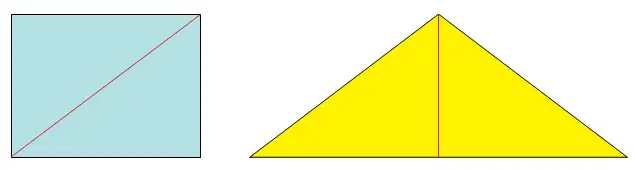
Comparing Triangle and Rectangle Areas
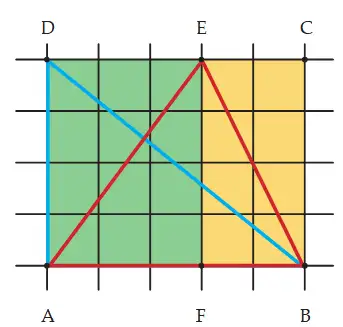
Key area relationships
- Triangle BAD: It has half the area of rectangle ABCD.
- Triangles BAD and ABE: They have the same area, even though they look different.
- Triangle ABE: Split it into triangles AEF and BEF; each part is half the area of its corresponding rectangle.
- Grid paper: A grid can help compare or find the area of a triangle and a rectangle.
Here, \(b\) is the base and \(h\) is the perpendicular height to that base. This is half the area of a rectangle with the same base and height.
Find the area using a matching rectangle
- Identify the triangle’s base and the perpendicular height to it.$$b,\ h$$
- Find the area of a rectangle with the same base and height.$$A_{\text{rectangle}}=bh$$
- Take half of the rectangle’s area and use square units.$$A_{\triangle}=\frac{1}{2}bh$$
Show how the area of triangle ABE relates to the area of rectangle ABCD.
- Split triangle ABE into triangles AEF and BEF.$$A_{\triangle ABE}=A_{\triangle AEF}+A_{\triangle BEF}$$
- Each smaller triangle is half the area of its corresponding rectangle.$$A_{\triangle AEF}=\frac{1}{2}A_{\text{AFED}},\quad A_{\triangle BEF}=\frac{1}{2}A_{\text{BFEC}}$$
- Add the two parts; rectangles AFED and BFEC together form rectangle ABCD.$$A_{\triangle ABE}=\frac{1}{2}(A_{\text{AFED}}+A_{\text{BFEC}})=\frac{1}{2}A_{\text{ABCD}}$$
The height in \(A=\frac{1}{2}bh\) must be perpendicular to the chosen base; a sloping side is not automatically the height.
A rectangle has area \(R\). A diagonal divides it into two triangles. What is the area of each triangle?
Triangle BAD is half of rectangle ABCD. Write its area in terms of the rectangle’s area.
Quick recap
- A diagonal divides a rectangle or square into two equal-area triangles.
- Each triangle formed this way has half the area of the rectangle.
- A triangle can be split into smaller triangles whose areas add together.
- The area formula is \(A=\frac{1}{2}bh\), where height is perpendicular to the base.
- Triangles BAD and ABE in the grid comparison have equal areas.
Area of a Triangle Part-2
Finding the Area of Composite Shapes
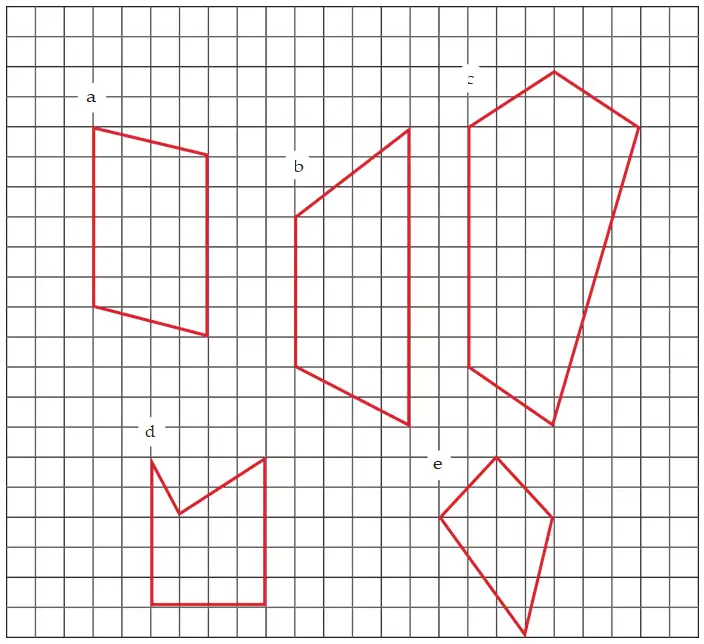
| Shape | a | b | c | d | e |
|---|---|---|---|---|---|
| Area | 24 square units | 30 square units | 48 square units | 16 square units | 12 square units |
Area by Splitting a Shape
- Divide the figure into familiar, non-overlapping shapes.
- Find each part's area using its formula.
- Add the areas, or subtract the missing part.
- Write the result in square units.
What is the total area of the composite shape?
- A composite shape has a rectangle measuring \(6\) units by \(4\) units and a triangle with base \(4\) units and height \(3\) units.
- Find the rectangle's area.$$6 \times 4 = 24$$
- Find the triangle's area.$$\frac{1}{2} \times 4 \times 3 = 6$$
- Add the two areas.$$24 + 6 = 30$$
Perimeter of Shapes Made from Unit Squares
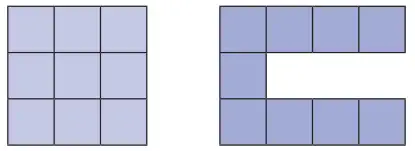
For unit squares, \(n\) is the number of squares and \(e\) is the number of pairs sharing a full side.
| Arrangement | Perimeter |
|---|---|
| Smallest: \(3 \times 3\) square (the only outline with this perimeter) | \(12\) units |
| Largest: \(9 \times 1\) strip | \(20\) units |
| Other outlines | A perimeter of \(18\) units is possible; some perimeters have more than one outline. |
Find the perimeter of the arrangement.
- A \(3 \times 3\) square is made from nine unit squares; it has \(12\) shared pairs of sides.
- Substitute the number of squares and shared-side pairs.$$P = 4(9) - 2(12)$$
- Evaluate.$$P = 36 - 24 = 12$$
Do not count a shared side as part of the outside boundary. Each shared side reduces the total by \(2\) units.
How Attaching a Square Changes Perimeter
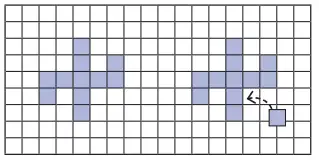
If the new square shares \(k\) full sides with the existing figure, this gives the change in perimeter.
Does the perimeter increase, decrease, or stay the same?
- A new square is attached by sharing two full sides.$$k = 2$$
- Use the perimeter-change rule.$$\Delta P = 4 - 2(2)$$
- Evaluate the change.$$\Delta P = 0$$
Area and Perimeter in House Plans
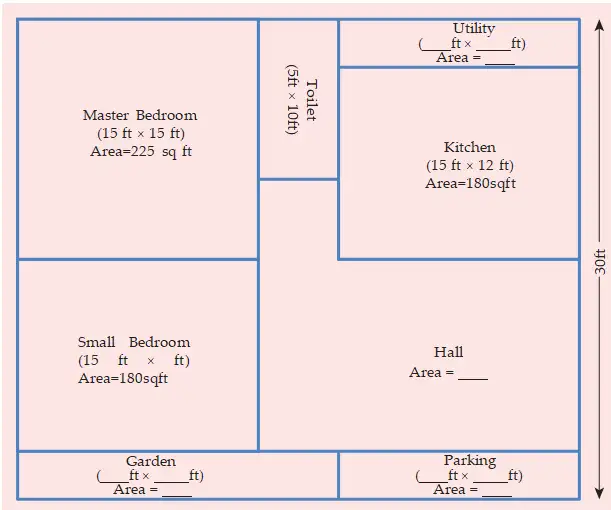
| Room | Dimensions | Area |
|---|---|---|
| Small bedroom | \(15\text{ ft} \times 12\text{ ft}\) | \(180\text{ ft}^2\) |
| Utility | \(15\text{ ft} \times 3\text{ ft}\) | \(45\text{ ft}^2\) |
| Hall | \(20\text{ ft} \times 12\text{ ft}\) | \(240\text{ ft}^2\) |
| Parking | \(15\text{ ft} \times 3\text{ ft}\) | \(45\text{ ft}^2\) |
| Garden | \(20\text{ ft} \times 3\text{ ft}\) | \(60\text{ ft}^2\) |
| Whole rectangular plan | \(35\text{ ft} \times 30\text{ ft}\) | \(1050\text{ ft}^2\) |
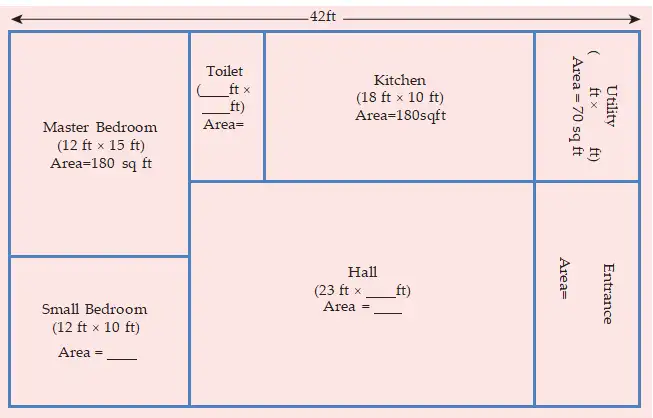
| Room | Dimensions | Area |
|---|---|---|
| Utility | \(7\text{ ft} \times 10\text{ ft}\) | \(70\text{ ft}^2\) |
| Hall | \(23\text{ ft} \times 15\text{ ft}\) | \(345\text{ ft}^2\) |
| Entrance | \(7\text{ ft} \times 15\text{ ft}\) | \(105\text{ ft}^2\) |
| Small bedroom | \(12\text{ ft} \times 10\text{ ft}\) | \(120\text{ ft}^2\) |
| Toilet | \(5\text{ ft} \times 10\text{ ft}\) | \(50\text{ ft}^2\) |
| Whole rectangular plan | \(42\text{ ft} \times 25\text{ ft}\) | \(1050\text{ ft}^2\) |
Use \(l\) for length and \(b\) for breadth.
| Point | Charan | Sharan |
|---|---|---|
| Outer dimensions | \(35\text{ ft} \times 30\text{ ft}\) | \(42\text{ ft} \times 25\text{ ft}\) |
| Area | \(1050\text{ ft}^2\) | \(1050\text{ ft}^2\) |
| Perimeter | \(130\text{ ft}\) | \(134\text{ ft}\) |
Compare the areas and perimeters of the two plans.
- Charan's outer plan is \(35\text{ ft} \times 30\text{ ft}\); Sharan's is \(42\text{ ft} \times 25\text{ ft}\).
- Calculate both areas.$$35 \times 30 = 1050, \qquad 42 \times 25 = 1050$$
- Find Charan's perimeter.$$2(35+30) = 130$$
- Find Sharan's perimeter.$$2(42+25) = 134$$
Area Maze Puzzles
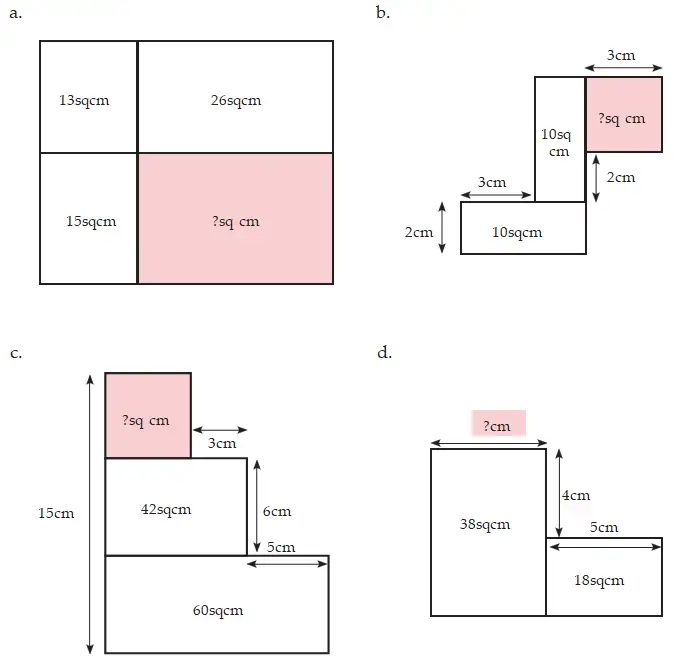
| Puzzle | Missing value |
|---|---|
| a | \(30\text{ cm}^2\) |
| b | \(9\text{ cm}^2\) |
| c | \(16\text{ cm}^2\) |
| d | \(5\text{ cm}\) |
When the area and one side are known, divide the area by the known side.
Find the rectangle's breadth.
- A rectangle has area \(45\text{ cm}^2\) and length \(9\text{ cm}\).
- Divide the area by the known side.$$b = \frac{45}{9}$$
- Calculate the breadth.$$b = 5\text{ cm}$$
A composite shape is a \(5\text{ cm} \times 4\text{ cm}\) rectangle joined to a triangle with base \(4\text{ cm}\) and height \(3\text{ cm}\). Find the total area.
A new unit square is attached along one full side to a figure with perimeter \(24\) units. Find the new perimeter.
A rectangle has area \(72\text{ cm}^2\) and length \(9\text{ cm}\). Find its breadth.
Quick recap
- Split composite shapes into rectangles and triangles; add their areas or subtract missing parts.
- Rectangle area is \(A = l \times b\); triangle area is \(A = \frac{1}{2}bh\).
- Nine unit squares have smallest perimeter \(12\) units, made only by the \(3 \times 3\) square; a \(9 \times 1\) strip has the largest, \(20\) units.
- For \(n\) unit squares with \(e\) shared side-pairs, perimeter is \(P = 4n - 2e\).
- Adding a square that shares \(k\) sides changes perimeter by \(\Delta P = 4 - 2k\).
- Equal areas can have different perimeters: both house plans have area \(1050\text{ ft}^2\), but their perimeters are \(130\text{ ft}\) and \(134\text{ ft}\).
Area of a Triangle Part-3
Area of rectangles
Area of a rectangle — The area of a rectangle is the surface it covers, found by multiplying its length by its width.
The area is the product of the side lengths. If area and one side are known, divide the area by that side to find the other dimension.
Use this to find area or an unknown side.
Add areas to make a rectangle
- Find the area of each rectangle.$$A_i=l_iw_i$$
- Add the areas, then choose dimensions whose product equals the total.$$A_{total}=A_1+A_2$$
Give possible dimensions of a rectangle whose area is the sum of the two given rectangle areas.
- Find the sum of the areas of rectangles measuring \(5\) m by \(10\) m and \(2\) m by \(7\) m.$$A_1=5\times10=50\text{ m}^2,\quad A_2=2\times7=14\text{ m}^2$$
- Add the areas and give one possible set of dimensions.$$A_{total}=50+14=64\text{ m}^2=8\times8\text{ m}^2$$
Area left uncovered
Remaining area — The remaining area is the total area minus the area covered or occupied.
For non-overlapping objects inside a region, subtract their combined area from the region's area to find what remains.
Add the areas of all covered parts before subtracting.
Find the area left over
- Calculate the area of the whole region.$$A_{whole}=lw$$
- Find the total area occupied by the objects.$$A_{covered}=\sum_i A_i$$
- Subtract the occupied area from the whole area.$$A_{remaining}=A_{whole}-A_{covered}$$
A \(15\) m by \(12\) m garden has four flower beds, each \(2\) m by \(1\) m. Find the lawn area.
- Find the garden's area.$$15\times12=180\text{ m}^2$$
- Find the total area of four flower beds, each measuring \(2\) m by \(1\) m.$$4\times(2\times1)=8\text{ m}^2$$
- Subtract the flower-bed area to find the area available for lawn.$$180-8=172\text{ m}^2$$
Area and perimeter are different
Perimeter — The perimeter is the total distance around the boundary of a shape.
Rectangles with the same area can have different perimeters; a smaller area can also have a greater perimeter than a larger area.
Use this to compare rectangle boundary lengths.
Give dimensions for two rectangles so that Shape A has area \(18\) square units and a greater perimeter than Shape B, whose area is \(20\) square units.
- Choose a rectangle of area \(18\) square units with perimeter greater than a rectangle of area \(20\) square units.$$A_A=2\times9=18,\quad P_A=2(2+9)=22$$
- Choose a rectangle of area \(20\) square units and find its perimeter.$$A_B=5\times4=20,\quad P_B=2(5+4)=18$$
- Compare the perimeters.$$22>18$$
More dimensions satisfying the shape conditions
- Shape A: Dimensions \(6\) by \(3\), \(2\) by \(9\), or \(18\) by \(1\) give area \(18\) square units and perimeters \(18\), \(22\), or \(38\) units.
- Shape B: Dimensions \(5\) by \(4\), \(10\) by \(2\), or \(20\) by \(1\) give area \(20\) square units and perimeters \(18\), \(24\), or \(42\) units.
- Valid pairing: Pair Shape A's \(2\)-by-\(9\) or \(18\)-by-\(1\) rectangle with Shape B's \(5\)-by-\(4\) rectangle to make Shape A's perimeter larger.
A rectangle with half the area
Fit an inner rectangle
- Outer area: A rectangle measuring \(12\) units by \(8\) units has area \(96\) square units.
- Half the area: The inner rectangle must have area \(48\) square units; an \(8\)-by-\(6\) rectangle works.
- Fit inside: Centering the \(8\)-by-\(6\) rectangle leaves space on all sides, so it does not touch the outer rectangle.
Cutting a square in half
Folded-square cut — Cutting a square along the fold after folding it in half makes two equal rectangles.
For a square of side \(s\), each rectangle measures \(s\) by \(\frac{s}{2}\). Together their perimeters equal \(\frac{3}{2}\) times the square's perimeter.
Which statement is always true when a square is cut into two rectangles along the fold?
- Let the square's side be \(s\). Find the perimeter of each half-rectangle.$$P_{one}=2\left(s+\frac{s}{2}\right)=3s$$
- Add the perimeters of both rectangles and compare with the square's perimeter.$$P_{two}=3s+3s=6s,\quad P_{square}=4s$$
- Write the ratio of their combined perimeter to the square's perimeter.$$\frac{P_{two}}{P_{square}}=\frac{6s}{4s}=\frac{3}{2}$$
A rectangular garden is \(50\) m long and has area \(1000\) m\(^2\). Find its width.
A \(5\) m by \(4\) m floor has a square carpet with side \(3\) m. Find the area not covered.
An outer rectangle measures \(12\) units by \(8\) units. Give dimensions for an inner rectangle that has half its area and does not touch the outer rectangle.
- Area measures covered surface; perimeter measures boundary length.
- When a square is cut in half along its fold, the combined perimeter of its two pieces is \(1\frac{1}{2}\) times the square's perimeter.
Quick recap
- Rectangle area is \(A=lw\); its perimeter is \(P=2(l+w)\).
- Add separate areas to find a combined area; divide area by a known side to find a missing dimension.
- Area left over equals total area minus the area covered or occupied.
- The \(15\) m by \(12\) m garden with four \(2\) m by \(1\) m beds leaves \(172\) m\(^2\) for lawn.
- Equal areas do not necessarily have equal perimeters; even a smaller-area rectangle can have a greater perimeter.
- A \(12\)-by-\(8\) outer rectangle has area \(96\) square units; an \(8\)-by-\(6\) inner rectangle has half that area.
- Cutting a square in half along its fold makes two rectangles whose combined perimeter is \(1\frac{1}{2}\) times the square's perimeter.
Summary
Perimeter
Use \(l\) for length, \(w\) for width, and \(s\) for the side of a square.
Find the perimeter of a rectangle with length \(8\) cm and width \(3\) cm.
- Find the perimeter of a rectangle with length \(8\) cm and width \(3\) cm.
- Substitute the dimensions into the rectangle formula.$$P=2(8+3)$$
- Add first, then multiply by \(2\).$$P=2\times11=22\text{ cm}$$
Area
Area — The area of a closed figure is the measure of the region enclosed by it.
Area facts
- Units: Area is generally measured in square units, such as square centimetres or square metres.
- Rectangle: Multiply its length by its width to find its area.
- Square: Multiply the length of one side by itself.
Use \(l\) for length, \(w\) for width, and \(s\) for the side of a square.
Estimate or find the area of an irregular region
- Count the unit squares covered by the region to estimate or determine its area.
- Alternatively, divide the region into rectangles and triangles whose areas can be calculated.
- Add the areas of the parts to find the total area.
Find the area of the combined region.
- A region is made from two non-overlapping rectangles: one measures \(4\) units by \(3\) units, and the other measures \(2\) units by \(3\) units.
- Find the area of each rectangle.$$A_1=4\times3=12,\quad A_2=2\times3=6$$
- Add the two areas.$$A=12+6=18\text{ square units}$$
Two closed figures can have the same area but different perimeters, or the same perimeter but different areas. For example, rectangles measuring \(1\) by \(6\) and \(2\) by \(3\) both have area \(6\) square units but perimeters \(14\) and \(10\) units; rectangles measuring \(1\) by \(5\) and \(2\) by \(4\) both have perimeter \(12\) units but areas \(5\) and \(8\) square units.
Find the perimeter of a square with side \(6\) cm.
Find the area of a rectangle with length \(9\) m and width \(4\) m.
A region is divided into \(3\) non-overlapping parts with areas \(5\), \(7\), and \(4\) square units. Find its total area.
Quick recap
- Perimeter is the sum of the lengths of a polygon's sides.
- A rectangle's perimeter is \(2(l+w)\); a square's is \(4s\).
- Area measures the region enclosed by a closed figure and is expressed in square units.
- A rectangle's area is \(lw\); a square's area is \(s^2\).
- Figures can share an area but have different perimeters, or share a perimeter but have different areas.
- Find or estimate a region's area by counting unit squares or splitting it into rectangles and triangles.