Fundamental Facts
A fraction represents a part of a whole. It is expressed as \( \frac{\text{Numerator}}{\text{Denominator}} \), where the denominator is not zero. To write a fraction correctly, all parts counted must be equal in size.
Introduction to Fractions
A fraction is a number that denotes a part of a whole or a group. It is written as \( \frac{a}{b} \) where \( b \neq 0 \). Fractions can be represented on a number line by dividing the segment between 0 and 1 into \( b \) equal parts and locating the point at \( a \) parts.
Types of fractions include:
- Proper fraction: Numerator less than denominator, e.g., \( \frac{1}{3} \).
- Improper fraction: Numerator greater than or equal to denominator, e.g., \( \frac{5}{3} \).
- Mixed fraction: Combination of a whole number and a proper fraction, e.g., \( 3 \frac{4}{5} \).
Equivalent fractions are fractions that represent the same value, found by multiplying or dividing numerator and denominator by the same non-zero number.
A fraction is in simplest form if numerator and denominator have no common factors other than 1.
Fractions
A fraction \( \frac{3}{5} \) means the whole is divided into 5 equal parts and 3 parts are taken. Examples include half \( \frac{1}{2} \) and quarter \( \frac{1}{4} \).
Example 1
Write the fraction of the shaded portions.
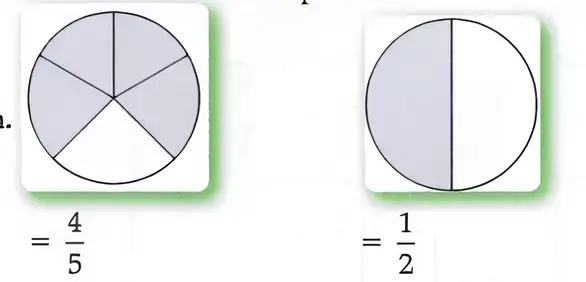
First circle: 5 equal parts, 4 shaded, fraction \( \frac{4}{5} \).
Second circle: 2 equal parts, 1 shaded, fraction \( \frac{1}{2} \).
Unit fractions are fractions with numerator 1, e.g., \( \frac{1}{2}, \frac{1}{3}, \frac{1}{4} \).
Keywords
- Fraction: part of a whole
- Numerator: number of parts taken
- Denominator: total equal parts
Fractions on the Number Line
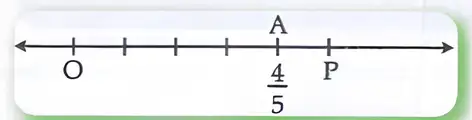
To represent \( \frac{4}{5} \) on a number line, divide the segment from 0 to 1 into 5 equal parts and mark the point at 4 parts.
Proper, Improper and Mixed Fractions
Proper fraction: Numerator less than denominator, e.g., \( \frac{1}{3} \).
Improper fraction: Numerator greater than or equal to denominator, e.g., \( \frac{5}{3} \).
Mixed fraction: Whole number plus proper fraction, e.g., \( 3 \frac{4}{5} \).
Conversion formulas:
Improper fraction to mixed number:
a. Divide numerator by denominator: \( \text{Quotient} = q, \text{Remainder} = r \)b. Write as \( q + \frac{r}{\text{denominator}} \)
Mixed number to improper fraction:
\[ \text{Improper fraction} = \frac{\text{denominator} \times \text{whole number} + \text{numerator}}{\text{denominator}} \]
Keywords
- Proper fraction: numerator < denominator
- Improper fraction: numerator ≥ denominator
- Mixed fraction: whole number + fraction
Equivalent Fractions
Fractions representing the same part of a whole are equivalent. For example, \( \frac{1}{4} = \frac{2}{8} = \frac{3}{12} = \frac{4}{16} \).
To find equivalent fractions, multiply or divide numerator and denominator by the same non-zero number.
Example: Find 5 equivalent fractions for \( \frac{11}{15} \):
\[ \frac{11 \times 2}{15 \times 2} = \frac{22}{30}, \frac{11 \times 3}{15 \times 3} = \frac{33}{45}, \frac{11 \times 5}{15 \times 5} = \frac{55}{75}, \frac{11 \times 10}{15 \times 10} = \frac{110}{150}, \frac{11 \times 20}{15 \times 20} = \frac{220}{300} \]
Simplest Form of a Fraction
A fraction is in simplest form if the highest common factor (HCF) of numerator and denominator is 1.
Example: Simplify \( \frac{36}{24} \)
HCF of 36 and 24 is 12.
Divide numerator and denominator by 12:
\[ \frac{36}{24} = \frac{36 \div 12}{24 \div 12} = \frac{3}{2} \]
Any fraction can be simplified by dividing numerator and denominator by their HCF.
Keywords
- Simplest form: numerator and denominator have no common factor except 1
- HCF: highest common factor
Example: Simplify \( \frac{54}{108} \)
HCF of 54 and 108 is 54.
\[ \frac{54}{108} = \frac{54 \div 54}{108 \div 54} = \frac{1}{2} \]
Like and Unlike Fractions
Fractions with the same denominator are called like fractions, e.g., \( \frac{7}{13}, \frac{6}{13} \).
Fractions with different denominators are unlike fractions, e.g., \( \frac{2}{6}, \frac{1}{5} \).
Keywords
- Like fractions: same denominators
- Unlike fractions: different denominators
Comparing Fractions
To compare fractions, determine which is larger or smaller.
Comparing like fractions: Compare numerators directly.
Comparing unlike fractions:
- Find LCM of denominators to get common denominator.
- Convert fractions to equivalent fractions with common denominator.
- Compare numerators.
Example: Compare \( \frac{1}{2} \) and \( \frac{2}{5} \)
LCM of 2 and 5 is 10.
\[ \frac{1}{2} = \frac{1 \times 5}{2 \times 5} = \frac{5}{10} \]
\[ \frac{2}{5} = \frac{2 \times 2}{5 \times 2} = \frac{4}{10} \]
Since \( 5 > 4 \), \( \frac{1}{2} > \frac{2}{5} \).
Fundamental Facts
If numerators are equal, the fraction with smaller denominator is larger.
Example: \( \frac{3}{5} > \frac{3}{6} \)
Addition and Subtraction of Fractions
Like fractions: Add or subtract numerators, keep denominator same.
Example: \( \frac{1}{7} + \frac{2}{7} + \frac{3}{7} = \frac{1+2+3}{7} = \frac{6}{7} \)
Unlike fractions:
- Find LCM of denominators.
- Convert fractions to equivalent fractions with common denominator.
- Add or subtract numerators.
- Simplify the result.
Example: Subtract \( \frac{2}{9} \) from \( \frac{3}{10} \)
LCM of 9 and 10 is 90.
\[ \frac{3}{10} = \frac{3 \times 9}{10 \times 9} = \frac{27}{90} \]
\[ \frac{2}{9} = \frac{2 \times 10}{9 \times 10} = \frac{20}{90} \]
Subtract:
\[ \frac{27}{90} - \frac{20}{90} = \frac{27 - 20}{90} = \frac{7}{90} \]
Keywords
- LCM: Least common multiple