CLASS 6 . MATHEMATICS . GANITA PRAKASH . THE OTHER-SIDE-OF-ZERO
Chapter 10 : The Other Side of Zero
Ch 10
MATHEMATICS
CLASS 6
Integers
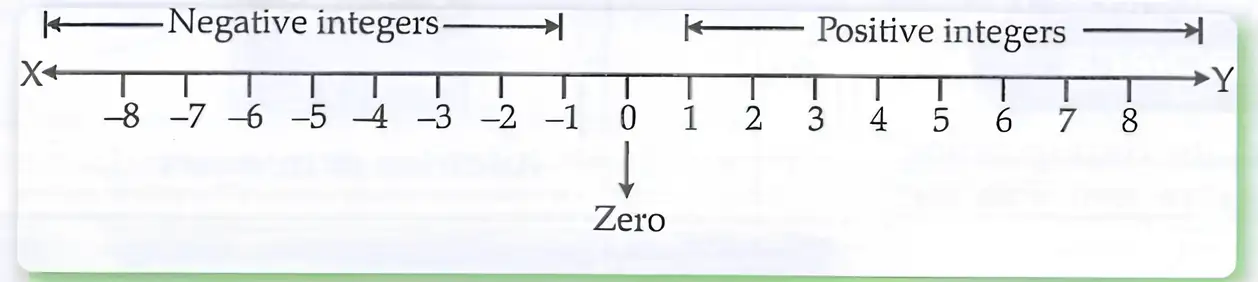
Integers are whole numbers that include positive numbers, negative numbers, and zero, without any fractional or decimal parts. The set of integers is represented as \( \ldots, -3, -2, -1, 0, 1, 2, 3, \ldots \).
Positive integers are numbers greater than zero, such as \(1, 2, 3, \ldots\), and negative integers are numbers less than zero, such as \(-1, -2, -3, \ldots\). Zero is neither positive nor negative.
The absolute value of an integer \(x\), denoted by \(|x|\), is the distance of \(x\) from zero on the number line, ignoring the sign. For example, \(|-5| = 5\) and \(|3| = 3\).
Representation on Number Line
To represent integers on a number line, draw a horizontal line with zero marked at the center. Positive integers are placed to the right of zero, increasing by 1 unit each step, and negative integers are placed to the left of zero, decreasing by 1 unit each step.
Successor and Predecessor
For any integer \(a\), the successor is \(a + 1\) and the predecessor is \(a - 1\).
Worked Example
Find the successor and predecessor of \(-5\).
Successor: \(-5 + 1 = -4\)
Predecessor: \(-5 - 1 = -6\)
Practice Set
- Find the successor and predecessor of \(0\).
- Represent the integers \(-3, 0, 4\) on a number line.
- Find the absolute value of \(-7\) and \(5\).
Answer Key
- Successor of 0 is 1, predecessor is -1.
- Number line representation places -3 left of 0 and 4 right of 0.
- \(|-7| = 7\), \(|5| = 5\).
Quick Reference
| Term | Definition |
|---|---|
| Integer | Whole number, positive, negative or zero |
| Successor | Next integer, \(a+1\) |
| Predecessor | Previous integer, \(a-1\) |
| Absolute Value | Distance from zero, \(|a|\) |
Glossary
- Integer: A whole number including negatives, zero, and positives.
- Successor: The integer immediately after a given integer.
- Predecessor: The integer immediately before a given integer.
- Absolute Value: The magnitude of a number without regard to its sign.
Additive Inverse of a Number
The additive inverse of an integer \(x\) is the number \(-x\) such that their sum is zero:
\[ x + (-x) = 0 \]Every integer has an additive inverse. For example, the additive inverse of \(7\) is \(-7\), and the additive inverse of \(-543\) is \(543\).
Worked Example
Find the additive inverse of \(6\) and \(-7\).
For \(6\), additive inverse is \(-6\).
For \(-7\), additive inverse is \(7\).
Practice Set
- Find the additive inverse of \(0\).
- Find the additive inverse of \(-15\).
- Verify that the sum of a number and its additive inverse is zero for \(x = 12\).
Answer Key
- Additive inverse of 0 is 0.
- Additive inverse of -15 is 15.
- \(12 + (-12) = 0\).
Quick Reference
| Number \(x\) | Additive Inverse \(-x\) | Sum \(x + (-x)\) |
|---|---|---|
| 7 | -7 | 0 |
| -3 | 3 | 0 |
| 0 | 0 | 0 |
Glossary
- Additive Inverse: The number which when added to the original number results in zero.
Addition of Integers
Addition of integers depends on their signs:
- If both integers are positive, add their absolute values and keep the positive sign.
- If both integers are negative, add their absolute values and keep the negative sign.
- If one integer is positive and the other negative, subtract the smaller absolute value from the larger absolute value and take the sign of the integer with the larger absolute value.
Using Number Line
To add integers on the number line, start at the first integer and move right if the second integer is positive, or left if it is negative, by the number of units equal to the absolute value of the second integer.

Worked Examples
1. Find \((-5) + (-3)\).
Both are negative, so add absolute values: \(5 + 3 = 8\), result is negative: \(-8\).
2. Find \((-9) + 4 + (-6) + 3\).
Group negatives and positives:
\[ (-9) + (-6) = -15, \quad 4 + 3 = 7 \]Sum: \(-15 + 7 = -8\).
Practice Set
- Calculate \(7 + (-2)\).
- Calculate \((-4) + (-5)\).
- Calculate \(10 + (-15) + 5\).
Answer Key
- \(7 + (-2) = 5\)
- \((-4) + (-5) = -9\)
- \(10 + (-15) + 5 = 0\)
Quick Reference
| Operation | Rule | Example |
|---|---|---|
| Positive + Positive | Add and keep positive | 2 + 3 = 5 |
| Negative + Negative | Add and keep negative | -2 + (-3) = -5 |
| Positive + Negative | Subtract smaller from larger, keep sign of larger | -5 + 3 = -2 |
Glossary
- Number Line: A line on which numbers are marked at equal intervals.
- Absolute Value: The magnitude of a number without its sign.
Subtraction of Integers
Subtraction of integers can be converted into addition by adding the additive inverse of the number to be subtracted:
\[ a - b = a + (-b) \]Use the number line to visualize subtraction by moving left or right depending on the sign of the number being subtracted.

Worked Example
Find \(-8 - (-10)\) using the number line.
Rewrite subtraction as addition:
\[ -8 - (-10) = -8 + 10 \]On the number line, start at \(-8\) and move 10 steps to the right, reaching \(2\).
Practice Set
- Calculate \(3 - 5\).
- Calculate \(-4 - 3\).
- Calculate \(-10 - (-4)\).
Answer Key
- \(3 - 5 = 3 + (-5) = -2\)
- \(-4 - 3 = -4 + (-3) = -7\)
- \(-10 - (-4) = -10 + 4 = -6\)
Quick Reference
| Subtraction | Equivalent Addition |
|---|---|
| \(a - b\) | \(a + (-b)\) |
| \(-8 - (-10)\) | \(-8 + 10\) |
Glossary
- Subtraction: Operation of removing one number from another.
- Additive Inverse: Number which when added to the original number results in zero.