SOLUTIONS

2026 BOARD EXAM

CBSE Class 12 Humanities Sociology Board Paper 2026 — Set 1 Solutions

2026

Sociology

Class 12 Humanities

CBSE EXAMINATION PAPER-2026

SOCIOLOGY

(Solved)

Time allowed : 3 hours

Maximum Marks : 82

General Instructions :

Read the following instructions carefully and follow them :

  1. This question paper contains 38 questions. All questions are compulsory.
  2. This question paper is divided into 5 sections.
  3. Section A – questions number 1 to 1 are case based questions
  4. Section B – questions number 2 to 17 are multiple choice questions
  5. Section C – questions number 18 to 28 are very short answer
  6. Section D – questions number 29 to 36 are short answer
  7. Section E – questions number 37 to 38 are long answer
  8. There is no overall choice given in the question paper. However, an internal choice has been provided in few questions.
  9. Use of calculator is NOT allowed.

Section A
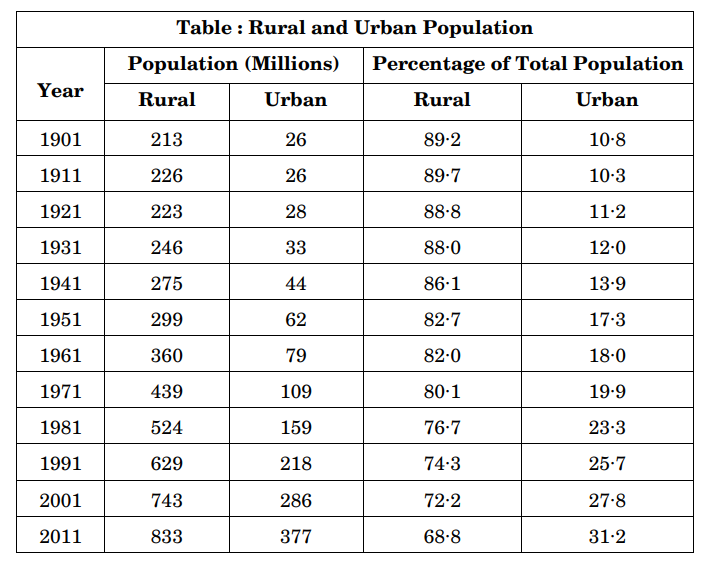
Question 1. The Rural and Urban population in India (1901 – 2011) is given below : Based on the above data, answer the following questions.
Diagram 1 – CBSE Class 12 Humanities Sociology 2026 Set 1 Solutions

(1) ‘It is not a question of numbers alone, processes of modern development ensure that the economic and social significance of the agrarian-rural way of life declines relative to the significance of the industrial way of life.’ Highlight the reasons for the decline in the agrarian-rural way of life.

[4 Marks]
Answer: Answer: The decline in the agrarian-rural way of life is due to several reasons as shown by the data and explanation in the passage. Firstly, urban population in India has increased significantly from 10.8% in 1901 to 31.2% in 2011, showing rapid urbanisation which draws people towards industrial and urban areas. Modern development and industrialisation create more job opportunities and better living conditions in cities compared to rural areas. Also, the entry of British manufactured goods affected rural agriculture, reducing its economic significance. Socially, modern development reduces the importance of traditional rural lifestyles as people adapt to urban culture. Thus, economic and social factors together cause a decline in the agrarian-rural way of life relative to industrial urban life.
Key Points: Rapid urbanisation leading to population shift - Impact of British manufactured goods on agriculture - Better economic and social opportunities in urban/industrial areas

(2) ‘Rural-urban migration is preferred for ‘social reasons’. Mention any two reasons.

[2 Marks]
Answer: Answer: Rural-urban migration occurs for social reasons such as better educational facilities and improved healthcare in cities. Urban areas provide more social amenities and opportunities for a better quality of life, attracting people from rural areas as mentioned in the passage showing increased urban population due to urbanisation.
Thus, people migrate seeking improved social services and better living standards.
Key Points: Better educational facilities - Improved healthcare services - Availability of more social amenities

Section B

Question 2.

Assertion (A) : Female literacy has been rising faster than male literacy.

Reason (R) : Literacy varies considerably across genders, across regions, and across social groups.

[1 Mark]
  • (A) Assertion (A) is false, but Reason (R) is true.
  • (B) Assertion (A) is true, but Reason (R) is false.
  • (C) Both Assertion (A) and Reason (R) are true, but Reason (R) is not the correct explanation of Assertion (A).
  • (D) Both Assertion (A) and Reason (R) are true and Reason (R) is the correct explanation of Assertion (A).
Explanation: Both Assertion (A) and Reason (R) are true based on the context. Female literacy has been rising faster than male literacy as indicated by the improvement in female literacy rates over the years. Literacy indeed varies considerably across genders, regions, and social groups. However, the reason given (literacy varies across gender, regions and social groups) does not directly explain why female literacy has been rising faster than male literacy, so Reason (R) is not the correct explanation for Assertion (A).
Question 3.

Assertion (A) : Some communities were characterised as ‘martial races’, some others as effeminate or cowardly, yet others as untrustworthy.

Reason (R) : Stereotypes are fixed and inflexible characterisations of a group of people.

[1 Mark]
  • (A) Assertion (A) is false, but Reason (R) is true.
  • (B) Assertion (A) is true, but Reason (R) is false.
  • (C) Both Assertion (A) and Reason (R) are true, but Reason (R) is not the correct explanation of Assertion (A).
  • (D) Both Assertion (A) and Reason (R) are true and Reason (R) is the correct explanation of Assertion (A).
Explanation: The assertion states that certain communities were labeled with specific traits such as 'martial races' or 'effeminate', which are examples of stereotypes. The reason explains that stereotypes are fixed and inflexible characterisations of groups of people. This is true and it correctly explains why communities were characterized in that way. These stereotypes were often colonial creations and do not reflect the complex and diverse nature of human societies.
Question 4.

_________ is a characteristic of the second/transitional stage in population growth of society.

(I) High death rate and population explosion

(II) Population explosion

(III) Low sex ratio

(IV) High maternal mortality rate

[1 Mark]
  • (A) (II) and (III)
  • (B) Only (IV)
  • (C) Only (II)
  • (D) Only (I)
Explanation: The second or transitional stage of population growth is characterized by a population explosion. This happens because the death rate falls rapidly due to improvements in disease control, public health, and nutrition, while the birth rate remains high. Therefore, population growth is very high during this stage. High death rate is not correct for this stage because the death rate actually decreases; low sex ratio and high maternal mortality are not specific characteristics of this stage. Hence, only (II) Population explosion is correct.
Question 5.

Assertion (A) : The government sells its shares in several public sector companies as part of the process of disinvestment.

Reason (R) : Many government workers are scared that they will lose their job after disinvestment.

[1 Mark]
  • (A) Both Assertion (A) and Reason (R) are true and Reason (R) is the correct explanation of Assertion (A).
  • (B) Assertion (A) is true, but Reason (R) is false.
  • (C) Assertion (A) is false, but Reason (R) is true.
  • (D) Both Assertion (A) and Reason (R) are true, but Reason (R) is not the correct explanation of Assertion (A).
Explanation:

The assertion is true because disinvestment means the government sells its shares in public sector companies to reduce its involvement and improve efficiency. The reason is also true because many government workers fear job loss after disinvestment, as seen in examples like 'Modern Foods'. However, the fear of job loss is not the reason why the government sells its shares; the government disinvests to reduce its burden and increase efficiency, not because workers are scared.

Question 6. Which of the following are not the changes brought about by colonialism to the caste system ?
[1 Mark]
  • (A) Numbering and recording of castes through census.
  • (B) Linking castes to traditional occupations.
  • (C) Hundreds of petitions were addressed to the Census Commissioner by representatives of different castes claiming a higher position in the social scale.
  • (D) Making ‘Schedules’ of castes for special treatment by the State.
Explanation: The ‘Schedules’ listing castes for special treatment were drawn up in 1935 by the British Indian government, which is prior to Indian Independence and part of colonial rule. However, this act is not considered a change brought by colonialism itself because the scheduling and special treatment policies were formalized later and continued after Independence with new additions. The other options such as petitions addressed to Census Commissioner, linking castes to traditional occupations, and numbering and recording castes through census were direct impacts seen during the colonial period when British administrators conducted systematic caste surveys and tried to classify caste for administrative purposes.
Question 7. Which of the following institutional incentives helps to build a feeling of unity in diversity ?
[1 Mark]
  • (A) Citizens cannot build trust in common institutions.
  • (B) Citizens can find the institutional and political space to identify with both their country and cultural identities.
  • (C) Citizens do not participate in and support democratic politics.
  • (D) Explicit efforts are not required to end the cultural exclusion of diverse groups.
Explanation: The institutional incentive that helps build a feeling of unity in diversity is when citizens can identify both with their country and their cultural identities. This recognition allows them to build trust in common institutions and participate in democratic politics, which consolidates democracy and fosters national cohesion without suppressing diversity. Explicit efforts are required to accommodate multiple and complementary identities to encourage unity in diversity.
Question 8. An authoritarian state is the opposite of a democratic state because :
[1 Mark]
  • (A) It is a state in which people have no voice.
  • (B) Those in power are accountable to everyone.
  • (C) The state responds well to the needs of the people.
  • (D) Authoritarian state does not abolish civil liberties.
Explanation: An authoritarian state is characterized by the fact that people have no voice and those in power are not accountable to anyone. Unlike a democratic state where people participate and have a say in decision-making, authoritarian states limit or abolish civil liberties and do not allow public participation.
Question 9.

Assertion (A) : Sanskritisation operated similarly in different parts of the country.

Reason (R) : In regions where the non-Sanskritic were dominant, it was their influence that was stronger.

[1 Mark]
  • (A) Assertion (A) is true, but Reason (R) is false.
  • (B) Both Assertion (A) and Reason (R) are true, but Reason (R) is not the correct explanation of Assertion (A).
  • (C) Assertion (A) is false, but Reason (R) is true.
  • (D) Both Assertion (A) and Reason (R) are true and Reason (R) is the correct explanation of Assertion (A).
Explanation:

The assertion that Sanskritisation operated similarly in different parts of the country is false because the process varied regionally. In areas where highly Sanskritised castes were dominant, the culture underwent Sanskritisation. However, in regions where non-Sanskritic castes were dominant, their cultural influence was stronger, leading to what is called 'de-Sanskritization'. Thus, the reason statement is true and explains the regional variations, but it contradicts the assertion that Sanskritisation was uniform across the country.

Question 10. Which of the following is a public perception of disability ?
[1 Mark]
  • (A) Disabilities are not understood as biologically given.
  • (B) The disabled person is not seen as a victim.
  • (C) Disability is not linked with an individual’s self-perception.
  • (D) The idea of disability suggests that they are in need of help.
Explanation: According to the provided context, one common feature central to the public perception of disability is that the very idea of disability suggests they are in need of help. The context explicitly states this perception, highlighting how society often views disabled individuals. Other options conflict with the text which mentions disability is understood as a biological given and is linked with individual’s self-perception.
Question 11.

Assertion (A) : India is still largely an agricultural country.

Reason (R) : Very few people in India have access to secure jobs.

[1 Mark]
  • (A) Assertion (A) is true, but Reason (R) is false.
  • (B) Assertion (A) is false, but Reason (R) is true.
  • (C) Both Assertion (A) and Reason (R) are true, but Reason (R) is not the correct explanation of Assertion (A).
  • (D) Both Assertion (A) and Reason (R) are true and Reason (R) is the correct explanation of Assertion (A).
Explanation:

The assertion that India is still largely an agricultural country is true because a significant portion of the population (around 42% as per 2018-19 data) is employed in agriculture. The reason that very few people have access to secure jobs is also true given the large informal sector and unemployment issues in India. However, the lack of secure jobs is not the correct explanation for India being largely agricultural; historical, social, and economic factors contribute to this. Therefore, both are true statements but Reason (R) does not explain Assertion (A).

Question 12.

Based on the following passage, answer:

Very few people who relax on their day off realise that this holiday is the outcome of a long struggle by workers. That the work-day should not exceed eight hours, that men and women should be paid equally for doing the same work, that workers are entitled to social security and pension — these and many other rights were gained through social movements.

How have social movements shaped the world we live in ?

[1 Mark]
  • (A) In the 19th century, reform movements did not influence caste and gender.
  • (B) Asia and Africa had nationalist movements, which ended colonialism.
  • (C) The Civil Rights Movement in the USA did not bring equal rights.
  • (D) Anti-apartheid struggle did not change society in South Africa.
Explanation: The passage and the relevant context illustrate that social movements have played a crucial role in shaping society by bringing about important rights and changes. Specifically, the context mentions nationalist movements in Asia and Africa that ended colonial rule, showing how social movements changed the world fundamentally. Other options are incorrect because reform movements did influence caste and gender in the 19th century, the Civil Rights Movement in the USA did bring equal rights, and the anti-apartheid struggle did change society in South Africa.
Question 13.

Based on the following passage, answer:

The term ‘Adivasi’ connotes political awareness and the assertion of rights. Literally meaning ‘original inhabitants’, the term was coined in the 1930s as part of the struggle against the intrusion by the colonial government and outside settlers and moneylenders.

Which of the following is not true about Adivasis ?

[1 Mark]
  • (A) They are found mainly in the north-eastern parts of India.
  • (B) They were believed to be the people of the forest.
  • (C) They had practised shifting cultivation.
  • (D) Their economic conditions were better than the non-Adivasis.
Explanation:

The passage explains that Adivasis have faced loss of land and forests, repeated displacements, and impoverished conditions due to colonial and post-independence resource extraction. They were denied access to forests and land for cultivation and had to resort to illegal use of forests or wage labour, indicating their economic conditions were worse, not better, than non-Adivasis. The other options are true as they have been traditionally associated with forest areas and practices like shifting cultivation, and are mainly found in north-eastern India.

Question 14.

Based on the following passage, answer:

The term ‘Adivasi’ connotes political awareness and the assertion of rights. Literally meaning ‘original inhabitants’, the term was coined in the 1930s as part of the struggle against the intrusion by the colonial government and outside settlers and moneylenders.

Write the following statements in the correct order :

(I) The resource extraction in areas inhabited by tribes can be traced to the British Government.

(II) Since the 1990s, when economic liberalisation policies were officially adopted by the Indian Government, the process of resource extraction in Adivasi areas has become even more powerful. (III) The term ‘Adivasi’ was coined in the 1930s as part of the struggle against intrusion by the colonial government and outside settlers.

(IV) The most significant achievement of Adivasi movements includes attainment of statehood for Jharkhand and Chhattisgarh in the year 2000.

[1 Mark]
  • (A) (I), (II), (III), (IV)
  • (B) (IV), (I), (III), (II)
  • (C) (III), (II), (IV), (I)
  • (D) (III), (I), (II), (IV)
Explanation: The correct order follows a historical timeline and logical flow: (I) refers to the beginning of resource extraction by the British colonial government, which sets the historical context; (III) explains the coining of the term 'Adivasi' in the 1930s as part of resisting this intrusion; (II) indicates the continuation and increase in resource extraction since the 1990s with economic liberalisation; and (IV) concludes with the post-Independence achievement of statehood for Jharkhand and Chhattisgarh in 2000, highlighting the success of Adivasi movements. This sequence is supported by the passage which traces the history from colonial times to the modern period.
Question 15. Which statement is true regarding the many-sided and paradoxical impact of the English language in India ?
[1 Mark]
  • (A) English is not widely used in India.
  • (B) We do not have an impressive body of literary writings by Indians in English.
  • (C) The knowledge of English has given Indians an edge in the global market.
  • (D) For those who were traditionally deprived of access to formal education, such as Dalits, knowledge of English did not open doors of opportunities.
Explanation: The context explains that English education in India, born out of colonialism, has had contradictory and paradoxical impacts. While English dailies have limited readership compared to Indian language dailies, knowledge of English has nonetheless provided Indians, especially the English-educated middle class, with advantages in global business and communication. This shows that the knowledge of English has given Indians an edge in the global market, making this the true statement among the options.
Question 16. Assertion (A) : Constitutional provisions define the powers of the States and the Centre. Reason (R) : Respecting regional sentiments is not just a matter of creating States but it has to be backed up with an institutional structure.
[1 Mark]
  • (A) Both Assertion (A) and Reason (R) are true and Reason (R) is the correct explanation of Assertion (A).
  • (B) Assertion (A) is true, but Reason (R) is false.
  • (C) Both Assertion (A) and Reason (R) are true, but Reason (R) is not the correct explanation of Assertion (A).
  • (D) Assertion (A) is false, but Reason (R) is true.
Explanation: The assertion states that Constitutional provisions define the powers of the States and the Centre, which is true as the Constitution lists subjects under the State List, Centre List, and Concurrent List, designating their exclusive or shared governance areas. The reason explains that respecting regional sentiments requires not only creating States but supporting them with an institutional structure, which is also true and is the correct explanation for the assertion. The constitutional framework forms this institutional structure ensuring States' viability as autonomous units within the federal system, thus accommodating regional sentiments effectively.
Question 17. Based on the following passage, answer: Very few people who relax on their day off realise that this holiday is the outcome of a long struggle by workers. That the work-day should not exceed eight hours, that men and women should be paid equally for doing the same work, that workers are entitled to social security and pension — these and many other rights were gained through social movements. Which of the following is not true about Karl Marx’s view on violent collective action
[1 Mark]
  • (A) Crowds’ and ‘mobs’ were not made up of anarchic hooligans out to destroy society.
  • (B) They often resorted to public protest because they had no other way of expressing their anger against deprivation.
  • (C) Poor people in urban areas had a good reason for protesting.
  • (D) Crowds’ and ‘mobs’ have no shared understanding of right and wron
Explanation: According to the passage and Marxist scholars like E. P. Thompson, crowds and mobs are not simply anarchic hooligans but have reasons for their protests, often as a means of expressing anger against deprivation. Marx’s view acknowledges that poor people in urban areas had justified reasons for protesting. The incorrect statement is that crowds and mobs have no shared understanding of right and wrong, which contradicts the view that collective action is often purposeful and based on shared grievances.

Section C

Question 18.

‘‘Malthus argued that human populations tend to grow at a much faster rate than the rate at which the means of human subsistence (specially food, but also clothing and other agriculture-based products) can grow. Therefore, humanity is condemned to live in poverty forever because the growth of agricultural production will always be overtaken by population growth.’’

What are the methods that Malthus suggests to check the rise in population ?

[2 Marks]
Answer: Malthus suggested two types of checks to control population growth: (1) Preventive checks: These include measures people can take to reduce birth rate voluntarily, such as delaying marriage, practicing abstinence, and moral restraint. (2) Positive checks: These are natural consequences that increase the death rate like famines, diseases, wars, and epidemics. Malthus believed these checks were necessary to balance population with resources and prevent widespread poverty and starvation.
Key Points: Preventive checks like delaying marriage and moral restraint - Positive checks like famines, diseases, wars - Checks help balance population with resources
Question 19.

‘‘Social exclusion is not accidental but systematic – it is the result of structural features of society.’’

In the context of the above statement, highlight the meaning of social exclusion.

[2 Marks]
Answer: Social Exclusion: Social exclusion means that individuals or groups are prevented from fully participating in the social, economic, and political life of the society. It is not random or accidental but a systematic outcome caused by the structure and institutions of society. This exclusion results from deprivation and discrimination and affects entire groups rather than just individuals. It shows a social pattern and is deeply rooted in social processes rather than individual actions.
Key Points: Social exclusion prevents full participation - Result of deprivation and discrimination - Systematic and structural in society
Question 20.

‘‘Untouchability is an extreme and vicious aspect of the caste system.’’

Explain any two dimensions of untouchability.

[2 Marks]
Answer: Untouchability is a social practice where certain castes are considered 'impure' and face discrimination. Two main dimensions are:
(a) Exclusion: Untouchables are socially excluded from temples, schools, and public places to prevent "pollution".
(b) Humiliation and Subordination: They face disrespect and are forced to adopt inferior roles in society, which lowers their dignity and status.
Key Points: Exclusion from social places - Humiliation and subordination - Considered ritually impure
Question 21.

‘‘Many of our cultural practices and patterns can be traced to our agricultural background. There is a close relationship between agriculture and culture.’’

Give one reason to support the given statement and name any two agriculture-related festivals.

[2 Marks]
Answer: (a) One reason to support the close relationship between agriculture and culture is that many traditional festivals and rituals are linked to farming activities, such as sowing and harvesting seasons, which are celebrated to thank nature for a good harvest and to seek blessings for future crops.
(b) Two agriculture-related festivals are Baisakhi and Onam. Baisakhi marks the harvest of Rabi crops in Punjab and includes cultural dances and prayers. Onam is celebrated in Kerala to thank King Mahabali and nature for a fruitful harvest, featuring boat races and traditional feasts.
Key Points: Agriculture influences festivals and rituals - Festivals like Baisakhi and Onam are linked to harvest - Cultural practices celebrate and thank nature for farming success
Question 22.

‘‘Our community provides us the language (our mother tongue) and the cultural values through which we comprehend the world. It also anchors our self-identity. Community identity is what we ‘are’ rather than what we have ‘become’.’’

How can you say that community identity is ascriptive ?

[2 Marks]
Answer: Community identity is called ascriptive because it is based on birth and belonging, not on any achievements or choices we make. We do not choose which community or family we are born into; it is given to us automatically. This identity is fixed and universal since everyone has a motherland, mother tongue, family, or faith. These identities are unconditional and inescapable, which shows that community identity is what we are born with, not what we have become.
Key points: Born into community - No choice involved - Universal and fixed identity
Key Points: Based on birth and belonging - No individual choice - Fixed and universal identity
Question 23.

The ‘Schedules’ listing the castes and tribes recognised as deserving of special treatment because of the massive discrimination practiced against them were drawn up in 1935, by the British Indian government.

Post-independence, which was the most important initiative taken by the government to compensate for this discrimination ? Write briefly about it.

[2 Marks]
Answer: The most important initiative taken by the Indian government post-independence to compensate for caste-based discrimination is the policy of reservations. This policy sets aside a certain number of seats in education, government jobs, and legislatures exclusively for members of Scheduled Castes and Scheduled Tribes. The Constitution of India, adopted in 1950, abolished untouchability through Article 17 and provided for such reservation provisions to uplift these socially disadvantaged groups and ensure their participation in public life.
Key Points: Reservation policy - Abolition of untouchability (Article 17) - Protection and upliftment of Scheduled Castes and Tribes
Question 24.

The notion of minority groups usually involves some sort of a relative disadvantage. Exemplify the statement.

[2 Marks]
Answer: The notion of minority groups involves relative disadvantage because such groups often face prejudice and discrimination in society. For example, in many countries, religious minorities or ethnic minorities may have fewer opportunities in education, employment, or political representation compared to the majority group. This relative disadvantage creates a sense of group solidarity among minority members. Hence, minority is not just about smaller numbers but also about social, economic, or political disadvantages.
Key Points: Minority involves relative disadvantage - Faces prejudice and discrimination - Leads to group solidarity
Question 25.

Highlight the meaning of Secularism in both, the Western and Indian context.

[2 Marks]
Answer: Secularism in Western context: It means the strict separation of religion and state, where the state does not interfere with religious matters and does not support any religion officially.
Secularism in Indian context: It means equal respect and treatment for all religions by the state. Unlike the western sense, it also includes tolerance towards religion and ensures no discrimination on religious grounds. It opposes communalism and supports harmony among different religious communities.
Key Points: Secularism means separation of religion and state in the West - Indian secularism means equal respect for all religions - Indian secularism opposes communalism and supports religious harmony
Question 26.

‘‘In a country where half the children in the age group of 5 – 14 years are out of school, how can there be space for children with disabilities, especially if a segregated schooling is being advocated for them ?’’ State two ways by which a disabled child can achieve autonomy.

[2 Marks]
Answer: Two ways by which a disabled child can achieve autonomy are :
(1) Inclusive education that allows disabled children to study with other children helps them develop confidence and independence.
(2) Providing skill development and vocational training enables them to perform daily tasks and earn a living independently, thus achieving autonomy.
Key Points: Inclusive education helps build confidence - Vocational training promotes self-reliance - Segregated schooling limits opportunities
Question 27.

‘‘In India, over 90% of the work, whether it is in agriculture, industry or services is in the unorganised or informal sector.’’ What are the social implications of this small size of the organised sector ?

[2 Marks]
Answer: In India, the small size of the organised sector has several social implications:
1. It limits opportunities for workers to get stable jobs with regular income and social security benefits like provident fund and health insurance.
2. People miss the experience of working in large firms where they can interact with employees from different regions and backgrounds, which can reduce social integration.
3. Low growth of the organised sector means many workers remain in low-paying, insecure jobs without proper rights, leading to economic insecurity.
4. It also limits skill development and career growth, preventing social mobility.
Thus, a small organised sector impacts the quality of life and social cohesion negatively.
Key Points: Lack of stable jobs and social security - Limited social interaction across regions - Economic insecurity due to informal jobs - Restricted skill development and career growth
Question 28.

“In our current information age, social movements around the globe are able to join together in huge regional and international networks.” Give suitable examples to support the statement.

[2 Marks]
Answer: Answer:
In the information age, social movements worldwide connect through large networks including non-governmental organisations, human rights groups, environmental activists and more. For example, the World Social Forum is an international alliance that raises awareness about globalization's effects. Similarly, environmental movements like Greenpeace work globally to protect nature. Human rights campaigns such as Amnesty International unite activists worldwide to fight for justice. These examples show how technology enables strong, global cooperation in social causes.
Key Points: Social movements connect globally - Examples: World Social Forum, Greenpeace, Amnesty International - Use of technology and networks to raise awareness and campaign internationally

Section D

Question 29.

“Globalisation of agriculture or the incorporation of agriculture into the larger global market – a process that has had direct effects on farmers and rural society.”

Discuss the role of ‘contract farming’ in this process of globalisation.

[4 Marks]
Answer: Role of Contract Farming in the Globalisation of Agriculture:
Contract farming refers to agreements between farmers and companies where farmers produce crops as per the company's requirements and the company assures to buy the produce at a predetermined price.
It plays a major role in integrating agriculture with the global market because multinational companies involve farmers to grow export-oriented crops like flowers, vegetables, and fruits. For example, companies such as PepsiCo have contracts with farmers in Punjab and Karnataka to grow tomatoes and potatoes.
This system helps farmers by providing assured markets and sometimes technical guidance. However, it also leads to changes in cropping patterns where land is used for commercial crops instead of food grains, impacting food security.
Moreover, contract farming shifts control from farmers to companies, sometimes making farmers dependent and reducing the role of traditional agricultural knowledge.
Overall, contract farming is a key link between global markets and rural farmers, deeply influencing rural society and agricultural practices.
Key Points: Contract farming links farmers and global markets - Encourages production of export-oriented commercial crops - Provides assured markets but may reduce food grain production - Changes traditional farming practices - Increases dependence on multinational companies
Question 30.

“The post-independent Indian state inherited and reflected the contradictions of the pre-independent period.”

Comment on the given statement with respect to the role of caste in the public sphere.

[4 Marks]
Answer: The post-independent Indian state inherited the complex social structure shaped by centuries, including the rigid caste system. Despite the Constitution explicitly committing to abolish caste discrimination, caste continued to influence social and political life. The contradictions lie in this coexistence of constitutional ideals and social reality. Caste remained a powerful factor in the public sphere, especially in politics where caste affiliations influenced voting and representation. The colonial legacy and rapid socio-economic changes after independence further transformed caste identities but did not eliminate caste inequalities. Thus, the Indian state reflects the persistence of caste in public life even as it strives to promote equality and social justice according to constitutional values.
Key Points: Post-independent state inherited caste contradictions - Constitution abolishes caste discrimination - Caste influenced politics and public sphere - Colonial and post-independence changes shaped caste - Persistence of caste in social and political life
Question 31.

‘‘In Indian nationalism, the dominant trend was marked by an inclusive and democratic vision.” Explain.

[4 Marks]
Answer: Explanation:
Indian nationalism embraced an inclusive and democratic vision, which meant accepting diversity and ensuring equal rights for all communities. Unlike exclusive nationalism that favors one group, Indian nationalism recognized the pluralistic nature of its society with many religions, languages, and cultures living together.
The leaders like Mahatma Gandhi and Rabindranath Tagore emphasized humanism and opposed any form of discrimination. This inclusive approach is reflected in the Indian Constitution that guarantees minority rights and promotes democracy.
It aimed at building a nation where everyone, regardless of their background, felt a sense of belonging and participation. This vision helped India stand against colonial rule and created a foundation for unity amid diversity.
Thus, Indian nationalism was not just about freedom from foreign rule but also about establishing a fair and democratic society for all its people.
Key Points: Inclusive nationalism recognizes diversity - Leaders emphasized humanism and opposed discrimination - Indian Constitution guarantees minority rights and democracy
Question 32.

‘‘A considerable part of ritual in India has a direct reference to the pursuit of secular ends. Rituals have secular dimensions as distinct from secular goals.’’

Justify with the help of suitable examples.

[4 Marks]
Answer: In India, rituals often serve secular purposes beyond their religious meanings.
Firstly, rituals provide opportunities for socialising and strengthening community bonds, such as during weddings and festivals where people meet, interact and celebrate together.
Secondly, rituals also display social status and wealth, for example, the elaborate decoration and attire during marriage ceremonies show family prosperity.
Thirdly, some rituals serve economic or political ends, like organizing large gatherings that help local vendors or leaders gain support.
Thus, rituals have secular dimensions because they involve social, economic and cultural activities, while their secular goals are the direct non-religious outcomes, such as social cohesion or economic benefits.
For example, the Indian state declares public holidays for religious festivals of all communities promoting secular respect.
This shows that rituals connect religion with everyday secular life in multiple ways.
Key Points: Rituals enable socialising - Rituals help display social status - Rituals have economic and political functions - Rituals serve secular purposes beyond religion
Question 33.

‘‘Jan Breman identified the change in the nature of relationship between landlords and agricultural workers.’’ Explain the meaning of the phrase ‘from patronage to exploitation’ stated by him.

[4 Marks]
Answer: Explanation of "from patronage to exploitation" by Jan Breman:
Jan Breman describes a shift in the relationship between landlords and agricultural workers from ‘‘patronage to exploitation.’’ Earlier, this relationship was based on patronage, meaning landlords (often from dominant castes) provided protection and paid agricultural workers often in kind (grain), forming traditional bonds similar to family or hereditary ties.
However, over time, this changed to a relationship of exploitation, where the traditional protective ties weakened. Landlords started paying wages in cash but often less than minimum wages, treating workers as free wage laborers without any security or rights.
This change led to increased hardships for agricultural workers, especially low caste and migrant laborers, who could be easily exploited with low pay and poor working conditions. Overall, the relationship shifted from a social system of mutual obligations to a capitalist system focusing on profit from labor, highlighting Jan Breman's phrase "from patronage to exploitation".
Key Points: Traditional patronage involved protection and payment in kind - Shift to cash wages and weakening of traditional bonds - Exploitation of agricultural laborers with low or no security
Question 34.

‘‘Cities played a key role in the economic system of empires.’’ Elucidate the statement with the help of suitable examples.

[4 Marks]
Answer: Cities played a key role in the economic systems of empires because they acted as centers for trade, manufacturing, and administration. For example, in British India, coastal cities like Mumbai, Kolkata, and Chennai were important hubs. Mumbai was redeveloped so that by 1900, over three-quarters of India’s raw cotton were shipped through it, linking Indian raw materials to British industries. These cities served as points for exporting raw materials and importing manufactured goods cheaply. They also formed crucial links between the empire's core (Britain) and the colonies by facilitating global trade. Similarly, modern global cities like New York, London, and Tokyo are economic centers hosting important companies, cultural institutions, and governments. A city’s location on trade routes, presence of ports, and strategic military position enhanced its economic importance. Thus, cities were the concrete expression of global capitalism and instrumental in the functioning and growth of empires’ economic systems.
Key Points: Cities were centers of trade and manufacturing - Coastal cities like Mumbai, Kolkata, Chennai facilitated export and import - Cities linked empire core and periphery in global capitalism - Location on trade routes and ports gave strategic advantage - Cities acted as economic hubs in empires
Question 35.

‘‘The laws of a colonised country did not have to stick to the democratic norms that the British back home had to follow. ’’ In what ways did the colonial laws favour the owners and managers of the tea industry ?

[4 Marks]
Answer: Answer: The colonial laws favoured the owners and managers of the tea industry in several ways. First, the laws allowed the planters to forcibly hire and keep labourers, often against their will, ignoring their rights and freedom. Second, the government did not enforce democratic norms like fair wages or working conditions, so workers remained exploited and powerless. Third, laws were designed to protect the interests of British planters, ensuring cheap labour and large profits. Finally, the colonial state changed land ownership and crop production laws to benefit tea plantations, strengthening British capitalism and neglecting the welfare of labourers.
Key Points: Forced labour hiring - No enforcement of fair wages or conditions - Protection of planter interests - Laws altered to benefit tea plantations
Question 36.

“Because the tribal areas were located in mineral-rich and forest-covered parts of the country, tribals have paid a disproportionate price for the development of the rest of Indian society.”

How has national development been a challenge for the tribal population of India, post-Independence ?

[4 Marks]
Answer: National development post-Independence has posed several challenges for the tribal population of India.
Most tribal areas are rich in minerals and forests, which made them targets for projects like large dams, factories, mines, and hydroelectric power plants during the Nehruvian era. These development projects often led to the displacement of tribal communities from their ancestral lands without adequate compensation or rehabilitation.
Furthermore, the exploitation of natural resources in tribal regions primarily benefited the mainstream society, while tribals bore the cost of losing their homes, livelihoods, and cultural identity.
Another challenge has been the heavy in-migration of non-tribals into tribal areas spurred by development activities. This migration threatens tribal cultures and communities by causing demographic changes and increased exploitation.
Thus, while national development aimed at overall progress, it created social and economic inequalities, disproportionately disadvantaging the tribal population who continue to struggle for their rights and resources.
Key Points: Tribal displacement due to development projects - Loss of land and livelihoods - Exploitation of natural resources benefiting mainstream society - In-migration threatening tribal culture - Lack of adequate rehabilitation policies

Section E

Question 37.

Home-based work is an important part of the economy.’ Elaborate on the functioning of any one ‘Home-based’ Industry.

[6 Marks]
Answer: Home-based work plays a vital role in the economy by providing employment opportunities especially to women and children. One important home-based industry is the bidi making industry.

Functioning of the Bidi Making Industry:
1. Raw Materials: The main raw materials used are tendu leaves and tobacco. The raw materials are supplied to home workers by local agents.
2. Work at Home: Women and children work at their homes by rolling the tobacco inside tendu leaves to make bidis. This work requires skill and is done manually.
3. Payment System: Workers are paid on a piece-rate basis, which means they are paid according to the number of bidis they roll.
4. Role of Agent: The agents act as intermediaries. They provide raw materials to workers and collect the finished bidis from their homes.

This industry contributes to the economy by producing cheap and popular smoking items while providing income to many families. However, workers face issues such as low wages, lack of social security, and health hazards from tobacco dust.

Summary: The bidi making industry is a classic example of a home-based industry where production occurs within homes, making it flexible and accessible, especially for women. It is an important part of the unorganized sector and links rural production to the market through agents.
Key Points: Home-based work provides employment especially to women and children - Bidi making involves rolling tobacco in tendu leaves at home - Agents supply raw materials and collect finished bidis
Question 38.

How have the women’s movements evolved over the period of history ?

[6 Marks]
Answer: Evolution of Women’s Movements: The women’s movements have evolved significantly over time, reflecting changes in society, politics and ideologies.
19th Century Social Reform Movements: The women’s question in modern India arose as part of the 19th century middle class social reform movements. These early movements focussed on issues like education for women, abolition of practices like Sati, and child marriage reforms. Women’s organizations started forming to address these social issues.
Early 20th Century: This period saw increased political awareness among women. The movement expanded from social reforms to include demands for political rights such as voting rights and participation in the freedom struggle. Women started forming more organized groups and associations.
Post Independence Period: After independence, the women’s movement addressed legal and social inequalities such as property rights, employment, sexual harassment and dowry. The focus shifted to both organisational strategies and ideologies, with more emphasis on women’s rights as human rights.
Recent Times: The movements now address a wider range of issues including gender violence, reproductive rights, and LGBTQ+ rights. Modern women’s movements use diverse methods like protests, legal campaigns and digital activism to bring change.
Summary: Over time, the women’s movements have evolved from social reform campaigns to comprehensive struggles for equality, justice and dignity for women in all spheres of life.
Key Points: 19th century social reform movements - formation of women’s organizations - expansion to political rights - post-independence legal and social rights focus - modern diverse issues and methods

Paper Details

CBSE Board Exam 2026

Class

Class 12 Humanities

Subject

Sociology

Year

2026

Set

Set 1

Other Years — Sociology

2022 Set-1

2023 Set-2

2024 Set-3

2025 Set-4

2026 Set-1