QUESTION PAPER
2026 BOARD EXAM
CBSE Class 12 Humanities Sociology Board Paper 2026 — Set 1
2026
Sociology
Class 12 Humanities
CBSE EXAMINATION PAPER-2026
SOCIOLOGY
(Solved)
General Instructions :
Read the following instructions carefully and follow them :
- This question paper contains 38 questions. All questions are compulsory.
- This question paper is divided into 5 sections.
- Section A – questions number 1 to 1 are case based questions
- Section B – questions number 2 to 17 are multiple choice questions
- Section C – questions number 18 to 28 are very short answer
- Section D – questions number 29 to 36 are short answer
- Section E – questions number 37 to 38 are long answer
- There is no overall choice given in the question paper. However, an internal choice has been provided in few questions.
- Use of calculator is NOT allowed.
Section A
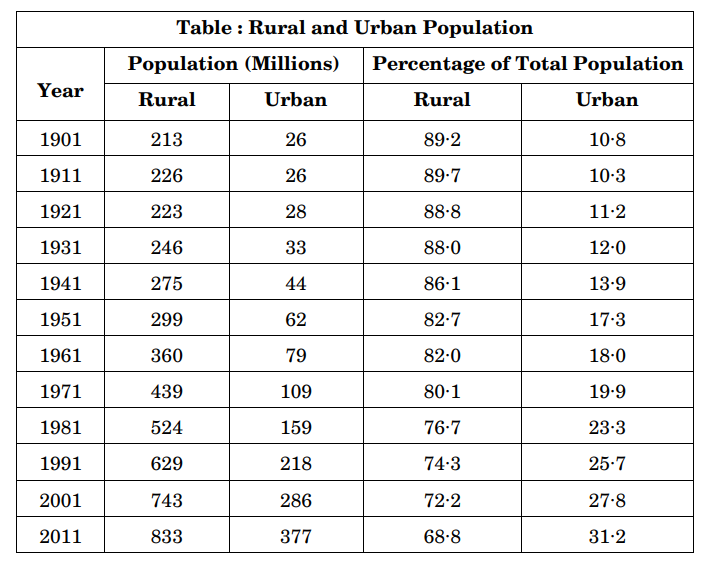
(1) ‘It is not a question of numbers alone, processes of modern development ensure that the economic and social significance of the agrarian-rural way of life declines relative to the significance of the industrial way of life.’ Highlight the reasons for the decline in the agrarian-rural way of life.
[4 Marks](2) ‘Rural-urban migration is preferred for ‘social reasons’. Mention any two reasons.
[2 Marks]Section B
Assertion (A) : Female literacy has been rising faster than male literacy.
Reason (R) : Literacy varies considerably across genders, across regions, and across social groups.
Assertion (A) : Some communities were characterised as ‘martial races’, some others as effeminate or cowardly, yet others as untrustworthy.
Reason (R) : Stereotypes are fixed and inflexible characterisations of a group of people.
_________ is a characteristic of the second/transitional stage in population growth of society.
(I) High death rate and population explosion
(II) Population explosion
(III) Low sex ratio
(IV) High maternal mortality rate
Assertion (A) : The government sells its shares in several public sector companies as part of the process of disinvestment.
Reason (R) : Many government workers are scared that they will lose their job after disinvestment.
Assertion (A) : Sanskritisation operated similarly in different parts of the country.
Reason (R) : In regions where the non-Sanskritic were dominant, it was their influence that was stronger.
Assertion (A) : India is still largely an agricultural country.
Reason (R) : Very few people in India have access to secure jobs.
Based on the following passage, answer:
Very few people who relax on their day off realise that this holiday is the outcome of a long struggle by workers. That the work-day should not exceed eight hours, that men and women should be paid equally for doing the same work, that workers are entitled to social security and pension — these and many other rights were gained through social movements.
How have social movements shaped the world we live in ?
Based on the following passage, answer:
The term ‘Adivasi’ connotes political awareness and the assertion of rights. Literally meaning ‘original inhabitants’, the term was coined in the 1930s as part of the struggle against the intrusion by the colonial government and outside settlers and moneylenders.
Which of the following is not true about Adivasis ?
Based on the following passage, answer:
The term ‘Adivasi’ connotes political awareness and the assertion of rights. Literally meaning ‘original inhabitants’, the term was coined in the 1930s as part of the struggle against the intrusion by the colonial government and outside settlers and moneylenders.
Write the following statements in the correct order :
(I) The resource extraction in areas inhabited by tribes can be traced to the British Government.
(II) Since the 1990s, when economic liberalisation policies were officially adopted by the Indian Government, the process of resource extraction in Adivasi areas has become even more powerful. (III) The term ‘Adivasi’ was coined in the 1930s as part of the struggle against intrusion by the colonial government and outside settlers.
(IV) The most significant achievement of Adivasi movements includes attainment of statehood for Jharkhand and Chhattisgarh in the year 2000.
Section C
‘‘Malthus argued that human populations tend to grow at a much faster rate than the rate at which the means of human subsistence (specially food, but also clothing and other agriculture-based products) can grow. Therefore, humanity is condemned to live in poverty forever because the growth of agricultural production will always be overtaken by population growth.’’
What are the methods that Malthus suggests to check the rise in population ?
‘‘Social exclusion is not accidental but systematic – it is the result of structural features of society.’’
In the context of the above statement, highlight the meaning of social exclusion.
‘‘Untouchability is an extreme and vicious aspect of the caste system.’’
Explain any two dimensions of untouchability.
‘‘Many of our cultural practices and patterns can be traced to our agricultural background. There is a close relationship between agriculture and culture.’’
Give one reason to support the given statement and name any two agriculture-related festivals.
‘‘Our community provides us the language (our mother tongue) and the cultural values through which we comprehend the world. It also anchors our self-identity. Community identity is what we ‘are’ rather than what we have ‘become’.’’
How can you say that community identity is ascriptive ?
The ‘Schedules’ listing the castes and tribes recognised as deserving of special treatment because of the massive discrimination practiced against them were drawn up in 1935, by the British Indian government.
Post-independence, which was the most important initiative taken by the government to compensate for this discrimination ? Write briefly about it.
The notion of minority groups usually involves some sort of a relative disadvantage. Exemplify the statement.
Highlight the meaning of Secularism in both, the Western and Indian context.
‘‘In a country where half the children in the age group of 5 – 14 years are out of school, how can there be space for children with disabilities, especially if a segregated schooling is being advocated for them ?’’ State two ways by which a disabled child can achieve autonomy.
‘‘In India, over 90% of the work, whether it is in agriculture, industry or services is in the unorganised or informal sector.’’ What are the social implications of this small size of the organised sector ?
“In our current information age, social movements around the globe are able to join together in huge regional and international networks.” Give suitable examples to support the statement.
Section D
“Globalisation of agriculture or the incorporation of agriculture into the larger global market – a process that has had direct effects on farmers and rural society.”
Discuss the role of ‘contract farming’ in this process of globalisation.
“The post-independent Indian state inherited and reflected the contradictions of the pre-independent period.”
Comment on the given statement with respect to the role of caste in the public sphere.
‘‘In Indian nationalism, the dominant trend was marked by an inclusive and democratic vision.” Explain.
‘‘A considerable part of ritual in India has a direct reference to the pursuit of secular ends. Rituals have secular dimensions as distinct from secular goals.’’
Justify with the help of suitable examples.
‘‘Jan Breman identified the change in the nature of relationship between landlords and agricultural workers.’’ Explain the meaning of the phrase ‘from patronage to exploitation’ stated by him.
‘‘Cities played a key role in the economic system of empires.’’ Elucidate the statement with the help of suitable examples.
‘‘The laws of a colonised country did not have to stick to the democratic norms that the British back home had to follow. ’’ In what ways did the colonial laws favour the owners and managers of the tea industry ?
“Because the tribal areas were located in mineral-rich and forest-covered parts of the country, tribals have paid a disproportionate price for the development of the rest of Indian society.”
How has national development been a challenge for the tribal population of India, post-Independence ?
Section E
Home-based work is an important part of the economy.’ Elaborate on the functioning of any one ‘Home-based’ Industry.
How have the women’s movements evolved over the period of history ?