SOLUTIONS
2026 BOARD EXAM
CBSE Class 12 Commerce Business Studies Board Paper 2026 — Set 4 Solutions
2026
Business Studies
Class 12 Commerce
CBSE EXAMINATION PAPER-2026
BUSINESS STUDIES
(Solved)
General Instructions :
Read the following instructions carefully and follow them :
- This question paper contains 40 questions. All questions are compulsory.
- This question paper is divided into 4 sections.
- Section A – questions number 1 to 21 are multiple choice questions
- Section B – questions number 22 to 27 are short answer type i
- Section C – questions number 28 to 34 are short answer type ii
- Section D – questions number 35 to 40 are long answer
- There is no overall choice given in the question paper. However, an internal choice has been provided in few questions.
- Use of calculator is NOT allowed.
Section A
Kabir purchased a luxury car for ₹ 2 crores from a well-known car dealer named ‘Global Motors’. Within a few days, he found serious defects in the car. When he contacted ‘Global Motors’, they refused to repair or replace the car. Kabir then filed a case in the appropriate consumer court. However, he was not satisfied with the orders of this court. Where can Kabir file an appeal now ?
Sharad was the Operations Manager at ‘Nova Ltd.’ He assigned the task of completing an urgent order to Anita, the Production Supervisor. She was given the authority to plan the work and meet the deadline. Anita further assigned the work to Rohit, a machine operator and asked him to finish it by the end of the day. Rohit did not complete the task on time, due to which the company failed to deliver the order. Who is accountable to Sharad for non-completion of the work ?
Anita, as the Production Supervisor, was directly responsible to Sharad for planning and ensuring the completion of the work on time. She had the authority to assign the task to Rohit but remains accountable for his performance. Rohit, as a machine operator, is responsible for carrying out the work, but Anita is accountable to Sharad for overseeing and ensuring the job is done by the deadline.
Read the following statements : Assertion (A) and Reason (R).
Assertion (A) : Motivation can be either positive or negative.
Reason (R) : Individuals are heterogeneous in their expectations, perceptions and reactions. Choose the correct alternative from the options given below :
Assertion (A) is true because motivation can indeed be positive (encouraging desired behavior) or negative (discouraging undesired behavior). Reason (R) is also true since individuals differ in their expectations, perceptions, and reactions, which affects how they are motivated. However, the heterogeneity of individuals does not directly explain why motivation can be positive or negative. Therefore, Reason (R) is not the correct explanation for Assertion (A).
‘Planning requires application of mind involving foresight, intelligence imagination and sound judgement.’ The feature of planning reflected by the above statement is :
The statement emphasizes that planning involves the application of the mind using foresight, intelligence, imagination, and sound judgment, which clearly indicates that planning is a mental exercise. It requires careful thinking and mental effort before decisions can be made.
‘The business environment differs from country to country and even region to region.’
The feature of business environment reflected in the above statement is :
The statement highlights that business environment changes based on location, such as country or region. This shows the feature of relativity in business environment, which means that the environment is relative and varies according to different geographical or cultural settings.
The pouch depicted below contains packets of different flavours of chips. Identify the level of packaging of the pouch :
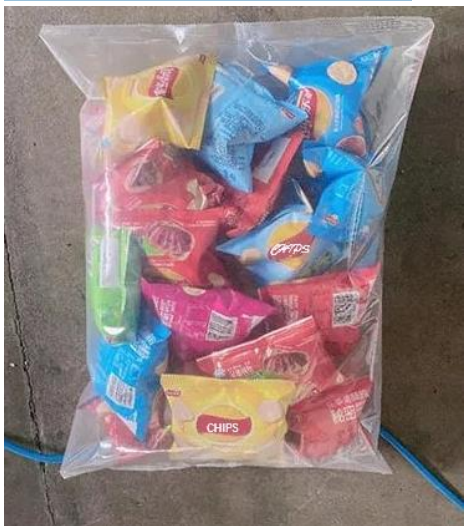
The pouch that contains packets of different flavours of chips represents secondary packaging. Primary packaging refers to the immediate packaging of the product that is in direct contact with it (such as individual packets of chips). Secondary packaging groups these primary packages together for easier handling and sale. Transportation packaging is used for bulk handling and shipment, whereas general packaging is not a specific packaging level. Hence, the pouch containing multiple packets is secondary packaging.
‘It involves a variety of programmes designed to promote or protect a company’s image and its individual products in the eyes of the public.’ The promotion tool being referred to in the above statement is :
The statement describes activities aimed at promoting or protecting a company’s image and its products. Public Relations (PR) involves a variety of programmes designed to maintain and enhance the reputation of a company in the eyes of the public, which matches the given description. Advertising is focused on promoting products through paid media, Personal Selling involves direct interaction with customers, and Sales Promotion offers short-term incentives, so these do not fully capture the intent described.
Identify the incorrect statement with respect to the importance of business environment :
The business environment generally helps businesses by providing useful resources, assisting in planning, and helping cope with rapid changes. However, increasing political instability is a negative factor and does not build confidence among investors. Instead, political instability creates uncertainty and discourages investment in long-term projects. Hence, this statement is incorrect.
Read the following statements : Assertion (A) and Reason (R).
Assertion (A) : The cost of debt is higher than the cost of equity for a firm.
Reason (R) : The lender’s risk is lower than the equity shareholder’s risk, since the lender earns an assured return and repayment of capital. Choose the correct alternative from the options given below :
The cost of debt is actually lower than the cost of equity because lenders take lower risk as they receive fixed interest payments and repayment of capital before equity shareholders. Equity shareholders face higher risk and expect higher returns, so the cost of equity is higher. Hence, Assertion (A) is false but Reason (R) is true.
‘Agri Solutions’, a fast-growing agri-tech company, was facing a problem of employees leaving the organisation frequently. As a result, work suffered and time and money were spent repeatedly on recruitment and training. On investigation, it was found that the problem was due to employees not getting sufficient time to settle into their new roles. So the company decided to keep their employees at the same position for a minimum tenure and give them sufficient time to show results. This led to a significant reduction in employee turnover and improvement in organisational efficiency.
The principle of management highlighted in the above case is :
The principle of Stability of Personnel emphasizes the importance of retaining employees and giving them adequate time to adjust and perform in their roles. By keeping employees at the same position for a minimum tenure, the company ensured that employees could settle properly, reducing turnover and improving organisational efficiency. This directly relates to maintaining stability of personnel.
_____________ is the framework within which the managerial and operating tasks are performed.
Organisational structure is the framework within which managerial and operating tasks are performed as it defines the formal arrangement of roles, responsibilities, and relationships in an organisation. This structure facilitates coordination and communication, enabling managers and employees to know their duties and how to work together effectively.
Rohit is a manager at a furniture manufacturing company. The company holds an annual sale in the month of December, which is very popular. Rohit prepares the production plans for the annual sale well in advance, in the month of June every year. After planning, he ensures that enough workers are available and continuously monitors whether the work is progressing as scheduled or not. He also informs the marketing team well in time so that they can plan their promotional campaigns accordingly. The feature of coordination highlighted in the above case is :
The case explains how Rohit continuously monitors work progress after planning and keeps informing the marketing team. This shows that coordination is an ongoing activity and not a one-time task, which makes 'Coordination is a continuous process' the correct feature highlighted here.
Identify the incorrect statement with respect to the feature of Directing function of management :
The directing function of management is not limited to the top level of management only. It involves guiding, supervising, and motivating employees at all levels of management. Directing initiates action, flows from top to bottom, and is a continuous process, which ensures smooth execution of plans.
Match the incentives given in Column I with their meanings given in Column II. Choose the correct option from the following :
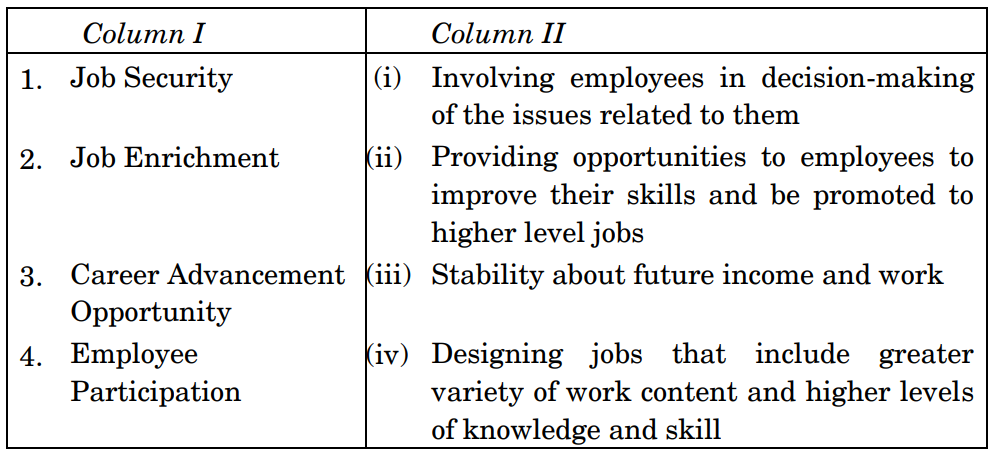
The correct matching is1-(iii), 2-(iv), 3-(ii), 4-(i) because each incentive in Column I corresponds accurately to its definition in Column II as per the context provided. This option aligns the incentives with their correct meanings, ensuring that the purpose of each incentive is clearly understood.
‘The larger the lead time, the larger the quantity of material to be stored, and the larger shall be the amount of working capital required.’ The factor affecting the requirement of working capital discussed in the above statement is :
The statement refers to 'lead time' which is the time taken for procurement and production. A longer lead time means materials need to be stored for a longer duration, increasing inventory levels and consequently, the amount of working capital required. This factor is related to the 'Production cycle' because the production cycle determines the duration of operations and storage, thus impacting working capital needs.
Read the following statements carefully :
Statement I : Planning and controlling are both forward-looking as well as backward-looking.
Statement II : Planning is evaluative, whereas controlling is prescriptive. In the light of the given statements, choose the correct alternative from the following
Planning involves looking forward by setting objectives and deciding the course of action to achieve them, and it also takes past experiences into account, making it both forward-looking and backward-looking. Similarly, controlling is forward-looking in that it anticipates deviations and backward-looking as it compares actual performance with standards. Therefore, Statement I is true. However, planning is prescriptive because it prescribes what needs to be done to achieve objectives, whereas controlling is evaluative as it involves assessing performance and taking corrective actions. Hence, Statement II is false.
Dinkar, the General Manager at ‘Tara Lamps’ noticed that rising costs were affecting the company’s profits. To increase the profits, he decided to reduce the costs and increase the productivity. He planned for rearrangement of work processes, assigned the tasks according to workers’ skills, gave clearer directions to employees than before and regularly controlled the activities of the organisation. This not only resulted in cost reduction but also in increased productivity and profits. The point of importance of management highlighted in the above case is :
The case describes how Dinkar reorganized work processes, assigned tasks according to skills, gave clear directions, and controlled activities which led to cost reduction and increased productivity. These are all efforts to increase efficiency in the organization. Therefore, the point of importance of management highlighted here is that management increases efficiency.
Read the following statements carefully :
Statement I : The production concept assumes that the customers will not buy, or not buy enough, unless they are adequately convinced and motivated to do so.
Statement II : The selling concept assumes that the consumers will favour those products which are widely available at an affordable price. In the light of the given statements,
choose the correct alternative from the following :
The production concept assumes that consumers will prefer products that are widely available and affordable, meaning it focuses on mass production and low cost. Therefore, Statement II correctly describes the production concept but is mistakenly assigned to the selling concept. Statement I incorrectly describes the production concept; the description given actually fits the selling concept, which focuses on convincing and motivating customers to buy. Hence, Statement I is false and Statement II is true.
‘The first step in the controlling process is setting up of performance standards.’ Identify the correct order of the subsequent steps of the controlling process.
After setting performance standards, the controlling process involves measuring the actual performance to see if it meets those standards. Then, the actual performance is compared with the set standards to identify any deviations. These deviations are then analysed to understand the reasons behind them. Finally, corrective actions are taken to address the deviations and ensure that performance aligns with the standards.
Section B
‘Delicious Salads’ was a company that supplied packaged salads to the supermarkets. Recently, the management noticed that a large amount of vegetables were getting spoiled every week. This was increasing the costs and reducing the profits because of which the company was not able to achieve its goals. To solve this, the Production Manager, Meera was asked to take charge of the situation and bring the wastage under control. Meera found that the vegetable cleaning, cutting and packing departments were working at their own pace, leading to the spoilage of vegetables.
Meera started out by setting standards for each of the departments, which were well coordinated with one another. Each activity would be performed in accordance with those standards. Within a month, ‘Delicious Salads’ was able to supply the salads with minimum wastage and achieve its goals.
Explain the two points of importance of the controlling function of management discussed in the above case.
1. Helps in Setting Standards and Coordination: Controlling helps in setting standards for each department as seen when Meera set standards for cleaning, cutting, and packing departments. These standards ensured that every department worked efficiently and in coordination, preventing the spoilage caused by uncoordinated work.
2. Reduces Waste and Improves Efficiency: By monitoring the work and enforcing the set standards, controlling helped minimize vegetable wastage. This resulted in reducing costs and increasing profitability, enabling the company to achieve its goals effectively.
State any three points of difference between Formal organisation and Informal organisation
(a) Definition: Formal organisation is a planned structure of roles and responsibilities designed by the management to achieve specific goals whereas Informal organisation arises naturally and spontaneously among individuals based on social relationships.
(b) Nature: Formal organisation is official and prescribed by rules and policies, while Informal organisation is unofficial and based on personal relations, emotions, and social interactions.
(c) Purpose: Formal organisation aims at achieving organisational objectives efficiently whereas Informal organisation satisfies social and psychological needs of employees within the workplace.
State any three points of difference between Divisional structure and Functional structure of an organisation.
(a) Basis of grouping: In Divisional structure, departments are grouped based on products, services, or geographical location. In Functional structure, employees are grouped based on their functions or roles such as marketing, finance, or production.
(b) Authority and responsibility: In Divisional structure, each division has its own resources and functions independently, with divisional managers having authority over their divisions. In Functional structure, authority is centralized with functional heads controlling the activities within their departments.
(c) Flexibility and focus: Divisional structure provides greater flexibility and focuses on specific products or markets, allowing quick response to changes. Functional structure promotes specialization and efficiency within functions but may face coordination difficulties across departments.
‘Tiva Motors’ planned to set up a new manufacturing unit for the electric scooters in Varanchal. One important consideration for setting up of the unit in Varanchal was that the government in Varanchal had been stable for several years. This had built confidence among business people to invest in long-term projects there. They understood that an adequate knowledge of the rules and regulations framed by the government is a prerequisite for a good business performance. So, before starting the operations, the company decided to obtain licences under environmental laws and necessary permissions from the government departments. Identify and explain the two dimensions of business environment that are highlighted in the above case.
(a) Political Environment: The stability of the government in Varanchal is a part of the political environment. A stable government ensures consistency in policies and long-term support for businesses, which increases investor confidence and encourages investments in long-term projects.
(b) Legal Environment: The company’s decision to obtain licences under environmental laws and necessary permissions from government departments highlights the importance of the legal environment. It includes laws and regulations that businesses must follow to operate legally and sustainably. Compliance with these laws ensures smooth functioning and avoids legal problems.
Hence, the two dimensions of business environment highlighted in the case are the political environment and the legal environment.
Differentiate between Capital Market and Money Market on the basis of :
(i) Participants
(ii) Liquidity
(iii) Duration
(ii) Liquidity: Money Market instruments are highly liquid as they are short-term and easy to convert into cash. Capital Market instruments are less liquid because they involve long-term securities which may take time to be sold.
(iii) Duration: Money Market deals with short-term funds, typically up to one year. Capital Market deals with long-term funds, usually more than one year.
Explain how the following factors affect the requirements of fixed capital of a company:
(i) Nature of the business
(ii) Technology upgradation
(iii) Level of collaboration
(ii) Technology upgradation: When a company adopts advanced technology, it often needs to invest more in fixed assets like modern machines and equipment, increasing the fixed capital requirement.
(iii) Level of collaboration: If a company collaborates with other firms, it may share resources, reducing the need to invest heavily in fixed capital. Conversely, without collaboration, the company may need to invest more on its own.
Section C
Explain the following features of principles of management :
(i) Cause and effect relationship
(ii) Contingent
(ii) Contingent: This means that management principles are not rigid rules but depend on the situation. They may vary according to the environment, time, people involved and other factors. Hence, principles should be applied flexibly keeping the situation in mind.
Explain the following techniques of scientific management :
(i) Motion Study
(ii) Differential Piece Wage System
(ii) Differential Piece Wage System is a wage payment method where workers are paid based on their output quality and quantity. Under this system, workers who produce more than a standard output are paid a higher rate per piece, while those producing less get a lower rate. This encourages workers to increase their efficiency and motivates them to produce more.
State any four responsibilities of a consumer under the Consumer Protection Act, 2019.
(a) To provide accurate information while filing a complaint or claim with the consumer forum.
(b) To avoid the use of false or misleading information about the goods or services.
(c) To read and understand the terms, conditions, and instructions of the goods and services purchased.
(d) To cooperate with the authorities or agencies while seeking redressal and follow prescribed legal procedures properly.
Arjun and Neha were close friends. They had studied together in the same school. After completing their higher education, both of them joined a company named ‘Apex Ltd.’ in different roles, based on their qualifications. Arjun’s role involved analysing the business environment and its implications for the survival of the firm. He was also responsible for the welfare and survival of the organisation. Neha, on the other hand, was heading the marketing department in the organisation. Her responsibility was to ensure that her department had the necessary personnel. In addition to many other responsibilities, she had to motivate them to achieve desired objectives.
Apart from the functions mentioned in the above case, state two more functions each for Arjun and Neha that they would perform at the level at which they are working
1. Planning: Arjun would plan the future course of action for the organisation by setting objectives and deciding the strategies to achieve them.
2. Organising: He would organise resources such as manpower, materials, and machinery to ensure smooth functioning of the organisation.
(b) Functions performed by Neha (Marketing Department Head):
1. Coordinating: Neha would coordinate with other departments like production and finance to ensure marketing plans are implemented effectively.
2. Controlling: She would monitor the performance of the marketing team and take corrective actions if targets are not met.
This way, Arjun focuses on overall managerial functions contributing to the survival of the firm, while Neha manages specific marketing functions to achieve departmental objectives.
‘Sabka Consumer Forum’, a well-known non-governmental organisation (NGO), has been working for the welfare of the consumers. Its main aim is to educate the general public about consumer rights by organising training programmes, seminars and workshops. Seeing the growing need for awareness, the NGO started publishing periodicals and other publications to impart knowledge about consumer problems, legal reporting, reliefs available and other matters of consumer interest. These publications became very popular and people began approaching the NGO for guidance.
One day, a group of residents from a nearby housing society approached ‘Sabka Consumer Forum’. They had purchased water purifiers from a company, which turned out to be defective. Even after repeated complaints, the company had failed to respond. ‘Sabka Consumer Forum’ studied the case and decided to file a complaint on behalf of the consumers in the appropriate consumer court.
Apart from the functions mentioned in the above case, state any four other functions which may be performed by ‘Sabka Consumer Forum’ for protecting and promoting consumer interests
(a) Conducting awareness campaigns to educate consumers about their rights and responsibilities.
(b) Assisting consumers in filing complaints and providing legal help in consumer dispute redressal forums.
(c) Monitoring and reporting violations of consumer rights by manufacturers and service providers.
(d) Collaborating with government agencies to influence policy changes for better consumer protection.
These functions help in protecting consumer interests effectively and promoting consumer welfare.
Rhea runs an online business selling handmade candles. During the Diwali season, the demand for her handmade scented candles increases a lot. A month before Diwali, she received a big order from a chain of gift stores in and around the city. Rhea immediately checked the order details and processed it. She was aware that it was important to provide for accurate and speedy processing of orders, in the absence of which goods would reach the customers late or in the wrong quantity or specifications. After processing the order, Rhea arranged a vehicle to pick up the cartons from her workshop. She knew that the products can reach the customers only when they are physically moved from the place of production to the place of sale. The vehicle delivered the order at the gift chain’s warehouse well before the festive rush.
(a) Identify the two components of physical distribution that Rhea managed effectively.
(b) Explain the other two components of physical distribution that Rhea needs to work on.
(b) The other two components of physical distribution that Rhea needs to work on are warehousing and inventory management. She should ensure that there is proper storage space for finished goods before dispatch and maintain optimal inventory levels to meet demand without delay or excess stock.
‘Neo Appliances Ltd.’, a company known for its innovative kitchen devices was established in 2001. Over the years, the company performed well and the market value of its shares increased. Rajan had bought shares of ‘Neo Appliances Ltd.’ many years ago. He sold some of the shares to arrange money for his daughter’s higher education. He shared with his friend Madhur how his investment had multiplied over the years. Madhur was impressed and wanted to start investing in shares. He asked Rajan in which market he had sold his shares and whether it was safe to invest in that market. Rajan said, yes this market provides safety of transactions to investors.
(a) Name the market in which Rajan sold his shares.
(b) Identify and explain the function of the above market which facilitated Rajan in selling his shares.
(c) Explain how the market identified in (a) above provides safety of transactions to investors.
(b) The stock market is a market where shares of companies are bought and sold. It provides a platform to investors like Rajan to sell their shares to interested buyers. The stock market helps in providing liquidity to shares, meaning investors can easily convert their shares into cash whenever they want.
(c) The stock market ensures safety of transactions through various mechanisms. It is regulated by authorities like SEBI (Securities and Exchange Board of India) who enforce rules to protect investors. The transactions happen through a transparent electronic system that records all trades officially. Also, the presence of brokers and clearinghouses reduces the risk of fraud and ensures the proper transfer of shares and money between buyer and seller.
Section D
‘Alpha Electronics’ had recently received a large order for the supply of electronic control panels. The management was under pressure to deliver it on time. When one of the production lines started malfunctioning, the Production Manager, Suresh, was concerned. Although ‘Alpha Electronics’ was an organisation with highly centralised pattern where free communication was not encouraged. Suresh, still decided to call his senior technician, Manoj, to understand the problem. Suresh had the reputation of being unapproachable. He was conscious of his seniority and position so he rarely encouraged his subordinates to speak freely. Manoj was nervous as the production line was damaged due to his own negligence and he thought sharing it with his senior, Suresh, would adversely affect his interests. Anyhow, he had to go to Suresh’s office. When Manoj entered Suresh’s office, he saw that Suresh was pre-occupied with an important file before him. Suresh asked Manoj to explain what the problem was. Manoj reluctantly started explaining, but he felt that Suresh wasn’t listening to him. So Manoj did not share the complete information and the problem in the production line could not be rectified on time. Identify and explain four communication barriers discussed in the above case.
(a) Organisational Barrier: Alpha Electronics follows a highly centralised pattern where free communication is not encouraged. This restricts smooth flow of information from lower to higher levels leading to delayed or incomplete communication.
(b) Emotional Barrier: Manoj was nervous and afraid to disclose the real reason of the malfunction as it was due to his own negligence. His fear and hesitation prevented open communication.
(c) Attitudinal Barrier: Suresh had a reputation of being unapproachable and conscious about his authority. He rarely encouraged his subordinates to speak freely which created a feeling of discomfort among employees like Manoj to communicate honestly.
(d) Physical Barrier: When Manoj met Suresh, Suresh was pre-occupied with an important file which distracted his attention. This affected the active listening process making Manoj feel that he was not being heard properly, leading to incomplete sharing of information.
These barriers together caused failure in effective communication which impacted the timely rectification of the production line problem.
Explain the following points of limitations of planning :
(i) Planning reduces creativity
(ii) Planning leads to rigidity
(iii) Planning does not guarantee success
(a) Planning reduces creativity: Planning involves setting fixed objectives and methods in advance which may discourage free thinking and innovation. Strict adherence to plans can limit the scope for creative ideas and new approaches, as employees might focus only on what is planned rather than exploring better or different ways to solve problems.
(b) Planning leads to rigidity: Once a plan is made, it creates a fixed path for action. This rigidity means that if there are unexpected changes in the environment or new opportunities arise, the organization may find it difficult to adapt quickly because the plan does not allow flexibility. This can affect the organization's ability to respond to dynamic market conditions.
(c) Planning does not guarantee success: Even with careful planning, success is not always certain. External factors such as competition, economic changes, and technological advancements can affect outcomes. Moreover, plans are based on assumptions and predictions, which may not always be accurate. Therefore, despite planning, the desired results may not be achieved.
‘Quality Foods Ltd.’, a company manufacturing packaged snacks has been in business for the last 10 years. It enjoys a good reputation and has a loyal customer base. This financial year, the profits of the company increased manifold as the company introduced a new range of baked snacks that became very popular. As the year came to an end, the company had to decide how much dividend to pay to its shareholders. In view of the above and with the understanding that investors, in general, view an increase in dividend as good news and stock prices react positively to it, the Board of Directors were keen on declaring a high dividend. However, the Chief Finance Officer of the company pointed out that they need to keep many considerations in mind before declaring dividend. He drew the attention of the Board of Directors to the loan that the company has taken, containing a clause that imposes restriction on the payment of dividend. Further, he pointed out that even though the profits were high, a large amount of money was tied to the amounts receivables from the debtors. Without enough cash in hand, announcing a high dividend may not be practical. He also reminded the Board of Directors that ‘Quality Foods Ltd.’ was planning to expand into the breakfast cereal market. Since this new project will require a huge investment, the company will need to retain more money out of their earnings to finance it.
(a) Identify and explain any two factors affecting dividend decision that would have influenced the decision of the Board of Directors to pay a high dividend.
(b) Identify and explain any two factors to which the Chief Finance Officer drew the attention of the Board of Directors.
Profitability: Quality Foods Ltd. has experienced a manifold increase in profits due to the successful launch of a new range of baked snacks. Higher profits generally enable a company to pay higher dividends to shareholders.
Market Expectations: Investors often view an increase in dividend as a sign of good financial health, and stock prices react positively. To maintain a good reputation among shareholders and attract more investors, the Board would be motivated to declare a high dividend.
(b) Two factors highlighted by the Chief Finance Officer that the Board should consider before declaring dividend are:
Loan Restrictions: The company has taken a loan containing a clause that restricts dividend payment. Such legal or contractual restrictions must be complied with, limiting the amount of dividend the company can declare.
Liquidity Position: Despite high profits, a large amount of money is tied up as receivables from debtors, meaning the company does not have enough cash on hand. Declaring a high dividend without sufficient cash may harm the company’s liquidity and operational needs.
Additionally, the CFO reminded that since the company plans to expand into the breakfast cereal market requiring large investments, retaining earnings to finance this project is essential and may limit the funds available for dividend distribution.
Explain the following steps in the process of staffing :
(i) Selection
(ii) Promotion and Career Planning
(iii) Compensation
(b) Promotion and Career Planning: Promotion involves advancing an employee to a higher position based on performance, skills, and qualifications. Career planning is a continuous process where employees set career goals and develop skills to achieve growth within the company. Both help in motivating employees and retaining talent.
(c) Compensation: Compensation refers to the payment and benefits given to employees for their work. It includes salary, wages, bonuses, incentives, and other benefits like health insurance and retirement plans. Proper compensation is essential to attract and retain employees and maintain their satisfaction and productivity.
Explain the following external sources of recruitment :
(i) Direct Recruitment
(ii) Casual Callers
(iii) Labour Contractors
(iii) Labour Contractors
(b) Casual Callers: Casual callers are individuals who directly approach an organisation to seek employment without any prior advertisement or recruitment process. These applicants are considered when there is an urgent or unexpected need for workers. It is an informal method and usually suits temporary or daily wage jobs.
(c) Labour Contractors: Labour contractors are intermediaries who supply workers to organisations for a specific period or project. The company hires these contractors who provide labourers as per requirement. This method is common in construction and manufacturing industries. It reduces the company's recruitment burden but might affect direct control over workers.
Explain the following points of importance of organising :
(i) Adaptation to change
(ii) Effective administration
(iii) Expansion and growth
(ii) Effective administration: Proper organising establishes a clear structure where tasks are assigned, and authority is defined. This clarity leads to better coordination among departments and employees, minimizing confusion and duplication of efforts. As a result, management functions such as planning, staffing, and controlling become more effective.
(iii) Expansion and growth: When an organisation is well organised, it has a solid foundation to support growth. The defined roles, communication channels, and processes make it easier to add new employees, departments or branches without disrupting existing operations. Hence, organising facilitates smooth expansion and sustainable development of the organisation.
Other Years — Business Studies