SOLUTIONS
2026 BOARD EXAM
CBSE Class 12 Commerce Business Studies Board Paper 2026 — Set 1 Solutions
2026
Business Studies
Class 12 Commerce
CBSE EXAMINATION PAPER-2026
BUSINESS STUDIES
(Solved)
General Instructions :
Read the following instructions carefully and follow them :
- This question paper contains 40 questions. All questions are compulsory.
- This question paper is divided into 4 sections.
- Section A – questions number 1 to 20 are multiple choice questions
- Section B – questions number 21 to 26 are short answer type i
- Section C – questions number 27 to 34 are short answer type ii
- Section D – questions number 35 to 40 are long answer
- There is no overall choice given in the question paper. However, an internal choice has been provided in few questions.
- Use of calculator is NOT allowed.
Section A
Ritika wanted to buy a new washing machine. She visited ‘Elec Duniya’, a large electronics store. She saw there many different brands and models on display like KM, Neo, Unipool, INH etc.
The salesperson at the store explained the differences in quality, brand reputation and prices of different washing machines. Ritika could now compare fully automatic, semi-automatic, top load and front load washing machines. The salesperson encouraged her to take her time, check different brands and resolve her queries. Ritika also went to another shop nearby to compare prices and features of different washing machines.
After comparing all the available options, Ritika chose a ‘Neo’ front load washing machine because it offered the best features within her budget. The consumer right exercised by Ritika in the above case is
Ritika exercised her right to consumer education as she took time to learn about different brands, models, features, and prices before making an informed decision. The salesperson helped her understand the product differences, enabling her to compare and choose the best washing machine according to her needs and budget. This right ensures consumers have complete information to make wise purchases.
The workers in Alpha manufacturing company were using traditional methods for production of metal parts. Since no standard procedure existed, workers relied on personal experience and guess work. As a result, productivity in the assembly line began to decline.
To improve productivity, the company hired a consultant specializing in scientific management. The consultant explained that there was only one best method to maximize efficiency and this method could be developed through proper study and analysis. He emphasized that the scientific method should replace the old method, that the workers were using. So, to develop the scientific method, the consultant carefully investigated the traditional methods through work-study and by unifying the best practices, he developed a standard method that would be followed by everyone in the organization.
After applying scientific method, there was a three fold increase in productivity within six months.
The principle of scientific management which helped the company in increasing the productivity was :
The consultant emphasized that only one best way exists to do a job and it can be determined through scientific study and analysis, replacing the old guesswork and personal experience. This directly aligns with the principle 'Science, not Rule of Thumb', which means decisions and methods should be based on scientific study rather than intuition or tradition.
Read the following statements carefully :
Statement – I : Consumers should get together and form themselves into consumer associations for protection and promotion of their interests.
Statement – II : The Consumer Protection Act provides for setting up a two-tier enforcement machinery for the redressal of consumer grievances.
With reference to given statements, choose the correct alternative from the following :
Both statements are correct. Statement I is true because consumers forming associations helps them to protect and promote their interests effectively. Statement II is true because the Consumer Protection Act provides for a two-tier enforcement machinery, which includes consumer courts at the district and state levels for redressal of consumer grievances.
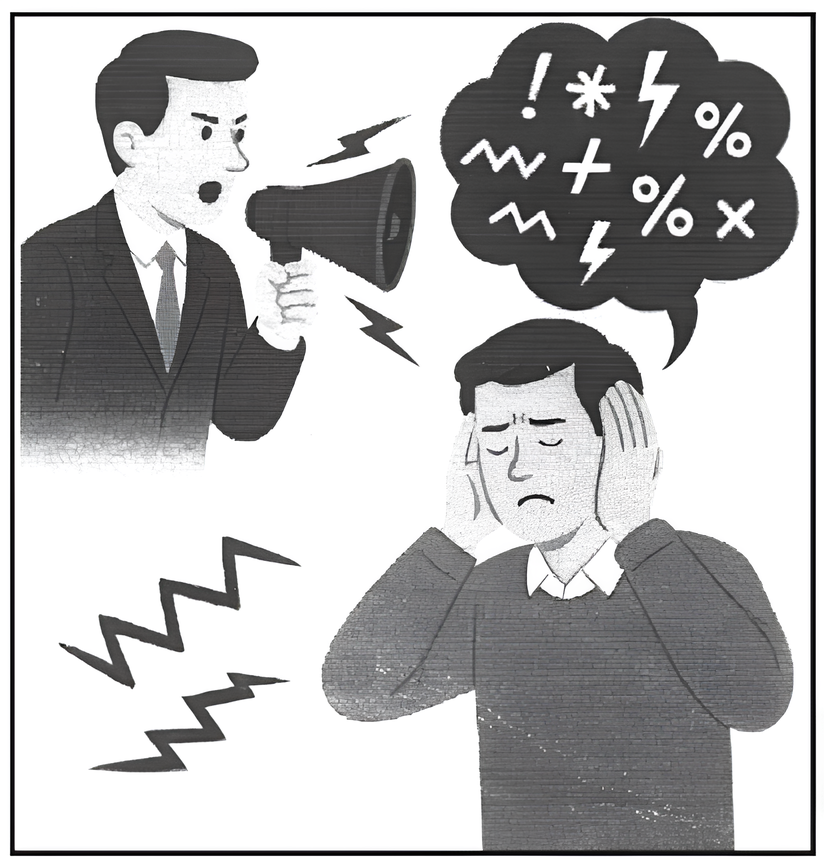
Read the following statements – Assertion (A) and Reason (R) :
Assertion (A) Many enlightened business firms have set up their own consumer service and grievance cells.
Reason (R) : The consumer has a right to file a complaint and to be heard in case of dissatisfaction with a good or service.
Choose the correct alternative from the alternatives given below
Both the assertion and the reason are true. Many enlightened business firms establish consumer service and grievance cells to address consumer complaints effectively. This is because consumers have the right to file complaints and be heard if they are unsatisfied with a product or service. The reason explains why firms take the initiative mentioned in the assertion.
Sudha is a corporate executive and has to attend a felicitation function to be held in her office tomorrow. So she decides to colour her hair. On recommendation of her friend, she purchased ‘NATURO’ hair colour. After reading essential details such as shade, its ingredients, usage instructions and expiry date mentioned on the box, Sudha opened the box. She took out the colour tube and developer bottle from the box and threw away the box. The level of packaging of box thrown away by Sudha was :
The box that Sudha threw away contained the tube and developer bottle, which are the actual products. The box serves as a protective and informative outer layer for the smaller containers inside. Packaging levels are commonly classified as primary, secondary, and tertiary packaging. Primary packaging is the direct packaging that holds the product in its usable form (here, the colour tube and developer bottle). Secondary packaging is the outer box that groups primary packages, providing protection and information. Tertiary packaging is used for bulk handling and transportation, such as cartons or pallets. Therefore, the box discarded by Sudha represents secondary packaging.
Read the following statements – Assertion (A) and Reason (R) :
Assertion (A) : Money market instruments have a higher degree of liquidity as compared to capital market securities.
Reason (R) : Money market instruments are traded on the stock exchanges.
Choose the correct alternative from the alternatives given below :
The assertion is correct because money market instruments are short-term financial instruments that generally have higher liquidity compared to capital market securities, which are long term. The reason is also true since some money market instruments are traded on stock exchanges. However, the reason does not fully explain why money market instruments have higher liquidity; their short-term maturities primarily contribute to higher liquidity, not just the fact that they are traded on stock exchanges.
Ravi purchased gold jewellery from a reputed jewellery store. He ensured that the jewellery had a hallmark which confirm its purity and authenticity. To avoid paying goods and services tax (GST) he asked the salesperson to write the gold weight and making charges on a slip of paper and hand over it to him.
Which of the following responsibilities of a consumer was not fulfilled by Ravi while purchasing jewellery ?
A cash memo is an important document that serves as proof of purchase and contains all necessary details like price, weight, making charges, and taxes paid. It protects the consumer's rights in case of any disputes or warranty claims. By asking the salesperson to write the gold weight and making charges on a slip of paper instead of getting a proper cash memo, Ravi did not fulfill the responsibility of asking for a cash memo, which is essential for transparency and consumer protection.
‘CARO Tech Solutions’ aimed at development of a software system for the company’s growing operations. The project was to be completed within six months with a budget of Rs.12,00,000.
The software development team successfully completed its project on time by outsourcing a part of the project, leading to an additional expense of Rs.2,00,000. From the following, identify whether the software development team is
Due to severe winter and rising pollution levels, ‘Green India Electronics’ planned to launch a new eco-friendly heater in the market. It conducted a survey and found that the demand of this product was very high. As the winter season lasts only for 2 to 3 months, the Chief Executive Officer wanted that there should be close coordination among all the managers to deliver orders on time. Top level managers were asked to work in coordination with their subordinates to ensure that company’s policies were properly followed. To ensure that the heaters would be ready on time, the production manager co-ordinated with the operational level managers. Operational level managers co-ordinated the activities of the workers to ensure that work proceeded according to plans. As a result ‘Green India Electronics’ was able to launch its heaters on time, in the market. The feature of co-ordination discussed in the above case is
The case highlights how different levels of management and workers worked together harmoniously to achieve the common objective of launching the heater on time. This shows that coordination brings unity of action among all members of the organization to achieve the desired goals effectively.
‘Business environment keeps on changing whether in terms of technological improvement, shifts in consumer preferences or entry of new competitors in the market.’ The feature of business environment highlighted in the above statement is
The statement highlights that the business environment is constantly changing with respect to technological improvements, consumer preferences, and competition. This continuous change and movement indicate the dynamic nature of the business environment, meaning it is not static but keeps evolving over time.
A position when a company is unable to meet its fixed financial charges like interest payment, dividend on preference shares and repayment obligations is referred to as ______ .
Financial risk refers to the risk when a company fails to meet its fixed financial obligations such as interest payments on loans, dividends on preference shares, and repayment of debts. This inability to fulfill fixed financial charges distinguishes financial risk from other types of risks like business risk or operating risk.
Identify the incorrect statement with respect to the importance of planning function of management :
This statement is incorrect because planning does not eliminate uncertainty completely. Instead, planning helps in reducing uncertainty by anticipating possible changes and preparing for them. Uncertainty can never be totally eliminated as future conditions and events cannot be predicted with absolute certainty.
Identify the feature of planning which states that the purpose of planning is to meet future events effectively to the best advantage of an organisation :
The feature 'Planning is futuristic' means that planning involves looking ahead and preparing for future events. It helps an organisation to meet upcoming challenges and opportunities effectively to achieve the best possible outcomes. Therefore, this feature clearly aligns with the purpose of planning to meet future events to the organisation's advantage.
The step of controlling process which reveals the deviation between actual performance and desired results is :
In the controlling process, the step that reveals the deviation between actual performance and desired results is the comparison of actual performance with the set standards. This step helps to identify whether there is any difference or deviation that needs to be addressed before taking corrective action.
‘Certain provisions of the Companies Act place restrictions on payouts as dividend. Such provisions must be adhered to while declaring the dividend.’ The factor affecting dividend decision discussed above is :
The question refers to restrictions placed by the Companies Act on dividend payouts. These restrictions are legal in nature, implying that companies must comply with laws and regulations when declaring dividends. Therefore, the factor affecting the dividend decision here is 'Legal constraints' because it involves adherence to legal provisions governing dividend distribution.
Read the following statements carefully :
Statement – I : Control should focus on key result areas which are critical to the success of an organization.
Statement – II : Only significant deviations which go beyond the permissible limit should be brought to the notice of management.
With reference to the given statements, choose the correct alternative from the following :
Both statements are correct because control in management aims at focusing on key result areas crucial for organizational success to ensure effectiveness. Additionally, to avoid information overload, only significant deviations that exceed permissible limits are reported to management so corrective actions can be taken timely and efficiently.
Which of the following is NOT an organisational barrier to communication ?
Organisational barriers to communication include factors like organisational facilities, status differences, and rules and regulations that restrict or complicate communication within an organisation. Lack of proper incentives is generally considered a motivational issue rather than a direct organisational barrier to communication.
Match the principle of management given in Column–I with its explanation given in Column–II:
Choose the correct option from the following :
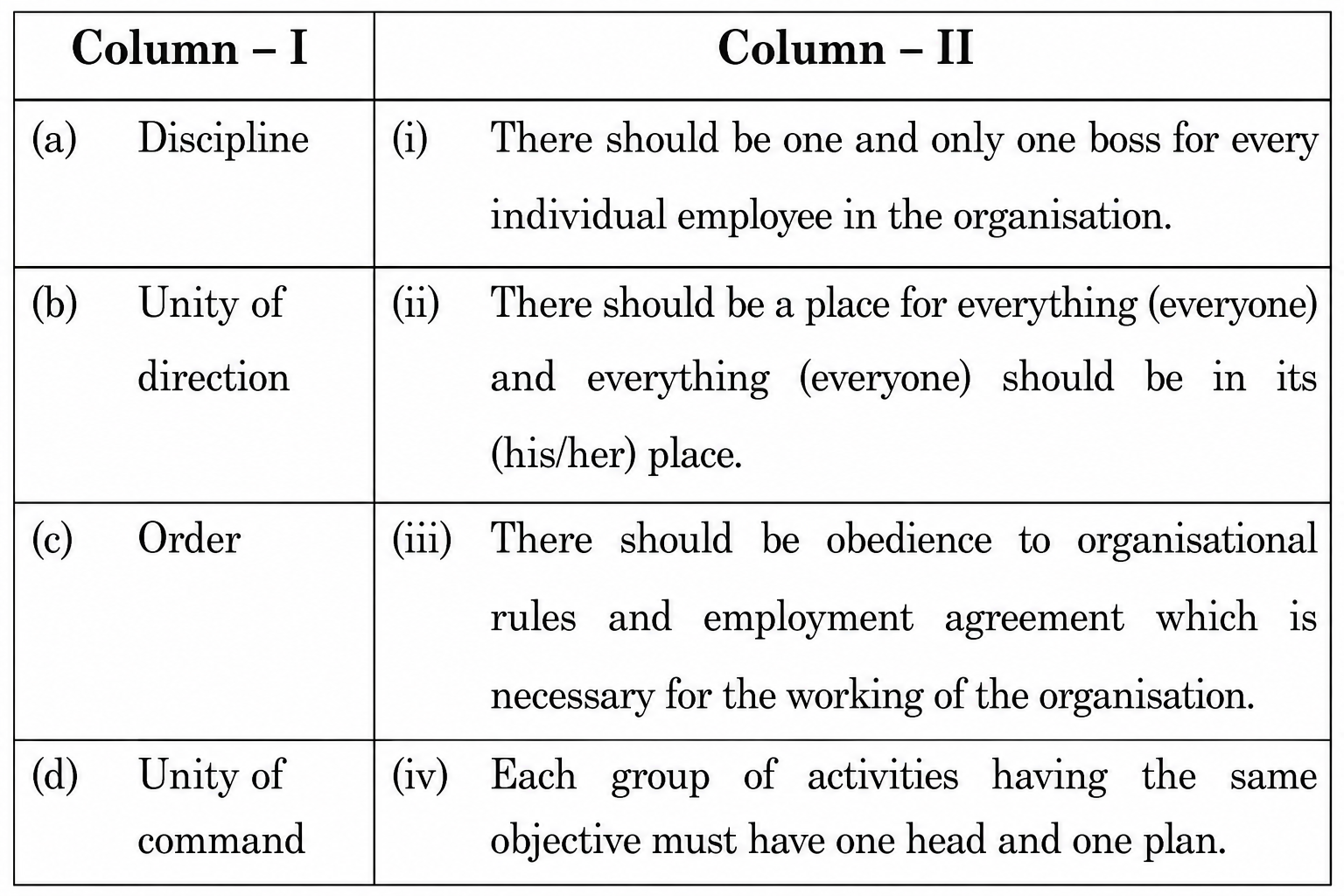
The correct matching is: (a) Discipline - (iii) There should be obedience to organisational rules and employment agreement which is necessary for the working of the organisation. (b) Unity of direction - (iv) Each group of activities having the same objective must have one head and one plan. (c) Order - (ii) There should be a place for everything (everyone) and everything (everyone) should be in its (his/her) place. (d) Unity of command - (i) There should be one and only one boss for every individual employee in the organisation. This corresponds to the option (iii) (iv) (ii) (i). Discipline relates to obedience, unity of direction to one plan and one head, order to proper arrangement, and unity of command to having a single superior.
Section B
‘Riya Mart’ is a company manufacturing disposable crockery. They have been in business for the past five years, but were not earning good profits. Concerned about this, the Chief Executive Officer (CEO), Verma, ordered an internal audit. The audit uncovered several issues like inventory pilferage, employees coming late and their performance not up to the mark. To stop inventory pilferage, Verma, the CEO, introduced surprise stock checks and installed an automated inventory management system to track stock movements. A biometric attendance system was also setup to keep a check on employees coming late. In addition to this, to motivate employees for better performance, they were told in advance what they are expected to do and what are their standards of performance. As a result of these steps, the inventory pilferage reduced, employees became more punctual and their performance improved.
(i) Identify and state the function of management performed by Verma, the Chief Executive Officer of the company.
(ii) State any two points of importance of the function identified in (i) above, which are not discussed in the above para.
(ii) Two points of importance of controlling not discussed above are:
- It helps in minimizing errors and reducing wastage of resources by regularly checking actual performance against planned standards.
- Controlling facilitates coordination among different departments by ensuring activities are performed according to plans, thus helping in achieving organizational objectives efficiently.
(a) Active Listening: Pay full attention to the speaker, avoid interruptions, and try to understand their message clearly.
(b) Clear and Concise Message: Use simple and precise language to avoid confusion and ensure that the message is easily understood.
(c) Feedback: Encourage feedback to confirm that the message has been received and understood correctly. This helps to clarify doubts and improve the communication process.
1. Ability to Influence: Leadership involves influencing the behavior of individuals or groups towards achieving common goals.
2. Goal Oriented: Leaders direct group efforts to accomplish specific objectives and motivate followers to work efficiently.
3. Communication Skills: Effective leaders communicate clearly and listen to feedback to maintain good relationships and guide their team.
These features help leaders to guide, motivate, and bring out the best in their followers.
1. Implementing plans: Middle level managers interpret and implement the plans and policies framed by the top management to the lower levels.
2. Coordinating departments: They coordinate activities of different departments to ensure smooth functioning of the organization.
3. Motivating employees: They motivate and guide the lower level managers and workers to achieve organizational goals effectively.
(a) Withdrawal of old currency notes: Demonetisation involves the withdrawal of existing currency notes of certain denominations from circulation, making them no longer legal tender.
(b) Introduction of new currency notes: After withdrawing old notes, new currency notes with different designs and security features are introduced to replace them.
(c) Aim to curb black money and counterfeit currency: It is implemented to reduce illegal cash holdings, counterfeit currency, and corruption by forcing people to deposit or exchange old notes within a specified time.
‘Soal Footwear Ltd.’ is known for its high quality athletic shoes and casual sneakers. With increasing competition and changing consumer preferences, it decided to diversify its product range by adding clothing, bags and accessories under the same brand umbrella. This diversification aimed to capture a larger share of the market and increase customer loyalty.
(i) Suggest with reason which type of organisational structure will be suitable for ‘Soal Footwear Ltd.’
(ii) State any two advantages of the organisational structure suggested in (i) above.
(ii) Two advantages of Divisional Structure are:
1. It enhances flexibility and quick response to market changes as each division functions independently.
2. It improves accountability since performance of each product category can be measured separately, aiding better control and coordination.
Section C
‘Sheetal Cosmetics Ltd.’, is a fast growing beauty and skin care company known for its innovative products and aggressive market expansion. As the company increased its marketing activities like new product launches, accelerated advertising campaigns, social media promotions and influencer collaborations etc., the workload of the marketing department grew sharply. Despite working long hours, the marketing manager Arjun couldn’t give adequate attention to strategic planning and high impact decisions as minor operational issues began consuming most of his time. Noticing this, the Chief Executive Officer (CEO) advised Arjun that it was now impractical for him to handle the entire volume of work alone, so he should allow his subordinates to take up routine tasks. This would not only help him manage his time better but also satisfy the subordinate’s need for recognition. This will also provide opportunities to the subordinates to develop and exercise initiative
(i) Identify the concept suggested by CEO that will help Arjun to manage volume of work effectively.
(ii) State any three points of importance of the concept identified in (i) above.
(ii) Importance of Delegation:
1. It helps the manager to reduce workload and manage time effectively by focusing on key tasks.
2. It motivates and empowers subordinates by giving them responsibility and opportunity for personal growth.
3. Delegation develops subordinates’ skills and initiative, preparing them for higher roles in future.
Overall, delegation improves efficiency and promotes team development in an organization.
State any four merits of internal source of recruitment.
1. Cost-effective: Internal recruitment saves money as it eliminates advertising and recruitment agency fees.
2. Faster Process: It reduces the time taken to fill the vacancy since suitable candidates are already within the organization.
3. Motivates Employees: Promoting from within encourages employees to perform well as they see opportunities for growth.
4. Better Knowledge of Candidates: The organization already knows the skills, abilities, and work habits of internal candidates, reducing the risk of a bad hire.
State any four benefits of training to the employees.
1. Improves Skills: Training helps employees learn new skills and improve existing ones making them more efficient in their work.
2. Increases Confidence: When employees are well-trained, they become more confident in their abilities.
3. Career Growth: Training provides opportunities for employees to grow in their careers by preparing them for higher responsibilities.
4. Job Satisfaction: Employees feel more satisfied and motivated when they are equipped with the knowledge and skills to perform their jobs well.
Explain the following points of importance of planning :
(i) Planning establishes standards for controlling
(ii) Planning reduces overlapping and wasteful activities
(ii) Planning reduces overlapping and wasteful activities: When proper planning is done, every task is clearly defined, and responsibilities are assigned. This helps to avoid duplication of work as everyone knows what they have to do. It also prevents wastage of resources like time, money, and effort, leading to better efficiency and productivity in the organization.
Explain the following types of plans :
(i) Objective
(ii) Method
(ii) Method Plan: A method plan outlines the procedures, steps, or techniques to be followed to achieve the objectives. It provides details on how tasks will be performed, ensuring efficiency and consistency in execution.
Rajiv was on the board of directors of ‘Tako Solutions’, a software development company and ‘Sabka Mart Retail’, a large supermarket chain. He wanted to apply management principles in both the companies to improve efficiency and profitability.
He knew that management principles can be applied as much to ‘Tako Solutions’ as to ‘Sabka Mart Retail’ though the extent to which the principles can be applied will differ, because the nature of work, scale of operations and business activities in a software firm and a supermarket chain are not the same.
Rajiv also knew that the management principles would not provide readymade solutions because real world situations faced by the two companies were very complex and dynamic. Still, he believed that even small guidelines could help in solving many problems and will improve the way both companies worked. Identify and explain the two points that highlight the nature of principles of management, in the above case
2. Principles are Guidelines, Not Rules: Management principles do not provide ready-made solutions for every situation because real-world problems are complex and dynamic. They serve as general guidelines that help managers in decision-making and problem-solving, but need to be adapted according to specific circumstances of the organization.
‘GW Industries’, known for its paper products, decided to produce and launch a new line of sustainable packaging called ‘EcoPac’.
As management is a complex activity, the Chief Executive Officer of the company translated the work into clear goals and assigned the means to achieve those. He knew that human resources are the greatest asset of an organization, so getting work done through them is also a major task. The production of high quality sustainable packaging also required a proper production process. This was put in place for managing the flow of input materials and technology to convert these materials into high quality sustainable packaging. In this way ‘GW industries’ took care of various aspects for successful launch of ‘EcoPac’.
A characteristic of management is discussed in the above case. Identify and explain the characteristic.
The case of GW Industries describes how management sets clear goals and assigns resources and tasks to achieve those goals. The CEO translated the complex activities into specific objectives like producing sustainable packaging called 'EcoPac'. Management also ensures proper allocation of human resources and a suitable production process to achieve these goals. This shows that management is focused on achieving specific targets efficiently and effectively, making it a goal-oriented process where every activity contributes to organizational objectives.
‘Eco Care’, a start-up, plans to launch a reusable water bottle for environmentally conscious millennials and Gen Z. For this, they conducted a market research to identify the needs of the customers so that an informed decision could be taken for successful marketing of the product. They wanted to work carefully on the design to make the bottle attractive to the target customers.
On the basis of consumer views and opinions, they developed a stylish stainless steel bottle with double wall insulation to keep beverages cold for 24 hours, giving it a competitive advantage in the market. They named the bottle ‘Eco-Sip’ creating a brand identity focused on sustainability and simplicity. It would also help in product differentiation. The packaging was made using hundred percent recyclable cardboard, with details of sustainability, features, price etc. printed on it.
State the four functions of marketing that are carried out by ‘Eco Care’ in the above case.
(a) Market Research: Eco Care conducted market research to understand the needs and preferences of their target customers, millennials and Gen Z, for informed decision-making.
(b) Product Planning and Development: They designed and developed a stylish stainless steel bottle with double wall insulation to attract customers and give a competitive advantage.
(c) Branding and Product Differentiation: Naming the bottle 'Eco-Sip' created a brand identity focused on sustainability, which helps in differentiating the product in the market.
(d) Packaging and Labelling: They used 100% recyclable cardboard for packaging and printed important details like sustainability features and price, informing and attracting customers effectively.
Section D
‘Koka Manufacturing Ltd.’ is a large scale manufacturer in the electronics industry. In this industry assets are prone to obsolescence and their replacement becomes due faster with change in technology. The company is constantly under pressure to upgrade its machinery and equipment as it would help company to stay competitive, improve its product quality and reduce production costs. So instead of purchasing the machinery, company decides to lease the required machinery, giving it flexibility to upgrade equipment at the end of lease term. This helps company to maintain operational efficiency, technological competitiveness and financial flexibility. Identify and explain four factors that would affect the fixed capital requirements of ‘Koka Manufacturing Ltd.’.
1. Nature of Industry: Being in the electronics industry, which experiences rapid technological changes and obsolescence, the company requires frequent upgrading and replacement of machinery. This increases the fixed capital requirement to stay updated with the latest technology.
2. Scale of Operations: Being a large scale manufacturer, Koka Manufacturing Ltd. needs a substantial investment in fixed assets like plant and machinery to meet high production demands, thus increasing fixed capital needs.
3. Technology Used: Advanced technology may require expensive machinery but can increase efficiency and reduce operating costs. The choice between expensive modern machinery versus cheaper older machines affects fixed capital.
4. Operational Flexibility: By choosing to lease machinery instead of buying, the company reduces its fixed capital requirement as leasing requires less initial investment and allows easy upgrading of equipment, giving financial flexibility.
Hence, factors such as the nature of industry facing rapid obsolescence, large scale of operations, choice of technology, and operational flexibility through leasing influence the fixed capital requirements of Koka Manufacturing Ltd.
Explain the following steps in the staffing process:
(i) Estimating manpower requirements
(ii) Selection
(iii) Placement and orientation
(ii) Selection: After estimating requirements, the organization conducts the selection process to choose the most suitable candidates from the pool of applicants. Selection includes several stages such as screening applications, conducting interviews, tests, and background checks. It ensures that the organization hires qualified and competent individuals who fit the job and organizational culture.
(iii) Placement and Orientation: Once selected, candidates are placed in appropriate job positions according to their skills and qualifications. Placement ensures that employees are assigned roles where they can perform best. Orientation is an introductory process where new employees are familiarized with the organization’s policies, culture, rules, and their job responsibilities. This helps them adjust smoothly and become productive quickly.
Explain the following non-financial incentives:
(i) Status
(ii) Organisational climate
(iii) Job security
(ii) Organisational climate: Organisational climate is the overall atmosphere, environment, and culture within a workplace. A positive organisational climate fosters cooperation, trust, and good relationships among employees and management. When employees experience a friendly and supportive climate, their motivation and satisfaction increase.
(iii) Job security: Job security means the assurance that an employee will continue to have their job for a reasonable period without fear of losing it. It helps reduce anxiety and stress related to unemployment. When employees feel secure, they are more committed and focused on their work, improving productivity and loyalty.
Ria ran a small online bakery business. Her business was doing very well. She saved a good amount of money every month and now wanted to invest it wisely. She was in a dilemma to keep her savings in a bank account or to invest it in the stock market. Her friend Aabha, who had done a certification course from National Stock Exchange, encouraged her to invest in the stock market. She explained to Ria that if she invests in the stock market, she could disinvest and reinvest whenever she wanted, which would provide her good liquidity. Aabha also told her that the membership of stock exchange is well regulated trading takes place within the legal framework. As a result, investors get a fair and safe deal.
Ria was still apprehensive as she had heard that there is lot of speculation in the stock market. She wanted to be cautious. Aabha clarified that speculation does exist, but it happens in a restricted and controlled way. She also told Ria that the stock exchange is keen to promote wider share ownership and does so by educating public about investments etc. As a result, young people have started investing in the stock market. After all this discussion, Ria felt confident and decided to invest a part of her savings in the stock market.
Quoting lines, identify and explain the four functions of stock exchange highlighted in the above case.
(a) Providing Liquidity and Marketability: The stock exchange allows investors like Ria to buy and sell shares easily, making their investment liquid and marketable. This encourages more people to invest.
(b) Speculation in a Controlled Manner: As Aabha said, 'speculation does exist, but it happens in a restricted and controlled way.' This shows that the stock exchange regulates speculative activities to protect genuine investors.
(c) Promoting Wider Share Ownership: The stock exchange actively encourages more people to invest by promoting wider share ownership, as mentioned, 'the stock exchange is keen to promote wider share ownership.'
(d) Investor Education: The exchange educates the public about investments, as seen in 'does so by educating public about investments etc.' This helps investors make informed decisions and develop confidence, like Ria did.
Thus, the stock exchange provides liquidity, controls speculation, promotes wider ownership, and educates investors, making investing safer and easier.
Explain the following elements of Marketing Mix:
(i) Product
(ii) Price
(iii) Promotion
(ii) Price: Price is the amount of money a customer pays to purchase a product. It is an important element as it affects demand and profitability. The price must be competitive and affordable while considering costs and customer perception. Pricing strategies include discount, premium pricing, and penetration pricing.
(iii) Promotion: Promotion involves all activities undertaken to make the product known to customers and persuade them to buy it. This includes advertising, sales promotion, public relations, and personal selling. Effective promotion helps increase sales and build brand loyalty.
Explain the following components of physical distribution:
(i) Order processing
(ii) Warehousing
(iii) Inventory control
(b) Warehousing: It refers to the storage of goods at different stages of production or finished products before they reach consumers. Warehousing helps maintain stock availability, protect goods from damage, and facilitates smooth distribution.
(c) Inventory Control: It involves managing the quantity and quality of stock to meet customer demand while minimizing costs. Proper inventory control prevents overstocking or stockouts, ensuring continuous supply and reducing losses.
Other Years — Business Studies