SOLUTIONS
2026 BOARD EXAM
CBSE Class 12 Commerce Business Studies Board Paper 2026 — Set 2 Solutions
2026
Business Studies
Class 12 Commerce
CBSE EXAMINATION PAPER-2026
BUSINESS STUDIES
(Solved)
General Instructions :
Read the following instructions carefully and follow them :
- This question paper contains 41 questions. All questions are compulsory.
- This question paper is divided into 4 sections.
- Section A – questions number 1 to 21 are multiple choice questions
- Section B – questions number 22 to 27 are short answer type i
- Section C – questions number 28 to 35 are short answer type ii
- Section D – questions number 36 to 41 are long answer
- There is no overall choice given in the question paper. However, an internal choice has been provided in few questions.
- Use of calculator is NOT allowed.
Section A
Identify which of the following functions is Not performed by ‘Top Level Management’ :
Top Level Management is primarily responsible for formulating overall organizational goals, analyzing the business environment, and ensuring the welfare and survival of the organization. Cooperating with other departments for smooth functioning is typically a role of Middle Level or Lower Level Management, who coordinate between various departments to implement policies and strategies decided at the top level.
The question mark in the picture given below represents a financial incentive. Identify the incentive :

A financial incentive is an additional reward given to employees to motivate higher productivity or better performance. Among the options, 'Productivity linked wage incentives' specifically refer to rewards based on the level of productivity, making it a financial incentive. 'Pay and allowances' are basic salary components, 'Retirement benefits' are post-employment compensations, and 'Perquisites' are non-monetary benefits. Therefore, the correct answer is 'Productivity linked wage incentives'.
Authority, responsibility, rewards, perquisites and prestige of job etc. indicate which of the following non-financial incentives given to a person holding a managerial position ?
Status refers to the social position or rank given to a person in an organization. It is a non-financial incentive that includes authority, responsibility, rewards, perquisites, and the prestige associated with the job. These elements collectively symbolize the status of a managerial position.
The process by which a manager synchronizes the activities of different departments is known as :
Co-ordination is the process by which a manager ensures that the activities of different departments or units are harmonized and work together efficiently. It involves synchronizing the efforts of various departments to achieve organizational goals smoothly.
Match the non-financial incentives given in Column I with their meaning given in Column II :
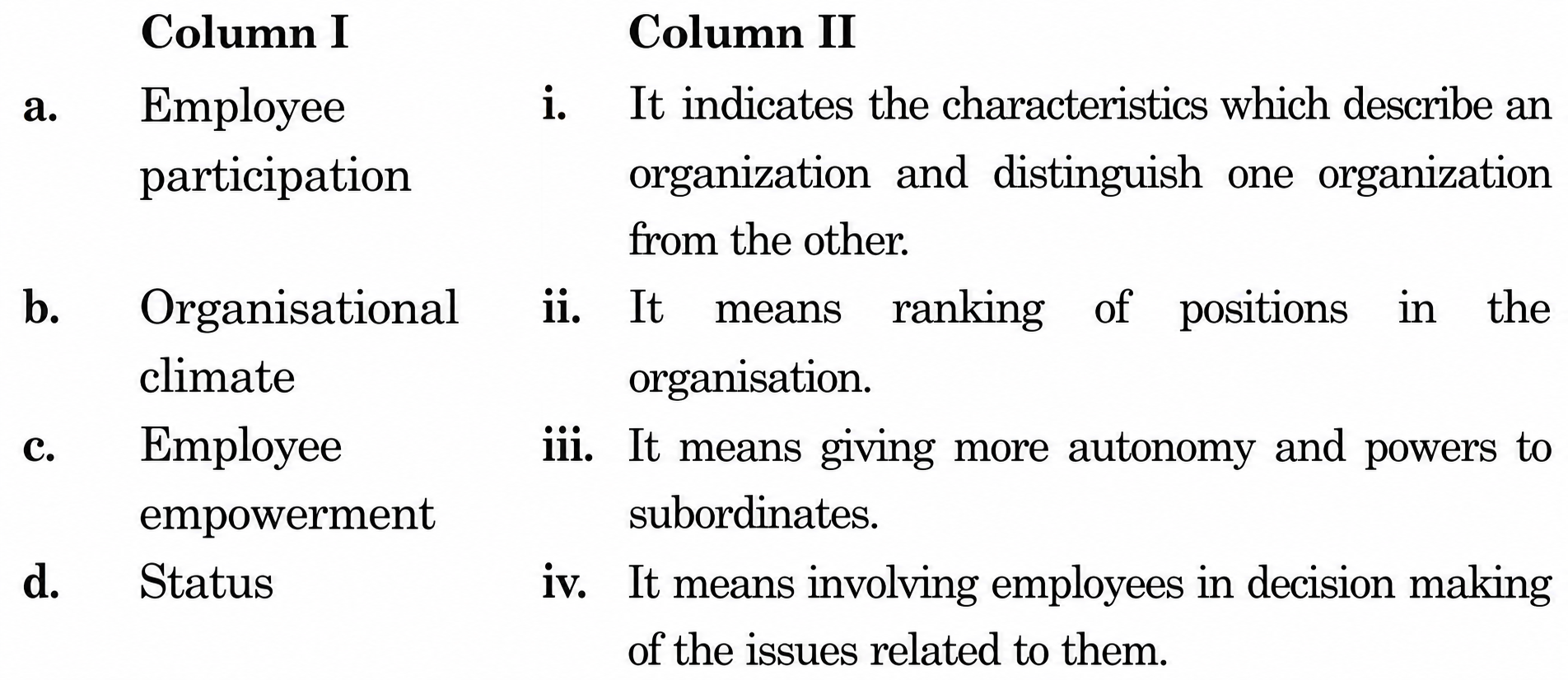
The correct matching is a-iv, b-i, c-iii and d-ii because employee participation means involving employees in decision-making, organisational climate refers to the characteristics of an organisation, employee empowerment means giving more authority to subordinates, and status refers to the ranking of positions in the organisation.
The process of estimating the fund requirements of a business and specifying the sources of funds is called _______.
Financial Planning is the process of estimating the fund requirements of a business and specifying the sources of funds. It involves determining how much money is needed for various activities and deciding the best ways to raise those funds. This helps the business in smooth functioning and achieving its goals.
‘Since business environment consists of numerous interrelated and dynamic conditions or forces which arise from different sources, it becomes difficult to comprehend at once what exactly constitutes a given environment.’
The feature of business environment highlighted above is :
The feature of business environment described here is Complexity because it emphasizes the presence of many interrelated factors coming from different sources, making it difficult to understand the environment fully at once. This complexity arises due to numerous elements interacting in diverse ways.
Statement-I : Workforce analysis enables an assessment of the number and types of human resources necessary for the performance of various jobs and accomplishment of organizational objectives. Statement-II : Workload analysis reveals the number and type of human resources available. Choose the correct option from the following :
Statement-I is correct because workforce analysis involves assessing the number and types of human resources needed to perform various jobs effectively to achieve organizational goals. On the other hand, Statement-II is incorrect because workload analysis determines the amount of work and the corresponding human resource requirements based on that work, not the number and type of human resources currently available. Hence, workforce analysis focuses on 'needed' resources, whereas workload analysis focuses on 'work demands' rather than available resources.
NV Electronics has an innovative range of smartphones, T.V’s, home entertainment systems, kitchen appliances and air conditioners. Besides supplying quality products, their focus is also on handling customer complaints speedily, providing maintenance services, procuring credit services etc.
The function of marketing discussed above is :
The function described involves handling customer complaints, providing maintenance services, and credit services which are all related to supporting the customer after the product is sold. This is known as Customer support services in marketing. Marketing planning, branding, and product designing are related to other stages of marketing and product development, but do not fit the description given.
Identify the incorrect statement with respect to ‘Motion Study’, as a technique of scientific management :
Motion Study is a technique in scientific management that focuses on analyzing the physical movements involved in performing a task to eliminate unnecessary motions and improve efficiency. It involves studying movements like lifting, putting objects, sitting, and changing positions to optimize work methods. However, determining the number of workers, framing incentive schemes, and calculating labor costs are generally related to other aspects of scientific management like time study and work measurement, not directly to motion study. Therefore, the statement about determining the number of workers and framing incentives is incorrect in the context of motion study.
Ramesh wanted to buy a room heater as it had become extremely cold. He went to the nearby market in search of a good room heater. He first visited a few big shops selling branded heaters and checked the design, quality and the price. Walking through the market he saw a road side shop displaying an attractive room heater. He walked into the shop to enquire about the room heater. The shopkeeper demonstrated how the heater worked and simultaneously explained its qualities like its rotating function, auto-cut etc.
Ramesh asked about its price and decided to buy it, as in comparison to other room heaters, it was cheaper and had various additional features. However while focusing on the price and features, he did not check the ISI mark or the label which displayed the date of manufacturing, safety features, directions for use etc. The right exercised by Ramesh in the above case is :
Ramesh exercised his right to choose or be assured by comparing the designs, quality, features and prices of different heaters before deciding to buy one. This right allows consumers to select the product of their choice based on relevant factors such as price and features. However, he did not exercise the right to safety as he did not check for safety marks like the ISI mark or labels indicating manufacturing date and safety instructions.
Statement – I : Capital market instruments are safer than money market instruments both with respect to returns and principal repayment. Statement – II : The capital market deals in medium and long-term securities such as equity shares and debentures etc. Choose the correct option from the following :
Statement I is false because capital market instruments generally carry higher risk compared to money market instruments; while they may offer higher returns, they are not necessarily safer with respect to returns and principal repayment. Money market instruments are considered safer and more liquid as they deal with short-term debt securities. Statement II is true as the capital market deals in medium and long-term securities such as equity shares and debentures.
There are two statements, Assertion (A) and Reason (R).
Assertion (A) : Controlling should not be misunderstood as the last function of management.
Reason (R) : Controlling is a function that brings the management cycle back to the planning function. Choose the correct alternative from those given below :
Controlling is not simply the last function of management; rather, it is a continuous process that ensures activities are aligned with plans. Since controlling identifies deviations from the planned objectives, it provides feedback that helps managers to revise and improve plans. This cyclical process means controlling connects back to planning, making the management process dynamic and ongoing. Therefore, both the Assertion and Reason are true, and Reason correctly explains Assertion.
‘Lima’ is a global sportswear brand known for shoes, apparel and sports accessories. Customers can recognize Lima’s shoes, t-shirts and bags just by seeing the tiger symbol imprinted on all Lima’s products. Lima has legally registered both its name ‘Lima’ and its tiger symbol so that no other company can legally use the same or similar design in their sportswear.
The tiger symbol is Lima’
The tiger symbol represents the visual design used by Lima to identify its products and differentiate them from others. This visual symbol is called a 'Brand mark'. Since it is legally registered, it also acts as a 'Trade mark', but specifically the symbol itself is known as a Brand mark, while the name 'Lima' would be the Brand name. Therefore, the tiger symbol is Lima's Brand mark.
There are two statements, Assertion (A) and Reason (R).
Assertion (A) : The dividend in growth companies is more than that in the non-growth companies. Reason (R) : Companies having good growth opportunities retain more money out of their earnings so as to finance the required investment.
Choose the correct alternative from those given below :
The assertion is incorrect because growth companies usually pay lower dividends compared to non-growth companies. This is because growth companies retain most of their earnings to reinvest in their business for expansion, as mentioned in the reason. The reason correctly explains that companies with good growth opportunities retain more money out of their earnings to finance the required investments, leaving less for dividend distribution.
Alka Motors is one of the leading automobile companies in India. Due to growing demand for electric vehicles, Alka Motors planned to expand its business and for this, it wanted to raise funds. The finance manager suggested that it should raise funds through equity as the market was bullish. As per the suggestion of finance manager, the company decided to raise Rs. 3,500 crore from equity for its expansion plan for electric vehicles.
The factor that the finance manager took into consideration to raise funds through equity was :
The finance manager suggested raising funds through equity because the market was bullish. This indicates that favorable stock-market conditions were the main factor considered, as a bullish market means investors are optimistic and likely to buy shares, allowing the company to raise funds more easily and at better terms.
Green-Eats is a start-up offering plant based meal kits. It gained popularity as more young consumers were becoming health conscious and awareness about environmental issues was increasing day-by-day. To promote sustainable eating, they collaborated with schools and colleges and organized workshops for them.
Identify the element of business environment highlighted in the above case
The case highlights how changes in consumer preferences towards health consciousness and environmental awareness influence the business. These factors are part of the social environment, which includes societal attitudes, cultural trends, and demographics affecting business decisions. Hence, 'Social Environment' is the correct element of business environment represented here.
Neha is working as a Manager at ‘NutriBite’, a company that makes protein rich snacks which are high in demand. She is responsible for implementing organisation’s marketing plans, and ensuring that her department has necessary personnel to achieve goals as per company’s policy.
Identify the ‘level’ of management at which Neha is working
Neha is responsible for implementing marketing plans and managing personnel in her department, which are typical duties of middle level management. Middle level managers act as a bridge between top level management and operational level, executing plans and managing departments to achieve organizational goals.
‘Taylor believed that industrial efficiency depends to a large extent on personnel competencies. He was of the view that the concern for efficiency could be built in right from the process of employee selection. Each person should be scientifically selected. The work assigned should suit her/his capabilities. To increase efficiency, they should be given the required training.’ The principle of scientific management discussed above is :
The principle described focuses on selecting employees scientifically based on their capabilities, assigning them suitable work, and providing necessary training to improve efficiency. This aligns with the principle of 'Development of Each and Every Person to His or Her Greatest Efficiency and Prosperity,' which emphasizes enhancing individual abilities and prosperity to increase industrial efficiency.
. ‘Stock Exchange is playing a vital role in ensuring wider share ownership by regulating new issues, better trading practices and taking effective steps in educating the public about investments.’
The above lines highlight which function of stock exchange from the following ?
The statement describes how the stock exchange promotes wider share ownership by regulating new issues, ensuring better trading practices, and educating the public about investments. This aligns with the function of 'Spreading of Equity Cult,' which refers to encouraging more people to invest in shares and build a habit of equity investment.
Section B
State any three features of Co-ordination.
(a) Central Metal Atom or Ion: It is usually a transition metal atom or ion that acts as the central atom to which ligands are attached.
(b) Ligands: These are ions or neutral molecules that have lone pairs of electrons which they donate to the central metal atom or ion to form coordinate bonds.
(c) Coordination Number: It is the number of ligand donor atoms bonded directly to the central metal atom or ion. The most common coordination numbers are 4 and 6.
These features help in forming complex structures known as coordination compounds which have significant importance in chemistry and biological systems.
State any three points of significance of Principles of Management.
(a) Provide a Useful Framework: Principles of Management offer a solid base for decision making and help managers in planning, organizing, leading, and controlling activities effectively.
(b) Increase Efficiency: They help in utilizing resources like men, materials, money, and machines efficiently, leading to better productivity and reduced wastage.
(c) Promote Professionalism: These principles help in developing managerial talent and promote professional behavior among managers, enabling them to handle complex managerial situations systematically and scientifically.
Explain ‘Transfers’ and ‘Promotions’ as internal sources of recruitment.
Promotions: Promotions involve elevating an employee to a higher position in the organisational hierarchy. It is a reward for good performance, increased responsibilities, and helps motivate employees. Promotions improve job satisfaction and encourage career growth within the organisation.
Both transfers and promotions are internal sources of recruitment as they fill vacancies with existing employees and help retain talent within the organisation.
Explain ‘Placement and Orientation’ and ‘Performance Appraisal’ as steps in the process of ‘Staffing’ function of management.
Orientation is the process of introducing the new employees to the organization’s culture, policies and work environment to help them adjust and perform better.
Performance Appraisal is the systematic evaluation of an employee’s performance over a period of time. It helps in assessing their strengths, weaknesses, and deciding on promotions, training or rewards.
These steps ensure the organization gets the best output from its employees and support their growth and satisfaction.
Identify and explain the external source of recruitment discussed in each of the following cases :
(i) Veer Infrastructure Pvt. Ltd. was handling the construction of a government hospital building in Unedabad. During the monsoon season, the project was delayed and there was a sudden rush of work to meet the deadline. The site supervisor placed a notice at the entrance of the construction site stating “Daily wage labourers needed for 15 days. Report with Identity Proof on Monday at 9:00 A.M. Preference for workers with experience in masonry or carrying materials”.
(ii) Vista Bank planned to expand its retail banking operations in Tier-2 and Tier-3 cities. They needed to hire over 200 middle-level managers with experience in sales, customer service and operations. Vista Bank approached ‘Avon Consultants’, one of India’s leading management consultancy firms. ‘Avon Consultants’ advertised positions on job portals under their own name and also accessed its database of experienced professionals across India. After extensive screening, they shortlisted and forwarded qualified candidates to Vista Bank
In the first case, Veer Infrastructure Pvt. Ltd. used a walk-in interview as an external source of recruitment. The company placed a notice at the entrance requesting daily wage labourers to report with identity proof. This is an immediate method to recruit temporary labourers quickly, especially for short-term urgent work, by inviting candidates to come directly and apply.
(ii) Recruitment through Recruitment Agencies:
In the second case, Vista Bank used a recruitment agency, ‘Avon Consultants’, as an external source of recruitment. The agency advertised jobs, accessed its database, and shortlisted candidates before forwarding them to the bank. Recruitment agencies help find experienced candidates more efficiently for specialized or large-scale hiring needs. They save time and effort for the company by filtering qualified candidates.
Riya, a software engineer wanted to invest a part of her savings in the stock-market. Encouraged by some online discussions, she came across a company ‘Smart-Tech Ltd.’, whose stock price was rising very fast. News began to circulate that company had got a large government contract and she believed that its share price would double soon. Convinced by the positive claims, Riya also invested in the shares of this company. Over the next week, the shares continued to rise but suddenly, the price started crashing. Within days, her investment had lost more than 60% of its value.
Riya started researching and discovered that the news about the government contract was false. Securities and Exchange Board of India (SEBI) also took immediate notice of the situation and called for detailed trading information and conducted enquiries and inspections. After examining trading information and conducting enquiries, SEBI found that a group of traders had spread false information to artificially boost the stock price. By taking action against the group of traders, SEBI made it clear that fraudulent and unfair trade practices are strictly prohibited.
(i) Quote lines from the above to identify the two functions being performed by SEBI.
(ii) Also state one more function of each category of the functions identified in (i) above.
1. "SEBI also took immediate notice of the situation and called for detailed trading information and conducted enquiries and inspections." (Regulatory function)
2. "By taking action against the group of traders, SEBI made it clear that fraudulent and unfair trade practices are strictly prohibited." (Protective function)
(ii) One more function of each category is:
1. Regulatory function: SEBI regulates the working of stock exchanges and brokers.
2. Protective function: SEBI protects investors by prohibiting insider trading and malpractice.
Thus, SEBI regulates the market and protects investors from unfair practices.
Section C
Meera purchased a mixer-grinder of a reputed brand from a well-known electronic store for Rs. 5,000. Within ten days, the mixer-grinder stopped working. Meera visited the shop for repair or replacement showing the cash memo and the warranty card but the shopkeeper refused to help her. Though the product was only for Rs.5,000, she filed a complaint at the District Consumer Disputes Redressal Forum.
The Forum ordered the store to replace the product within 30 days. They also added Rs.1,000 as compensation for mental harassment and Rs.800 for legal costs.
State two responsibilities fulfilled by Meera and two reliefs which Meera got through Consumer Redressal Forum.
(b) Two reliefs Meera got through the Consumer Disputes Redressal Forum are: 1. The Forum ordered the store to replace the defective mixer-grinder within 30 days. 2. She was awarded Rs. 1,000 as compensation for mental harassment and Rs. 800 for legal expenses.
State any four limitations of internal sources of recruitment.
(a) Limited Choice: Internal recruitment limits the selection to existing employees only, which may reduce the variety and quality of candidates.
(b) Employee Rivalry: It can create unhealthy competition and jealousy among employees who compete for the same position.
(c) Lack of New Ideas: Relying only on internal candidates may lead to stagnation due to lack of fresh ideas and innovation.
(d) Skill Gaps: Sometimes, the required skills for higher positions may not be available within the organization through internal sources.
State any four benefits of staffing to the organization.
1. Right People at Right Place: Staffing ensures that the organization gets the right people with suitable skills and qualifications for various jobs.
2. Effective Utilization of Human Resources: It helps in the proper allocation and utilization of human resources which improves productivity.
3. Helps in Growth and Development: Staffing provides trained and skilled employees which contributes to the growth and development of the organization.
4. Reduces Employee Turnover: Proper staffing reduces job dissatisfaction and employee turnover by placing employees in suitable positions.
Fresh Foods Pvt. Ltd. manufactures and distributes organic packaged food products. It’s operations are divided into five main departments – Production, Marketing, Finance, Human Resources and Research and Development. Each department has its own head and a team that focuses only on the work related to their department. This promotes efficiency in utilization of manpower as employees perform similar tasks within a department and are able to improve performance. This also helps in increasing managerial and operational efficiency and results in increased profit .
Since each department handles a narrow range of tasks and focus is on a limited range of skills, it is easier to train new employees.
(i) Identify the organization structure followed by Fresh Foods Pvt. Ltd.
(ii) Also state three advantages of the structure identified in (i) above not discussed in the given case.
(ii) Three advantages of Functional Organization Structure not mentioned in the case are:
1. Specialization: Employees become experts in their specific functions forming high skill level.
2. Clear Authority and Responsibility: Each department has clear roles leading to better control.
3. Better Coordination Within Departments: Since employees work on similar tasks, coordination within departments is easier and faster, improving overall effectiveness.
Aditya owned a skincare company named ‘Nat-Ayur’. In July, 2025, he decided to launch a new herbal face cream in the market using traditional herbs like turmeric, sandalwood, neem, aloe vera, saffron etc.
The total cost of producing, packaging, distributing and selling the cream came to `Rs. 60 per tube. ‘Nat-Ayur’ decided that this would be the minimum price to cover the cost. They wanted to earn a fair margin of profit too. For this ‘Nat-Ayur’ conducted a survey and found that the expected demand would be high. Customers were ready to pay more for herbal and chemical free products. They also found that many face creams with similar features are available in the market priced between Rs. 80 to Rs.120. To compete effectively, ‘Nat-Ayur’ decided to price the cream at Rs.99 to attract the customers while offering better benefits.
To add value to the product ‘Nat-Ayur’ invested in eco-friendly packaging, free home delivery and on-line advertisements. This uniqueness gives ‘Nat-Ayur’ a competitive freedom in fixing price of its
cream.
Identify and explain any two factors that were taken into consideration by ‘Nat-Ayur’ for determining the price of their herbal face cream.
1. Cost of Production: The total cost for producing, packaging, distributing and selling the cream was calculated as 60 per tube. This cost was considered as the minimum price to cover the expenses and avoid losses.
2. Competitor Pricing and Market Demand: ‘Nat-Ayur’ analyzed the price range of similar face creams available in the market, which was between 80 to 120. They noticed that customers were willing to pay more for herbal and chemical-free products. Considering high demand and better benefits, they priced their cream at 99, which is competitive yet attractive to customers.
Additionally, they added value by investing in eco-friendly packaging, free home delivery, and online advertisements which gave them competitive freedom in pricing.
Explain the following limitations of planning :
(i) Planning leads to rigidity
(ii) Planning may not work in a dynamic environment
(ii) Planning may not work in a dynamic environment: In rapidly changing or uncertain environments, plans made in advance may become outdated quickly. New situations or information may require quick decisions that do not fit the original plan. Thus, planning may fail or become irrelevant when the external environment changes unpredictably, requiring continuous adjustments.
Explain the following points of importance of Decentralisation :
(i) Develops initiative among subordinates
(ii) Develops managerial talent for the future.
(ii) Develops managerial talent for the future: When authority is delegated, subordinates get opportunities to handle responsibilities and challenges. This helps in developing their managerial skills and prepares them to take higher positions in future. Thus, decentralisation acts as a training ground for future managers.
‘Priya Motors’, a motorbike manufacturing company, launched a new model of bike in the market named ‘Moto Glide III’. The company planned carefully to make this bike appeal to young riders. The design team focused on making the bike attractive and stylish to the target customers, primarily the youth. They gave it a sleek body, sharp headlights and a digital speedometer. The design made the bike not just look good but also improved its aerodynamics and fuel efficiency. This helped the company stand out from other brands, thereby getting a competitive edge.
The company followed strict quality standards in making each part of the bike which helped in achieving uniformity and consistency in output. ‘Priya Motors’ also offered different versions of bike with different prices based on features like Bluetooth connectivity, colour options etc. Identify and explain two functions of marketing discussed above.
(b) Promotion and Competitive Edge: By making the bike look good and improving aspects like aerodynamics and fuel efficiency, the company created a product that stands out from other brands. This helps in promotion by making the product desirable and gaining a competitive edge in the market.
(c) Quality Control and Standardization: The company followed strict quality standards to ensure uniformity and consistency in production, which builds customer trust and enhances brand reputation.
(d) Pricing and Market Segmentation: Offering different versions of the bike at different prices based on features like Bluetooth and colour options illustrates the function of pricing strategy and market segmentation to cater to different customer preferences and budgets.
Section D
Explain ‘Science, not Rule of Thumb’ as a principle of Scientific Management and ‘Functional Foremanship’ and ‘Time study’ as techniques of Scientific Management.
(b) Functional Foremanship: Functional foremanship is a technique where the responsibility of supervising workers is divided among several specialized foremen, each focusing on a specific function. For example, one foreman may be responsible for planning work, another for discipline, another for quality control, and so on. This division increases efficiency because foremen are experts in their particular area, improving supervision and worker performance.
(c) Time Study: Time study is a technique used to determine the standard time required to complete a particular task. It involves careful observation and measurement of the time taken by a skilled worker to perform each element of a job. By analyzing these times, managers can set realistic time standards, improve methods, reduce wasted time, and increase productivity. Time study helps in planning and scheduling work effectively.
Explain the following principles of General Management :
(i) Unity of Command
(ii) Esprit De Corps
(iii) Stability of Perso
(ii) Esprit De Corps: This principle emphasizes promoting team spirit and harmony among employees. A positive morale and unity within the team leads to increased loyalty, cooperation, and better performance. Managers should encourage mutual trust and respect to foster a strong sense of belonging.
(iii) Stability of Personnel: According to this principle, employee turnover should be minimized to maintain stability in the workforce. Stability allows employees to gain experience, improve skills, and contribute effectively to the organization. High turnover leads to disruption and increased training costs. Management should provide job security and good working conditions to enhance stability.
‘Freshju’ is a trading company, selling bottled juices made by other manufacturers. Now, it planned to sell its juices across India. For this, ‘Freshju’ decided to enter into ‘Juice manufacturing’. It also has ambitious plans to export its juices to other countries in the future. To meet anticipated higher demand in future, the company set-up a larger manufacturing unit. The Chief Executive Officer, Ravinder, ordered automatic juice-filling and bottling machines to increase speed, improve hygiene and for consistency in production. Since the investment was huge, instead of buying all new machinery ‘Freshju’ took some expensive machines on lease.
They also collaborated with a nearby packaging unit to use their packing machines during peak-season. This helped ‘Freshju’ to manage seasonal surges in demand without investing in additional equipment that would remain underutilized during off season. Quoting lines from the above, identify and explain any four factors that will affect the fixed capital requirements of ‘Freshju’.
(a) Scale of Operations: "To meet anticipated higher demand in future, the company set-up a larger manufacturing unit." This shows that Freshju is increasing its production capacity which increases the fixed capital requirements.
(b) Type of Machinery: "The Chief Executive Officer, Ravinder, ordered automatic juice-filling and bottling machines to increase speed, improve hygiene and for consistency in production." The use of advanced automatic machines requires higher investment, thus affecting fixed capital.
(c) Leasing of Machinery: "Since the investment was huge, instead of buying all new machinery ‘Freshju’ took some expensive machines on lease." Leasing reduces the immediate fixed capital requirement as machines are rented rather than bought.
(d) Seasonal Demand Management: "They also collaborated with a nearby packaging unit to use their packing machines during peak-season." This arrangement helps Freshju manage demand volatility without investing more fixed capital in machines that would be idle in off season.
Hence, these factors like scale of operations, type of machinery, leasing of machines and seasonal demand considerations affect the fixed capital requirements of Freshju.
Greener Organic is a company producing eco-friendly fertilizers and soil boosters. With the growing interest in organic farming, the company is planning to expand its operations across India.
Greener sets its target to increase its sales by 25% in the next year. This gave all departments – sales, production, marketing and logistics – a common target to work. To achieve this, Greener made a comprehensive plan to enter Tier-2 and Tier-3 cities by working with local farmer groups. They also plan to promote their brand through on-line campaigns focused on eco-friendly farming. The company also laid down broad parameters within which the managers could function. All raw materials used had to be certified organic and preferably sourced from local farmers. This would improve quality, support local people and build trust with customers. The company allocated Rs.50 lakhs for marketing, which included funds for regional newspaper advertisements, digital marketing, promotional events and dealer incentives. By quantifying future facts and figures, the company planned to control costs and evaluate performance.
Identify and explain any four type of plans discussed in the above case
(a) Objective or Goal Setting: Greener Organic has set a clear objective to increase its sales by 25% in the next year. This target gives a direction to all departments like sales, production, marketing, and logistics to work towards this common goal.
(b) Strategic Plan: The company made a strategic decision to expand its market to Tier-2 and Tier-3 cities by collaborating with local farmer groups. This is a long-term plan that helps the company grow and capture new markets.
(c) Marketing Plan: Greener allocated 50 lakhs specifically for marketing activities, which include regional newspaper ads, digital marketing, promotional events, and dealer incentives. This plan details how the company will promote its products.
(d) Operational or Procedural Plan: The company set broad parameters for managers, such as using only certified organic raw materials preferably from local farmers. This ensures quality, supports local communities, and builds customer trust. This plan guides day-to-day operations and decision making.
These four plans together help Greener Organic to organize its efforts and achieve the growth targets effectively.
Explain any four semantic barriers to communication.
(a) Language Differences: When people speak different languages or dialects, messages may be misunderstood or not understood at all.
(b) Jargon and Technical Terms: Using specialized words or technical language unfamiliar to the receiver can confuse the message.
(c) Ambiguity: When words or phrases have more than one meaning, it can lead to confusion in interpreting the message.
(d) Badly Expressed Messages: Poor choice of words, incomplete sentences, or incorrect grammar can distort the intended meaning, causing miscommunication.
These barriers affect effective communication as the receiver may misinterpret or fail to understand the message correctly, leading to errors or conflicts.
Explain any four points of importance of directing function of management.
(a) Provides Guidance and Leadership: Directing helps managers provide clear instructions and guidance to employees, ensuring everyone knows what to do and how to do it effectively.
(b) Motivates Employees: It plays a crucial role in motivating employees by recognizing their efforts, providing incentives, and encouraging them to perform better, which increases productivity.
(c) Facilitates Communication: Directing ensures smooth and effective communication within the organization, helping to avoid misunderstandings and ensuring that messages are clearly conveyed.
(d) Helps in Coordination: Through directing, managers coordinate the efforts of different individuals and departments, making sure that all activities are aligned towards common objectives and work is done efficiently.
Other Years — Business Studies