CBSE EXAMINATION PAPER-2026
ENGLISH
(Solved)
General Instructions :
Read the following instructions carefully and follow them :
- This question paper contains 34 questions. All questions are compulsory.
- This question paper is divided into 7 sections.
- Section A – questions number 1 to 4 are case based questions
- Section B – questions number 5 to 6 are unseen passage
- Section C – questions number 7 to 18 are grammar short
- Section D – questions number 19 to 26 are short answer
- Section E – questions number 27 to 28 are paragraph
- Section F – questions number 29 to 30 are letter
- Section G – questions number 31 to 34 are long answer
- There is no overall choice given in the question paper. However, an internal choice has been provided in few questions.
- Use of calculator is NOT allowed.
Section A
(1) Which of the following describes how Fowler felt on seeing Ausable for the first time? (A) excited and happy (B) indifferent and disgusted (C) surprised and disappointed (D) envious and in awe
(2) Fill in the blank with the correct word: Ausable’s reaction on seeing how Fowler felt shows that he was _______. (observant/embarrassed)
(3) In what way does Ausable defy the typical spy image?
[1 Mark](4) How did the hotel’s atmosphere influence Fowler’s mood?
[2 Marks](1) What is the main ideal Mandela is talking about? (A) economic prosperity (B) representative and free society (C) absolute power (D) finishing racism
(2) How does the statement reflect Mandela’s commitment to justice? (Answer in about 40 words)
[2 Marks](3) Fill in the blank with the correct word from the bracket : Nelson’s vision was not simply to reverse the oppression but to end it completely as he wishes to _______ (fight/appease) all forms of domination in which all persons live with equal opportunities.
(4) The phrase “prepared to die” shows Mandela’s : (A) anxiety (B) desperation (C) passion (D) uprightness
What, what is the boy now
who has lost his ball.
What, what is he to do.
I saw it go
Merrily bouncing, down the street and then Merrily over – there it is in the water!
No use to say ’O there are other balls’.
(The Ball Poem by John Berryman)
(1) What does the repetition of the word “merrily” suggest in the context of the ball’s movement?
[1 Mark](2) Fill in the blank with the correct word from the bracket : The poet uses the ball as a symbol of the boy’s _______. (childhood/adventure)
(3) How does this moment contrast the mood of the poem before and after the ball falls into the water? (Answer in about 40 words)
[2 Marks](4) The line, ‘No use to say, oh there are other balls’ signifies: (A) Words of consolation are inappropriate. (B) The boy must be left alone and play with other toys. (C) The boy should not be left alone. (D) No ball will be as expensive as the one the boy has lost.
All night the roots work
To disengage themselves from the cracks
in the veranda floor. The leaves strain towards the glass
small twigs stiff with exertion
long-cramped boughs shuffling
under the roof
like newly discharged patients
half dazed, moving to the clinic doors.
(Trees)
(1) What do the roots work upon all night?
[1 Mark](2) Each part of the trees works to get itself free. Describe their struggle. (Answer in about 40 words)
[2 Marks](3) Fill the blank with one word. The long branches are compared to _______.
(4) The phrase ‘half-dazed’ is used for the branches as they adjust from being indoors to being in the open. It highlights the branches’ : (A) disorientation and fragility (B) experience and privilege (C) hurt and injury (D) barrenness and pain
Section B
Read the following text :
(1) Forests are often called the lungs of the Earth, and in India, they are an integral part of the country’s ecological, economic, and cultural fabric. They regulate temperatures and help keep the air clean. Covering about 21.71% of India’s geographical area, forests play a pivotal role in sustaining biodiversity, regulating climate, and supporting the livelihoods of millions of people. However, these verdant expanses face numerous challenges, raising important questions about conservation, sustainable development, and policy priorities.
(2) India’s forests are incredibly diverse, ranging from the lush tropical rain forests to the alpine vegetation of the Himalayas. This diversity is home to a wide variety of flora and fauna, many of which are endemic or endangered, such as the Bengal tiger, Indian elephant, and Nilgiri Tahr. Forests also provide critical ecosystem services like water conservation, soil fertility, and carbon sequestration, which are essential in combating climate change.
(3) Economically, forests contribute significantly through timber, medicinal plants and Non-Timber Forest Products (NTFPs) like honey and bamboo. They are also central to the lives of tribal communities who depend on them for sustenance and cultural practices. However, this dependence brings to light the complex relationship between human development and forest preservation.
(4) Is it possible to achieve economic growth without degrading forest resources ? The pressures on India’s forests are immense. Rapid urbanization, industrial expansion, mining, and agricultural encroachment have led to significant deforestation. According to recent reports, India lost around 66,000 hectares of forest cover between 2019 and 2021. This loss not only threatens biodiversity but also exacerbates climate-related challenges such as rising temperatures and erratic rainfall.
(5) Policy measures like the Forest Conservation Act of 1980 and initiatives such as Compensatory Afforestation and Van Mahotsav (Forest Festival) reflect efforts to preserve and expand forest areas. However, critics argue that these measures often fail to address ground realities. For instance, afforestation projects may involve planting monoculture species that disrupt ecosystems rather than restore natural biodiversity. Similarly, conflicts arise when policies overlook the rights of indigenous communities, leading to displacement and social tensions. India’s forests are a microcosm of the global struggle to balance development with conservation.
(6) Solutions lie in adopting sustainable practices, such as agroforestry, eco-tourism, and community-based conservation models. Empowering local communities to act as custodians of forests ensures both their livelihoods and the health of forest ecosystems. Moreover, raising awareness about the importance of forests can inspire collective action at all levels.
Answer the following questions, based on the passage above :
(1) In paragraph 1, what does the phrase ‘Lungs of the Earth’ refer to with reference to the passage?
[1 Mark](2) Complete the following with the correct option from the two given: Forests play a significant role in sustaining biodiversity by _______ (a) balancing climate change and creating livelihoods for people. (b) Providing wood for fuel and industries worldwide.
(3) Support the writer’s idea that forests provide critical ecosystem services with textual evidence. (Para 2)
[2 Marks](4) What do the recent statistics on deforestation reveal about the state of India’s forests? (Para 4) (A) Deforestation has decreased significantly. (B) Forest loss has been stabilized. (C) Forest cover is rapidly declining. (D) There is no significant impact on forest cover.
(5) Select the concept that best reflects the complex relationship between human development and preservation. (Para 3) (a) Rapid urbanization has led to widespread deforestation depriving flora and fauna of its natural habitat. (b) The introduction of initiatives like Van Mahotsav serve as compensatory afforestation.
(6) State whether the following statement is true or false: Deforestation is one of the reasons for erratic rainfall. (Para 4)
[1 Mark](7) List one challenge that critics see in compensatory afforestation measures. (Para 5)
[1 Mark](8) How do community-based conservation models benefit both forests and local communities? (Para 6)
[2 Marks]Read the following passage carefully :
The Rise of Electric Vehicles in India :
(1) Electric Vehicles (EVs) are gaining significant traction globally. In India, the push for EVs is driven by concerns over air pollution, rising fuel costs and government’s commitment to reducing carbon emissions. The Indian Government has set ambitious targets for EV adoption, aiming for 30% of private cars, 70% of commercial vehicles, and 80% of two wheelers and three-wheelers to be electric by 2030. (2) The benefits of EVs extend beyond environmental impact : Lower running cost due to cheaper electricity, reduces maintenance because of fewer moving parts, and lowers noise pollution in urban areas.
(3) Despite the promising outlook, the EV industry in India faces several challenges currently. While public charging stations are slowly increasing, their availability, especially in semi-urban and rural areas, remains a bottleneck. The initial high purchase cost of EVs and concerns about range or the fear of running out of charge are other causes of anxiety.
(4) To overcome these hurdles, the government is offering subsidies and tax benefits to make EVs more affordable. Private companies are investing in developing new EV models with improved battery technology for longer ranges and battery swapping technology is also being explored as a quick alternative to traditional charging.
(5) The Indian EV market is witnessing rapid growth, with sales figures steadily climbing. In 2023, India recorded sales of over 1.5 million EVs, a significant jump from previous years. Two-wheelers dominated the sales, followed by three-wheelers and then passenger cars. States like Maharashtra, Delhi, and Karnataka have emerged as leaders in EV adoption, largely due to supportive state policies and greater awareness among consumers.
Answer the following questions, based on the above passage :
(1) Justify the following statement: Despite governmental support, the initial cost of EVs remains a challenge for consumers.
[1 Mark](2) Electric vehicles offer multiple benefits in India. Support the above statement in 40 words with evidence from the text.
[2 Marks](3) “In 2023, India recorded sales of over 1.5 million EVs, a significant jump from previous years.” State any one inference that can be drawn from the above statement.
[1 Mark](4) Complete the sentence suitably: To address the challenge of charging infrastructure, various initiatives are being undertaken, such as _________.
(5) Select the option that is true for the assertion and reason given below: Assertion: EVs are gaining traction in India. Reason: The Indian government is committed to reducing carbon emissions. (A) Both the assertion and reason are true, and the reason is the correct explanation of the assertion. (B) Both the assertion and reason are true, but the reason is not the correct explanation of the assertion. (C) The assertion is true, but the reason is false. (D) The assertion is false, but the reason is true.
(6) Complete the following with one suitable reason from the text: The silent operation of EVs contributes to better urban living because ________.
(7) According to the passage, what is ‘range anxiety’ in the context of electric vehicles?
[1 Mark](8) Give one reason to support why the adoption of EVs is slow in some parts of India.
[1 Mark](9) Based on the given text, which type of EV dominated sales in India in 2023?
[1 Mark]Section C
A manager wrote a report to his seniors about his team. Fill in the blank with the correct option to complete the report:
By the end of this quarter, the assistant manager _______ on this campaign for eight months.
(A) will be working
(B) will have been working
(C) will have working
(D) would have been working
Explanation: The sentence talks about a future point in time (the end of this quarter) and the duration of an action until that point (eight months). The correct tense to express an action that will continue up to a certain time in the future is the future perfect continuous tense. "Will have been working" is the future perfect continuous form of the verb "to work". Therefore, the correct sentence is: "By the end of this quarter, the assistant manager will have been working on this campaign for eight months." This shows the action started eight months ago and will still be ongoing at the specified future time.
Read the given sentence from a sales report: Identify the error and supply the correction:
Being checked all the figures twice, she was sure there were no errors.
Read the conversation between the store supervisor and the salesman :
Supervisor : “Did you switch off all the lights before leaving office yesterday ?”
Salesman – “Yes, I did and I also handed over the keys to the night supervisor.”
A store supervisor asked the salesman whether he had switched off all the lights before leaving the office the day before.
The salesman confirmed _________. Report the salesman’s response.
A school Principal addressed Board aspirants and said:
'_______ candidates must carry their identification proof.' Fill in the blank with the appropriate option:
(A) Each
(B) All
(C) Every
(D) One
Explanation:
1. Each refers to individual items considered separately but is often used when focusing on individuals one by one.
2. All refers to the total number or group collectively and is generally used with plural nouns.
3. Every is used to refer to all the members of a group considered individually and is followed by a singular noun.
4. One refers to a single item or person.
Since the sentence talks about candidates individually having to carry ID proof, the correct usage is Every candidate must carry their identification proof. Note that the noun should be singular after 'every'.
Isha said to her parents, 'My mentor will always guide me, even after this programme ends.'
Report what Isha said to her parents.
Find the error in the sentence and supply the correction:
I was disappointed to see that in the library there was less books on the subject than expected.
Explanation:
1. 'Books' is a countable noun, so we must use 'fewer' instead of 'less'.
2. Also, since 'books' is plural, the verb should be 'were' instead of 'was'.
Thus, the corrected sentence is: "I was disappointed to see that in the library there were fewer books on the subject than expected."
Fill in the blank with the correct option:
My friends _______ the movie tickets before we even reached the ticket counter.
(A) has collected
(B) had collected
(C) collect
(D) will collect
Explanation: The sentence talks about an action that was completed before another past action ('before we even reached the ticket counter'). For actions completed before another past event, we use the past perfect tense. The past perfect tense is made by using 'had' + past participle of the verb. Here, 'collected' is the past participle of 'collect', so the correct phrase is 'had collected'. The other options are incorrect because (A) 'has collected' is present perfect, (C) 'collect' is simple present, and (D) 'will collect' is future tense, which do not fit the sentence context.
Select the correct option to complete the sentence from a recipe book:
After stirring the cocoa into the melted butter, you _______ add the eggs one at a time before adding the flour.
(A) would
(B) might
(C) may
(D) must
Report the following sentence by a customer:
'Did you double-check the address before dispatching the washing machine?'
Complete the following sentence by choosing the correct option:
If we had consulted the engineer, we _____ this mistake.
(A) would avoid
(B) will avoid
(C) would have avoided
(D) had avoided
This sentence is a third conditional sentence which talks about an unreal past condition and its probable past result. The structure of a third conditional sentence is: If + past perfect, ... would have + past participle.
Here, 'If we had consulted the engineer' is the condition in past perfect tense, and the result should be 'we would have avoided this mistake' which shows what could have happened but did not happen. Therefore, option (C) is correct because it follows this structure.
Options (A) and (B) are present or future forms and do not fit the past unreal condition. Option (D) 'had avoided' is not correct as it lacks the auxiliary 'would have' needed for the main clause in third conditional.
Hence, the completed sentence is: If we had consulted the engineer, we would have avoided this mistake.
Complete the following newspaper report by filling in the blank:
The number of road accidents _______ increased this year.
(A) have
(B) are
(C) has
(D) were
The speaker in conversation with a group of ministers said,
"I feel reassured after hearing your opinions."
What did the speaker say to the ministers?
Section D
How does the short structure of poem ‘Dust of Snow’ enhance its message about emotional renewal ? Support your answer briefly.
In ‘Mijbil the Otter’, how does the narrator’s patience contrast with the reactions of fellow passengers and local people ? What does this reveal about human understanding of the unfamiliar ?
In ‘Madam Rides the Bus’, how does the contrast between Valli’s boldness and her emotional response to the dead cow shape your view of her maturity ?
What was Chubukov’s reaction when he heard about Lomov’s proposal for his daughter’s hand ? (The Proposal)
Why does Griffin, despite his scientific genius, end up leading a destructive life ? (Footprints Without Feet)
Why does Horace Danby consider himself an honest man despite being a thief ? How does this self-perception affect his decision in the story ? (A Question of Trust)
(b) This self-perception affects his decision because when he believes the lady of the house trusts him, he is willing to take risks and not suspect any deceit. His belief in his own honesty blinds him to the possibility of being tricked, which ultimately causes him to falter in the story.
In ‘A Triumph of Surgery’, how does Tricki’s condition reflect the consequences of pampering pets excessively ? What does this suggest about human attachment ?
(a) Tricki’s condition shows the negative effects of pampering pets excessively. His mistress, Mrs Pumphrey, spoils him with too much rich food and treats him like a baby. Because of this, Tricki becomes overweight, unhealthy and falls seriously ill. The excessive feeding makes him weak and sick instead of strong and active.
(b) This situation suggests that human attachment to pets can sometimes be overprotective and indulgent. Mrs Pumphrey’s love and care, though well-meaning, become harmful because she cannot control her desire to pamper Tricki. It shows that being overly attached can prevent owners from taking practical and effective care of their pets.
(c) Dr Herriot, the veterinary surgeon, cures Tricki by putting him on a strict diet and limiting his food. The dog recovers not through surgery but through discipline and a healthier lifestyle. This teaches us that love should be balanced with responsibility and knowledge about what is best for pets.
Section E
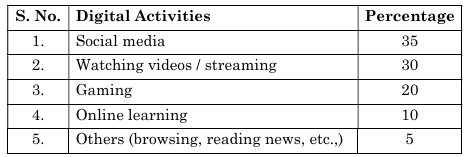
The data given below shows how teenagers spend their daily screen time across different digital activities.
Analyse the data provided and write a paragraph analyzing how teenagers allocate their daily screen time. Focus on the activity that occupies the largest proportion of time and on other major and minor activities in descending order, and on the balance between entertainment and educational screen use. Conclude with an observation about the overall trend.
Read the given details of a community library designed for your neighbourhood:
● A well lit and ventilated reading lounge;
● A digital section with computers, tablets and e-books;
● A dedicated children’s corner with picture books and storytelling sessions;
● A quiet study area with desk lamps and soundproof partitions for students;
● outdoor reading space under trees for senior citizens;
● book-sharing stands where people can donate and borrow books freely.
Analyse the details and write an analytical paragraph in about 120 words about the suitability of this library. Focus on factors such as accessibility, reading environment, suitability for different age groups, and community engagement.
Section F
I am Dev Arora, a resident of this city. I am writing to express my deep concern regarding the overflowing garbage dumps in our localities. These dumps have become eyesores and pose serious environmental and health risks to the residents. The foul odour from these dumps is unbearable and they attract stray animals and other scavengers, increasing the risk of spreading diseases.
I believe that the main reasons for this alarming situation are the insufficient number of garbage collection vehicles and the irregular cleaning of the dumps. There seems to be a systemic flaw in the garbage collection system that needs urgent attention. I urge you to take immediate action to identify and rectify these issues. Increasing the number of collection vehicles, ensuring regular cleaning, and implementing better waste management practices can greatly improve the situation.
Please consider this as an urgent matter that affects the health and well-being of the citizens. I hope the municipal authorities will take quick and effective measures to solve this problem.
Thanking you,
Yours sincerely,
Dev Arora
Subject: Need for Community Centers with Indoor Sporting Facilities for Children
Respected Sir,
I am Sharan, a resident of Green Meadows Apartments. I wish to express my concern about the lack of open spaces for children in multistoreyed complexes nowadays. This situation forces children to stay indoors, leading to increased screen addiction, lack of concentration, and unhealthy eating habits. To address this, I strongly urge the authorities and resident welfare associations to build community centers equipped with indoor sporting facilities. Such centers would provide a comfortable and safe environment for children to engage in physical activities regardless of weather conditions. Moreover, these centers would promote fitness, social interaction, and mental well-being among children. They would also benefit residents by creating a strong community bond and encouraging a healthy lifestyle. Therefore, I request the concerned authorities to consider establishing these facilities at an early date to ensure the holistic development of our children.
Thank you.
Yours sincerely,
Sharan
Section G
(b) Kisa Gotami's Skepticism in 'Sermon at Benares': In contrast, Kisa Gotami begins her journey with grief and denial after losing her child. She approaches the Buddha seeking medicine to bring her dead son back to life. The Buddha gently teaches her about the reality of death and suffering, leading her to realize that death is a universal truth and to let go of her skepticism and pain. Kisa Gotami moves from denial towards accepting the impermanence of life, showing a different kind of faith—not in miracles, but in understanding reality.
(c) Contrast in Their Faith: Lencho’s faith is hopeful and devotional—he believes God will directly intervene to solve his problems. On the other hand, Kisa Gotami’s skepticism comes from harsh reality and grief; her story is about seeking enlightenment and understanding rather than asking for help. While Lencho's faith is based on expectation, Kisa Gotami’s journey teaches acceptance.
In conclusion, Lencho shows strong, unwavering faith in God's power to help him materially, whereas Kisa Gotami represents the path from skepticism and grief to wisdom and acceptance of life’s truths.
Analyse how Amanda in the poem ‘Amanda’ and the dragon in the poem ‘The Tale of Custard the Dragon’ yearn for acceptance and a life free from criticism.
Both Amanda and the dragon from ‘The Tale of Custard the Dragon’ express a deep desire for acceptance and to live free from criticism, but in different ways.
(a) Amanda, in the poem ‘Amanda’, feels the constant burden of criticism mainly from adults and society who expect her to behave perfectly. She yearns to enjoy her childhood freely without being judged for her behaviors and mistakes. Amanda wants a life where she can be accepted as she is, with her faults and imperfections, and experience happiness and freedom away from the harsh eyes of critics.
(b) Similarly, the dragon in ‘The Tale of Custard the Dragon’ also craves acceptance. Although he is brave and loyal, others in the poem make fun of him and call him a coward, which hurts him deeply. Despite these criticisms, the dragon displays true courage when needed, showing that he wants to be valued and recognized for who he really is, beyond the negative opinions. His yearning is to be respected and accepted by his friends, living without constant mockery.
In summary, both Amanda and Custard the dragon reveal a universal human desire to be accepted without judgment and to live a life free from unfair criticism, highlighting themes of understanding, empathy, and the importance of recognizing true worth beyond appearances or mistakes.
In ‘The Necklace’, Madam Loisel spends years repaying a debt for a necklace that was never valuable. How does this irony expose the illusion of wealth and the consequences of chasing appearances ?
The irony in "The Necklace" lies in the fact that Madam Loisel and her husband spend ten years repaying a debt for a necklace that turns out to be fake and worthless. This twist exposes the illusion of wealth because Madam Loisel had believed that possessing a beautiful and expensive necklace would make her appear wealthy and admired in society. She chased this false appearance out of vanity and desire to fit into higher social circles.
By borrowing the necklace, she tried to hide her true social status, but this led to real suffering and hardship. The Loisels worked hard, sacrificed their comforts, and lived a life of poverty for many years, all because of this false belief in material wealth and appearances. This shows the consequences of chasing outward appearances instead of valuing truth and contentment.
The story teaches us that putting too much importance on material things and social status can lead to unnecessary misery. True happiness and worth do not come from outward show but from honesty and acceptance of one’s reality. Thus, the irony highlights how illusions of wealth can ruin lives when people prioritize appearance over truth.
In ‘The Book That Saved the Earth’, how does the play use humour and irony to comment on both futuristic technology and human assumptions ? What message do you think the author conveys through the Martians’ misinterpretation of a nursery rhyme ?
Other Years — English