Class 12 PCM . Mathematics . Mathematics Part I . Inverse Trigonometric Functions
Chapter 2: Inverse Trigonometric Functions
Ch 2
Mathematics
Class 12 PCM
Introduction
Inverse Functions: Basic Idea
Inverse function — For a bijection \(f:X\to Y\), its inverse \(f^{-1}:Y\to X\) reverses the mapping: if \(f(x)=y\), then \(f^{-1}(y)=x\).
An inverse exists only when the function is both one-to-one and onto. The domain of \(f^{-1}\) is the range of \(f\), and its range is the domain of \(f\). The inverse is also bijective.
Check an inverse relationship
- Check that the function is one-to-one and onto on the stated domain and range.
- Reverse the input-output mapping to define the inverse.$$f(x)=y\;\Longrightarrow\;f^{-1}(y)=x$$
- Verify both compositions return their inputs.$$\left(f^{-1}\circ f\right)(x)=x,\quad \left(f\circ f^{-1}\right)(y)=y$$
Find the inverse of \(f(x)=2x+3\).
- Find the inverse of the bijection \(f(x)=2x+3\) from \(\mathbb{R}\) to \(\mathbb{R}\).
- Write the output as \(y\) and solve for the input.$$y=2x+3\quad\Longrightarrow\quad x=\frac{y-3}{2}$$
- Swap the variable names to express the inverse.$$f^{-1}(x)=\frac{x-3}{2}$$
- Check by composition.$$f^{-1}(f(x))=\frac{2x+3-3}{2}=x$$
A trigonometric function does not have an inverse on its full natural domain if it is not one-to-one. Restrict its domain first so that it becomes bijective.
Domains and Ranges of Trigonometric Functions
| Function | Domain | Range |
|---|---|---|
| \(\sin x\) | \(\mathbb{R}\) | \([-1,1]\) |
| \(\cos x\) | \(\mathbb{R}\) | \([-1,1]\) |
| \(\tan x\) | \(\mathbb{R}\setminus\left\{\frac{(2n+1)\pi}{2}:n\in\mathbb{Z}\right\}\) | \(\mathbb{R}\) |
| \(\cot x\) | \(\mathbb{R}\setminus\{n\pi:n\in\mathbb{Z}\}\) | \(\mathbb{R}\) |
| \(\sec x\) | \(\mathbb{R}\setminus\left\{\frac{(2n+1)\pi}{2}:n\in\mathbb{Z}\right\}\) | \(\mathbb{R}\setminus(-1,1)\) |
| \(\cosec x\) | \(\mathbb{R}\setminus\{n\pi:n\in\mathbb{Z}\}\) | \(\mathbb{R}\setminus(-1,1)\) |
Why restrictions are needed
- Problem: The trigonometric functions repeat values over their natural domains, so most are not one-to-one there.
- Solution: Restrict the domain to a suitable interval where the function is bijective; its inverse then has that interval as its range.
- Inverse trigonometric functions: These are the inverse functions obtained from the suitably restricted trigonometric functions.
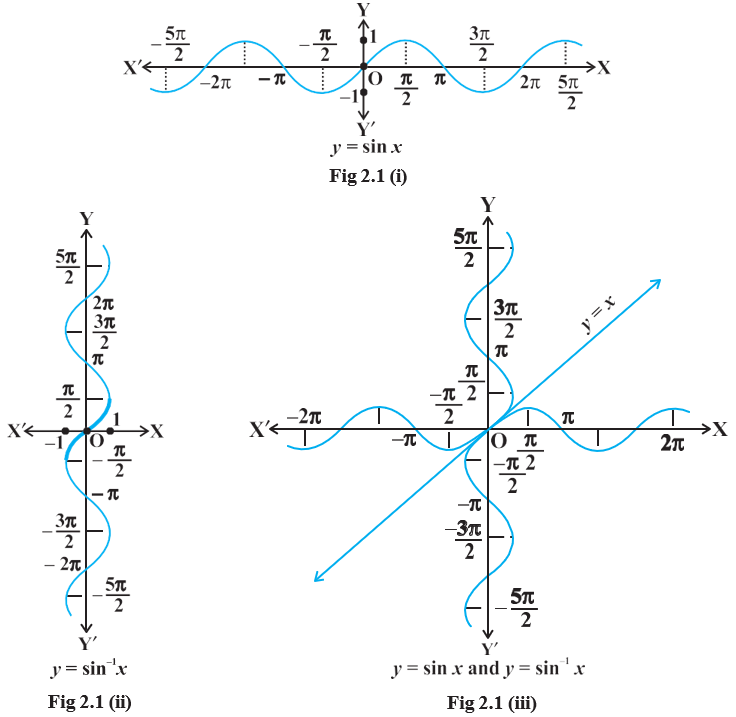
Inverse Sine Function
Principal inverse sine — The principal inverse sine, written \(\sin^{-1}x\) or \(\arcsin x\), is the inverse of sine restricted to \(\left[-\frac{\pi}{2},\frac{\pi}{2}\right]\).
The restricted sine function is one-to-one and onto from \(\left[-\frac{\pi}{2},\frac{\pi}{2}\right]\) to \([-1,1]\). Other suitable intervals of length \(\pi\) give other inverse-sine branches; the branch shown here is the principal-value branch.
The first identity holds for inputs in the inverse sine domain; the second holds when the angle is in the principal interval.
Evaluate a principal inverse sine
- Identify the angle in the principal interval whose sine equals the given input.$$\sin y=x,\quad -\frac{\pi}{2}\le y\le\frac{\pi}{2}$$
- Return that angle as the inverse-sine value.$$y=\sin^{-1}x$$
Evaluate \(\sin^{-1}\left(-\frac{1}{2}\right)\).
- Evaluate \(\sin^{-1}\left(-\frac{1}{2}\right)\) using the principal range.
- Find the angle in \(\left[-\frac{\pi}{2},\frac{\pi}{2}\right]\) whose sine is \(-\frac{1}{2}\).$$\sin\left(-\frac{\pi}{6}\right)=-\frac{1}{2}$$
- The angle lies in the required principal interval.$$-\frac{\pi}{6}\in\left[-\frac{\pi}{2},\frac{\pi}{2}\right]$$
Inverse Cosine Function
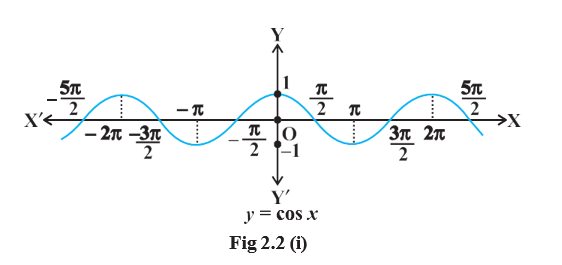
Principal inverse cosine — The principal inverse cosine, written \(\cos^{-1}x\) or \(\arccos x\), is the inverse of cosine restricted to \([0,\pi]\).
Cosine restricted to \([0,\pi]\) is one-to-one and onto \([-1,1]\). Other intervals such as \([-\pi,0]\) or \([\pi,2\pi]\) give other branches; \([0,\pi]\) gives the principal-value branch.
The first identity holds for inputs in the inverse cosine domain; the second holds for angles in the principal interval.
Evaluate a principal inverse cosine
- Identify the angle in \([0,\pi]\) whose cosine equals the given input.$$\cos y=x,\quad 0\le y\le\pi$$
- Return that angle as the inverse-cosine value.$$y=\cos^{-1}x$$
Evaluate \(\cos^{-1}\left(-\frac{1}{2}\right)\).
- Evaluate \(\cos^{-1}\left(-\frac{1}{2}\right)\) in the principal range.
- Find the angle in \([0,\pi]\) whose cosine is \(-\frac{1}{2}\).$$\cos\left(\frac{2\pi}{3}\right)=-\frac{1}{2}$$
- The angle is in the principal interval.$$\frac{2\pi}{3}\in[0,\pi]$$
Inverse Cosecant: Domain and Restricted Branch
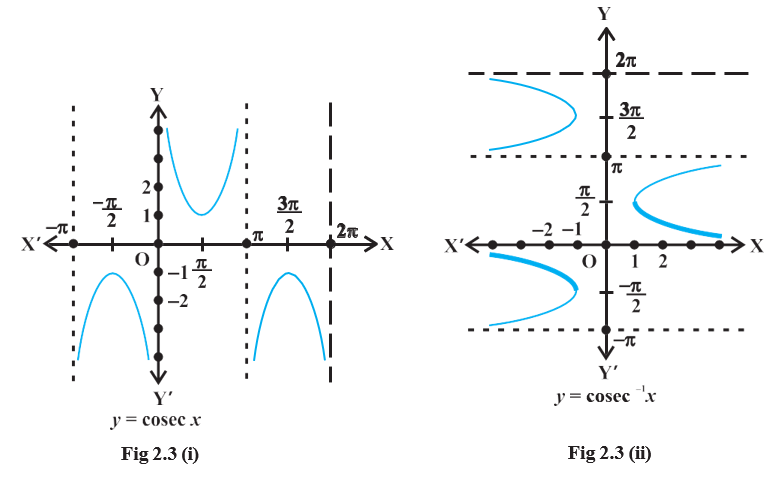
Cosecant function — Cosecant is the reciprocal of sine, so it is undefined at integer multiples of \(\pi\) and never takes values strictly between \(-1\) and \(1\).
Restricting the domain to \(\left[-\frac{\pi}{2},\frac{\pi}{2}\right]\setminus\{0\}\) makes cosecant one-to-one and onto the stated range, so an inverse branch can be defined.
Evaluate \(\cosec\left(\frac{\pi}{6}\right)\).
- Find the cosecant value at \(x=\frac{\pi}{6}\), which lies in the restricted interval.
- Use the reciprocal relationship.$$\cosec\left(\frac{\pi}{6}\right)=\frac{1}{\sin\left(\frac{\pi}{6}\right)}=\frac{1}{\frac{1}{2}}=2$$
- This confirms that the restricted branch reaches a value outside \((-1,1)\).$$2\in\mathbb{R}\setminus(-1,1)$$
For inverse trigonometric functions, the output must lie in the chosen range. For example, \(\sin^{-1}(\sin x)\) is not always \(x\) unless \(x\in\left[-\frac{\pi}{2},\frac{\pi}{2}\right]\).
State the domain and range of the principal inverse sine.
When does \(\sin^{-1}(\sin x)=x\) hold?
Evaluate \(\sin^{-1}\left(\frac{\sqrt{3}}{2}\right)\).
Evaluate \(\cos^{-1}(0)\).
State the domain and range of \(\cosec x\).
Quick recap
- An inverse exists when a function is one-to-one and onto; the inverse swaps the original domain and range.
- Trigonometric functions need suitable restricted domains before their inverses can be defined.
- The principal inverse sine maps \([-1,1]\) to \(\left[-\frac{\pi}{2},\frac{\pi}{2}\right]\).
- The principal inverse cosine maps \([-1,1]\) to \([0,\pi]\).
- An inverse graph is the reflection of the restricted original graph across \(y=x\).
- Cosecant is undefined at \(n\pi\) and has range \(\mathbb{R}\setminus(-1,1)\).
Basic Concepts (continue)
Branches and Principal Values
Inverse Cosecant
The domain is \(\mathbb{R}\setminus(-1,1)\) and the principal range is \([-\frac{\pi}{2},\frac{\pi}{2}]\setminus\{0\}\).
Evaluate an Inverse Cosecant
- Set the inverse value equal to \(y\) and write the equivalent cosecant equation.$$\cosec y=x$$
- Choose the angle in the principal range.$$y\in[-\frac{\pi}{2},\frac{\pi}{2}]\setminus\{0\}$$
Find the principal value of \(\cosec^{-1}(2)\).
- Find the principal value of \(\cosec^{-1}(2)\).
- Let \(\cosec^{-1}(2)=y\); then use the reciprocal relation.$$\sin y=\frac{1}{2}$$
- The angle in the principal range with this sine is \(\frac{\pi}{6}\).$$y=\frac{\pi}{6}$$
Inverse Secant
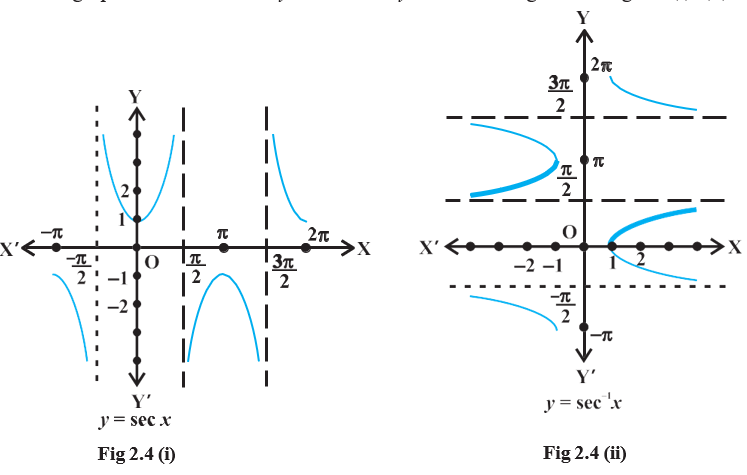
The domain is \(\mathbb{R}\setminus(-1,1)\) and the principal range is \([0,\pi]\setminus\{\frac{\pi}{2}\}\).
Evaluate an Inverse Secant
- Set the inverse value equal to \(y\) and use the reciprocal relation.$$\cos y=\frac{1}{x}$$
- Choose the angle in the principal range.$$y\in[0,\pi]\setminus\{\frac{\pi}{2}\}$$
Find the principal value of \(\sec^{-1}(-2)\).
- Find the principal value of \(\sec^{-1}(-2)\).
- Let \(\sec^{-1}(-2)=y\); the corresponding cosine is:$$\cos y=-\frac{1}{2}$$
- The angle in the principal range is \(\frac{2\pi}{3}\).$$y=\frac{2\pi}{3}$$
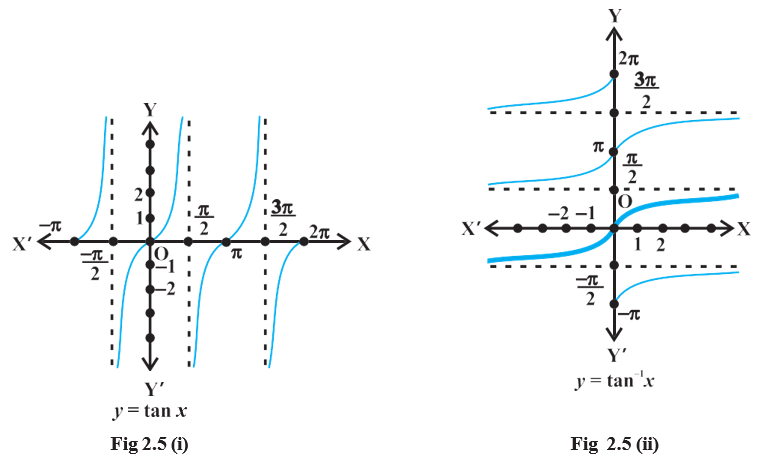
Inverse Tangent
The domain is \(\mathbb{R}\) and the principal range is \((-\frac{\pi}{2},\frac{\pi}{2})\).
Evaluate an Inverse Tangent
- Set the inverse value equal to \(y\) and write the tangent equation.$$\tan y=x$$
- Choose the angle in the open principal interval.$$y\in(-\frac{\pi}{2},\frac{\pi}{2})$$
Find the principal value of \(\tan^{-1}(1)\).
- Find the principal value of \(\tan^{-1}(1)\).
- Solve the equivalent equation in the principal interval.$$\tan y=1,\quad y\in(-\frac{\pi}{2},\frac{\pi}{2})$$
- The required angle is:$$y=\frac{\pi}{4}$$
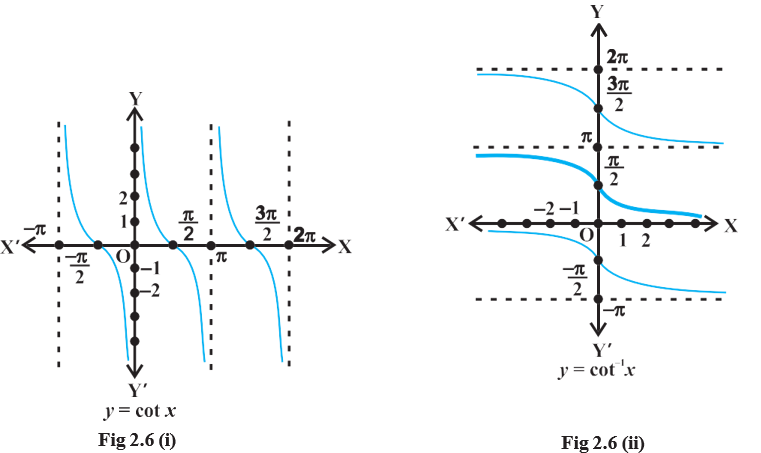
Inverse Cotangent
The domain is \(\mathbb{R}\) and the principal range is \((0,\pi)\).
Evaluate an Inverse Cotangent
- Set the inverse value equal to \(y\) and write the cotangent equation.$$\cot y=x$$
- Choose the angle in the principal interval.$$y\in(0,\pi)$$
Find the principal value of \(\cot^{-1}(-\frac{1}{\sqrt{3}})\).
- Find the principal value of \(\cot^{-1}(-\frac{1}{\sqrt{3}})\).
- Use the cotangent reference angle and select the angle in \((0,\pi)\).$$\cot(\pi-\frac{\pi}{3})=-\cot\frac{\pi}{3}=-\frac{1}{\sqrt{3}}$$
- Therefore, the principal angle is:$$y=\frac{2\pi}{3}$$
The cotangent example's printed question has a sign mismatch: the worked solution uses \(-\frac{1}{\sqrt{3}}\). For the positive input, \(\cot^{-1}(\frac{1}{\sqrt{3}})=\frac{\pi}{3}\); for the negative input, \(\cot^{-1}(-\frac{1}{\sqrt{3}})=\frac{2\pi}{3}\).
Principal-Branch Domains and Ranges
| Inverse function | Domain | Principal range |
|---|---|---|
| \(\sin^{-1}x\) | \([-1,1]\) | \([-\frac{\pi}{2},\frac{\pi}{2}]\) |
| \(\cos^{-1}x\) | \([-1,1]\) | \([0,\pi]\) |
| \(\cosec^{-1}x\) | \(\mathbb{R}\setminus(-1,1)\) | \([-\frac{\pi}{2},\frac{\pi}{2}]\setminus\{0\}\) |
| \(\sec^{-1}x\) | \(\mathbb{R}\setminus(-1,1)\) | \([0,\pi]\setminus\{\frac{\pi}{2}\}\) |
| \(\tan^{-1}x\) | \(\mathbb{R}\) | \((-\frac{\pi}{2},\frac{\pi}{2})\) |
| \(\cot^{-1}x\) | \(\mathbb{R}\) | \((0,\pi)\) |
Do not confuse \(\sin^{-1}x\) with \((\sin x)^{-1}\). The first is inverse sine; the second means \(\frac{1}{\sin x}=\cosec x\). The same distinction applies to other trigonometric functions.
Find the principal value of \(\sin^{-1}(\frac{1}{\sqrt{2}})\).
- Find the principal value of \(\sin^{-1}(\frac{1}{\sqrt{2}})\).
- The principal angle must lie in \([-\frac{\pi}{2},\frac{\pi}{2}]\) and have sine \(\frac{1}{\sqrt{2}}\).$$\sin y=\frac{1}{\sqrt{2}}$$
- The required angle is:$$y=\frac{\pi}{4}$$
Find \(\sec^{-1}(2)\).
Find \(\cot^{-1}(\frac{1}{\sqrt{3}})\).
Find \(\sin^{-1}(\frac{1}{\sqrt{2}})\).
Quick recap
- Principal value: Choose the inverse angle from the principal range.
- Inverse cosecant and secant: Their domain is \(\mathbb{R}\setminus(-1,1)\); principal ranges exclude \(0\) and \(\frac{\pi}{2}\), respectively.
- Inverse tangent and cotangent: Their principal ranges are \((-\frac{\pi}{2},\frac{\pi}{2})\) and \((0,\pi)\), respectively.
- Other branches: Restrict the original periodic function to another suitable interval to define a different inverse branch.
- Notation: \(\sin^{-1}x\) means inverse sine, not \(1/\sin x\).
- Cotangent sign: Check the sign of the input before selecting the angle in \((0,\pi)\).
Properties Of Inverse Trigonometric Functions
Principal-Value Identities
The first identity applies for \(x\in[-1,1]\); the second applies when the angle is in the principal range of \(\sin^{-1}x\).
Show that \(\sin^{-1}(2x\sqrt{1-x^2})=2\sin^{-1}x\) for \(-1/\sqrt{2}\le x\le1/\sqrt{2}\), and equals \(2\cos^{-1}x\) for \(1/\sqrt{2}\le x\le1\).
- For the first identity, set \(\theta=\sin^{-1}x\); the given range ensures \(2\theta\) is in the principal range of \(\sin^{-1}\).$$\begin{aligned}-\frac{1}{\sqrt{2}}\le x\le\frac{1}{\sqrt{2}}&\Longrightarrow -\frac{\pi}{4}\le\theta\le\frac{\pi}{4}\\\sin^{-1}\left(2x\sqrt{1-x^2}\right)&=\sin^{-1}(2\sin\theta\cos\theta)\\&=\sin^{-1}(\sin 2\theta)=2\theta=2\sin^{-1}x\end{aligned}$$
- For the second identity, set \(\theta=\cos^{-1}x\); then \(2\theta\) is again in the principal range of \(\sin^{-1}\).$$\begin{aligned}\frac{1}{\sqrt{2}}\le x\le1&\Longrightarrow 0\le\theta\le\frac{\pi}{4}\\\sin^{-1}\left(2x\sqrt{1-x^2}\right)&=\sin^{-1}(2\cos\theta\sin\theta)\\&=\sin^{-1}(\sin 2\theta)=2\theta=2\cos^{-1}x\end{aligned}$$
Simplifying an Inverse Tangent Expression
Use a half-angle identity
- Rewrite numerator and denominator using half-angle expressions.$$\frac{\cos x}{1-\sin x}=\frac{\cos^2\frac{x}{2}-\sin^2\frac{x}{2}}{\cos^2\frac{x}{2}+\sin^2\frac{x}{2}-2\sin\frac{x}{2}\cos\frac{x}{2}}$$
- Factor and cancel the common factor, valid on the stated interval.$$\frac{\left(\cos\frac{x}{2}+\sin\frac{x}{2}\right)\left(\cos\frac{x}{2}-\sin\frac{x}{2}\right)}{\left(\cos\frac{x}{2}-\sin\frac{x}{2}\right)^2}=\frac{\cos\frac{x}{2}+\sin\frac{x}{2}}{\cos\frac{x}{2}-\sin\frac{x}{2}}$$
- Recognise the quotient as a tangent and use the principal range of \(\tan^{-1}\).$$\tan\left(\frac{\pi}{4}+\frac{x}{2}\right)$$
Express \(\tan^{-1}\left(\dfrac{\cos x}{1-\sin x}\right)\) in simplest form for \(-\dfrac{3\pi}{2}<x<\dfrac{\pi}{2}\).
- Rewrite the quotient using half-angle expressions, factor, and cancel.$$\frac{\cos x}{1-\sin x}=\frac{\left(\cos\frac{x}{2}+\sin\frac{x}{2}\right)\left(\cos\frac{x}{2}-\sin\frac{x}{2}\right)}{\left(\cos\frac{x}{2}-\sin\frac{x}{2}\right)^2}=\frac{\cos\frac{x}{2}+\sin\frac{x}{2}}{\cos\frac{x}{2}-\sin\frac{x}{2}}$$
- The quotient is \(\tan\left(\frac{\pi}{4}+\frac{x}{2}\right)\); the angle lies in the principal range of \(\tan^{-1}\) for the given interval.$$\tan^{-1}\left(\frac{\cos x}{1-\sin x}\right)=\tan^{-1}\left(\tan\left(\frac{\pi}{4}+\frac{x}{2}\right)\right)=\frac{\pi}{4}+\frac{x}{2}$$
Relating Cotangent and Secant Inverses
This identity uses the principal values for \(x>1\).
Express \(\cot^{-1}\left(\dfrac{1}{\sqrt{x^2-1}}\right)\) in simplest form for \(x>1\).
- Let \(x=\sec\theta\) with \(0<\theta<\dfrac{\pi}{2}\); then the radical becomes a tangent.$$\sqrt{x^2-1}=\sqrt{\sec^2\theta-1}=\tan\theta$$
- Use the reciprocal and the principal range of \(\cot^{-1}\).$$\cot^{-1}\left(\frac{1}{\sqrt{x^2-1}}\right)=\cot^{-1}(\cot\theta)=\theta=\sec^{-1}x$$
Evaluate \(\sin^{-1}(2x\sqrt{1-x^2})\) and \(2\sin^{-1}x\) at \(x=-\dfrac{1}{2}\).
Simplify \(\tan^{-1}\left(\dfrac{\cos x}{1-\sin x}\right)\) at \(x=0\).
Find \(\cot^{-1}\left(\dfrac{1}{\sqrt{x^2-1}}\right)\) at \(x=2\).
Quick recap
- Inverse-trigonometric composition identities depend on the principal-value branch.
- \(\sin(\sin^{-1}x)=x\) for \(x\in[-1,1]\).
- \(\sin^{-1}(\sin x)=x\) only for \(x\in\left[-\dfrac{\pi}{2},\dfrac{\pi}{2}\right]\).
- \(\sin^{-1}(2x\sqrt{1-x^2})=2\sin^{-1}x\) for \(|x|\le\dfrac{1}{\sqrt{2}}\).
- \(\tan^{-1}\left(\dfrac{\cos x}{1-\sin x}\right)=\dfrac{\pi}{4}+\dfrac{x}{2}\) on the stated interval.
- \(\cot^{-1}\left(\dfrac{1}{\sqrt{x^2-1}}\right)=\sec^{-1}x\) for \(x>1\).
Miscellaneous Examples
Principal values of inverse trigonometric functions
An inverse function reverses the original function when the input lies in the inverse function’s domain; the reverse composition returns the principal value.
Use these identities only with the stated domain or principal-value restriction.
Find the value of \(\sin^{-1}(\sin\frac{3\pi}{5})\).
- \(\frac{3\pi}{5}\) is not in the principal-value range \([-\frac{\pi}{2},\frac{\pi}{2}]\).$$\frac{3\pi}{5}\notin\left[-\frac{\pi}{2},\frac{\pi}{2}\right]$$
- Use sine symmetry to obtain an angle in the principal range with the same sine.$$\sin\frac{3\pi}{5}=\sin\left(\pi-\frac{3\pi}{5}\right)=\sin\frac{2\pi}{5}$$
- Since \(\frac{2\pi}{5}\) is in the principal range, the inverse sine returns that angle.$$\frac{2\pi}{5}\in\left[-\frac{\pi}{2},\frac{\pi}{2}\right]$$
Do not assume \(\sin^{-1}(\sin x)=x\) for every real \(x\); the result must lie in the principal-value range. Also, \((\sin x)^{-1}=\frac{1}{\sin x}=\cosec x\), which is different from \(\sin^{-1}x\).
Evaluate \(\cos^{-1}(\cos\frac{5\pi}{4})\).
Evaluate \(\tan^{-1}(\tan\frac{3\pi}{4})\).
Quick recap
- Principal value: The output of an inverse trigonometric function is restricted to its principal-value range.
- Inverse sine range: \(\sin^{-1}x\) takes values in \([-\frac{\pi}{2},\frac{\pi}{2}]\).
- Composition: \(\sin(\sin^{-1}x)=x\) for \(x\in[-1,1]\).
- Restricted reverse composition: \(\sin^{-1}(\sin x)=x\) only for \(x\) in the principal range.
- Angle reduction: Use symmetry or periodicity to bring an angle inside the relevant principal-value range.
- Notation: \(\sin^{-1}x\) is inverse sine, whereas \((\sin x)^{-1}=\frac{1}{\sin x}\).
Formula sheet
Mathematics — ALL CHAPTERS
1
Relations And Functions
2
Inverse Trigonometric Functions
3
Matrices
4
DETERMINANTS
5
Continuity And Differentiability
6
Application Of Derivatives
7
Integrals
8
APPLICATION OF INTEGRALS
9
DIFFERENTIAL EQUATIONS
10
VECTOR ALGEBRA
11
Three Dimensional Geometry
12
Linear Programming
13
Probability
14
Proofs In Mathematics
15
Mathematical Modelling