CLASS 12-PCM . MATHEMATICS . MATHEMATICS PART II . VECTOR ALGEBRA
Chapter 10 : VECTOR ALGEBRA
Ch 10
MATHEMATICS
CLASS 12-PCM
Basic Algebra of Vectors
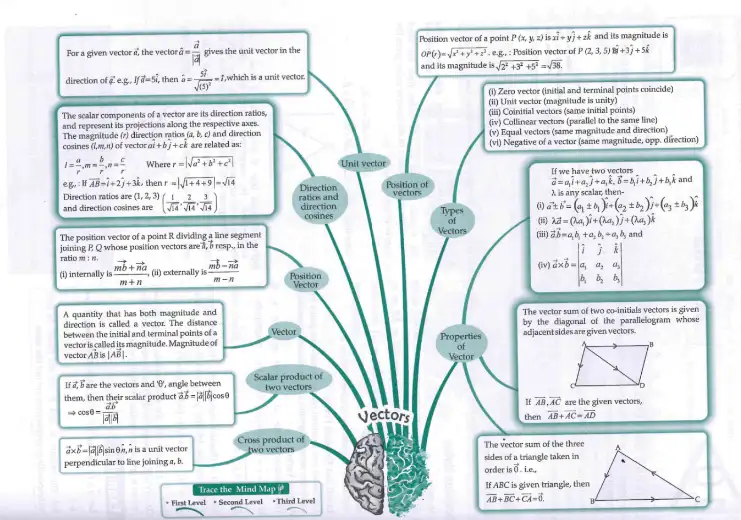
A vector is a physical quantity having both magnitude and direction, denoted as \(\vec{A}, \vec{B}, \vec{a}\). The magnitude of a vector \(\vec{a}\) is denoted by \(|\vec{a}|\).
Initial and Terminal Points: The initial point is where the vector originates, and the terminal point is where it ends.
Position Vector: For a point \(P(x,y,z)\), the position vector is \(\vec{OP} = \vec{r} = x\hat{i} + y\hat{j} + z\hat{k}\) with magnitude \(|\vec{r}| = \sqrt{x^2 + y^2 + z^2}\).
For points \(A(x_1,y_1,z_1)\) and \(B(x_2,y_2,z_2)\), the vector \(\vec{AB} = (x_2 - x_1)\hat{i} + (y_2 - y_1)\hat{j} + (z_2 - z_1)\hat{k}\).
Example 1
Given \(\vec{a} = \hat{i} + 2\hat{j}\) and \(\vec{b} = 2\hat{i} + \hat{j}\), check if \(\vec{a} = \vec{b}\).
Solution: Since components differ, \(\vec{a} \neq \vec{b}\).
Addition of Vectors
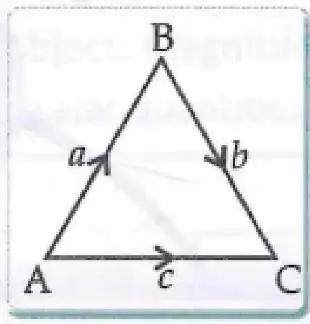
Triangular Law: If \(\vec{AB} = \vec{a}\) and \(\vec{BC} = \vec{b}\), then \(\vec{AC} = \vec{a} + \vec{b}\). Also, \(\vec{AB} + \vec{BC} + \vec{CA} = \vec{0}\).
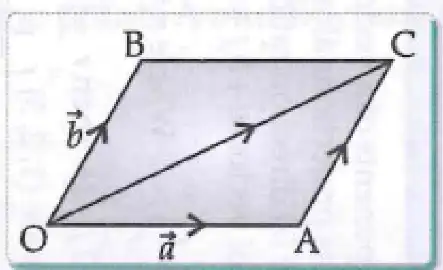
Parallelogram Law: If \(\vec{a}\) and \(\vec{b}\) are adjacent sides of parallelogram \(OACB\), then \(\vec{OC} = \vec{a} + \vec{b}\).
Multiplication of a Vector by a Scalar
For scalar \(k\) and vector \(\vec{a}\), \(k\vec{a}\) has magnitude \(|k||\vec{a}| angle\) and direction same as \(\vec{a}\) if \(k>0\), opposite if \(k<0\).
Types of Vectors
- Zero Vector: Initial and terminal points coincide, magnitude zero.
- Co-initial Vectors: Vectors with the same initial point.
- Co-terminus Vectors: Vectors with the same terminal point.
- Negative Vector: Same magnitude, opposite direction, denoted \(-\vec{r}\).
- Unit Vector: Vector with magnitude 1, \(\hat{r} = \frac{\vec{r}}{|\vec{r}|}\).
- Reciprocal Vector: Same direction as \(\vec{r}\), magnitude \(\frac{1}{|\vec{r}|}\), denoted \(\vec{r}^{-1}\).
- Equal Vectors: Same magnitude and direction.
- Collinear Vectors: Parallel vectors, \(\vec{a} = \lambda \vec{b}\) for scalar \(\lambda\).
- Free Vectors: Vectors that can be moved parallel without changing magnitude or direction.
Properties of Vectors
The sum of vectors around a triangle is zero: \(\vec{AB} + \vec{BC} + \vec{CA} = \vec{0}\).
Key Formulae
Position vector of point \(P\) dividing segment \(AB\) in ratio \(m:n\):
- Internally: \(\vec{OP} = \frac{m\vec{b} + n\vec{a}}{m+n}\)
- Externally: \(\vec{OP} = \frac{m\vec{b} - n\vec{a}}{m-n}\)
- If \(P\) is midpoint, \(\vec{OP} = \frac{\vec{a} + \vec{b}}{2}\)
Practice Set
- Level 1: Find the magnitude of \(\vec{a} = 3\hat{i} + 4\hat{j}\).
- Level 2: Given \(\vec{a} = 2\hat{i} + 3\hat{j} + \hat{k}\) and \(\vec{b} = \hat{i} + 2\hat{j} + 4\hat{k}\), find \(\vec{AB}\) where \(A\) and \(B\) have position vectors \(\vec{a}\) and \(\vec{b}\).
- Level 3: Prove that the sum of vectors around a triangle is zero.
Answer Key
- Level 1: \(|\vec{a}| = \sqrt{3^2 + 4^2} = 5\)
- Level 2: \(\vec{AB} = \vec{b} - \vec{a} = (-1)\hat{i} - 1\hat{j} + 3\hat{k}\)
- Level 3: Using triangle law, \(\vec{AB} + \vec{BC} + \vec{CA} = \vec{0}\) by vector addition.
Quick Reference
| Concept | Formula |
|---|---|
| Position Vector | \(\vec{r} = x\hat{i} + y\hat{j} + z\hat{k}\) |
| Vector between points | \(\vec{AB} = \vec{b} - \vec{a}\) |
| Midpoint | \(\frac{\vec{a} + \vec{b}}{2}\) |
Glossary
- Vector: Quantity with magnitude and direction.
- Magnitude: Length of a vector.
- Unit Vector: Vector of length 1.
- Scalar: A real number.
- Position Vector: Vector from origin to a point.
Dot Product of Vector
The dot product (scalar product) of vectors \(\vec{a}\) and \(\vec{b}\) is defined as:
\[ \vec{a} \cdot \vec{b} = |\vec{a}| |\vec{b}| \cos \theta \]
where \(\theta\) is the angle between \(\vec{a}\) and \(\vec{b}\), \(0 \leq \theta \leq \pi\).
For \(\vec{a} = a_1 \hat{i} + a_2 \hat{j} + a_3 \hat{k}\) and \(\vec{b} = b_1 \hat{i} + b_2 \hat{j} + b_3 \hat{k}\),
\[ \vec{a} \cdot \vec{b} = a_1 b_1 + a_2 b_2 + a_3 b_3 \]
Projection of a Vector
Projection of \(\vec{a}\) on \(\vec{b}\):
\[ \text{proj}_{\vec{b}} \vec{a} = \frac{\vec{a} \cdot \vec{b}}{|\vec{b}|} \]
Projection of \(\vec{b}\) on \(\vec{a}\):
\[ \text{proj}_{\vec{a}} \vec{b} = \frac{\vec{a} \cdot \vec{b}}{|\vec{a}|} \]
Example 2
Find the projection of \(\vec{a} = 2\hat{i} + 3\hat{j} + 2\hat{k}\) on \(\vec{b} = \hat{i} + 2\hat{j} + \hat{k}\).
Solution:
\[ \vec{a} \cdot \vec{b} = 2 \times 1 + 3 \times 2 + 2 \times 1 = 2 + 6 + 2 = 10 \]
\[ |\vec{b}| = \sqrt{1^2 + 2^2 + 1^2} = \sqrt{6} \]
Projection = \( \frac{10}{\sqrt{6}} = \frac{5 \sqrt{6}}{3} \)
Properties of Dot Product
- \(\hat{i} \cdot \hat{i} = 1\), \(\hat{i} \cdot \hat{j} = 0\)
- Dot product is commutative: \(\vec{a} \cdot \vec{b} = \vec{b} \cdot \vec{a}\)
- \(\vec{a} \cdot \vec{b} = 0\) if vectors are perpendicular or one is zero vector.
- Distributive: \(\vec{a} \cdot (\vec{b} + \vec{c}) = \vec{a} \cdot \vec{b} + \vec{a} \cdot \vec{c}\)
Key Formula
Angle between two vectors:
\[ \cos \theta = \frac{\vec{a} \cdot \vec{b}}{|\vec{a}| |\vec{b}|} \quad \Rightarrow \quad \theta = \cos^{-1} \left( \frac{\vec{a} \cdot \vec{b}}{|\vec{a}| |\vec{b}|} \right) \]
Practice Set
- Level 1: Find \(\vec{a} \cdot \vec{b}\) for \(\vec{a} = \hat{i} + 2\hat{j}\), \(\vec{b} = 3\hat{i} + \hat{j}\).
- Level 2: Find the angle between \(\vec{a} = 2\hat{i} + 3\hat{j} + \hat{k}\) and \(\vec{b} = \hat{i} + 2\hat{j} + 2\hat{k}\).
- Level 3: Prove that if \(\vec{a} \cdot \vec{b} = 0\), then \(\vec{a}\) and \(\vec{b}\) are perpendicular.
Answer Key
- Level 1: \(\vec{a} \cdot \vec{b} = 1 \times 3 + 2 \times 1 = 5\)
- Level 2: \(\cos \theta = \frac{2 \times 1 + 3 \times 2 + 1 \times 2}{\sqrt{4+9+1} \sqrt{1+4+4}} = \frac{2 + 6 + 2}{\sqrt{14} \sqrt{9}} = \frac{10}{3\sqrt{14}}\)
- Level 3: By definition, \(\vec{a} \cdot \vec{b} = |\vec{a}||\vec{b}| \cos \theta = 0\) implies \(\cos \theta = 0\), so \(\theta = 90^\circ\).
Quick Reference
| Concept | Formula |
|---|---|
| Dot Product | \(\vec{a} \cdot \vec{b} = a_1 b_1 + a_2 b_2 + a_3 b_3\) |
| Projection of \(\vec{a}\) on \(\vec{b}\) | \(\frac{\vec{a} \cdot \vec{b}}{|\vec{b}|}\) |
| Angle between vectors | \(\cos \theta = \frac{\vec{a} \cdot \vec{b}}{|\vec{a}| |\vec{b}|}\) |
Glossary
- Dot Product: Scalar product of two vectors.
- Projection: Shadow or component of one vector on another.
- Angle between vectors: The angle formed by two vectors.
Cross Product
The cross product (vector product) of vectors \(\vec{a}\) and \(\vec{b}\) is defined as:
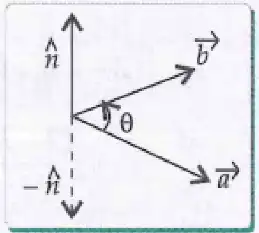
\[ \vec{a} \times \vec{b} = |\vec{a}| |\vec{b}| \sin \theta \hat{n} \]
where \(\theta\) is the angle between \(\vec{a}\) and \(\vec{b}\), and \(\hat{n}\) is a unit vector perpendicular to both \(\vec{a}\) and \(\vec{b}\) following the right-hand rule.
For \(\vec{a} = a_1 \hat{i} + a_2 \hat{j} + a_3 \hat{k}\) and \(\vec{b} = b_1 \hat{i} + b_2 \hat{j} + b_3 \hat{k}\),
\[ \vec{a} \times \vec{b} = \begin{vmatrix} \hat{i} & \hat{j} & \hat{k} \\ a_1 & a_2 & a_3 \\ b_1 & b_2 & b_3 \end{vmatrix} = (a_2 b_3 - a_3 b_2) \hat{i} - (a_1 b_3 - a_3 b_1) \hat{j} + (a_1 b_2 - a_2 b_1) \hat{k} \]
Properties of Cross Product
- \(\hat{i} \times \hat{i} = \vec{0}\), similarly for \(\hat{j}\) and \(\hat{k}\).
- \(\hat{i} \times \hat{j} = \hat{k}\), \(\hat{j} \times \hat{k} = \hat{i}\), \(\hat{k} \times \hat{i} = \hat{j}\).
- \(\vec{a} \times \vec{b} = \vec{0}\) if \(\vec{a}\) and \(\vec{b}\) are parallel or zero vectors.
- Cross product is not commutative: \(\vec{a} \times \vec{b} = - (\vec{b} \times \vec{a})\).
- Distributive over addition: \(\vec{a} \times (\vec{b} + \vec{c}) = \vec{a} \times \vec{b} + \vec{a} \times \vec{c}\).
Relationship Between Vector and Scalar Products (Lagrange's Identity)
\[ |\vec{a} \times \vec{b}|^2 + (\vec{a} \cdot \vec{b})^2 = |\vec{a}|^2 |\vec{b}|^2 \]
Cauchy-Schwarz Inequality
For any vectors \(\vec{a}\) and \(\vec{b}\),
\[ |\vec{a} \cdot \vec{b}| \leq |\vec{a}| |\vec{b}| \]
Applications
- Area of triangle with adjacent sides \(\vec{a}\) and \(\vec{b}\): \(\frac{1}{2} |\vec{a} \times \vec{b}|\)
- Area of parallelogram with adjacent sides \(\vec{a}\) and \(\vec{b}\): \(|\vec{a} \times \vec{b}|\)
Practice Set
- Level 1: Compute \(\hat{i} \times \hat{j}\).
- Level 2: Find \(\vec{a} \times \vec{b}\) for \(\vec{a} = \hat{i} + 2\hat{j} + 3\hat{k}\), \(\vec{b} = 4\hat{i} + 5\hat{j} + 6\hat{k}\).
- Level 3: Prove Lagrange's identity for vectors \(\vec{a}\) and \(\vec{b}\).
Answer Key
- Level 1: \(\hat{i} \times \hat{j} = \hat{k}\)
- Level 2: \(\vec{a} \times \vec{b} = (-3)\hat{i} + 6\hat{j} - 3\hat{k}\)
- Level 3: Use vector algebra to expand \(|\vec{a} \times \vec{b}|^2 + (\vec{a} \cdot \vec{b})^2\) and show it equals \(|\vec{a}|^2 |\vec{b}|^2\).
Quick Reference
| Concept | Formula |
|---|---|
| Cross Product | \(\vec{a} \times \vec{b} = \begin{vmatrix} \hat{i} & \hat{j} & \hat{k} \\ a_1 & a_2 & a_3 \\ b_1 & b_2 & b_3 \end{vmatrix}\) |
| Area of Triangle | \(\frac{1}{2} |\vec{a} \times \vec{b}|\) |
| Lagrange's Identity | \(|\vec{a} \times \vec{b}|^2 + (\vec{a} \cdot \vec{b})^2 = |\vec{a}|^2 |\vec{b}|^2\) |
Glossary
- Cross Product: Vector perpendicular to two given vectors.
- Unit Vector: Vector of length 1.
- Lagrange's Identity: Relation between dot and cross products.
- Cauchy-Schwarz Inequality: Bound on dot product magnitude.