CLASS 12-PCM . MATHEMATICS . MATHEMATICS PART II . MATHEMATICAL MODELLING
Chapter 15 : Mathematical Modelling
Ch 15
MATHEMATICS
CLASS 12-PCM
Mathematical Modelling Introduction
Mathematical modelling is the process of translating real-life physical situations into mathematical terms using suitable variables, parameters, and conditions. It involves creating models that describe the behavior of phenomena using words, drawings, computer programs, or mathematical formulae. This approach helps solve complex problems by applying mathematical techniques.
Mathematical modelling is essential because it provides physical insight into situational problems, allowing us to apply physical laws and compare mathematical results with practical values. Examples include finding the width of a river, height of a tower, temperature of the Sun's surface, mass of the Earth, estimating crop yields, blood volume, and population projections.
Why Mathematical Modelling?
- To solve real-world problems by converting them into mathematical form.
- To apply physical laws and mathematical techniques for solutions.
- To gain insight into complex phenomena where direct measurement or experimentation is difficult.
Principles of Mathematical Modelling
- Identify the need for the model.
- List required parameters and variables.
- Identify available relevant data.
- Make assumptions applicable to the situation.
- Identify governing physical principles.
- Formulate equations, calculations, and solutions.
- Test for consistency and utility of the model.
- Adjust parameters to improve the model.
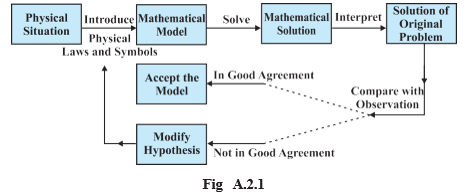
Steps for Mathematical Modelling
- Identify the physical situation.
- Convert the situation into a mathematical model using variables and physical laws.
- Solve the mathematical problem.
- Interpret the solution in terms of the original problem.
- Compare results with observations or experiments.
- Accept or modify the model based on agreement with observations.