CLASS 12-PCM . MATHEMATICS . MATHEMATICS PART II . APPLICATION OF-INTEGRALS
Chapter 8 : APPLICATION OF INTEGRALS
Ch 8
MATHEMATICS
CLASS 12-PCM
Area Under Simple Curves
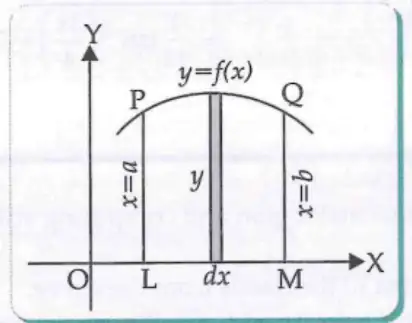
The area bounded by a curve and the coordinate axes can be found using definite integrals. Consider a curve defined by \( y = f(x) \) between \( x = a \) and \( x = b \). The area under the curve and above the x-axis is approximated by summing the areas of thin vertical strips of width \( dx \) and height \( y = f(x) \).
The area of an elementary strip is \( dA = y \, dx = f(x) \, dx \). Summing these strips from \( a \) to \( b \) gives the total area:
\[ A = \int_a^b f(x) \, dx \]
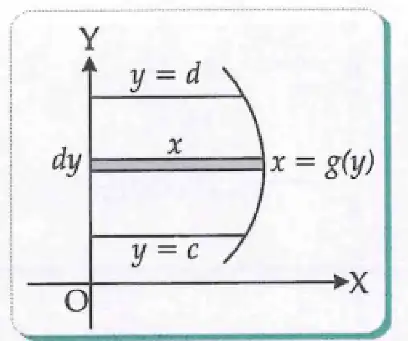
Similarly, if the curve is given by \( x = g(y) \) between \( y = c \) and \( y = d \), the area bounded by the curve, y-axis, and the lines \( y = c \) and \( y = d \) is:
\[ A = \int_c^d g(y) \, dy \]
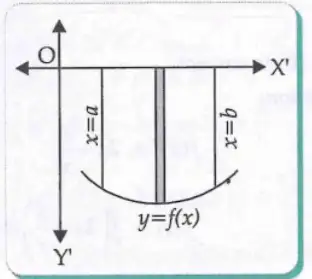
If the curve lies below the x-axis, i.e., \( f(x) < 0 \) for \( x \in [a,b] \), the definite integral \( \int_a^b f(x) \, dx \) is negative. The area bounded by the curve and the x-axis is the absolute value of this integral:
\[ \text{Area} = \left| \int_a^b f(x) \, dx \right| \]
If the curve crosses the x-axis, the total area bounded by the curve and the x-axis between \( x = u \) and \( x = b \) is the sum of the absolute values of the areas above and below the x-axis:
\[ A = |A_1| + |A_2| \]
Worked Illustration: Area Enclosed by an Ellipse
Find the area enclosed by the ellipse:
\[ \frac{x^2}{a^2} + \frac{y^2}{b^2} = 1 \]
Solution:
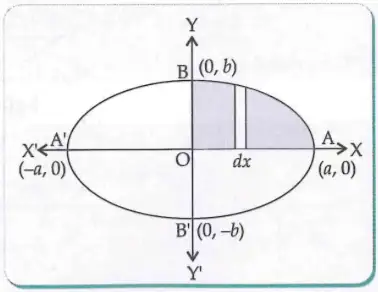
The ellipse is symmetric about both axes. The total area is four times the area in the first quadrant:
\[ A = 4 \times \text{Area in first quadrant} = 4 \int_0^a y \, dx \]
From the ellipse equation, solve for \( y \):
\[ y = \frac{b}{a} \sqrt{a^2 - x^2} \]
Substitute into the integral:
\[ A = 4 \int_0^a \frac{b}{a} \sqrt{a^2 - x^2} \, dx = \frac{4b}{a} \int_0^a \sqrt{a^2 - x^2} \, dx \]
Use the standard integral formula:
\[ \int \sqrt{a^2 - x^2} \, dx = \frac{x}{2} \sqrt{a^2 - x^2} + \frac{a^2}{2} \sin^{-1} \frac{x}{a} + C \]
Evaluate the definite integral:
\[ \int_0^a \sqrt{a^2 - x^2} \, dx = \left[ \frac{x}{2} \sqrt{a^2 - x^2} + \frac{a^2}{2} \sin^{-1} \frac{x}{a} \right]_0^a \]
At \( x = a \):
\[ \frac{a}{2} \times 0 + \frac{a^2}{2} \times \frac{\pi}{2} = \frac{a^2 \pi}{4} \]
At \( x = 0 \):
\[ 0 + 0 = 0 \]
Therefore,
\[ \int_0^a \sqrt{a^2 - x^2} \, dx = \frac{a^2 \pi}{4} \]
Substitute back:
\[ A = \frac{4b}{a} \times \frac{a^2 \pi}{4} = \pi a b \]
Thus, the area enclosed by the ellipse is \( \pi a b \) square units.
Worked Illustration: Area Bounded by Parabola and Line
Find the area of the region bounded by the curve \( y = x^2 \) and the line \( y = 4 \).
Solution:
The parabola is symmetric about the y-axis. The region bounded by \( y = x^2 \) and \( y = 4 \) is symmetric about the y-axis. Calculate the area in the first quadrant and multiply by 2:
Express \( x \) in terms of \( y \):
\[ x = \sqrt{y} \]
The area in the first quadrant is:
\[ \int_0^4 \sqrt{y} \, dy \]
Therefore, total area:
\[ A = 2 \int_0^4 \sqrt{y} \, dy = 2 \int_0^4 y^{1/2} \, dy \]
Integrate:
\[ \int y^{1/2} \, dy = \frac{2}{3} y^{3/2} + C \]
Evaluate definite integral:
\[ \int_0^4 y^{1/2} \, dy = \left[ \frac{2}{3} y^{3/2} \right]_0^4 = \frac{2}{3} (4)^{3/2} - 0 = \frac{2}{3} \times 8 = \frac{16}{3} \]
Multiply by 2:
\[ A = 2 \times \frac{16}{3} = \frac{32}{3} \]
Thus, the area of the region bounded by \( y = x^2 \) and \( y = 4 \) is \( \frac{32}{3} \) square units.
Practice Set
- Level 1 – Easy
- Find the area under the curve \( y = 3x \) between \( x = 0 \) and \( x = 2 \).
- Calculate the area bounded by \( y = x^2 \) and the x-axis from \( x = 0 \) to \( x = 3 \).
- Level 2 – Moderate
- Find the area bounded by the curve \( y = \sqrt{x} \), the x-axis, and the lines \( x = 1 \) and \( x = 4 \).
- Calculate the area bounded by the curve \( x = y^2 \), the y-axis, and the lines \( y = 1 \) and \( y = 3 \).
- Level 3 – Challenging
- Find the area enclosed by the ellipse \( \frac{x^2}{9} + \frac{y^2}{16} = 1 \).
- Calculate the area bounded by the curve \( y = x^3 \) and the line \( y = 8 \).
Answer Key
- Level 1
- \( \int_0^2 3x \, dx = \left[ \frac{3x^2}{2} \right]_0^2 = \frac{3 \times 4}{2} = 6 \)
- \( \int_0^3 x^2 \, dx = \left[ \frac{x^3}{3} \right]_0^3 = \frac{27}{3} = 9 \)
- Level 2
- \( \int_1^4 \sqrt{x} \, dx = \left[ \frac{2}{3} x^{3/2} \right]_1^4 = \frac{2}{3} (8 - 1) = \frac{14}{3} \)
- \( \int_1^3 y^2 \, dy = \left[ \frac{y^3}{3} \right]_1^3 = \frac{27 - 1}{3} = \frac{26}{3} \)
- Level 3
- Area of ellipse \( = \pi a b = \pi \times 3 \times 4 = 12 \pi \)
- Set \( y = x^3 \), line \( y = 8 \) implies \( x = 2 \). Area:
\( \int_0^2 (8 - x^3) \, dx = \left[ 8x - \frac{x^4}{4} \right]_0^2 = (16 - 4) - 0 = 12 \)
Quick Reference
| Concept | Formula |
|---|---|
| Area under \( y = f(x) \) from \( a \) to \( b \) | \( \int_a^b f(x) \, dx \) |
| Area under \( x = g(y) \) from \( c \) to \( d \) | \( \int_c^d g(y) \, dy \) |
| Area enclosed by ellipse \( \frac{x^2}{a^2} + \frac{y^2}{b^2} = 1 \) | \( \pi a b \) |
Glossary
- Arbitrary: A constant or value that can be chosen freely within a problem.
- Curve: A continuous and smooth flowing line without sharp angles.
- Definite Integral: The integral of a function over a specific interval, representing area under the curve.
- Ordinates: The y-coordinates of points on a curve.
- Abscissa: The x-coordinates of points on a curve.