CLASS 12-PCM . MATHEMATICS . MATHEMATICS PART I . MATRICES
Chapter 3 : Matrices
Ch 3
MATHEMATICS
CLASS 12-PCM
Matrices and Operations
A matrix is an ordered rectangular array of numbers or functions arranged in rows and columns. It is denoted by uppercase letters such as \( A, B, C \). A matrix \( A \) of order \( m \times n \) has \( m \) rows and \( n \) columns, with elements \( a_{ij} \) where \( i \) is the row number and \( j \) is the column number.
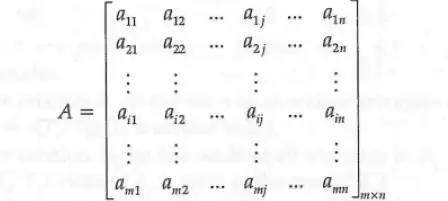
The elements are arranged as:
\[ A = \begin{bmatrix} a_{11} & a_{12} & \cdots & a_{1n} \\ a_{21} & a_{22} & \cdots & a_{2n} \\ \vdots & \vdots & \ddots & \vdots \\ a_{m1} & a_{m2} & \cdots & a_{mn} \end{bmatrix} \]Types of Matrices
- Column matrix: A matrix with only one column, order \( m \times 1 \).
- Row matrix: A matrix with only one row, order \( 1 \times n \).
- Square matrix: Number of rows equals number of columns, order \( n \times n \).
- Diagonal matrix: Square matrix where all off-diagonal elements are zero, i.e., \( a_{ij} = 0 \) for \( i \neq j \).
- Scalar matrix: Diagonal matrix with all diagonal elements equal to a constant \( k \), i.e., \( a_{ij} = k \) if \( i = j \), else 0.
- Identity matrix: Scalar matrix with \( k = 1 \), denoted by \( I_m \), where \( a_{ij} = 1 \) if \( i = j \), else 0.
- Zero matrix: All elements are zero.
- Horizontal matrix: Matrix with more columns than rows, \( m < n \).
- Vertical matrix: Matrix with more rows than columns, \( m > n \).
Equality of Matrices
Two matrices \( A = [a_{ij}] \) and \( B = [b_{ij}] \) of the same order \( m \times n \) are equal if and only if \( a_{ij} = b_{ij} \) for all \( i, j \).
Addition of Matrices
If \( A = [a_{ij}] \) and \( B = [b_{ij}] \) are matrices of order \( m \times n \), their sum \( A + B = [a_{ij} + b_{ij}] \) is also a matrix of order \( m \times n \). Addition is defined only if matrices have the same order.
Multiplication of a Matrix by a Scalar
For a scalar \( k \) and matrix \( A = [a_{ij}] \), the product \( kA = [k a_{ij}] \) is obtained by multiplying each element of \( A \) by \( k \).
Multiplication of Two Matrices
Let \( A = [a_{ij}] \) be an \( m \times n \) matrix and \( B = [b_{jk}] \) be an \( n \times p \) matrix. The product \( C = AB = [c_{ik}] \) is an \( m \times p \) matrix where
\[ c_{ik} = \sum_{j=1}^n a_{ij} b_{jk} \]Matrix multiplication is defined only if the number of columns of \( A \) equals the number of rows of \( B \). Note that matrix multiplication is not commutative.
Properties of Matrix Multiplication
- If \( A \) is \( m \times n \) and \( B \) is \( n \times p \), then \( AB \) is \( m \times p \).
- If \( A \) and \( B \) are square matrices of order \( n \), and \( I_n \) is the identity matrix, then \( I_n A = A I_n = A \).
Idempotent Matrix
A square matrix \( A \) is idempotent if \( A^2 = A \).
Transpose of a Matrix
The transpose of an \( m \times n \) matrix \( A = [a_{ij}] \) is the \( n \times m \) matrix \( A^T = [a_{ji}] \) obtained by interchanging rows and columns.
Properties of Transpose
- \( (A + B)^T = A^T + B^T \)
- \( (A^T)^T = A \)
- \( (kA)^T = k A^T \), where \( k \) is a scalar
- \( (AB)^T = B^T A^T \)
- \( (ABC)^T = C^T B^T A^T \)
Worked Examples
Example 1
Problem: Find all possible orders of a matrix with 8 elements.
Solution: If a matrix has order \( m \times n \), then \( m n = 8 \). The possible pairs \( (m, n) \) are (1,8), (8,1), (2,4), (4,2). Hence, possible orders are \( 1 \times 8, 8 \times 1, 2 \times 4, 4 \times 2 \).
Example 2
Problem: Construct a \( 3 \times 2 \) matrix \( A = [a_{ij}] \) where \( a_{ij} = \frac{1}{2} |i - 3j| \).
Solution:
\[ \begin{aligned} a_{11} &= \frac{1}{2} |1 - 3 \times 1| = \frac{1}{2} |1 - 3| = 1 \\ a_{12} &= \frac{1}{2} |1 - 3 \times 2| = \frac{1}{2} |1 - 6| = \frac{5}{2} \\ a_{21} &= \frac{1}{2} |2 - 3 \times 1| = \frac{1}{2} |2 - 3| = \frac{1}{2} \\ a_{22} &= \frac{1}{2} |2 - 3 \times 2| = \frac{1}{2} |2 - 6| = 2 \\ a_{31} &= \frac{1}{2} |3 - 3 \times 1| = \frac{1}{2} |3 - 3| = 0 \\ a_{32} &= \frac{1}{2} |3 - 3 \times 2| = \frac{1}{2} |3 - 6| = \frac{3}{2} \end{aligned} \]Thus,
\[ A = \begin{bmatrix} 1 & \frac{5}{2} \\ \frac{1}{2} & 2 \\ 0 & \frac{3}{2} \end{bmatrix} \]Example 3
Problem: Multiply matrices
\[ A = \begin{bmatrix} 6 & 9 \\ 2 & 3 \end{bmatrix}, \quad B = \begin{bmatrix} 2 & 6 & 0 \\ 7 & 9 & 8 \end{bmatrix} \]Solution: Since \( A \) is \( 2 \times 2 \) and \( B \) is \( 2 \times 3 \), multiplication \( AB \) is defined and will be \( 2 \times 3 \).
\[ AB = \begin{bmatrix} (6 \times 2 + 9 \times 7) & (6 \times 6 + 9 \times 9) & (6 \times 0 + 9 \times 8) \\ (2 \times 2 + 3 \times 7) & (2 \times 6 + 3 \times 9) & (2 \times 0 + 3 \times 8) \end{bmatrix} = \begin{bmatrix} 75 & 117 & 72 \\ 25 & 39 & 24 \end{bmatrix} \]Example 4
Problem: Verify the matrix identity \( (AB)^T = B^T A^T \) for given matrices \( A \) and \( B \).
Solution: Calculate \( AB \), then \( (AB)^T \). Calculate \( A^T \) and \( B^T \), then multiply \( B^T A^T \). Verify both results are equal.
Practice Set
Level 1 – Easy
- Find the order of a matrix with 12 elements.
- Write a \( 2 \times 3 \) zero matrix.
- Add two matrices \( A = \begin{bmatrix}1 & 2 \\ 3 & 4\end{bmatrix} \) and \( B = \begin{bmatrix}5 & 6 \\ 7 & 8\end{bmatrix} \).
Level 2 – Moderate
- Multiply matrix \( A = \begin{bmatrix}1 & 2 & 3 \\ 4 & 5 & 6\end{bmatrix} \) by scalar 3.
- Find the product of \( A = \begin{bmatrix}2 & 0 \\ 1 & 3\end{bmatrix} \) and \( B = \begin{bmatrix}1 & 4 \\ 2 & 5\end{bmatrix} \).
- Find the transpose of \( A = \begin{bmatrix}1 & 2 & 3 \\ 4 & 5 & 6\end{bmatrix} \).
Level 3 – Challenging
- Given \( A = \begin{bmatrix}1 & 2 \\ 3 & 4\end{bmatrix} \), find \( A^2 \) and verify if \( A \) is idempotent.
- Find the product \( AB \) where \( A = \begin{bmatrix}1 & 0 & 2 \\ -1 & 3 & 1\end{bmatrix} \) and \( B = \begin{bmatrix}3 & 1 \\ 2 & 1 \\ 1 & 0\end{bmatrix} \).
- Verify the property \( (ABC)^T = C^T B^T A^T \) for matrices \( A, B, C \) of appropriate orders.
Answer Key
Level 1
- Possible orders for 12 elements: (1,12), (12,1), (2,6), (6,2), (3,4), (4,3).
- Zero matrix \( 2 \times 3 \): \( \begin{bmatrix}0 & 0 & 0 \\ 0 & 0 & 0\end{bmatrix} \).
- Sum: \( \begin{bmatrix}6 & 8 \\ 10 & 12\end{bmatrix} \).
Level 2
- Scalar multiplication: \( \begin{bmatrix}3 & 6 & 9 \\ 12 & 15 & 18\end{bmatrix} \).
- Product: \( \begin{bmatrix}2 & 10 \\ 7 & 19\end{bmatrix} \).
- Transpose: \( \begin{bmatrix}1 & 4 \\ 2 & 5 \\ 3 & 6\end{bmatrix} \).
Level 3
- \( A^2 = \begin{bmatrix}7 & 10 \\ 15 & 22\end{bmatrix} \), so \( A^2 \neq A \), not idempotent.
- \( AB = \begin{bmatrix}5 & 1 \\ 4 & 2\end{bmatrix} \).
- Verification requires matrix multiplication and transpose; results will be equal.
Quick Reference
| Operation | Formula | Condition |
|---|---|---|
| Addition | \( (A + B)_{ij} = a_{ij} + b_{ij} \) | Same order matrices |
| Scalar Multiplication | \( (kA)_{ij} = k a_{ij} \) | Any matrix |
| Matrix Multiplication | \( (AB)_{ik} = \sum_{j} a_{ij} b_{jk} \) | Columns of A = Rows of B |
| Transpose | \( (A^T)_{ij} = a_{ji} \) | Any matrix |
| Idempotent | \( A^2 = A \) | Square matrix |
Glossary
- Matrix: Rectangular array of elements arranged in rows and columns.
- Order: Number of rows and columns of a matrix, denoted \( m \times n \).
- Element: Individual entry in a matrix, denoted \( a_{ij} \).
- Scalar: A single number used to multiply a matrix.
- Transpose: Matrix obtained by interchanging rows and columns.
- Idempotent matrix: Matrix satisfying \( A^2 = A \).
Symmetric, Skew-Symmetric and Invertible Matrices
A square matrix \( A = [a_{ij}] \) is:
Symmetric Matrix
If \( A^T = A \), i.e., \( a_{ij} = a_{ji} \) for all \( i, j \).
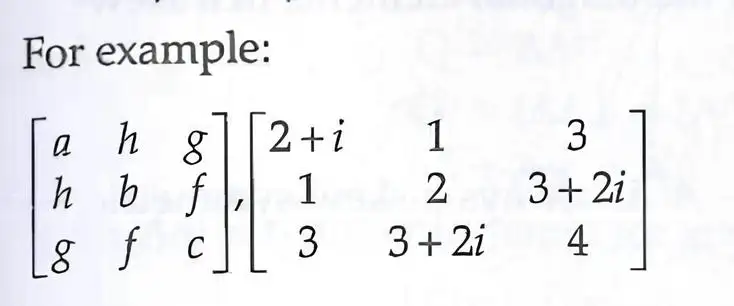
Skew-Symmetric Matrix
If \( A^T = -A \), i.e., \( a_{ij} = -a_{ji} \) and all diagonal elements \( a_{ii} = 0 \).
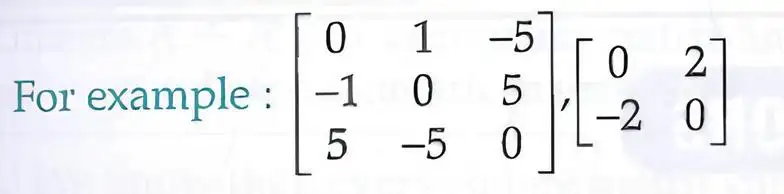
Orthogonal Matrix
A matrix \( A \) is orthogonal if \( A A^T = I \), where \( I \) is the identity matrix.
Invertible Matrix
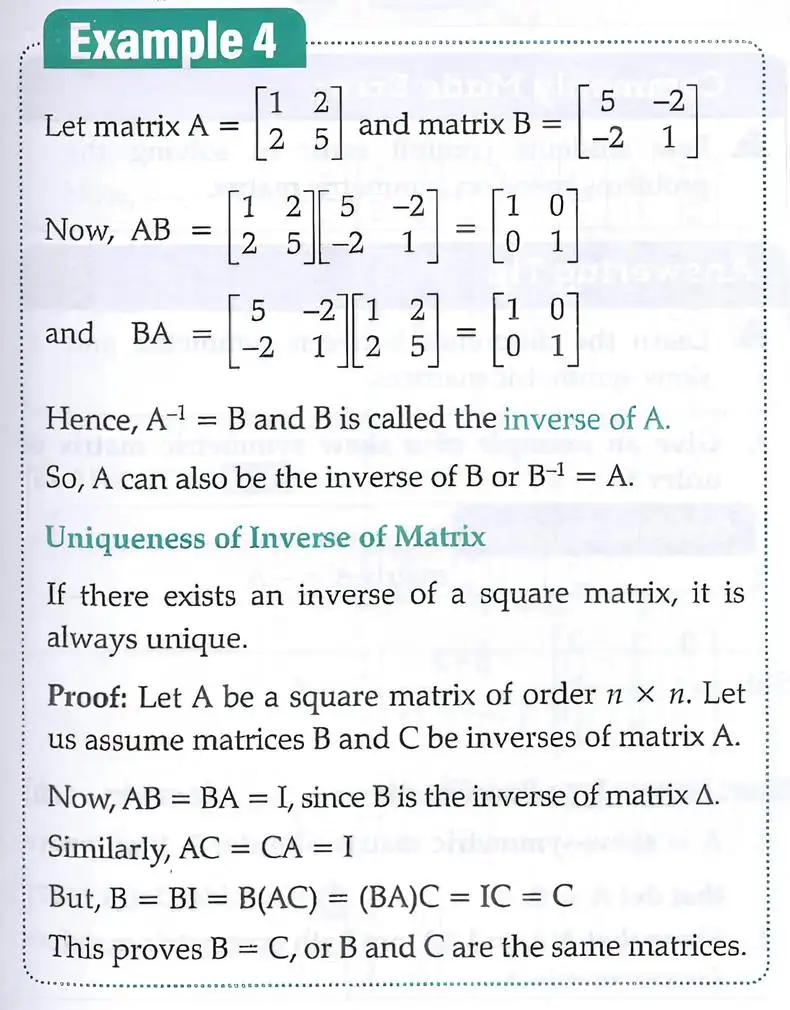
A square matrix \( A \) is invertible if there exists a matrix \( B \) such that \( AB = BA = I \), where \( I \) is the identity matrix.
Worked Examples
Example 4
Problem: Show that the inverse of a matrix, if it exists, is unique.
Solution: Given matrices \( A \) and \( B \) such that \( AB = BA = I \), \( B \) is the inverse of \( A \). If another matrix \( C \) also satisfies \( AC = CA = I \), then \( B = C \), proving uniqueness.
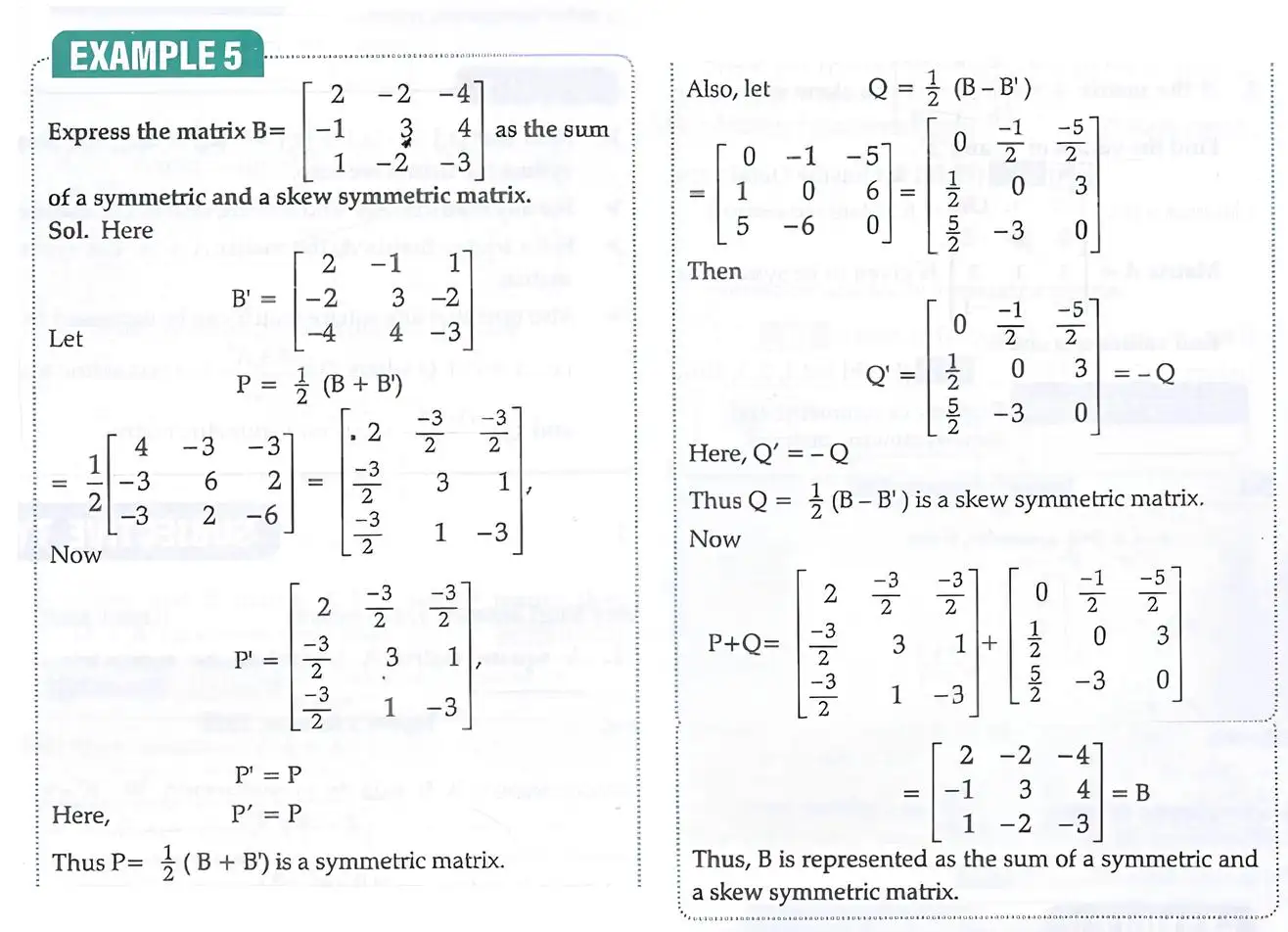
Example 5
Problem: Express matrix \( B \) as the sum of a symmetric matrix \( P \) and a skew-symmetric matrix \( Q \).
Solution:
\[ P = \frac{1}{2} (B + B^T), \quad Q = \frac{1}{2} (B - B^T), \quad B = P + Q \]Calculate \( B^T \), then \( P \) and \( Q \) accordingly.
Key Facts
- Diagonal elements of a skew-symmetric matrix are zero.
- For any matrix \( A \), \( AA^T \) and \( A^T A \) are symmetric.
- Any square matrix \( A \) can be expressed as \( A = P + Q \), where \( P = \frac{1}{2}(A + A^T) \) is symmetric and \( Q = \frac{1}{2}(A - A^T) \) is skew-symmetric.
Glossary
- Symmetric matrix: Matrix equal to its transpose.
- Skew-symmetric matrix: Matrix whose transpose equals its negative.
- Orthogonal matrix: Matrix whose product with its transpose is the identity matrix.
- Invertible matrix: Matrix having a unique inverse such that their product is the identity matrix.