SOLUTIONS
2026 BOARD EXAM
CBSE Class 12 PCM English Board Paper 2026 — Set 1 Solutions
2026
English
Class 12 PCM
CBSE EXAMINATION PAPER-2026
ENGLISH
(Solved)
General Instructions :
Read the following instructions carefully and follow them :
- This question paper contains 29 questions. All questions are compulsory.
- This question paper is divided into 10 sections.
- Section A – questions number 1 to 2 are unseen passage
- Section B – questions number 3 to 8 are case based questions
- Section C – questions number 9 to 17 are short answer
- Section D – questions number 18 to 19 are notice
- Section E – questions number 20 to 21 are formal invitation
- Section F – questions number 22 to 25 are long answer
- Section G – questions number 26 to 26 are letter
- Section H – questions number 27 to 27 are job application
- Section I – questions number 28 to 28 are article
- Section J – questions number 29 to 29 are report
- There is no overall choice given in the question paper. However, an internal choice has been provided in few questions.
- Use of calculator is NOT allowed.
Section A
Read the following passage carefully :
(1) Jonathan Seagull discovered that boredom, fear and anger are the reasons a gull’s life is so short and with those gone from his thought, he lived a long, fine life indeed.
(2) They laughed at him. The other gulls scorned him. ‘Such nonsense’, they would squawk, as he practised flying, not for food but for the joy of flight itself. But Jonathan, undeterred, flew higher and faster than any gull before him. He learned that the secret to flight was not merely flapping wings, but in knowing the purpose of flying.
(3) ‘Break the chain of your thought’, he told himself, ‘And you break the chains of your body.’ In solitude, he mastered loops, dives and rolls. He flew at speeds that blurred the ocean below. The flock cast him out for defying tradition, he discovered that exile was not the end but a beginning. Alone, he found peace. Alone, he found the sky.
(4) One morning, soaring silently above the clouds, Jonathan was joined by two radiant gulls. Their wings shone with light and their presence was calm and sure. ‘We’ve been watching you’, they said. ‘You’re ready to come with us.’
‘Where ?’ Jonathan asked blinking in the sunlight.
‘To a higher level of being,’ they answered.
‘You have learned much but there is more – more to flying, more to being a gull.’
(5) He followed them into a realm where flight was pure thought and time had no meaning. There, gulls didn’t fight over scraps of bread or squawk at one another in fear. They flew to understand themselves to explore the limitless. There Jonathan met Chiang, the wisest gull, who told him : ‘The only true law is that which leads to freedom – there is no other.’
(6) Jonathan began to teach others what he had learned, sharing not just flight techniques but freedom of thought. ‘You can go as far as you wish,’ he would say. ‘Because you have the right to learn. You have the right to be free.’ No longer bound by rules, written in sand, Jonathan soared not just through the skies but through understanding. And as he flew, he knew that greatness is not measured in a wingspan but in the courage to break free. (365 words)
Source : Jonathan Livingstone Seagull by Richard Bach.
Answer the following questions, based on the above passage :
(1) According to Jonathan, what was the secret of living a long life ? (para-1)
[1 Mark](2) How did Jonathan’s unconventional passion for flying lead to his exclusion from the flock ? (para-2)
[2 Marks](3) Read and complete the following sentence suitably : ‘Break the chains of your thought and you break the chains of your body’, suggests : (para-3) Choose the correct response from the two options to complete the sentence : (A) freedom is achieved through physical strength. (B) mental liberation is the key to true freedom.
(4) What do the two radiant gulls who approached Jonathan, most likely represent ? (para-4) (A) rivals sent to watch his skills. (B) a hallucination formed out of his loneliness. (C) fellow gulls returning from his original flock. (D) spiritual guides leading him to a higher plane.
(5) Complete the following suitably with ONE advantage with reference to paragraph 3. It was ironical that Jonathan Seagull’s exile did not mean isolation but _________.
(6) In Chiang’s statement, “the only true law is that which leads to freedom – there is no other”, what does the phrase ‘the only true law refer to ? (para-5)
[1 Mark]It means freedom is the highest law that guides us, and without it there can be no true law.
This is shown in the passage where gulls fly to understand and explore without fear or fighting.
So, "the only true law" refers to the law that leads to freedom and breaks all chains of fear and limitations.
(7) Provide one textual evidence with reference to paragraph 4 to prove the following : You are ready to come with us.
(8) Complete the analogy with ONE word from paragraph 6 : free : bound dropped : _________ (A) soared (B) learned (C) measured (D) break
(9) Select the option that best explains Jonathan’s transformation after meeting Chiang. (A) becomes more aggressive and fearless (B) forgets that past and returns to his flock. (C) learns to use his skills to dominate the other gulls. (D) internalises freedom and shares his wisdom with others.
(10) In what way did Jonathan’s journey challenge traditional beliefs ? Give an example.
[2 Marks]Jonathan’s journey challenged traditional beliefs by choosing to fly not for food but for the joy of flying itself. The other gulls laughed at him for this, as they followed the usual way of living just for survival. Jonathan flew higher and faster than any gull before him by thinking differently. He also broke the flocks rules and was cast out, showing he did not accept old customs blindly. This is seen in the passage when it says, ?The flock cast him out for defying tradition?.
Example: He isolated himself to master loops and dives.
Read the following passage carefully :
(1) Introduction : India faces a serious road safety challenge. According to the Ministry of Road Transport and Highways, over 4.8 lakh road accidents were reported in 2023, leading to 1.72 lakh deaths. Many of these could have been avoided by simple precautions – wearing helmets, fastening seatbelts and following speed limits. These statistics aren’t just numbers; they represent lives lost and family dynamics changed forever.
(2) Methodology : Recognising this, several cities are becoming proactive, especially near school zones. The municipal corporations and traffic police have introduced stricter school-zone safety measures – speed bumps, zebra crossings and digital signboards. This led to a 30% drop in minor accidents near schools, within a year. The success lay in combining infrastructure with awareness. Parents, teachers and traffic marshals helped monitor traffic during school hours.
(3) Survey : It’s not just governments stepping up. In many cities, class XI and XII students launched a campaign called ‘Ride Right’, promoting helmet use among two-wheeler riders. They handed out stickers, ran roadshows and launched a ‘No Helmet, No Selfie’ challenge that went viral. Over 2000 riders pledged to wear helmets daily. Their success even led to invitations from the municipal body to speak in other schools – proof of how youth-led efforts can spark policy engagement.
(4) Results : Technology is also playing a significant role. Automation through AI-powered traffic cameras, digital signs and automated lights is being implemented in metros to reduce human error and improve monitoring including Pilot projects such as iRASTE and AI based road safety pilot to predict and prevent accidents using real time data and alerts for drivers. These systems have led to a 40% rise in fine collection, showing improved rule enforcement. GPS based alert systems in school buses now notify parents of speeding or unscheduled stops – another step towards safer school commutes.
(5) Implication for interventions : Still, personal responsibility is the most powerful safety tool. Whether it’s a student cyclist using the left lane or a pedestrian waiting for the signal, every right choice sets an example. A popular slogan in school says it best : ‘I follow, I influence.’ Road safety is about respecting life, valuing time, and leading by example.
Answer the following questions, based on the given passage :
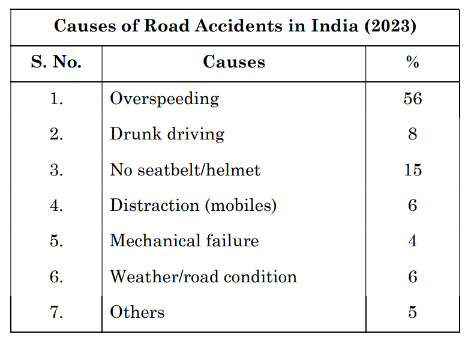
(1) What strategy does the author use in paragraph (1) to highlight the seriousness of road accidents ? (A) use of statistics and emotional appeal. (B) humour and satire (C) technical jargon and neutrality (D) personal anecdotes and optimism
The passage gives numbers like 4.8 lakh accidents and 1.72 lakh deaths to show the scale.
It also talks about lives lost and families affected to create emotional impact.
(2) What evidence from the passage suggests that stricter school zone measures were effective ? (A) the number of schools increased rapidly. (B) there was a 30% drop in minor accidents near schools. (C) teachers and parents opposed the new rules. (D) students stopped commuting by bicycle.
(3) What would the following be classified as ? Students launched a campaign called “Ride Right” promoting helmet use among two wheeler riders. Select the appropriate response : (A) primary purpose (B) secondary objective (C) method of analysis (D) research outcome
(4) Give two points to support the success of the No Helmet – No Selfie Challenge.
[2 Marks](5) Analyze why does the author emphasise that both technology and personal responsibility are important in promoting road safety.
(6) Which word from paragraph 4 best conveys the idea of ‘ensuring compliance through authoritative measures’ especially in the context of traffic systems ? (A) collection (B) enforcement (C) monitoring (D) automation
Reference: Paragraph 4 mentions 'showing improved rule enforcement' which means ensuring people comply with traffic laws.
(7) Complete the following with a suitable reason : Road safety is about personal responsibility because _________.
[1 Mark](8) Which of the following inferences is best supported by the data in the table ? (A) enforcement of helmet and seat belt rules would address the cause of road deaths. (B) speeding is the key issue, which requires technological and behavioural interventions. (C) mobile phone use while driving is the fastest growing cause of accidents. (D) drunk driving accounts for more deaths than ‘no helmet/seat belt’ and distractions combined.
Section B
Read the following extracts and answer the questions:
It would be an exotic moment
without rush, without engines.
we would all be together
in sudden strangeness
Fishermen in the cold sea
would not harm whales
and the man gathering salt
would look at his hurt hands.
(Keeping Quiet)
(1) What does the phrase ‘an exotic moment’ in the extract signify ? (A) surreal pause from mechanized human activity enabling reflection and unity (B) ceremonial halt wherein humans acknowledge traditional and ecological wisdom (C) spontaneous event where all human labour becomes obsolete (D) rare disruption of routine that highlights cultural diversity and isolation
(2) Complete the following sentence suitably : The words ‘we’ and ‘together’ signify _________.
(3) Select the option from those given in brackets to fill in the blank : The excerpt tells us that the poet _________ (condemns/glorifies) the moment ‘without rush, without engines’.
(4) Choose the correct option that BEST reflects the tone of the poet in the given extract : (A) despairing and cynical (B) aggressive and accusatory (C) meditative and hopeful (D) humorous and sarcastic
(5) Complete the sentence : The phrase ‘hurt hands’ is a symbol of _________.
(6) What message is the poet conveying through the given extract ?
[1 Mark]You have the money, but if you want to be mean
Why keep your money (this crossly) and go along
The hurt to the scenery, wouldn’t be my complaint
So much as the trusting sorrow of what is unsaid :
Here far from the city we make our roadside stand
And ask for some city money to feel in hand
To try if it will not make our being expand,
And give us the life of the moving – pictures’ promise
That the party in power is said to be keeping from us.
(A Roadside Stand)
(1) What does the speaker imply in the statement ‘The hurt to the scenery wouldn’t be my complaint’
[1 Mark]The speaker means that the damage caused to the natural beauty of the countryside is not his main concern.
Instead, he feels sad about the unspoken suffering and neglect of the poor people who run the roadside stand.
This shows his deeper worry for human hardship than for the environment.
(2) What emotion does the speaker reveal when he says, ‘if you want to be mean, why keep your money (this crossly) and go along’ ? (A) curiosity (B) bitterness (C) indifference (D) detachment
(3) Complete the following suitably : The word ‘expand’ in the line ‘to see if it will not make our being expand’ implies an aspiration to _________.
(4) Read the two statements and choose the correct option : Assertion (A) : The speaker critiques the governing party for withholding opportunities from the rural poor. Reason (R) : The extract praises the government for their promises of a life of the moving pictures’. (A) Both the Assertion (A) and Reason (R) are true, and Reason (R) is the correct explanation of the Assertion (A). (B) Both the Assertion (A) and Reason (R) are true, but Reason (R) is not the correct explanation of Assertion (A). (C) Assertion (A) is true, but the Reason (R) is false. (D) Assertion (A) is false, but the Reason (R) is true.
The speaker criticizes the ruling party for denying opportunities to the rural poor, as seen in the line 'That the party in power is said to be keeping from us'.
However, the extract does not praise the government but rather points out the unfulfilled promises, so the Reason (R) is false.
(5) Which of the following concerns is NOT explored in the extract ? (A) political manipulation of rural dreams (B) discrimination faced due to different religious policies. (C) transactional disconnection between the city and the village. (D) impact of unfulfilled expectations.
(6) State in one sentence : What advice your address to the politicians from this extract is most likely to include ?
This will help fulfill the hopes and promises that the government is said to be keeping from them.
Read the following extracts and answer the questions :
I cried aloud, shaking my head all the while until I felt the cold blades of the scissors against my neck, and heard them gnaw off one of my thick braids. Then I lost my spirit. Since the day I was taken from my mother, I had suffered extreme indignities. People had stared at me. I had been tossed about in the air like a wooden puppet. And now my long hair was shingled like a coward’s ! In my anguish, I moaned for my mother, but no one came to comfort me. Not a soul reasoned quietly with me, as my own mother used to do; for now I was only one of many little animals driven by a herder.
(Memories of Childhood)
(1) Complete the following suitably “Then I lost my spirit”, indicates that the speaker _________.
[1 Mark]"Then I lost my spirit" indicates that the speaker felt completely hopeless and broken after the painful experience of having her thick braid cut off and being separated from her mother. She felt despirited because of the harsh treatment and loneliness, as described in the passage where she was subjected to indignities and no one comforted her.
This shows her deep emotional pain and loss of courage.
(2) What does Zit Kala-Sa imply about the prejudice prevailing in society when she talks of having ‘suffered extreme indignities’ ?
[1 Mark](3) Why did Zit Kala-Sa yearn to be with her mother in her moment of anguish ?
[1 Mark]Zit Kala-Sa yearned to be with her mother in her moment of anguish because she felt extreme pain and loneliness after being taken away. She suffered indignities like being stared at and treated harshly, and missed her mother's comforting presence as no one else comforted her, making her feel helpless and abandoned, as described in the passage.
(4) The tone of the narrator in the extract can be best described as (A) bitter and strong willed (B) detached and impersonal (C) pained and despairing (D) grateful and reflective
The tone of the narrator in the extract is pained and despairing because the narrator feels sorrow and helplessness after being taken away from the mother and suffering indignities like having the hair cut. The sadness is clear when the narrator says "Then I lost my spirit" and moans for the mother in anguish.
Read the following extracts and answer the questions:
Derry : But I’m not…. I’m not afraid [pause] people are afraid of me.
Mr. Lamb : Why should that be ?
Derry : Everyone is. It doesn’t matter who they are, or what they say, or how they look. How they pretend. I know. I can see.
Mr. Lamb : See what ?
Derry : What they think ?
Mr. Lamb : What do they think, then ?
Derry : You think…. ‘Here’s a boy’. You look at me… and then you see my face and you think. That’s bad. That’s a terrible thing. ‘That’s the ugliest thing I ever saw.’ You think, ‘poor boy’. But I’m not. Not poor. Underneath, you are afraid. Anybody would be – I am. When I look in the mirror, and see it, I’m afraid of me.
Mr. Lamb : No, not the whole of you. Not of you.
Derry : Yes !
(On the Face of It)
(1) Complete the following suitably : According to Derry, the people put up a pretence when they see him because _________.
(2) Which emotion dominates Derry’s dialogue in this extract ? (A) superiority (B) shrewdness (C) vulnerability (D) indifference
(3) Complete the following suitably : When Mr. Lamb says, ‘No, not the whole of you. Not of you.’ He means _________. (A) Your face will get healed and your ideas about your appearance will change. (B) You are not just your face or your injury. That is not the sum total of who you are. (C) I am afraid of your face and your appearance. (D) You shouldn’t look into the mirror so that you don’t get the feeling of dejection.
(4) State in one sentence : What advice will you give to the people who pretend to look away when they see Derry’s face ?
Read the following extracts and answer the questions:
The make-up room had the look of a hair-cutting salon with lights at all angles around half a dozen large mirrors. They were all incandescent lights, so you can imagine the fiery misery of those subjected to make-up. The make-up department was first headed by a Bengali who became too big for the studio and left. He was succeeded by a Maharashtrian who was assisted by a Dharwar Kannadiga, an Andhra, a Madras Indian Christian, an Anglo Burmese and the usual local Tamils. All this shows that there was a great deal of National Integration long before A.I.R. and Doordarshan began broadcasting programmes on national integration. This gang of nationally integrated make-up men could turn any decent-looking person into a hideous crimson hued monster with the help of truckloads of pancake and a number of other locally made potions and lotions. Those were the days of mainly indoor shooting, and only five percent of the film was shot outdoors. I suppose the sets and studio lights needed girls and boys to be made to look ugly in order to look presentable in the movie. A strict hierarchy was maintained in the make-up department.
(Poets and Pancakes)
(1) Why did the make-up room have a look of a hair-cutting salon ?
[1 Mark]The make-up room looked like a hair-cutting salon because there were lights all around half a dozen large mirrors, similar to those in salons. This setup helped the make-up men work under bright incandescent lights to make actors and actresses look suitable for the indoor shoots, often making them look ugly to appear presentable on camera. It was a busy room with a strict hierarchy and people from different nationalities working together, showing national integration from the case passage.
(2) What does ‘fiery misery of those subjected to make-up’ suggest ? (A) emotional stress faced by the actors. (B) physical discomfort due to heat and lighting. (C) anger of the make-up artists due to irritation. (D) the discomfort caused by the cramped room.
The phrase 'fiery misery of those subjected to make-up' suggests the physical discomfort faced by actors due to the heat from the incandescent lights in the make-up room. The case passage mentions that the lights caused great heat making the actors feel uncomfortable.
(3) Complete the following suitably : The tone of the author in the phrase ‘hideous crimson hued monster’ is _________
The tone of the author in the phrase 'hideous crimson hued monster' is humorous and slightly exaggerated.
He uses this phrase to show how the talented make-up men could transform a normal person into a scary character using pancake and potions. This also adds a light, amusing touch to the description of the make-up process in the studio, as mentioned in the passage.
(4) What does ‘became too big for a studio and left’ imply about the Bengali make-up artist ?
[1 Mark]The phrase 'became too big for the studio and left' implies that the Bengali make-up artist gained a lot of confidence and probably fame, which made him move on from the studio to seek better opportunities. This shows he outgrew the studio and left to advance his career, as stated in the passage.
(5) Why was excessive make-up considered a cinematic necessity at Gemini Studios during that era ? (A) minimised the cost of set design and costumes. (B) was a mandated practice by the studio’s creative heads and lead actors. (C) aligned with the theatrical traditions the studio admired. (D) compensated for the lack of advanced lighting and camera technology.
Excessive make-up was necessary at Gemini Studios because films were mainly shot indoors with incandescent lights, which affected how actors appeared on camera. The make-up helped compensate for the lack of advanced lighting and camera technology to make actors look presentable on screen, as mentioned in the passage.
(6) Complete the sentence with a suitable reason : The author refers to the presence of people from different regions in the make-up department to _________.
The author refers to the presence of people from different regions in the make-up department to show that there was great national integration even before it was promoted through media like A.I.R. and Doordarshan. This diversity among the make-up men highlights unity among different cultures and regions in India at that time, as mentioned in the passage.
Read the following extracts and answer the questions:
‘Now I am going to tell you, Mr. Ironmaster, how things are’, he said. ‘The whole world is nothing but a big rattrap. All the good things that are offered to you are nothing but cheese rinds and bits of pork, set out to drag a poor fellow into trouble. And if the sheriff comes now and locks me up for this, then you, Mr. Ironmaster, must remember that a day will come when you yourself may want to get a big piece of pork, and then you will get caught in the trap.
The ironmaster began to laugh.
‘That was not so badly said, my good fellow. Perhaps we should let the sheriff alone on Christmas Eve.’ (The Rattrap)
(1) What does the speaker mean when he says ‘The whole world is nothing but a big rattrap’ ? (A) The world offers many chances for success and prosperity. (B) Temptations in life are traps that lead people into trouble. (C) Good deeds are always rewarded with cheese rinds. (D) Justice and fairness are not guaranteed for everyone.
The speaker means that the whole world is like a big rattrap where good things are just temptations (cheese rinds and bits of pork) set to trap people and lead them into trouble. This shows that the world offers pleasures as bait which can trap a person if they get tempted, as explained in the passage.
(2) What does the following phrase from the extract showcase : ‘Cheese rinds’. (A) temptation (B) affirmation (C) gluttony (D) deprivation
(3) What does the following line from the extract showcase about the ironmaster’s nature ? ‘Perhaps, we should let the sheriff alone on Christmas Eve.’ (A) materialistic (B) understanding (C) conniving (D) enterprising
(4) Select the correct option from those given in brackets to fill in the blank : By calling himself a ‘poor fellow’, the speaker emphasises his _________. (vulnerability/credibility)
(5) Complete the following with a suitable reason : In the extract, it is implied that the speaker would be locked up because _____.
The speaker implies that he would be locked up because accepting the good things offered is like falling into a trap, as these are just temptations (cheese rinds and bits of pork) meant to drag a poor fellow into trouble, which could lead to his arrest as mentioned in the extract.
This shows that the world has traps set for people through tempting offers that eventually cause problems or punishment.
(6) What does the speaker imply through his warning to the ironmaster ?
[1 Mark]The speaker implies that the world is like a big rattrap where attractive things are traps that lead to trouble. He warns the ironmaster that if he punishes him now, he might later get trapped himself when tempted by similar offers, showing how everyone is vulnerable to such traps.
Section C
The poem explores the relationship between a mother and daughter. Comment.
(My Mother at sixty six)
The poem "My Mother at Sixty-six" by Kamala Das beautifully explores the deep and sensitive relationship between a mother and her child, highlighting themes of love, aging, and fear of loss.
(a) The poem shows the poet's loving concern for her mother, who is growing old and frail. Using vivid images like her mother’s "ashen" face and "young eyes" full of pride, the poet expresses both admiration and sadness.
(b) The relationship is portrayed as tender and intimate, reflecting the universal bond between a mother and daughter. The poet’s awareness of her mother’s aging and her own helplessness creates an emotional atmosphere of vulnerability.
(c) The poem captures a moment of journey and change — the mother is on her way to the airport, symbolizing distance and separation, which metaphorically extends to the inevitable loss that comes with time.
Overall, the poem sensitively and realistically shows the complexities of a mother-daughter relationship shaped by love, concern, and the pain caused by aging and mortality.
What does Umberto Eco mean when he says he is ‘a professor who writes novels on Sundays’ ? (The Interview)
The British landlords agreed to refund 25% of the money to the sharecroppers in the Champaran dispute. What is the significance of this event ? (Indigo)
How did Douglas’ experience at the beach in California affect him ?
(Deep Water)
The constraints of Aunt Jennifer’s married life leave her terrorised and emotionally scarred. Elaborate. (Aunt Jennifer’s Tigers)
“Will they make them sing in German, even the pigeons ?” What does Franz’s remark suggest about the imposition of German in school in Aloace ?
(Last Lesson)
What does Bama’s decision to excel in academics reveal about her character ? (Memories of Childhood – We Too are Human Beings)
Bama's decision to excel in academics reveals her strong determination and courage to overcome social discrimination. Despite facing the challenges of untouchability and caste-based discrimination, she did not give up on her education. This shows her resilience and belief in the power of knowledge to change her life and society. It also reflects her hope and ambition to rise above the limitations imposed on her by society and fight for equality and dignity.
How did the newspaper ‘The World’ contribute to Charley’s belief in the existence of the third level ? (The Third Level)
Evaluate the role of the court astrologer in shaping the trajectory of the Tiger King’s life. (The Tiger King)
Section D
Your school is organising a career counselling session for students of classes XI and XII to help them make informed decisions about their future career choices. As the Head Girl / Head Boy of M.L.C. School, draft a notice informing them about the session. Include all necessary details. You are Riya/Rohan. Put the notice in a box.
NOTICE
Date: 20/06/2024
All students of classes XI and XII are hereby informed that a Career Counselling Session will be held on 25/06/2024 at 10:00 a.m. in the School Auditorium. The session aims to help students make informed decisions about their future career choices with guidance from expert counsellors.
Students are requested to be present on time and actively participate.
Rohan
Head Boy
M.L.C. School
You are Kavya/Karan Chief Editor of ‘Parakh’ the school magazine. Draft a notice inviting contributions in the form of articles, stories, poems, artwork etc. for the special annual edition. All contributions are to be submitted to the Chief Editor. Include necessary details. Put your notice in a box.
Parakh, the School Magazine
Date: 10 June 2024
All students are invited to contribute to the special annual edition of ‘Parakh’. You can send your articles, stories, poems, artwork and other creative writings. Please submit your contributions to the Chief Editor, Kavya/Karan, by 25 June 2024.
Make sure your work is original and neatly written or typed. This is a great opportunity to showcase your talent and be a part of our school magazine.
For any queries, contact the Chief Editor at the school office.
Kavya/Karan
Chief Editor, ‘Parakh’
Section E
Draft an invitation to invite the M.L.A. of your Constituency, to be the Chief Guest at a felicitation function to honour eminent residents who have contributed to the upliftment of the colony. Mention one compelling highlight of the programme. You are Satupa/Satish,
President of the Surya Vikas, RWA.
On behalf of Surya Vikas Residents Welfare Association, I, Satish, President of the Association, cordially invite you to be the Chief Guest at our felicitation function to honour eminent residents who have significantly contributed to the upliftment of our colony. The function is scheduled to be held on 15th August 2024 at 5 PM in the Community Hall.
A compelling highlight of the programme will be the unveiling of a commemorative plaque dedicated to the selfless efforts of these residents, symbolizing unity and progress in our community.
Your gracious presence will encourage and inspire all residents to continue their valuable contributions.
Looking forward to your kind acceptance.
Thanking you,
Satish
President
Surya Vikas RWA
You are Dr. Vora, a certified art therapist from Manipur. You have been invited by Green Valley Public School, Jammu to conduct a seminar on ‘Art Therapy, the Way Forward’ for the students. Draft a reply accepting the invitation.
Jammu
Date: 15 June 2024
Subject: Acceptance of Invitation to Conduct Seminar on "Art Therapy, the Way Forward"
Respected Principal,
I am Dr. Vora, a certified art therapist from Manipur. I am writing to express my sincere gratitude for inviting me to conduct a seminar on "Art Therapy, the Way Forward" for the students of your esteemed school. I am pleased to accept your kind invitation and look forward to sharing my knowledge and experience with the students. Kindly inform me about the date, time, and other formalities for the seminar.
Thank you once again for this opportunity.
Yours sincerely,
Dr. Vora
Section F
Sophie in ‘Going Places’ and Mukesh in ‘Lost Spring’ aspire for a better life yet external forces shape their realities and opportunities.
Discuss.
(b) Sophie dreams of driving a car and having a glamorous life, which indicates her desire for freedom and self-expression. However, external forces like her father’s authoritarian nature, societal expectations, and peer influence shape her opportunities and limit her choices. Jansie, her friend, discourages her unrealistic dreams, reflecting the reality imposed by their environment.
(c) Mukesh, on the other hand, comes from a very poor socio-economic background, belonging to a family of ragpickers and child labourers as depicted in ‘Lost Spring.’ His dreams of education and a better future are crushed by poverty and exploitation. The external factors like lack of education, economic hardship, and social inequality dictate his harsh reality.
(d) Both Sophie and Mukesh aspire for better lives, but their realities are shaped by external socio-economic and familial forces. Sophie’s limitations come from social expectations and family dominance, while Mukesh faces the brutal challenges of poverty and child labour. Their stories highlight how aspirations are often restrained by external conditions beyond individual control, reflecting the influence of society and economic status on one’s opportunities and future.
How is the transient nature of beauty and life portrayed in the poems ‘My Mother at Sixty Six’ and ‘A Thing of Beauty’ ?
In the poem ‘A Thing of Beauty’ by John Keats, the transient nature of beauty is described through the idea that beautiful things provide joy and happiness even when they last for a short time. The poem says that beauty, like a lovely thing or a pleasant sight, never fades completely because it leaves a lasting impression on the mind and soul. Though beauty may disappear, its positive effect remains, symbolizing that though life and beauty are temporary, their impact is eternal.
Comparison: Both poems emphasize that beauty and life are temporary and change with time. ‘My Mother at Sixty Six’ highlights the emotional pain of seeing a loved one age and lose their youthful beauty, while ‘A Thing of Beauty’ celebrates the enduring nature of beauty through memories and feelings. Thus, both poems portray the transient nature of life and beauty by showing their temporariness and their lasting emotional or spiritual effects.
Examine how the presence of school students on the expedition contribute to the message of environmental responsibility and hope.
(Journey to the End of the Earth)
How does Pearl S. Buck explore the theme of humanitarianism versus patriotism in the lesson ‘The Enemy’ ? Support your answer with evidence from the text.
Section G
You are Kaneshta/Shirish, an avid yoga follower. Write a letter to the editor expressing your views and urging people especially students and young adults to incorporate yoga into their daily lives. You may use some of the given cues along with your own ideas.
● need to follow a disciplined exercise routine
● reduces stress, improves physical and mental health
● increases focus
● schools and educational establishments must encourage practice of yoga
I am Kaneshta/Shirish, a regular yoga practitioner and I would like to express my thoughts on the importance of yoga in daily life. Yoga is not just an exercise but a disciplined routine that helps reduce stress and improves both physical and mental health. It increases concentration and focus which is very important for students and young adults to achieve success in their studies and personal life. I urge all schools and educational institutions to promote yoga practice as part of their daily curriculum to help students stay healthy and balanced. Adopting yoga in our lives can lead to a peaceful mind and a strong body. Let us all embrace yoga for a healthier and happier life.
Thank you.
Yours sincerely,
Kaneshta/Shirish
Section H
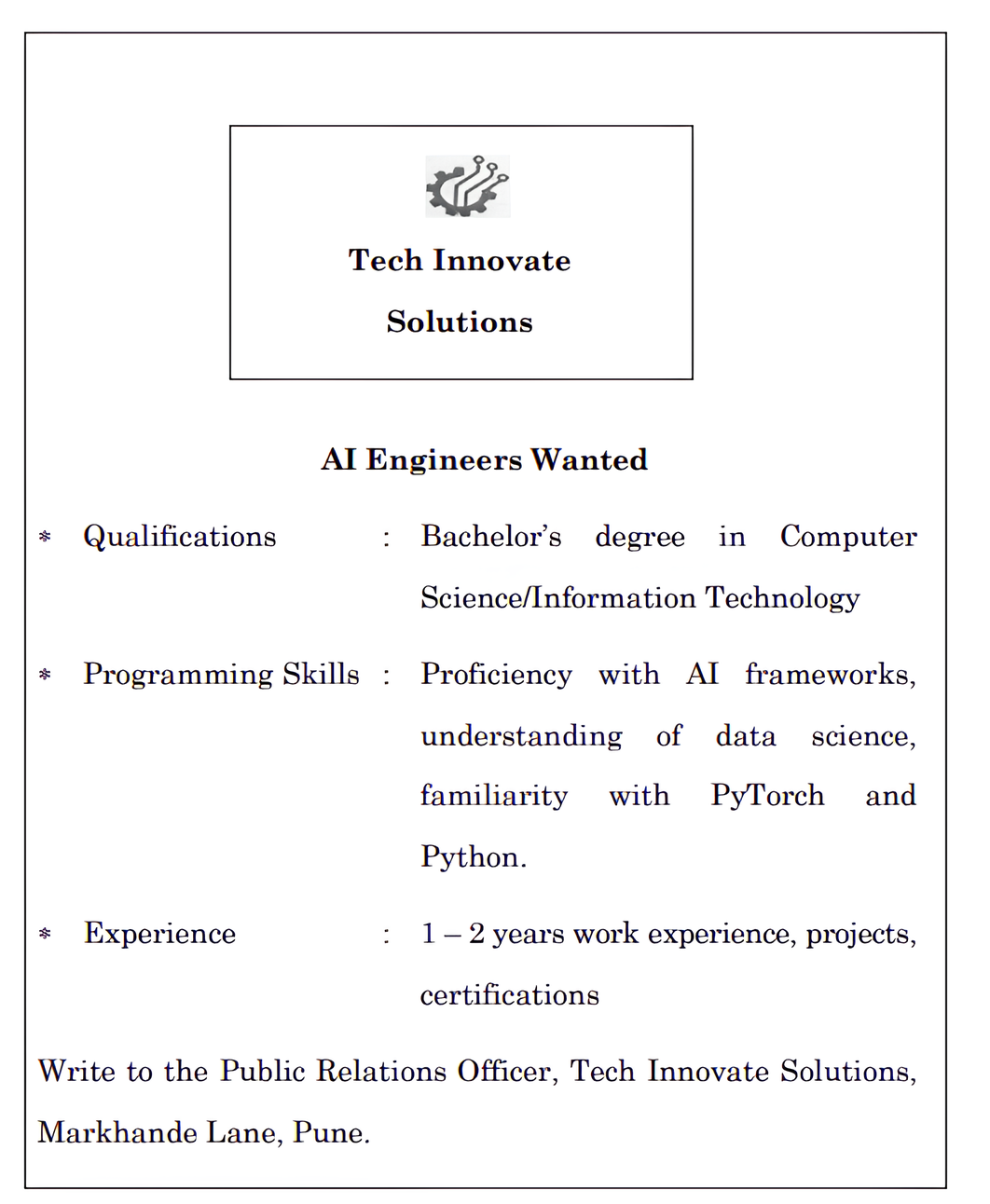
You are Roshni/Rohan, a final year student pursuing a degree in Computer Science. You have read the following advertisement in ‘The National Times’. You find yourself suitable for the job and wish to apply for the post. Write this job application along with your bio-data.
Flat No. 402, Green Meadows Apartments,
Kalyani Nagar,
Pune - 411006
22nd June 2026
The Public Relations Officer
Tech Innovate Solutions
Markhande Lane,
Pune
Subject: Application for the post of AI Engineer
Sir/Madam,
In response to your advertisement in 'The National Times' dated 18th June 2026 for the post of AI Engineer, I wish to offer my candidacy for the same.
I am a final-year student pursuing a Bachelor’s degree in Computer Science. I have a strong foundation in Python programming, data science concepts, and modern AI frameworks like PyTorch. Additionally, I have completed relevant academic projects and certifications during my course that align perfectly with your requirements. I am highly motivated, eager to learn, and ready to contribute effectively to your esteemed organization.
I am enclosing my detailed bio-data herewith for your kind perusal. If given an opportunity, I assure you that I will work with utmost dedication and sincerity.
Thanking you.
Yours faithfully,
Rohan / Roshni
Enclosure: Bio-data
Bio-Data
Name: Rohan / Roshni
Father's Name: Mr. K. S. Sharma
Date of Birth: 15th August 2004
Gender: Male / Female
Marital Status: Unmarried
Permanent Address: House No. 123, Sector 4, Pune
Educational Qualifications:
Pursuing B.Tech in Computer Science (Final Year), ABC University (Expected 8.5 CGPA)
Class XII (CBSE Board), XYZ Public School (92% marks)
Class X (CBSE Board), XYZ Public School (95% marks)
Technical Skills:
Programming Languages: Python, C++
AI Frameworks & Libraries: PyTorch, NumPy, Pandas, Scikit-Learn
Areas of Interest: Machine Learning, Data Science, Neural Networks
Experience / Projects:
Completed a 6-month internship as an AI Developer trainee at TechTinker Labs.
Developed a "Predictive Analytics Model using PyTorch" as a major college project.
Certifications: Certified Data Scientist (Python) from Coursera / DeepLearning.AI
Languages Known: English, Hindi, and Marathi
Section I
You are Aanya/Ankit. You are deeply disturbed by how moments of silence and relaxed living are vanishing from today’s fast-paced, lives. You decide to write an article for the newspaper on ‘The Vanishing Art of Slowing Down’.
You may use the following cues along with your own ideas:
● impact of hustle culture and technology on mental well-being.
● losing connection with nature, people and self.
● importance of mindful celebrations and slow/relaxed living.
● role of schools, communities, and media.
● need for digital boundaries, reflection, and simple joys.
In today's fast-paced world, hustle culture and constant technology use have taken a toll on our mental well-being. People are constantly busy, leading to stress and anxiety. We are losing our connection with nature, with other people, and even with our own thoughts and feelings. Mindful celebrations and slow living help us to appreciate the moment and find peace.
Schools, communities, and media have an important role to play in promoting slower, healthier lifestyles. They can educate us about the benefits of relaxation and encourage moments of silence and reflection.
It is essential to set digital boundaries, take time for reflection, and enjoy simple joys like spending time with family, walking in nature, or just breathing deeply. Slowing down is not just an art, but a need for better mental health and a happier life. We must learn to embrace it for a balanced future.
Section J
Your school organised a ‘Tastes of India’ Week to educate students on the diversity of Indian cuisine. Write a comprehensive report detailing the activities conducted during the week. Describe the events, participation details, chief guest, and the overall impact of the programme on the school. You are Arti/Aryan a student of Std. XII and the Secretary of the School Magazine Editorial Board. You may organise your report on the basis of
What – When – Where – Who – Why – How
What: Our school organised a special event called ‘Tastes of India’ Week to introduce students to the rich diversity of Indian cuisine. Various activities such as cooking demonstrations, food stalls, recipe sharing sessions, and cultural performances were held.
When: The event took place from 10th to 14th March 2024.
Where: All the activities were conducted on the school premises, including the auditorium, classrooms, and the school courtyard.
Who: The entire student body, teachers, and staff participated actively. The chief guest for the closing ceremony was Chef Sanjay Singh, a renowned expert in Indian cuisine.
Why: The main reason for organising this week was to educate students about the variety of food across different regions of India and to promote cultural unity through culinary arts.
How: The programme was organized by the school’s cultural committee with the help of the Home Science department. Students from different classes prepared traditional dishes from their native states and presented information about the ingredients and cooking methods. There was also a photo exhibition showcasing famous food delicacies from various Indian states.
Overall, the ‘Tastes of India’ Week was a grand success. It helped students appreciate the diversity of Indian cuisine and encouraged them to learn about different cultures. The event fostered a spirit of cooperation and cultural pride among the students and staff.
Other Years — English