Class 11 PCM . Chemistry . Chemistry Part I . Thermodynamics
Chapter 5: Thermodynamics
Ch 5
Chemistry
Class 11 PCM
Thermodynamics Terms
Thermodynamics and Energy Changes
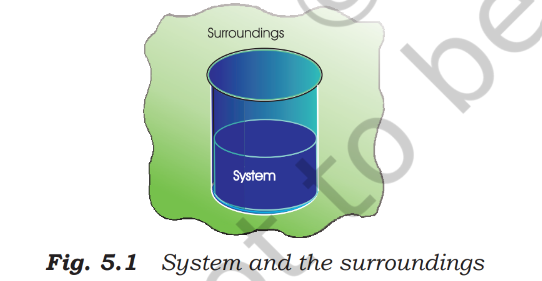
System and Surroundings
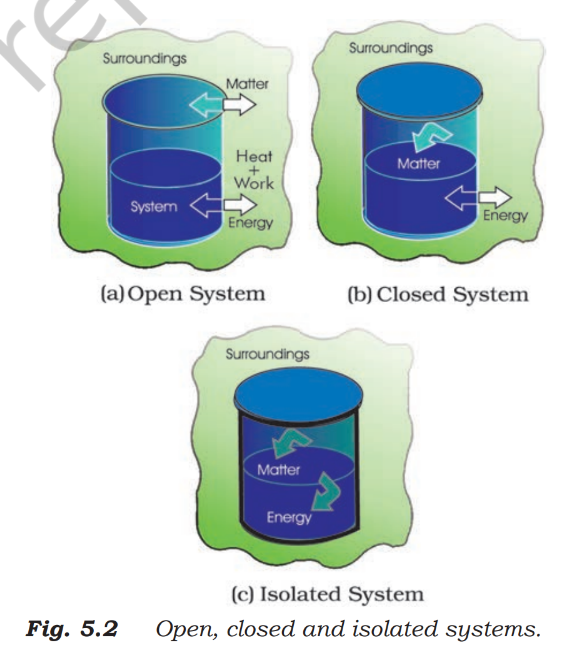
Types of Thermodynamic Systems
State of a System
Do not confuse a state function with the path taken: its value depends on the system’s state, not how that state was reached.
Quick recap
- Thermodynamics studies energy transformations in macroscopic systems.
- It focuses on initial and final equilibrium states, not mechanisms or rates.
- The universe consists of the system and its surroundings, separated by a boundary.
- Open systems exchange matter and energy; closed systems exchange energy only; isolated systems exchange neither.
- A system’s state is described by macroscopic properties such as \(p\), \(V\), \(T\), \(n\) and composition.
- State-function values depend on the state, not the path taken.
The Internal Energy as a State Function
Internal Energy and State Functions
Change in Internal Energy by Work
Examples of State Functions
- Temperature: A change from \(25^{\circ}\mathrm{C}\) to \(35^{\circ}\mathrm{C}\) is \(+10^{\circ}\mathrm{C}\), regardless of the route taken.
- Volume: The change in a pond’s water volume depends on its initial and final volumes, not whether water came from rain, a tubewell or both.
Change in Internal Energy by Heat
The First Law of Thermodynamics
| Situation | Internal-energy change | Wall or system |
|---|---|---|
| No heat absorbed; work \(w\) done on the system | \(\Delta U=w\) | Adiabatic wall |
| No work; heat amount \(q\) taken out of the system | \(\Delta U=-q\) | Thermally conducting wall |
| Work amount \(w\) done by the system; heat amount \(q\) supplied to it | \(\Delta U=q-w\) | Closed system |
Do not treat \(q\) or \(w\) as state functions: they depend on the path. Only their sum, \(\Delta U\), is fixed by the initial and final states.
Measuring Internal Energy
- Absolute value: Unlike volume, the absolute internal energy of a system cannot be specified or measured directly.
- Measurable quantity: Changes in internal energy, \(\Delta U\), can be measured.
Quick recap
- Internal energy, \(U\), is the total energy of a system and is a state function.
- For an adiabatic change, \(q=0\) and \(\Delta U=w_{\text{ad}}\).
- Heat is energy transferred because of a temperature difference; at constant volume with no work, \(\Delta U=q\).
- The first law is \(\Delta U=q+w\); heat entering and work done on the system are positive.
- In an isolated system, \(q=w=0\), so its energy remains constant.
- Pressure, volume and temperature are state functions; only changes in internal energy—not its absolute value—are measurable.
Work
Pressure–Volume Work
Pressure–volume work — Mechanical work associated with a system’s change in volume against an external pressure.
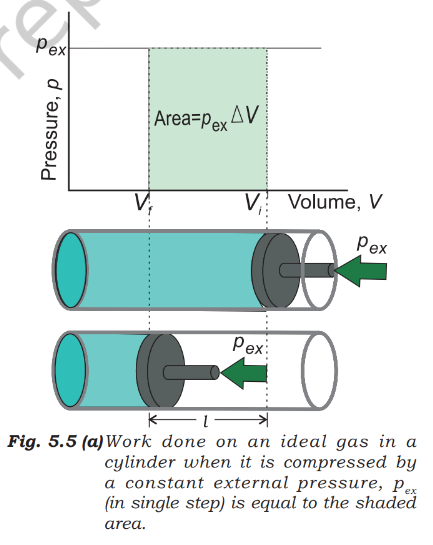
Work at Constant External Pressure
- Sign convention: \(w\) is work done on the system; compression gives positive \(w\), while expansion gives negative \(w\).
- Volume change: For a piston with cross-sectional area \(A\) moving distance \(l\), the volume change is \(\Delta V=V_f-V_i\).
- Force: External pressure exerts force \(p_{\mathrm{ex}}A\) on the piston, giving work on the gas of \(w=-p_{\mathrm{ex}}\Delta V\).
Use when external pressure remains constant during the volume change.
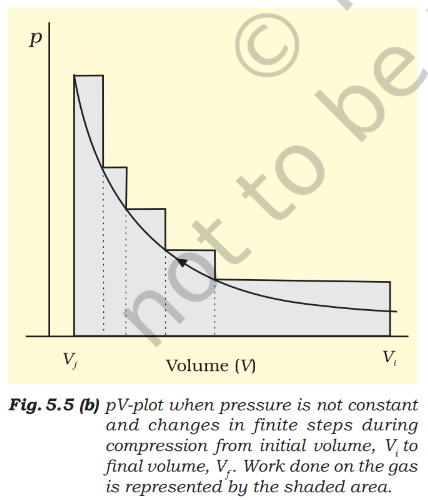
Changing External Pressure
- Finite steps: Add the work for each volume change: \(w=-\sum p_{\mathrm{ex}}\Delta V\).
- Continuous change: Work is the signed area under the external-pressure versus volume curve.
For a continuously changing external pressure, integrate over the volume change.
Reversible and Irreversible Processes
Reversible process — A process that can be reversed at any point by an infinitesimal change in conditions.
- Near-equilibrium: A reversible process proceeds infinitely slowly through equilibrium states; the system and surroundings remain nearly in equilibrium.
- Pressure difference: In reversible compression, \(p_{\mathrm{ex}}\) exceeds internal pressure infinitesimally; in expansion, it is infinitesimally lower.
- Irreversible process: A process that does not satisfy the reversible condition.
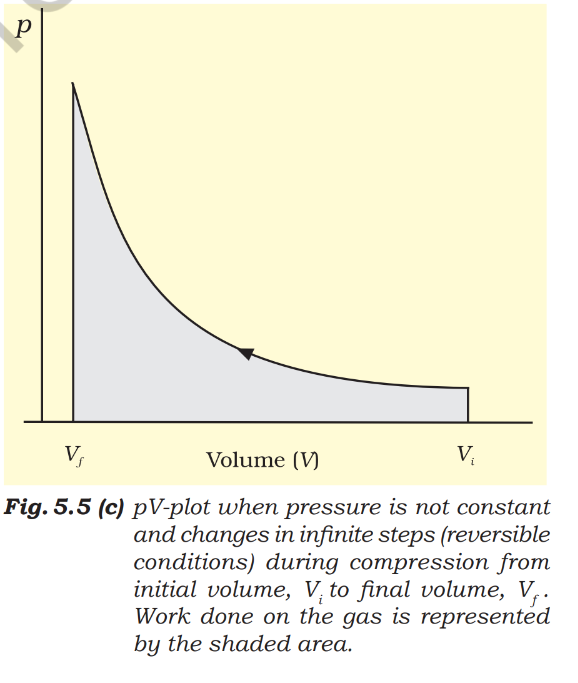
Because external and internal pressures differ only infinitesimally, use the system pressure in the work integral.
Isothermal Work for an Ideal Gas
- Ideal-gas equation: \(pV=nRT\), so \(p=nRT/V\).
- Isothermal condition: Temperature is constant, so \(nRT\) can be taken outside the reversible-work integral.
For \(n\) moles of an ideal gas at constant temperature; \(\log\) denotes base \(10\).
Do not confuse work done on the gas with work done by it: during expansion, \(w\) is negative under the chemistry sign convention, and work done by the gas is \(-w\).
Free Expansion and the First Law
Free expansion — Expansion of a gas into a vacuum, where external pressure is zero.
Key Energy Relations
- Free expansion: Since \(p_{\mathrm{ex}}=0\), \(w=0\). For an ideal gas, Joule’s experimental result gives \(q=0\), so \(\Delta U=0\).
- First law: Internal-energy change equals heat supplied plus work done on the system: \(\Delta U=q+w\).
- Constant volume: When \(\Delta V=0\), pressure–volume work is zero and \(\Delta U=q_v\); \(q_v\) is heat supplied at constant volume.
- Adiabatic change: No heat is exchanged, so \(q=0\) and \(\Delta U=w_{\mathrm{ad}}\).
| Process | Work on gas | Heat relation |
|---|---|---|
| Irreversible, against constant \(p_{\mathrm{ex}}\) | \(w=-p_{\mathrm{ex}}(V_f-V_i)\) | \(q=-w=p_{\mathrm{ex}}(V_f-V_i)\) |
| Reversible | \(w=-nRT\ln(V_f/V_i)\) | \(q=-w=nRT\ln(V_f/V_i)\) |
| Into vacuum | \(w=0\) | For an ideal gas, \(q=0\) and \(\Delta U=0\) |
An ideal gas expands from \(2\,\mathrm{L}\) to \(10\,\mathrm{L}\) into a vacuum. How much work is done, and how much heat is exchanged?
An ideal gas expands isothermally from \(2\,\mathrm{L}\) to \(10\,\mathrm{L}\) against a constant external pressure of \(1\,\mathrm{atm}\). Find \(w\) and \(q\).
For reversible isothermal expansion of \(1\) mol from \(2\,\mathrm{L}\) to \(10\,\mathrm{L}\) at \(298\,\mathrm{K}\), find the work and heat using the values in the text.
Quick recap
- Constant pressure: \(w=-p_{\mathrm{ex}}\Delta V\); compression is positive and expansion is negative.
- Changing pressure: \(w=-\int_{V_i}^{V_f}p_{\mathrm{ex}}\,dV\); for reversible work, use internal pressure.
- Reversible isothermal ideal gas: \(w=-nRT\ln(V_f/V_i)\) and \(q=-w\).
- Free expansion: Into vacuum, \(p_{\mathrm{ex}}=0\) and \(w=0\); for an ideal gas, \(q=0\) and \(\Delta U=0\).
- Energy relations: \(\Delta U=q+w\); at constant volume, \(\Delta U=q_v\); adiabatically, \(\Delta U=w_{\mathrm{ad}}\).
Enthalpy, H
Enthalpy as a State Function
Enthalpy, H — A state function defined as internal energy plus the pressure–volume product: \(H = U + pV\).
Enthalpy and Heat at Constant Pressure
- Why useful: Most chemical reactions take place at constant atmospheric pressure, where heat exchange is described by enthalpy change.
- Constant-pressure relation: From \(\Delta U = q_p - p\Delta V\), rearrangement gives \(q_p = \Delta U + p\Delta V = \Delta H\).
- State function: \(H\) depends on \(U\), \(p\) and \(V\), which are state functions; therefore, \(\Delta H\) depends only on the initial and final states.
- Sign: Exothermic processes release heat and have \(\Delta H < 0\); endothermic processes absorb heat and have \(\Delta H > 0\).
For a finite change at constant pressure.
Special Cases and Gas Reactions
- Constant volume: The lecture gives \(\Delta H = \Delta U = q_v\) when \(\Delta V = 0\).
- Solids and liquids: Usually, \(\Delta H\) and \(\Delta U\) differ little because their volume changes are small.
- Gas reactions: The difference may be significant because the volume change can be large.
- Gas-mole change: \(\Delta n_g\) is moles of gaseous products minus moles of gaseous reactants.
For gaseous reactants and products at constant temperature and pressure, use the ideal gas law.
Calculating Internal Energy for Vaporisation
- Gas-mole change: For vaporisation of \(1\) mol of water, \(\Delta n_g = 1\).
- Given: \(\Delta H = 41.00\ \mathrm{kJ\ mol^{-1}}\), \(T = 373\ \mathrm{K}\) and \(R = 8.3\ \mathrm{J\ mol^{-1}\ K^{-1}}\).
- Calculation: \(\Delta U = \Delta H - \Delta n_gRT = 41.00 - 3.096 = 37.904\ \mathrm{kJ\ mol^{-1}}\).
Extensive and Intensive Properties
| Type | Meaning | Examples |
|---|---|---|
| Extensive | Depends on the amount or size of matter. | Mass, volume, internal energy, enthalpy, heat capacity |
| Intensive | Does not depend on the amount or size of matter. | Temperature, density, pressure; molar properties such as \(V_m\) and \(C_m\) |
Molar property — The value of an extensive property per mole: \(X_m = X/n\); it is independent of the amount of substance and is therefore intensive.
Examples
- Molar properties: Molar volume, \(V_m\), and molar heat capacity, \(C_m\), are intensive.
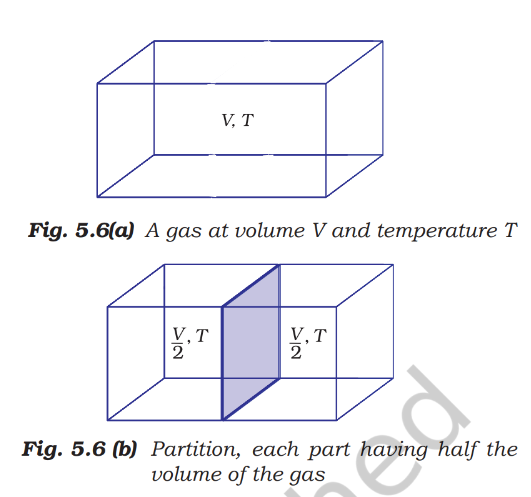
- Partition example: Splitting a gas into equal parts halves each part's volume to \(V/2\), while the temperature remains \(T\).
Heat Capacity
Heat capacity, C — The heat required to raise the temperature of a system by one degree.
Heat and Temperature Change
- Relation: For a given system, heat supplied is proportional to its temperature change.
- Large heat capacity: A given heat input causes a smaller temperature rise; water has a large heat capacity.
- Molar heat capacity, \(C_m\): Heat needed to raise the temperature of one mole by one degree Celsius or kelvin; \(C_m = C/n\).
- Specific heat capacity, \(c\): Heat needed to raise one unit mass by one degree Celsius or kelvin.
Use the sample's specific heat capacity, mass and temperature change.
Relationship Between \(C_p\) and \(C_V\) for an Ideal Gas
Heat Capacities at Fixed Conditions
- Constant volume: \(q_v = C_V\Delta T = \Delta U\).
- Constant pressure: \(q_p = C_p\Delta T = \Delta H\).
- One mole of ideal gas: Since \(pV = RT\), \(\Delta H = \Delta U + R\Delta T\).
For one mole of an ideal gas.
Measuring \(\Delta U\) and \(\Delta H\): Calorimetry
Calorimetry — An experimental technique that measures energy changes by tracking temperature changes in a calorimeter.
Calorimetry Measurements
- Principle: Known heat capacities and measured temperature changes allow the heat transferred in a process to be calculated.
- Constant volume: Measure \(q_v = \Delta U\), commonly using a bomb calorimeter.
- Constant pressure: Measure \(q_p = \Delta H\); this heat is also called the heat of reaction or enthalpy of reaction, \(\Delta_r H\).
- Sign: Exothermic reactions have negative \(q_p\) and \(\Delta_r H\); endothermic reactions have positive values.
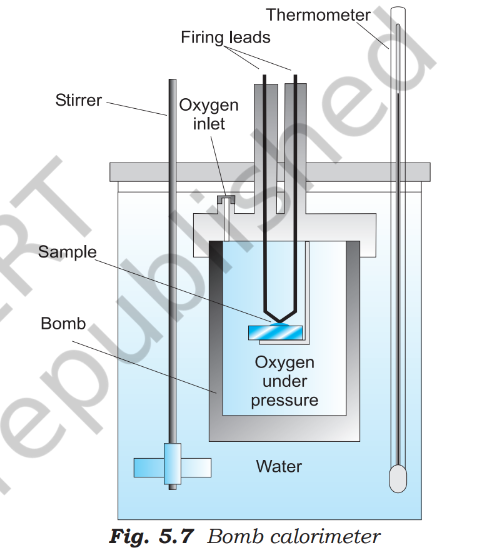
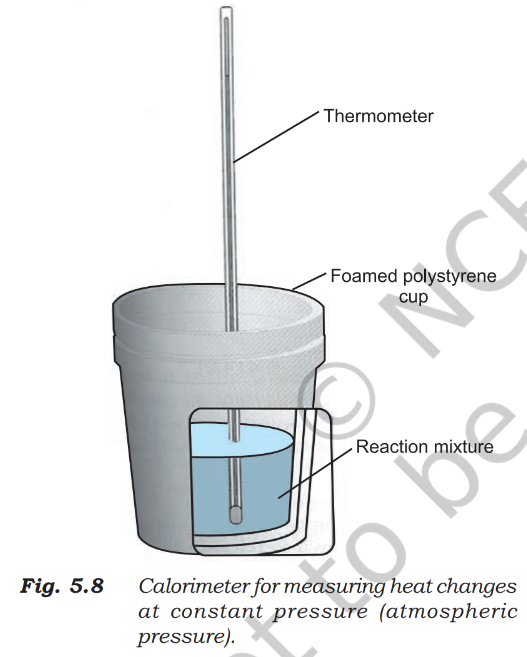
Bomb Calorimeter Calculation
- Given: \(1\ \mathrm{g}\) graphite burns; temperature rises from \(298\ \mathrm{K}\) to \(299\ \mathrm{K}\), and \(C_{\mathrm{cal}} = 20.7\ \mathrm{kJ\ K^{-1}}\).
- Calorimeter heat gained: \(q_{\mathrm{cal}} = C_{\mathrm{cal}}\Delta T = 20.7\ \mathrm{kJ}\).
- Reaction heat: Equal magnitude, opposite sign: \(\Delta U = -20.7\ \mathrm{kJ\ g^{-1}} = -2.48 \times 10^2\ \mathrm{kJ\ mol^{-1}}\).
- Enthalpy: Since \(\Delta n_g = 0\), \(\Delta H = \Delta U = -2.48 \times 10^2\ \mathrm{kJ\ mol^{-1}}\).
How are \(\Delta H\) and \(\Delta U\) related for a gaseous reaction?
What is the relation between \(C_p\) and \(C_V\) for one mole of an ideal gas?
Quick recap
- Enthalpy is defined as \(H = U + pV\); at constant pressure, \(q_p = \Delta H\).
- At constant pressure, \(\Delta H = \Delta U + p\Delta V\); for gases, \(\Delta H = \Delta U + \Delta n_gRT\).
- Extensive properties depend on the amount of matter; intensive properties do not, and molar properties are intensive.
- Heat capacity relates heat to temperature change: \(q = C\Delta T = mc\Delta T\).
- For one mole of an ideal gas, \(C_p - C_V = R\).
- Calorimetry uses temperature changes to determine heat; bomb calorimeters measure at constant volume.
Enthalpy Change, ∆rh Of A Reaction – Reaction Enthalpy
Reaction Enthalpy
Reaction enthalpy — The enthalpy change accompanying a chemical reaction is called its reaction enthalpy, denoted by \(\Delta_r H\).
Use the balanced equation’s stoichiometric coefficients to weight the enthalpies of products and reactants.
Meaning and use
- Coefficients: \(a_i\) and \(b_i\) are the stoichiometric coefficients of products and reactants in the balanced equation.
- Molar enthalpy: \(H_m\) is the enthalpy per mole of a substance; include each substance’s physical state.
- Applications: Reaction enthalpy helps estimate heating or cooling needs in industrial processes and calculate the temperature dependence of equilibrium constants.
Each \(H_m\) is the molar enthalpy of the indicated substance in the stated physical state.
Standard Enthalpy of Reaction
Standard enthalpy of reaction — The enthalpy change when all reactants and products are in their standard states is the standard reaction enthalpy, written \(\Delta_r H^\circ\).
Standard state
- Definition: At a specified temperature, a substance’s standard state is its pure form at a pressure of \(1\ \text{bar}\).
- Temperature: Standard-state data are commonly reported at \(298\ \text{K}\).
- Examples: At \(298\ \text{K}\), pure liquid ethanol at \(1\ \text{bar}\) is its standard state; at \(500\ \text{K}\), pure solid iron at \(1\ \text{bar}\) is its standard state.
Enthalpy Changes during Phase Transformations
| Change | Definition per mole | Symbol | Sign / example |
|---|---|---|---|
| Solid → liquid (fusion) | Enthalpy change for melting one mole of a solid at constant temperature and standard pressure | \(\Delta_{\mathrm{fus}}H^\circ\) | Positive; water: \(6.00\ \text{kJ mol}^{-1}\) (about \(6.01\ \text{kJ mol}^{-1}\) in the data table) |
| Liquid → gas (vaporisation) | Heat required to vaporise one mole of liquid at constant temperature and standard pressure | \(\Delta_{\mathrm{vap}}H^\circ\) | Positive; water at its boiling point: \(40.79\ \text{kJ mol}^{-1}\) |
| Solid → vapour (sublimation) | Enthalpy change when one mole of solid sublimes at constant temperature and standard pressure | \(\Delta_{\mathrm{sub}}H^\circ\) | Positive; dry ice at \(195\ \text{K}\): \(25.2\ \text{kJ mol}^{-1}\); naphthalene: \(73.0\ \text{kJ mol}^{-1}\) |
Phase-change facts
- Fusion: Ice melts at constant pressure at about \(273\ \text{K}\) without a temperature change; freezing is the reverse and releases the same amount of heat.
- Direction: Reversing a phase change reverses the sign of its enthalpy change.
- Intermolecular forces: Stronger attractions generally require more heat to overcome during vaporisation; water’s hydrogen bonding makes its vaporisation enthalpy greater than acetone’s, whose molecules mainly have weaker dipole–dipole interactions.
| Substance | Melting point, \(T_f\) (K) | \(\Delta_{\mathrm{fus}}H^\circ\) (\(\text{kJ mol}^{-1}\)) | Boiling point, \(T_b\) (K) | \(\Delta_{\mathrm{vap}}H^\circ\) (\(\text{kJ mol}^{-1}\)) |
|---|---|---|---|---|
| \(\ce{NH3}\) | 195.40 | 5.65 | 239.73 | 23.35 |
| \(\ce{CH3COCH3}\) (acetone) | 177.8 | 5.72 | 329.4 | 29.1 |
| \(\ce{H2O}\) | 273.15 | 6.01 | 373.15 | 40.79 |
| \(\ce{NaCl}\) | 1081.0 | 28.8 | 1665.0 | 170.0 |
For ideal-gas changes, \(\Delta n_g\) is gaseous product moles minus gaseous reactant moles.
Example: evaporation of 18 g water at 298 K
- Amount and heat: \(18\ \text{g}\) water is \(1\ \text{mol}\). With \(\Delta_{\mathrm{vap}}H^\circ=44.01\ \text{kJ mol}^{-1}\), the heat required is \(n\Delta H=44.01\ \text{kJ}\).
- Internal energy: Assuming ideal water vapour, \(\Delta n_g=1\); hence \(\Delta U=44.01-(1)(8.314)(298)\times10^{-3}=41.53\ \text{kJ}\).
Example: water at 100 °C converted to ice at 0 °C
- Cool the liquid: \(\Delta H_1=-(18)(4.2)(100)=-7.56\ \text{kJ mol}^{-1}\), using \(18\ \text{g mol}^{-1}\) and heat capacity \(4.2\ \text{J g}^{-1}\,^{\circ}\text{C}^{-1}\).
- Freeze at 0 °C: \(\Delta H_2=-6.00\ \text{kJ mol}^{-1}\); freezing releases the enthalpy of fusion.
- Total: \(\Delta H=-7.56-6.00=-13.56\ \text{kJ mol}^{-1}\). The liquid-to-solid volume change is negligible, so \(p\Delta V=\Delta n_gRT=0\) and \(\Delta U=\Delta H=-13.56\ \text{kJ mol}^{-1}\).
Standard Enthalpy of Formation
Standard molar enthalpy of formation — The enthalpy change when one mole of a compound forms from its constituent elements in their most stable standard states is its standard molar enthalpy of formation, \(\Delta_f H^\circ\).
Formation enthalpy essentials
- Reference state: An element’s reference state is its most stable form at \(25\ ^\circ\text{C}\) and \(1\ \text{bar}\).
- Examples: Hydrogen and oxygen reference states are \(\ce{H2(g)}\) and \(\ce{O2(g)}\); carbon is graphite and sulphur is rhombic sulphur.
- Zero convention: \(\Delta_f H^\circ=0\) for an element in its reference state, such as \(\ce{H2(g)}\), \(\ce{Br2(l)}\), and graphite.
- Sign: Negative formation enthalpy means formation releases heat; positive formation enthalpy means it absorbs heat.
- Special case: Formation enthalpy is a reaction enthalpy for a balanced reaction that forms exactly one mole of a compound from its elements.
| Compound formed | Formation equation | \(\Delta_f H^\circ\) (\(\text{kJ mol}^{-1}\)) |
|---|---|---|
| Liquid water | \(\ce{H2(g) + 1/2 O2(g) -> H2O(l)}\) | \(-285.8\) (table value: \(-285.83\)) |
| Methane | \(\ce{C(graphite,s) + 2H2(g) -> CH4(g)}\) | \(-74.81\) |
| Liquid ethanol | \(\ce{2C(graphite,s) + 3H2(g) + 1/2 O2(g) -> C2H5OH(l)}\) | \(-277.7\) |
| Hydrogen bromide | \(\ce{1/2 H2(g) + 1/2 Br2(l) -> HBr(g)}\) | \(-36.40\) |
| Point | Formation enthalpy | General reaction enthalpy |
|---|---|---|
| Starting substances | Elements in their most stable standard states | Any specified reactants |
| Amount formed | Exactly one mole of a compound | Amount determined by the balanced equation |
| Example | \(\ce{1/2 H2(g) + 1/2 Br2(l) -> HBr(g)}\) defines \(\Delta_f H^\circ\) for HBr | \(\ce{H2(g) + Br2(l) -> 2HBr(g)}\) forms two moles, so its reaction enthalpy is twice the formation enthalpy |
A reaction is not a formation reaction if the compound is made from other compounds; formation enthalpy requires formation from elements in their reference states and production of exactly one mole.
Multiply each species’ standard formation enthalpy by its balanced-equation coefficient, then subtract the reactant total from the product total.
Worked calculation: calcium carbonate decomposition
- Data: \(\Delta_f H^\circ[\ce{CaO(s)}]=-635.1\), \(\Delta_f H^\circ[\ce{CO2(g)}]=-393.5\), and \(\Delta_f H^\circ[\ce{CaCO3(s)}]=-1206.9\ \text{kJ mol}^{-1}\).
- Calculation: \(\Delta_r H^\circ=[-635.1+(-393.5)]-[-1206.9]=+178.3\ \text{kJ mol}^{-1}\).
- Conclusion: Decomposition is endothermic; heat must be supplied to obtain lime and carbon dioxide.
Thermochemical Equations
Thermochemical equation — A balanced chemical equation written with physical states and its reaction enthalpy is a thermochemical equation.
Thermochemical equation conventions
- States: Specify physical states and, where relevant, the allotropes of all substances.
- Coefficients: Coefficients represent moles of reactants and products, not numbers of molecules.
- Enthalpy value: The stated \(\Delta_r H^\circ\) applies to the exact quantities in that balanced equation; units are usually \(\text{kJ mol}^{-1}\) per mole of reaction.
- Scaling: Enthalpy is extensive. Multiplying every equation coefficient by a factor multiplies \(\Delta_r H^\circ\) by the same factor.
- Reversal: Reversing a reaction reverses the sign of its enthalpy change.
Scaling example
- Full equation: \(\Delta_r H_1^\circ=3(-285.83)-(-824.2)=-33.3\ \text{kJ mol}^{-1}\).
- Half-sized equation: Halving all coefficients gives \(\Delta_r H_2^\circ=\frac{3}{2}(-285.83)-\frac{1}{2}(-824.2)=-16.6\ \text{kJ mol}^{-1}=\frac{1}{2}\Delta_r H_1^\circ\).
Hess’s Law of Constant Heat Summation
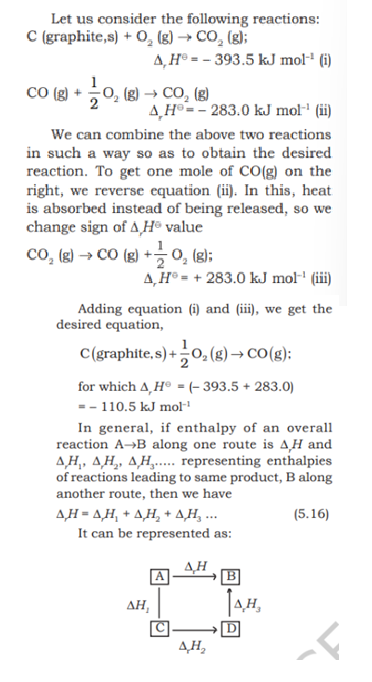
Hess’s law — If a reaction occurs in several steps at the same temperature, its standard reaction enthalpy equals the sum of the standard enthalpies of those steps.
Why Hess’s law works
- State function: Enthalpy depends only on the initial and final states, not on the path.
- Path equivalence: Enthalpy change is the same whether the reaction occurs in one step or through intermediate reactions.
- Use: Hess’s law allows an enthalpy change to be calculated indirectly when the target reaction cannot be measured directly.
Quick recap
- Reaction enthalpy is the coefficient-weighted enthalpy of products minus that of reactants.
- A standard state is a pure substance at \(1\ \text{bar}\); standard reaction enthalpy is commonly reported at \(298\ \text{K}\).
- Fusion, vaporisation, and sublimation are endothermic in the forward direction; reversing a change reverses its enthalpy sign.
- Formation enthalpy forms exactly one mole of a compound from elements in their most stable reference states; an element in its reference state has zero formation enthalpy.
- Calculate reaction enthalpy from formation data using the coefficient-weighted product sum minus the reactant sum.
- Thermochemical enthalpy values apply to the specified balanced equation: scaling scales the value, while reversing the equation reverses its sign.
- Hess’s law follows from enthalpy being a state function: total enthalpy change is independent of the reaction pathway.
Enthalpies For Different Types Of Reactions
Standard Enthalpy of Combustion
Benzene formation enthalpy from combustion
- Combustion: \(\ce{C6H6(l) + 15/2 O2(g) -> 6CO2(g) + 3H2O(l)}\), \(\Delta_{\mathrm c}H^\ominus=-3267.0\ \mathrm{kJ\ mol^{-1}}\).
- Products: \(6(-393.5)+3(-285.83)=-3218.49\ \mathrm{kJ\ mol^{-1}}\).
The lecture’s final printed sign for benzene is incorrect: Hess’s law gives \(+48.51\ \mathrm{kJ\ mol^{-1}}\), not \(-48.51\ \mathrm{kJ\ mol^{-1}}\).
Enthalpy of Atomization
Bond Enthalpy
Successive C–H bond breaking in methane
- First: \(\ce{CH4(g) -> CH3(g) + H(g)}\), \(+427\ \mathrm{kJ\ mol^{-1}}\).
- Second: \(\ce{CH3(g) -> CH2(g) + H(g)}\), \(+439\ \mathrm{kJ\ mol^{-1}}\).
- Third: \(\ce{CH2(g) -> CH(g) + H(g)}\), \(+452\ \mathrm{kJ\ mol^{-1}}\).
- Fourth: \(\ce{CH(g) -> C(g) + H(g)}\), \(+347\ \mathrm{kJ\ mol^{-1}}\).
- Total atomization: The four steps sum to \(1665\ \mathrm{kJ\ mol^{-1}}\).
Mean bond enthalpy — The average enthalpy required to break one mole of a particular type of bond; it is used when successive bond dissociation enthalpies differ.
Divide the total atomization enthalpy by the four C–H bonds.
Estimate reaction enthalpy by subtracting product bond enthalpies from reactant bond enthalpies. This approximation applies when all reactants and products are gases.
| Bond | Enthalpy (\(\mathrm{kJ\ mol^{-1}}\)) |
|---|---|
| \(\ce{H-H}\) | \(435.8\) |
| \(\ce{C-H}\) | \(414\) |
| \(\ce{C-C}\) | \(347\) |
| \(\ce{O-H}\) | \(464\) |
| \(\ce{N#N}\) | \(418\) |
| \(\ce{N=N}\) | \(946\) |
| \(\ce{C#N}\) | \(615\) |
| \(\ce{C=N}\) | \(891\) |
| \(\ce{C#C}\) | \(611\) |
| \(\ce{C=C}\) | \(837\) |
| \(\ce{C=O}\) | \(741\) |
| \(\ce{O=O}\) | \(498\) |
| \(\ce{C#O}\) | \(1070\) |
Lattice Enthalpy
Using \(\Delta_{\mathrm f}H^\ominus(\ce{NaCl(s)})=-411.2\ \mathrm{kJ\ mol^{-1}}\) and reversing the lattice-formation step gives the dissociation lattice enthalpy.
Ionization and electron-gain enthalpies at temperature \(T\)
- Temperature correction: Ionization energy and electron affinity are defined at absolute zero; at temperature \(T\), enthalpy values include heat-capacity corrections.
- Gas heat capacities: For the species considered, \(C_p=\frac{5}{2}R\) and \(C_v=\frac{3}{2}R\).
- Ionization: \(\Delta_{\mathrm r}C_p^g=+\frac{5}{2}R\), so ionization enthalpy is \(E_0+\frac{5}{2}RT\).
- Electron gain: \(\Delta_{\mathrm r}C_p^g=-\frac{5}{2}R\), so electron-gain enthalpy is \(-A-\frac{5}{2}RT\).
For \(\ce{NaCl(s) -> Na+(g) + Cl-(g)}\), \(\Delta n_g=2\); therefore, at 298 K, \(\Delta U\) is about \(+783\ \mathrm{kJ\ mol^{-1}}\).
Enthalpy of Solution
For an ionic solid dissolving in water, add the lattice dissociation enthalpy and the enthalpy of hydration of its ions.
NaCl dissolution example
- Lattice enthalpy: \(+788\ \mathrm{kJ\ mol^{-1}}\).
- Hydration enthalpy: \(-784\ \mathrm{kJ\ mol^{-1}}\).
- Result: \(\Delta_{\mathrm{sol}}H^\ominus=+4\ \mathrm{kJ\ mol^{-1}}\); NaCl dissolution involves very little heat change.
Enthalpy of Dilution
The dilution enthalpy depends on the solution’s starting concentration and the amount of solvent added.
Why is mean bond enthalpy used for polyatomic molecules?
How is lattice enthalpy of an ionic solid determined?
What determines the enthalpy of solution of an ionic solid?
Quick recap
- Combustion enthalpy is the heat change per mole completely burnt in standard states and is usually negative.
- Atomization enthalpy forms gaseous atoms; for diatomic molecules, it equals bond dissociation enthalpy.
- Mean bond enthalpy averages successive bond-breaking energies and estimates gaseous reaction enthalpies.
- Lattice enthalpy for solid-to-gaseous-ion dissociation is calculated indirectly using a Born–Haber cycle.
- Solution enthalpy balances lattice separation against solvation or hydration.
- Dilution enthalpy depends on the initial solution concentration and the amount of solvent added.
Spontaneity
Spontaneous Processes and the First Law of Thermodynamics.
- First law: It relates heat absorbed by a system to work performed on or by it, but does not specify the direction in which heat flows.
- Need for a criterion: Naturally occurring physical and chemical changes generally proceed spontaneously in one direction; a separate criterion is needed to predict that direction.
- Examples: Heat flows from hotter to colder bodies, a gas expands to fill its available volume, and carbon burns in dioxygen to form carbon dioxide.
- Reverse changes: Heat does not flow from a colder to a hotter body on its own; a gas does not spontaneously contract into one corner, nor does carbon dioxide spontaneously form carbon and dioxygen.
Spontaneous process — A process that has the potential to proceed without assistance from an external agency.
- Direction: A spontaneous process proceeds naturally in one direction; it cannot reverse on its own and can be reversed only by an external agency.
- Rate: Spontaneity does not mean a process is fast. A mixture of hydrogen and oxygen can remain unchanged perceptibly for years while their reaction is still spontaneous but extremely slow.
- Description: A spontaneous process is irreversible in the sense that its reverse does not occur on its own.
Enthalpy and Spontaneity
- Energy decrease: Water flowing downhill and a falling stone lose potential energy, suggesting that a decrease in energy might drive spontaneous change.
- Exothermic reactions: Many spontaneous reactions have negative reaction enthalpy, but this alone does not establish a universal criterion for spontaneity.
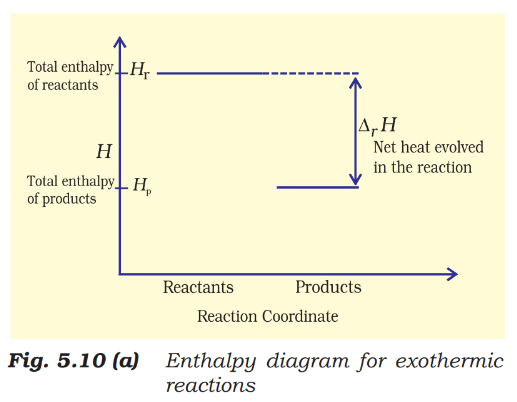
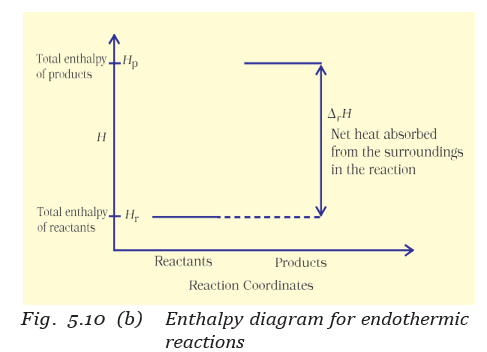
- A decrease in enthalpy may contribute to spontaneity, but enthalpy alone cannot predict spontaneity.
- Both enthalpy and entropy changes must be considered for most chemical reactions.
Entropy and Spontaneity
Entropy (\(S\)) — A state function that measures the randomness or disorder of a system and the dispersal of energy among its particles.
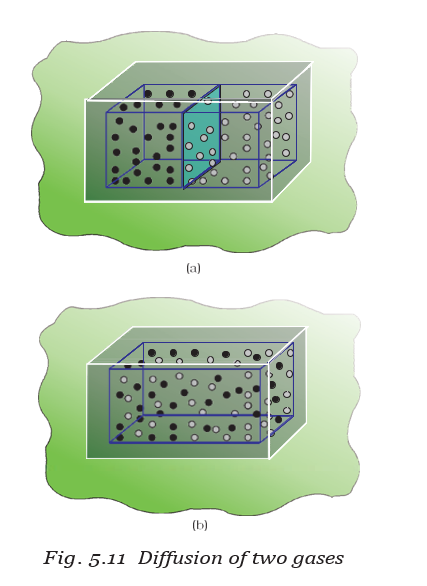
- Mixing: When two gases mix in an isolated container, their identities become less predictable and entropy increases, even when \(\Delta H=0\).
- Reactions: Rearrangement of atoms or ions can make products more or less ordered than reactants; reduced structural regularity means increased entropy.
- Physical states: For a given substance, crystalline solid generally has the lowest entropy and gaseous state the highest.
- Temperature: Heating increases molecular motion and generally increases entropy; for the same heat input, entropy change is greater at lower temperature.
- State function: Entropy change depends only on the initial and final states, not on the path.
For heat transferred reversibly at temperature \(T\).
A process is spontaneous when the entropy change of the system and surroundings combined is positive.
- Equilibrium: In an isolated system, entropy reaches a maximum at equilibrium; the entropy change for a further change at equilibrium is zero.
- Reversible versus irreversible: In isothermal expansion of an ideal gas, \(\Delta U=0\) for both reversible and irreversible paths, but total entropy change distinguishes them; it is zero for a reversible change and positive for an irreversible spontaneous change.
- Qualitative estimates: Entropy increases when a liquid crystallises? No: crystallisation orders particles, so entropy decreases. Heating a crystal from \(0\ \mathrm{K}\) increases entropy; producing more gas particles usually increases entropy.
| Change | Entropy trend | Reason |
|---|---|---|
| Liquid crystallises into a solid | Decreases | The particles become more ordered. |
| A crystalline solid is heated from \(0\ \mathrm{K}\) to \(115\ \mathrm{K}\) | Increases | Particles begin to move and vibrate in the lattice. |
| \(\ce{2NaHCO3(s) -> Na2CO3(s) + CO2(g) + H2O(g)}\) | Increases | The products include two gases, more disordered than the solid reactant. |
| \(\ce{H2(g) -> 2H(g)}\) | Increases | The number of particles increases. |
Example: Oxidation of Iron
- Reaction: \(\ce{4Fe(s) + 3O2(g) -> 2Fe2O3(s)}\) has \(\Delta S_{\mathrm{sys}}=-549.4\ \mathrm{J\,K^{-1}\,mol^{-1}}\) at \(298\ \mathrm{K}\), but is strongly exothermic with \(\Delta_r H^\circ=-1648\times10^3\ \mathrm{J\,mol^{-1}}\).
- Surroundings: At constant pressure, \(\Delta S_{\mathrm{surr}}=-\Delta_r H^\circ/T=5530\ \mathrm{J\,K^{-1}\,mol^{-1}}\).
- Conclusion: \(\Delta S_{\mathrm{total}}=5530-549.4=4980.6\ \mathrm{J\,K^{-1}\,mol^{-1}}>0\), so the reaction is spontaneous despite its negative system entropy change.
Gibbs Energy and Spontaneity
Gibbs energy (\(G\)) — An extensive state function combining the enthalpy and entropy contributions of a system; it is also called Gibbs function or free energy.
At constant temperature, this equation combines the enthalpy and entropy changes of the system.
- Temperature condition: The change in Gibbs energy is \(\Delta G=\Delta H-T\Delta S\) when temperature is constant.
- Meaning: \(T\Delta S\) is the energy unavailable for useful work; \(\Delta G\) measures the net energy available for useful work.
- Units: \(\Delta G\) has units of energy because \(T\Delta S\) has units \(\mathrm{K}\times\mathrm{J\,K^{-1}}=\mathrm{J}\).
- Spontaneity condition: The Gibbs criterion applies at constant temperature and pressure.
For the system in thermal equilibrium with its surroundings, at constant temperature and pressure.
| \(\Delta G\) | Prediction |
|---|---|
| \(\Delta G<0\) | Spontaneous in the forward direction. |
| \(\Delta G>0\) | Non-spontaneous in the forward direction; the reverse direction is favoured. |
| \(\Delta G=0\) | At equilibrium. |
| \(\Delta H\) | \(\Delta S\) | Spontaneity |
|---|---|---|
| \(-\) | \(+\) | Spontaneous at all temperatures. |
| \(-\) | \(-\) | Spontaneous at low temperature; non-spontaneous at high temperature. |
| \(+\) | \(+\) | Non-spontaneous at low temperature; spontaneous at high temperature. |
| \(+\) | \(-\) | Non-spontaneous at all temperatures. |
- Positive enthalpy and entropy: When \(\Delta H>0\) and \(\Delta S>0\), the process is spontaneous if \(T\Delta S\) is large enough to exceed \(\Delta H\).
- Temperature effect: A small positive entropy change may require a high temperature; a larger positive entropy change can make the process spontaneous at a lower temperature.
Second Law of Thermodynamics
Second law of thermodynamics — The entropy of an isolated system increases in a spontaneous process and reaches a maximum at equilibrium.
- Exothermic reactions: Heat released by a reaction increases the entropy of the surroundings; total entropy can increase even if the system's entropy decreases.
- Spontaneity test: For system and surroundings together, spontaneity requires \(\Delta S_{\mathrm{total}}>0\).
Third Law and Absolute Entropy
Third law of thermodynamics — The entropy of a pure crystalline substance approaches zero as its temperature approaches absolute zero.
- Reason: A perfect crystal is perfectly ordered at absolute zero.
- Molecular motions: Molecules have translational, rotational and vibrational motions; these become more vigorous as temperature rises, generally increasing entropy.
- Scope: The zero-entropy statement applies to pure crystalline solids; solutions and supercooled liquids need not have zero entropy at \(0\ \mathrm{K}\).
- Use: The third law allows calculation of absolute entropy by summing reversible heat increments \(q_{\mathrm{rev}}/T\) from \(0\ \mathrm{K}\) to the desired temperature. Standard entropies can be used to calculate reaction entropy changes by a Hess's-law-type method.
Gibbs Energy Change and Equilibrium
- Reversible reaction: In strict thermodynamic usage, a reversible process is carried out so that the system remains in perfect equilibrium with its surroundings at all times.
- Chemical equilibrium: A reaction termed reversible can proceed in both directions simultaneously, establishing dynamic equilibrium. At equilibrium, Gibbs energy of the system is minimum; otherwise it would change spontaneously toward lower Gibbs energy.
- Criterion: For \(\ce{A + B <=> C + D}\) at equilibrium, \(\Delta_r G=0\).
- Applications of Gibbs energy: Its sign and magnitude predict spontaneity and indicate the useful work that could be extracted.
For a reaction with reactants and products in their standard states; \(K\) is the equilibrium constant and \(T\) is in kelvin.
| Standard Gibbs energy | Equilibrium constant | General implication |
|---|---|---|
| \(\Delta_r G^\circ<0\) | \(K>1\) | Products are favoured at equilibrium. |
| \(\Delta_r G^\circ>0\) | \(K<1\) | Reactants are favoured at equilibrium. |
| \(\Delta_r G^\circ=0\) | \(K=1\) | Neither side is favoured by the standard Gibbs-energy term. |
Enthalpy, Entropy and Equilibrium
- Strongly endothermic reactions: A large positive \(\Delta_r H^\circ\) often corresponds to a small \(K\), so little product is formed.
- Strongly exothermic reactions: A large negative \(\Delta_r H^\circ\) often corresponds to a large \(K\), so the reaction can proceed nearly to completion.
- Entropy contribution: \(\Delta_r S^\circ\) also affects \(\Delta_r G^\circ\) and therefore \(K\) and the extent of reaction.
- Applications: Use \(\Delta_r H^\circ\) and \(\Delta_r S^\circ\) to estimate \(\Delta_r G^\circ\) and \(K\) at a temperature; if \(K\) is measured, calculate \(\Delta_r G^\circ\).
Reference Numerical Results
- Ozone formation: For \(\ce{3/2 O2(g) -> O3(g)}\) at \(298\ \mathrm{K}\) with \(K_p=2.47\times10^{-29}\), \(\Delta_r G^\circ\approx+163\ \mathrm{kJ\ mol^{-1}}\).
- Urea formation: At \(298\ \mathrm{K}\) with \(\Delta_r G^\circ=-13.6\ \mathrm{kJ\ mol^{-1}}\), \(\log K\approx2.38\) and \(K\approx2.4\times10^2\).
Why can an exothermic reaction be spontaneous even when the system's entropy decreases?
Does a spontaneous reaction have to be fast?
State the strict thermodynamic meaning of a reversible process.
Quick recap
- The first law relates heat and work but does not determine the direction of a spontaneous change.
- A spontaneous process can proceed without external assistance, but it need not be fast and cannot reverse on its own.
- Enthalpy decrease alone is not a universal criterion; entropy and the total entropy change must also be considered.
- For a spontaneous process, \(\Delta S_{\mathrm{total}}>0\); at equilibrium, entropy of an isolated system is maximum.
- At constant temperature and pressure, \(\Delta G=\Delta H-T\Delta S\): negative means spontaneous, positive means non-spontaneous, and zero means equilibrium.
- For a pure crystal, entropy approaches zero as temperature approaches \(0\ \mathrm{K}\); at equilibrium, \(\Delta_r G=0\) and \(\Delta_r G^\circ=-RT\ln K\).
Summary
Thermodynamic System and Energy Changes
The first law
- Thermodynamics studies energy changes in physical and chemical processes and helps predict their outcomes quantitatively.
- Universe is divided into the system (the part being studied) and its surroundings.
- Heat and work: A process may absorb or release heat, and some energy may be transferred as work.
- First law: Change in internal energy equals heat and work transferred to the system.
- Sign convention: Heat and work are positive when energy is added to the system.
Here, \(\Delta U\) is the change in internal energy, \(q\) is heat, and \(w\) is work.
| Point | State function | Path function |
|---|---|---|
| Depends on | Initial and final states only | The path taken during the process |
| Examples | Internal energy, enthalpy, entropy, Gibbs energy | Heat and work |
Heat Capacity and Work
Heat and pressure-volume work
- Heat capacity (\(C\)): The heat needed to raise a substance’s temperature depends on its heat capacity.
- Expansion work: For a gas changing volume against external pressure, work depends on the external pressure and volume change.
- Reversible expansion: For infinitesimal volume changes, external pressure equals the gas pressure; use the gas equation \(pV=nRT\).
For a temperature change, \(\Delta T\); for reversible expansion, the differential work is shown.
Internal Energy and Enthalpy
Constant-volume and constant-pressure processes
- Constant volume: Since volume does not change, pressure-volume work is zero; heat transferred equals the change in internal energy.
- Enthalpy (\(H\)): A state function useful for reactions commonly studied at constant pressure.
- Constant pressure: The heat transferred equals the enthalpy change.
For an ideal-gas reaction, \(\Delta n_g\) is the change in moles of gaseous products minus gaseous reactants.
Enthalpy Changes
| Type | Meaning / key point |
|---|---|
| Phase change | Melting, vaporisation and sublimation generally occur at constant temperature; their enthalpy changes are positive. |
| Formation | Enthalpy change associated with forming a substance. |
| Combustion | Enthalpy change associated with combustion. |
Calculating reaction enthalpy
- Hess’s law: Enthalpy changes can be calculated by combining enthalpy changes for suitable steps; the overall change is independent of the route.
- Formation enthalpies: Calculate reaction enthalpy as the sum for products minus the sum for reactants, using stoichiometric coefficients.
- Bond enthalpies: For gaseous reactions, subtract the sum of product bond enthalpies from the sum of reactant bond enthalpies.
Each term is multiplied by its stoichiometric coefficient.
For gaseous reactions, \(D_R\) and \(D_P\) are the sums of bond enthalpies of reactants and products, respectively.
Entropy and Spontaneity
Entropy as a criterion for direction
- Limitation of the first law: Energy conservation alone does not show which direction a chemical reaction will proceed spontaneously.
- Entropy (\(S\)): A state function measuring disorder or randomness.
- Spontaneous change: The total entropy change is positive. For an isolated system, \(\Delta U=0\) and spontaneity is distinguished by \(\Delta S>0\).
- Reversible process: Entropy change can be calculated using reversible heat transfer; \(q_{\mathrm{rev}}/T\) is path-independent.
For a reversible process at temperature \(T\).
Gibbs Energy and Equilibrium
Gibbs energy as a spontaneity criterion
- Gibbs energy (\(G\)): A state function relating enthalpy and entropy changes, especially useful for reactions at constant pressure.
- Spontaneous change: The system has \(\Delta G_{\mathrm{sys}}<0\).
- Equilibrium: The system has \(\Delta G_{\mathrm{sys}}=0\).
- Temperature effect: A positive reaction entropy makes the \(-T\Delta S\) contribution more favourable as temperature rises; some reactions non-spontaneous at low temperature become spontaneous at high temperature.
Use reaction quantities for a chemical reaction.
Relates standard reaction Gibbs energy to the equilibrium constant \(K\).
Calculate it from standard enthalpy and entropy changes at temperature \(T\).
How do heat and work relate to internal energy?
State the Gibbs energy criteria for spontaneity and equilibrium.
Quick recap
- First law: \(\Delta U=q+w\); internal energy is a state function, while heat and work depend on path.
- Heat and work: \(q=C\Delta T\); expansion work is \(w=-p_{\mathrm{ex}}\Delta V\).
- Enthalpy: At constant volume, \(q_V=\Delta U\); at constant pressure, \(q_p=\Delta H\).
- Reaction enthalpy: Use Hess’s law, formation enthalpies, or bond enthalpies.
- Entropy: For a reversible process, \(\Delta S=q_{\mathrm{rev}}/T\); isolated-system spontaneity requires \(\Delta S>0\).
- Gibbs energy: \(\Delta_rG=\Delta_rH-T\Delta_rS\); negative for spontaneity and zero at equilibrium.
- Equilibrium link: \(\Delta_rG^{\circ}=-RT\ln K\).
Chemistry — ALL CHAPTERS
1
Some Basic Concepts Of Chemistry
2
Structure Of Atom
3
Classification Of Elements And Periodicity In Properties
4
Chemical Bonding And Molecular Structure
5
Thermodynamics
6
Equilibrium
7
Redox Reactions
8
Organic Chemistry – Some Basic Principles And Techniques
9
Hydrocarbons