Class 9 . Mathematics . Ganita Manjari . Orienting Yourself the Use of Coordinates
Chapter 1: Orienting Yourself: The Use of Coordinates
Ch 1
Mathematics
Class 9
Introduction
Coordinate Systems
In a two-dimensional plane, the coordinates \((x,y)\) specify a point's positions relative to two perpendicular axes. The origin is \((0,0)\); negative coordinate values lie in the negative direction of the corresponding axis.
Write the horizontal coordinate first and the vertical coordinate second.
Reading an ordered pair
- Start at the origin.$$(0,0)$$
- Use the first coordinate to move horizontally.$$x$$
- Use the second coordinate to move vertically; the endpoint is the point.$$y$$
How is the point \((3,2)\) located?
- Locate the point represented by \((3,2)\), starting from the origin.$$(0,0)$$
- Move \(3\) units horizontally, then \(2\) units vertically.$$(0,0)\to(3,0)\to(3,2)$$
- The endpoint is the required point.$$(3,2)$$
Do not reverse the coordinates: \((x,y)\) means horizontal position first, vertical position second.
Coordinates, Algebra, and Geometry
Why coordinates are useful
- Precise location: Coordinates allow points and objects to be identified exactly.
- Connection: Coordinates help represent algebraic equations as geometric shapes, and describe geometric shapes using algebra and equations.
Starting at the origin, what point is reached by moving \(4\) units horizontally and then \(1\) unit vertically?
For the point \((-2,3)\), which coordinate gives the vertical position?
Quick recap
- A coordinate system uses numbers and reference axes to locate points precisely.
- The Cartesian plane has two perpendicular axes that meet at the origin \((0,0)\).
- An ordered pair \((x,y)\) gives the horizontal position first and vertical position second.
- Negative values indicate positions in the negative direction of the corresponding axis.
- Coordinates connect algebraic equations with geometric shapes.
Settling In
Representing a Room on a Grid
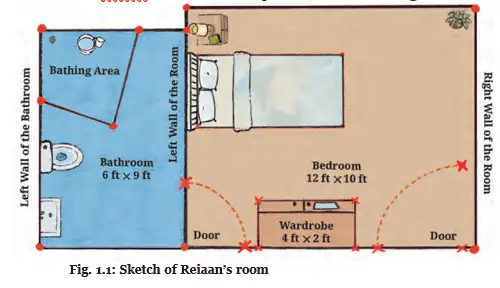
Use the map scale to convert a measured map distance into the corresponding room distance.
Using the map scale
- Measure the distance between the points on the map.
- Use the scale: each map centimetre represents one room foot.$$1\,\mathrm{cm}=1\,\mathrm{ft}$$
- State the corresponding distance in the room.
What room distance does \(3\,\mathrm{cm}\) on the map represent?
- A distance measures \(3\,\mathrm{cm}\) on the map. Apply the scale.$$3\,\mathrm{cm}\times\frac{1\,\mathrm{ft}}{1\,\mathrm{cm}}$$
- Cancel the map-length units.$$3\,\mathrm{ft}$$
Do not assume a floor map shows every part of a room: it represents the floor layout, not vertical features such as windows.
On the room map, a distance is \(6\,\mathrm{cm}\). What is the corresponding room distance?
Why can the room’s windows not be marked on this floor map?
Quick recap
- A grid can represent the layout of a room’s floor.
- Pins mark important points, and wool can connect them to make the layout tactile.
- The map scale is \(1\,\mathrm{cm}\) to \(1\,\mathrm{ft}\).
- A floor map shows positions on the floor, not vertical features such as windows.
The 2-D Cartesian Coordinate System
2-D Cartesian coordinate system — A system of two perpendicular number lines used to locate points in a plane.
Axes and the origin
- \(x\)-axis: The horizontal number line; values to the right are positive and to the left are negative.
- \(y\)-axis: The vertical number line; values above are positive and below are negative.
- Origin: The axes intersect at \(O\), whose coordinates are \((0,0)\).
- Scale: Mark equal units on both axes to measure distances from the origin.
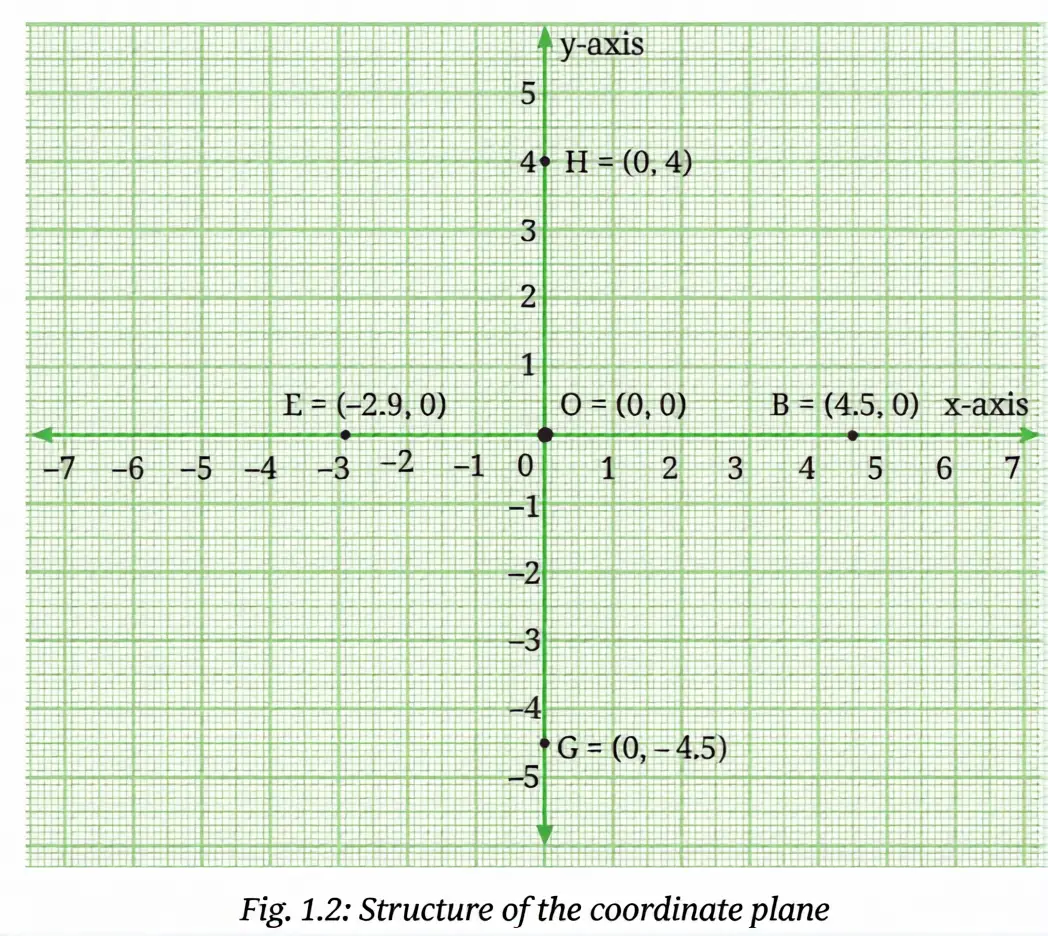
Coordinates and positions
Coordinates — The ordered pair \((x,y)\) gives a point’s horizontal position first and its vertical position second.
Write the horizontal coordinate before the vertical coordinate.
| Position | Coordinate form | Example |
|---|---|---|
| On the \(x\)-axis | \((x,0)\) | \(B=(4.5,0)\) is 4.5 units right of \(O\). |
| On the \(y\)-axis | \((0,y)\) | \(G=(0,-4.5)\) is 4.5 units below \(O\); \(H=(0,4)\) is 4 units above \(O\). |
- On the \(x\)-axis: The second coordinate is \(0\); a positive first coordinate is right of \(O\), and a negative one is left.
- On the \(y\)-axis: The first coordinate is \(0\); a positive second coordinate is above \(O\), and a negative one is below.
- Writing points: \(P=(x,y)\) is often shortened to \(P(x,y)\) when labelling a graph.
Locate a point from its coordinates
- Start at the origin \(O\).$$O=(0,0)$$
- Use the first coordinate to move horizontally: right if positive, left if negative.$$x>0\Rightarrow\text{right},\quad x<0\Rightarrow\text{left}$$
- Then use the second coordinate to move vertically: up if positive, down if negative.$$y>0\Rightarrow\text{up},\quad y<0\Rightarrow\text{down}$$
Where is the point \(P=(-3,2)\)?
- Locate \(P=(-3,2)\) from the origin.$$P=(-3,2)$$
- The first coordinate is negative, so move 3 units left.$$x=-3$$
- The second coordinate is positive, so move 2 units up.$$y=2$$
Do not reverse the coordinate order: \((x,y)\) means horizontal first, vertical second. On an axis, the coordinate perpendicular to it is \(0\).
Write the coordinates of a point 6 units left of \(O\) on the \(x\)-axis.
Write the coordinates of a point 2.5 units below \(O\) on the \(y\)-axis.
A point is 4 units right and 3 units below \(O\). Write its coordinates.
Quick recap
- The \(x\)-axis is horizontal and the \(y\)-axis is vertical; they meet at \(O=(0,0)\).
- Coordinates are ordered \((x,y)\): horizontal position first, vertical position second.
- Right and up are positive; left and down are negative.
- Points on the \(x\)-axis have the form \((x,0)\); points on the \(y\)-axis have the form \((0,y)\).
- A point label may be written as \(P(x,y)\) instead of \(P=(x,y)\).
Distance Between Two Points in the 2-D Plane
Distance Between Two Points
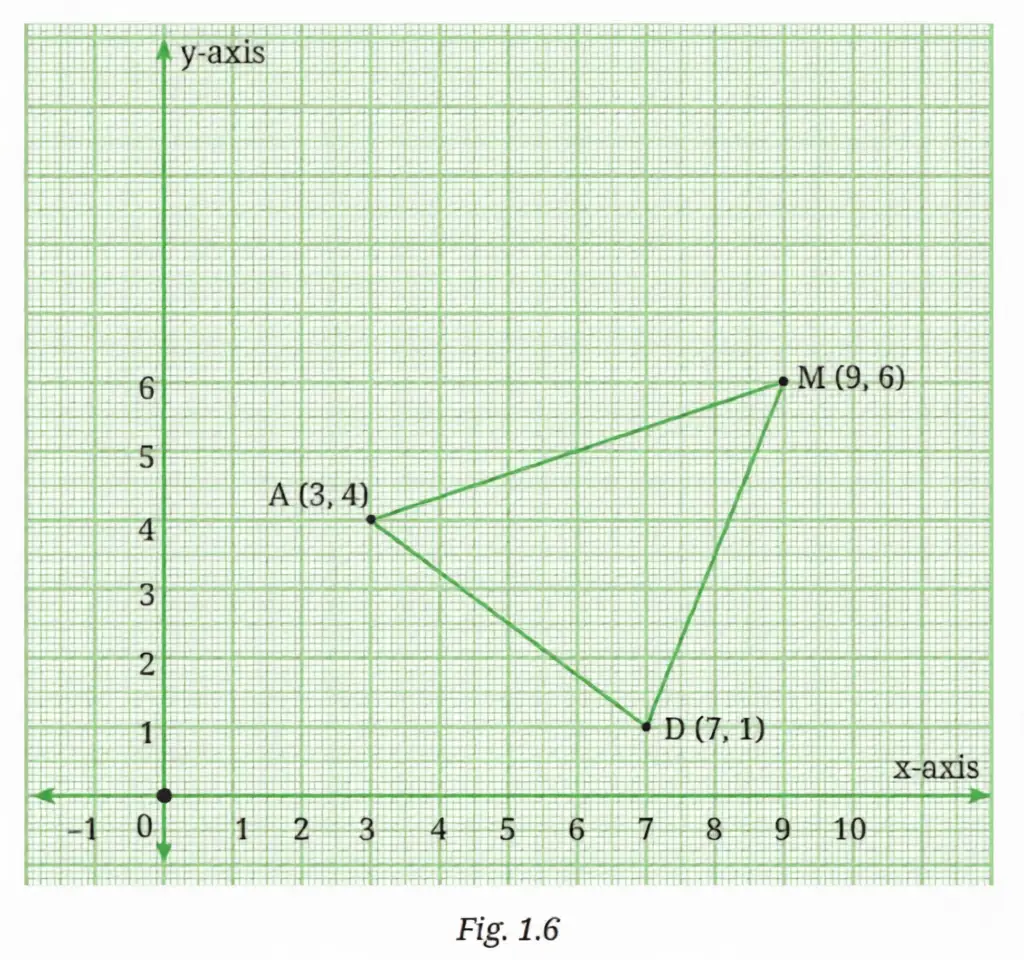
For points \(P(x_1,y_1)\) and \(Q(x_2,y_2)\), the Pythagorean theorem gives the distance from their horizontal and vertical coordinate changes.
Use for any two points in the coordinate plane.
Finding the distance
- Identify the coordinates of the two points.
- Find the horizontal and vertical coordinate differences.$$\Delta x=x_2-x_1,\qquad \Delta y=y_2-y_1$$
- Square both differences, add them, and take the square root.$$d=\sqrt{(\Delta x)^2+(\Delta y)^2}$$
Find the lengths of \(AD\), \(DM\), and \(MA\) for \(A(3,4)\), \(D(7,1)\), and \(M(9,6)\).
- Find the lengths of all three sides of triangle \(ADM\), where \(A(3,4)\), \(D(7,1)\), and \(M(9,6)\).
- For \(AD\), the coordinate changes are \(4\) and \(-3\).$$AD=\sqrt{(7-3)^2+(1-4)^2}=\sqrt{4^2+(-3)^2}=5$$
- For \(DM\), the coordinate changes are \(2\) and \(5\).$$DM=\sqrt{(9-7)^2+(6-1)^2}=\sqrt{2^2+5^2}=\sqrt{29}$$
- For \(MA\), the coordinate changes are \(-6\) and \(-2\).$$MA=\sqrt{(3-9)^2+(4-6)^2}=\sqrt{(-6)^2+(-2)^2}=\sqrt{40}=2\sqrt{10}$$
Negative Coordinates and Reflection
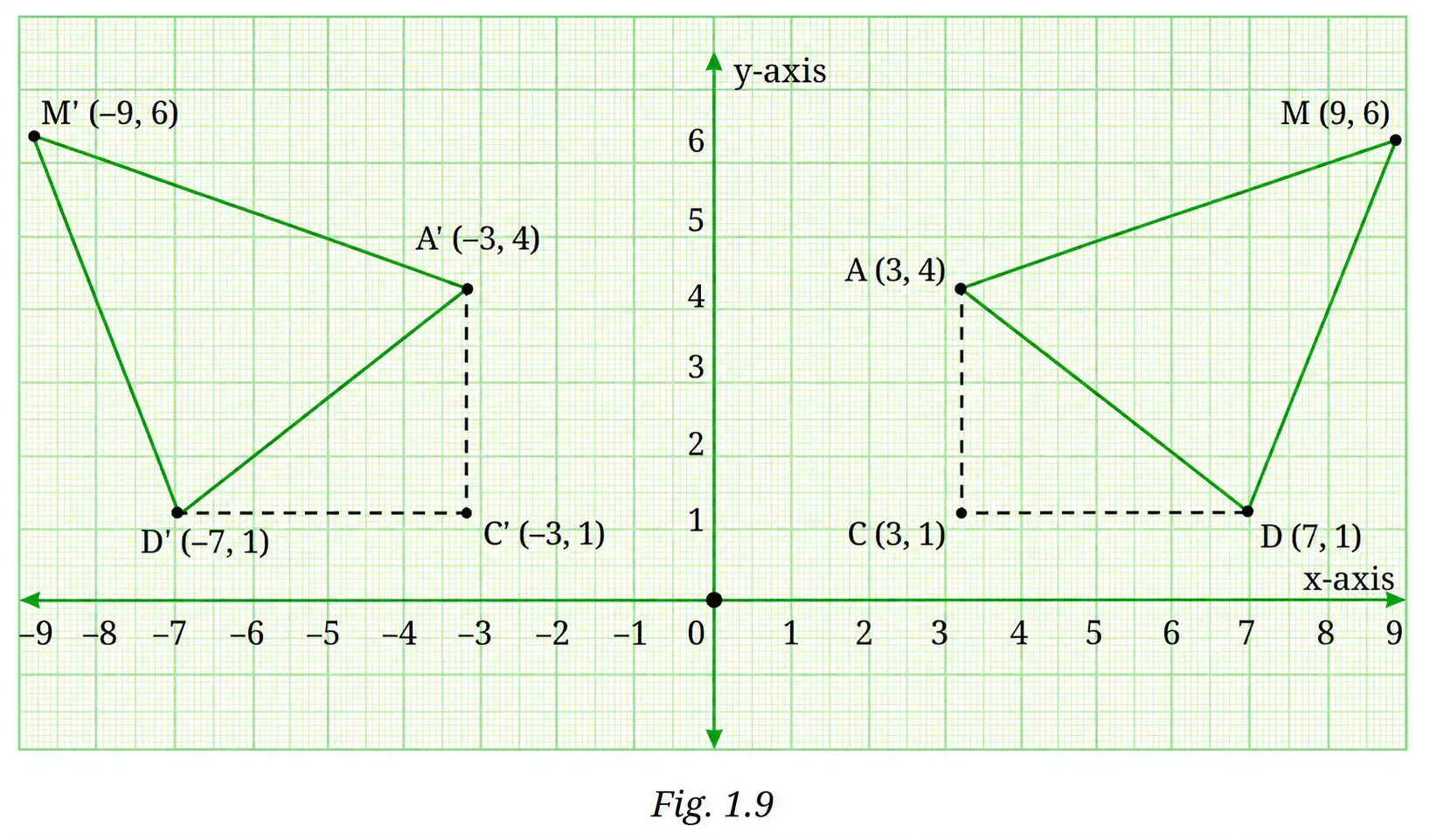
Do not treat coordinate differences as distances or ignore their signs before calculating. Square both differences, add them, and take the square root.
Square, add, root
Square the coordinate changes, add the squares, then take the square root.
Find the distance between \(P(-3,4)\) and \(Q(1,1)\).
Find the distance between \(A(2,-1)\) and \(B(2,5)\).
Find the distance between \(M(9,6)\) and \(D(7,1)\).
Quick recap
- The distance between two points follows from the Pythagorean theorem.
- For \(P(x_1,y_1)\) and \(Q(x_2,y_2)\), use \(PQ=\sqrt{(x_2-x_1)^2+(y_2-y_1)^2}\).
- Coordinate differences may be negative; squaring removes their effect on the distance.
- The formula works for points with negative coordinates and in every quadrant.
- Reflection across an axis changes some coordinate signs but preserves distances.
- For \(A(3,4)\), \(D(7,1)\), and \(M(9,6)\), the side lengths are \(AD=5\), \(DM=\sqrt{29}\), and \(MA=\sqrt{40}\).
Summary
The Cartesian Plane and Coordinates
Coordinates — A point’s \(x\)-coordinate gives its horizontal distance from the \(y\)-axis, and its \(y\)-coordinate gives its vertical distance from the \(x\)-axis; the signs indicate the side of each axis.
Use these forms to recognise points lying on either axis.
Identify a point's quadrant
- Check the signs of the point's coordinates.
- Match the sign pair to the quadrant.
Locate \(P=(-3,2)\) and state its distances from the axes.
- For the point, the first coordinate is negative and the second is positive.$$P=(-3,2)$$
- The sign pair is \((-,+)\), so the point lies in the second quadrant.$$(-,+)\longrightarrow \text{Quadrant II}$$
- Its horizontal and vertical distances from the axes are \(3\) and \(2\) units.$$|-3|=3,\qquad |2|=2$$
Do not swap the coordinates: \((x,y)\) gives the horizontal position first and the vertical position second.
Distance Between Two Points
For points on the same horizontal or vertical line, use the absolute difference. For any two points, combine the horizontal and vertical differences using the Pythagorean theorem.
Find the distance between two points
- Identify the coordinates \((x_1,y_1)\) and \((x_2,y_2)\).
- Substitute into the distance formula.$$d=\sqrt{(x_2-x_1)^2+(y_2-y_1)^2}$$
- Simplify and give the non-negative distance.
Find the distance between \(A=(1,2)\) and \(B=(4,6)\).
- Substitute the coordinates of the two points.$$A=(1,2),\qquad B=(4,6)$$
- Apply the distance formula.$$AB=\sqrt{(4-1)^2+(6-2)^2}$$
- Evaluate the squares and simplify.$$AB=\sqrt{3^2+4^2}=\sqrt{25}=5$$
Find the distance between \((-2,5)\) and \((4,5)\).
Find the distance between \((3,-1)\) and \((3,7)\).
Quick recap
- The Cartesian plane, coordinate plane, or \(xy\)-plane has perpendicular \(x\)- and \(y\)-axes meeting at \((0,0)\).
- A point’s \(x\)-coordinate measures its distance from the \(y\)-axis; its \(y\)-coordinate measures its distance from the \(x\)-axis.
- Coordinates are ordered as \((x,y)\); the \(x\)-coordinate comes first.
- The signs of the coordinates identify a point's quadrant.
- Points on the \(x\)-axis have form \((x,0)\); points on the \(y\)-axis have form \((0,y)\).
- Horizontal and vertical distances are absolute coordinate differences; the general distance formula follows from the Pythagorean theorem.
Formula sheet
Mathematics — ALL CHAPTERS
1
Orienting Yourself: The Use of Coordinates
2
Introduction to Linear Polynomials
3
The World of Numbers
4
Exploring Algebraic Identities
5
I’m Up and Down, and Round and Round
6
Measuring Space: Perimeter and Area
7
The Mathematics of Maybe: Introduction to Probability
8
Predicting What Comes Next: Exploring Sequences and Progression