Class 10 . English . First Flight . Mijbil the Otter Gavin Maxwell
Chapter 6: Mijbil The Otter: Gavin Maxwell
Ch 6
English
Class 10
Adopt An Outter
Section I: How Mijbil Came to Maxwell
- In early 1956, Gavin Maxwell travelled to Southern Iraq. He thought Camusfearna, surrounded by water, would be a suitable place to keep an otter instead of a dog.
- A friend suggested getting an otter from the Tigris marshes near Basra, where otters were common and sometimes tamed.
- Maxwell went to the Consulate-General in Basra to collect his mail. His letters had not arrived, and communication with England was delayed by a faulty telephone line and a religious holiday.
- After his friend left, Maxwell’s mail arrived five days later. In his bedroom he found two Arabs with a squirming sack and a note from his friend: the sack contained his otter.
Section II: Mijbil Settles In
- Maxwell describes receiving Mijbil as the beginning of a lasting attachment to otters. At first, Mijbil looked like a tiny dragon, covered in dried mud over soft, chocolate-brown fur.
- Zoologists identified him as a previously unknown race and named it *Lutrogale perspicillata maxwelli*, or Maxwell’s otter.
- For the first day Mijbil was distant and indifferent. On the second night, he slept close to Maxwell, in the crook of his knees.
- Mijbil soon became curious and especially delighted by water. In the bathtub he plunged, rolled and splashed about.
- Otters enjoy moving water: Mijbil tried to turn the bathroom taps on, sometimes succeeding and sometimes becoming irritated when they would not work.
- Mijbil learned to follow Maxwell and come when called. He played by dribbling and throwing a rubber ball, and by lying on his back and juggling marbles on his belly.
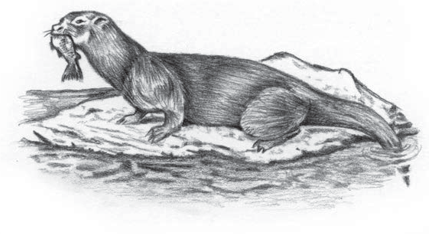
Mijbil
- Initially reserved: He keeps away from Maxwell on the first day.
- Affectionate: He later sleeps close to Maxwell and responds to his company.
- Curious and clever: He explores his surroundings and learns to operate the taps.
- Playful and water-loving: He splashes in the bath, plays with a ball and juggles marbles.
The Bond Between Humans and Animals
Maxwell’s growing affection for Mijbil shows how patience and close companionship can build a strong bond with an animal.
- a stone’s throw
- A very short distance.
- squirmed
- Twisted or wriggled about.
- thraldom
- A state of being under someone’s or something’s control.
- fixation
- A very strong attachment or interest.
- aloof
- Distant and not friendly.
- apathy
- Lack of interest or feeling.
- fumbling
- Trying clumsily to do something.
- chittering
- Making short, high-pitched sounds.
- flick
- A quick, light movement.
- christened
- Named.
Why did Maxwell think Camusfearna was suitable for keeping an otter?
How did Maxwell finally receive Mijbil?
What do Mijbil’s actions reveal about his nature?
Quick recap
- Maxwell travelled to Southern Iraq in early 1956 hoping to find an otter.
- His friend arranged for Mijbil to be brought to him from the Tigris marshes.
- Mijbil was named *Lutrogale perspicillata maxwelli*, or Maxwell’s otter.
- Mijbil was initially aloof but soon grew close to Maxwell.
- Mijbil loved water and showed cleverness by learning to turn on the taps.
- His ball and marble games reveal his playful nature.
Transporting Mij to England
Preparing for the Journey
Preparing for the Journey
- Maxwell feared the journey from Basra to England. The British airline would not carry animals, so he booked a flight to Paris and then London.
- The airline required Mij to travel in a box no larger than eighteen inches square, carried on the floor at Maxwell’s feet. Maxwell put him inside an hour before departure to help him get used to it.
- On returning, Maxwell found blood around the box. Mij had torn its lining to shreds and was exhausted and injured.
- With only ten minutes left and the airport five miles away, Maxwell put Mij back in the box and held its lid shut during the hurried drive.
Mij on the Aeroplane
The Flight
- At the aircraft, Maxwell was rushed aboard by angry officials. He covered the floor near his seat with newspapers and gave the air hostess fish to keep cool for Mij.
- After hearing what had happened, the kind air hostess suggested Mij could sit on Maxwell’s knee. Maxwell was deeply grateful, though he did not know what to expect.
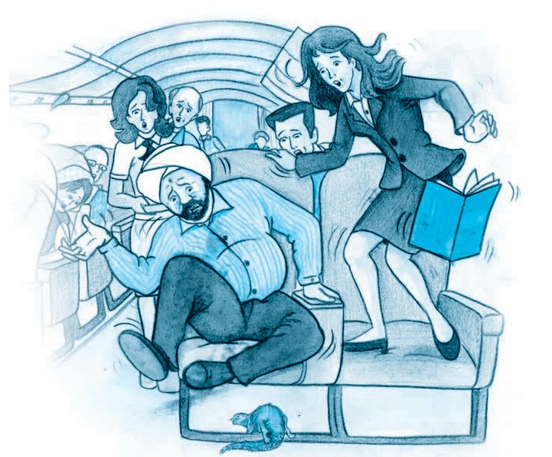
- Mij escaped from the box and raced down the aircraft. A woman screamed, “A rat! A rat!” Maxwell tried to catch him but ended up with curry on his face.
- The air hostess offered to find Mij. Before she could bring him back, he returned to Maxwell, chittering with recognition, and nuzzled his face and neck.
Gavin Maxwell
- Deeply devoted to Mij: he worries about transporting him safely and is relieved when Mij returns to him.
- Resourceful under pressure: he arranges another airline, prepares fish, and adapts when Mij escapes.
The Air Hostess
- Kind and helpful: she allows Maxwell to keep Mij on his knee and offers to find him after he escapes.
- Calm and tactful: she gently suggests Maxwell return to his seat during the search.
The Bond Between Maxwell and Mij
Maxwell’s anxiety for Mij and Mij’s joyful return to him show their strong affection and trust. The escape also creates humour and chaos during the journey.
- Dreaded the prospect
- Was very afraid of something that might happen.
- Appalling spectacle
- A shocking or horrifying sight.
- Whipped off
- Removed quickly.
- Ricochetting
- Changing direction after striking a surface.
- Infuriated
- Extremely angry.
- Took her into my confidence
- Shared personal information or experiences with her.
- Portly
- Stout or rather fat.
- Bounded on to
- Jumped or climbed onto quickly.
- Nuzzle
- Rub gently with the nose.
How was Mij to be transported to England, and what did he do to the box?
Why did Maxwell put Mij back in the box, and how might he have felt?
Why did Maxwell call the air hostess “the very queen of her kind”?
Quick recap
- The airline required Mij to travel in a small box on the floor at Maxwell’s feet; Mij badly damaged it.
- Maxwell rushed to the airport and boarded just before the aircraft took off.
- The air hostess kindly allowed Mij to sit on Maxwell’s knee.
- Mij escaped, causing panic and a comical chase through the aircraft.
- Mij returned to Maxwell and affectionately nuzzled him.
Stay In London & Fog (Poem)
Mij and Maxwell in London
A month in London
- Mij’s game: He rolled a ping-pong ball down a sloping suitcase lid, dashed to the bottom to catch it, then carried it back to the top.
- Schoolchildren’s habits: Maxwell compares Mij’s routines to children who step on the centre of each paving block, touch every seventh railing upright, or pass outside every second lamp post.
- Mij’s walking habit: Exercised on a lead, he tugged Maxwell to a low wall on the way home—but not on the way out—and galloped along its length.
- Londoners’ guesses: People mistook Mij for a baby seal, squirrel, walrus, hippo, beaver, bear cub, leopard and even a brontosaur.
- Maxwell’s response: The range of guesses surprised him; the “walrus” guess made him giggle. A labourer finally asked, “What is that supposed to be?”
Mustellines — A group of animals that includes otters, badgers, mongooses, weasels, stoats and minks.
“Fog” — Carl Sandburg
Fog
- The fog arrives softly and quietly, like a cat moving on padded feet.
- It pauses over the harbour and city, then silently moves away.
| Device | Example | Effect |
|---|---|---|
| Metaphor | “on little cat feet” | Compares the fog’s quiet arrival to the soft steps of a cat. |
| Personification | “It sits looking” | Makes the fog seem like a cat pausing to observe the city. |
| Imagery | “on silent haunches” | Creates the picture of a cat crouching quietly. |
| Free verse | No regular rhyme scheme | The poem has no obvious regular rhythm or rhyme. |
Quiet movement in nature
The poem presents fog as a cat that arrives silently, pauses over the city and then drifts away.
- Terrapin shell
- The shell of a small North American turtle.
- Engrossed
- Completely absorbed or interested.
- Ambush
- To attack or surprise from a hidden position.
- Compulsive habits
- Repeated actions that are difficult to control.
- Upright
- A post or rod standing vertically.
- Distraction
- Something that takes attention away from a task.
- Conjectural
- Based on guesses rather than certainty.
- Haunches
- The back parts of an animal’s body, near the thighs.
What game did Mij invent, and what routines did he follow on walks?
Which group do otters belong to, and what did Londoners guess Mij was?
How is fog compared to a cat, and does the poem have a regular rhyme scheme?
Quick recap
- Mij invented a ping-pong game using a sloping suitcase lid.
- Maxwell compares Mij’s walking routines with schoolchildren’s compulsive habits.
- Londoners guessed many animals, while Maxwell was surprised by the variety of guesses.
- Otters belong to the Mustellines group.
- Sandburg compares fog’s quiet arrival, pause and departure to a cat’s movements.
- “Fog” is written in free verse, without a regular rhyme scheme.
Exercise
Understanding Mij and Maxwell’s Description
Mij’s behaviour and Maxwell’s description
- Playful: Mij plunges and rolls in water, splashing about.
- Curious: He investigates the tap, even though he turns it the wrong way.
- Affectionate: He nuzzles Maxwell’s face and neck during the aeroplane journey.
- Maxwell’s portrayal: His close observations make Mij’s antics seem surprising, humorous and sometimes almost human.
How do Mij’s actions show that he is playful and affectionate?
How does Maxwell’s description make Mij seem unusual?
Why is Mij’s species known as Maxwell’s otter?
Repeated Actions and States in the Past
Would / used to — Both forms can describe repeated past actions or habits that have ended; use used to alone for past states or situations.
| Point | Would | Used to |
|---|---|---|
| Repeated past action | Yes: “We would take long walks.” | Yes: “We used to take long walks.” |
| Past state or situation | No | Yes: “Few people used to own cars.” |
| Typical verbs | Repeated actions, e.g. play, walk, follow | Actions and states, e.g. be, have, believe |
- Would: Use for repeated past actions, usually when the past time or context is clear: “Mij would play for hours.”
- Used to: Use for repeated past actions and past states: “We used to believe in ghosts.”
- Avoid: Do not use *would* for past states expressed by verbs such as *be*, *have* or *believe*.
Noun Modifiers
Noun modifier — A noun modifier is a word or phrase placed before a noun to give more information about it; adjectives and adjectival phrases can also modify nouns.
- Noun + noun: “dinner party,” “designer dress,” “car keys.”
- Proper noun + noun: “Christmas dinner party,” “Maruti car keys.”
- Adjectives and adjectival phrases: These also modify nouns, as in “wide, flat belly,” “symmetrical pointed scales” and “eminently suitable spot.”
- Multiple modifiers: An adjective can come before noun modifiers, as in “trendy silk designer dress”; *trendy* is an adjective, while *silk* and *designer* modify *dress*.
- Examples from the text: *otter fixation* and *iron railings* use noun modifiers; *Tigris marshes* and *London streets* use proper nouns as modifiers.
- Mixed modifiers: *soft velvet fur* has an adjective plus noun modifier; *four-footed soccer player* has an adjective plus noun modifier.
Quantity Expressions
Quantity expression — A quantity expression uses a measure word to describe an amount, especially of something uncountable.
Common combinations
- Advice / information: a bit of advice; a piece of information.
- Clay / smoke: a lump of clay; a cloud of smoke.
- Flowers / wind: a bunch of flowers; a gust of wind.
- Other examples: a portion of fried fish; a pool of water; flakes of snow; a heap of stones; drops of blood; a piece of cotton; a pot of gold.
Quick recap
- Mij: His splashing, curiosity and nuzzling suggest a playful, clever and affectionate animal.
- Maxwell’s otter: The previously unidentified otter species or subspecies was named after Maxwell.
- Past habits: Use *would* or *used to* for repeated actions; use *used to* for past states.
- Modifiers: Adjectives, adjectival phrases, nouns and proper nouns can add information before another noun.
- Quantity phrases: Measure words such as *bit*, *piece*, *cloud*, *bunch* and *lump* express amounts.
English — ALL CHAPTERS
1
A Letter To God
2
Nelson Mandela Long Walk To Freedom
3
Two Stories About Flying
4
From The Diary Of Anne Frank
5
Glimpses Of India
6
Mijbil The Otter: Gavin Maxwell
7
Madam Rides The Bus
8
The Sermons At Benares
9
The Proposal
1
A Triumph of Surgery
2
The Thief’s Story
3
The Midnight Visitor
4
A Question of Trust
5
Footprints without Feet
6
The Making of a Scientist
7
The Necklace
8
Bholi
9
The Book That Saved the Earth