Understanding Chemical Mixtures: Types, Properties, and Examples
Fundamentals of Mixtures in Chemistry
Defining Mixtures and Their Formation
In chemistry, a mixture is formed when two or more substances combine physically without undergoing any chemical reaction. Unlike compounds, the individual components in a mixture retain their original chemical identities and properties. This physical combination can occur in various forms such as solutions, suspensions, or colloids, where the substances coexist without forming new chemical bonds.
Mixtures result from mechanical blending rather than chemical synthesis, meaning no new substances are created during the process. This distinction is crucial for understanding how mixtures behave and how their components can be separated.
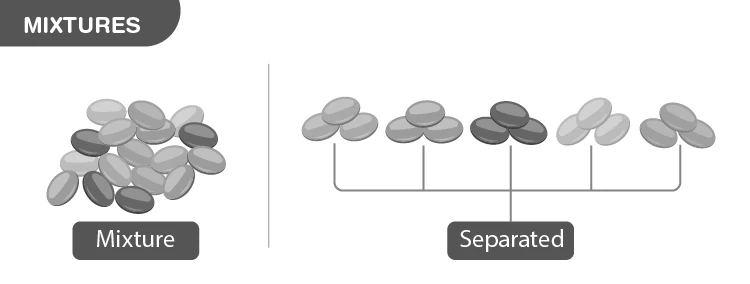
Visual representation of various chemical mixtures
Example Problem
Question: A student mixes 50 g of salt with 200 g of sand. Explain whether this combination forms a mixture or a compound and justify your answer.
Solution:
Salt and sand are two distinct substances with different chemical properties.
When mixed, they do not chemically react or form new substances.
The mixture retains the individual properties of salt and sand.
Therefore, the combination is a physical mixture, not a compound.
Hence, mixing 50 g of salt with 200 g of sand results in a heterogeneous mixture where components can be physically separated.
Key Characteristics and Behavior of Mixtures
Properties That Define Mixtures
Mixtures are characterized by several distinctive features that differentiate them from pure substances. Each component in a mixture maintains its own physical and chemical properties, and the overall composition can vary without fixed ratios. Additionally, the components can be separated through physical means such as filtration, evaporation, or decantation.
There is no chemical bonding between the substances in a mixture, and no energy change occurs during their combination. Mixtures can exist in any state of matter—solid, liquid, or gas—and can be either uniform or non-uniform in composition.
Example Problem
Question: Identify which of the following statements about mixtures is incorrect:
The components retain their original properties.
The components are chemically bonded.
The components can be separated physically.
The composition ratio can vary.
Solution: Statement 2 is incorrect because in mixtures, components are not chemically bonded but physically combined. All other statements correctly describe mixtures.
Classification of Mixtures: Homogeneous and Heterogeneous
Understanding Heterogeneous Mixtures
Heterogeneous mixtures consist of components that are not uniformly distributed, resulting in visibly distinct parts. The properties and composition vary from one region to another within the mixture. Examples include mixtures like sand and salt, where the individual substances can be easily identified and separated.
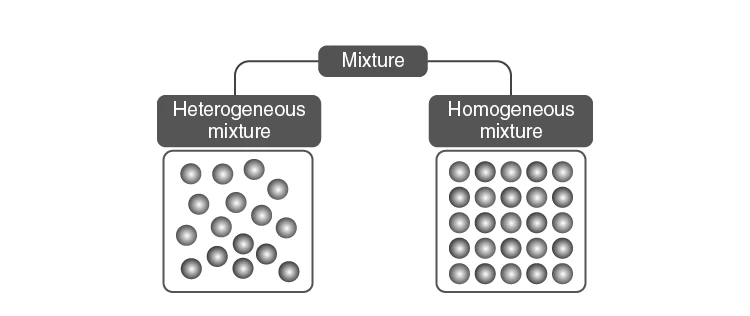
Classification of mixtures into homogeneous and heterogeneous
Example Problem
Question: A mixture contains oil and water. Classify this mixture and explain your reasoning.
Solution:
Oil and water do not mix uniformly and form separate layers.
The composition varies in different parts of the mixture.
Therefore, this is a heterogeneous mixture.
Exploring Homogeneous Mixtures
Homogeneous mixtures have a uniform composition throughout, meaning the properties are consistent in every part of the mixture. These mixtures are often called solutions. Common examples include sugar dissolved in water or alloys where metals are blended evenly.
Example Problem
Question: When salt dissolves completely in water, what type of mixture is formed? Justify your answer.
Solution:
Salt dissolves uniformly in water, creating a single-phase mixture.
The properties are consistent throughout the solution.
This is a homogeneous mixture.
Summary Table: Essential Features of Mixtures
Aspect | Description |
|---|---|
Composition | Two or more substances physically combined |
Chemical Bonding | Absent between components |
Properties | Components retain original properties |
Separation | Possible by physical methods |
Ratio of Components | Variable and not fixed |
Energy Change | No energy change during mixing |
Types | Homogeneous and heterogeneous |
States of Matter | Can be solid, liquid, or gas mixtures |
Glossary of Key Terms Related to Mixtures
Term | Definition |
|---|---|
Mixture | A physical combination of two or more substances without chemical bonding. |
Homogeneous Mixture | A mixture with uniform composition and properties throughout. |
Heterogeneous Mixture | A mixture with non-uniform composition and visibly distinct parts. |
Solution | A homogeneous mixture where one substance dissolves in another. |
Suspension | A heterogeneous mixture where particles are dispersed but settle over time. |
Colloid | A mixture with particles dispersed evenly but not dissolved. |
Physical Separation | Methods like filtration or evaporation used to separate mixture components. |
Component | Individual substances present in a mixture. |
Phase | A physically distinct part of a mixture with uniform composition. |
Mechanical Mixing | Process of physically combining substances without chemical change. |
Frequently Asked Questions About Mixtures
What are the main categories of mixtures?
Mixtures are primarily classified into homogeneous mixtures, which have uniform properties throughout, and heterogeneous mixtures, which have varying properties in different parts.
How do the properties of components behave in a mixture?
Each component in a mixture retains its original physical and chemical properties, and the mixture's overall properties depend on these individual components.
Can the components of a mixture be separated easily?
Yes, components of mixtures can be separated by physical methods such as filtration, evaporation, or decantation without chemical reactions.
Is vinegar considered a mixture?
Yes, vinegar is a homogeneous mixture (solution) of water and acetic acid, appearing uniform throughout.
What distinguishes a mixture from a compound?
A mixture involves physical combination without chemical bonding, while a compound is formed by chemical bonding between elements with fixed ratios.