Understanding the Fundamental States of Matter
Essence and Classification of Matter
Defining Matter and Its Particle Nature
Matter is composed of minuscule particles that are imperceptible to the naked eye. These particles form the building blocks of everything around us. Observations reveal that matter manifests in various forms, each with distinct physical characteristics. For instance, some materials like wood and stone maintain a fixed shape and volume, while others such as water adapt their shape to the container they occupy. Additionally, certain forms like air lack a definite shape or size altogether.
Scientists categorize matter based on its physical state, which depends on external conditions like temperature and pressure. The primary states include solids, liquids, and gases, with additional exotic states such as plasma and Bose-Einstein condensates observed under special conditions.
Example Problem
A substance occupies a fixed volume but changes shape depending on the container. Identify the state of matter and explain the particle arrangement responsible for this behavior.
Solution:
The substance described is a liquid because it has a definite volume but no fixed shape, conforming to the container's shape.
In liquids, particles are closely packed but not rigidly fixed, allowing them to slide past one another. This mobility enables liquids to flow and take the shape of their container while maintaining volume.
Characteristics of Solid Matter
Properties and Particle Arrangement in Solids
In solids, particles are densely packed in a fixed, orderly pattern, leaving minimal space between them. This tight packing results in solids having a definite shape and volume that resist compression. The particles vibrate around fixed positions but do not move freely, which accounts for the rigidity of solids.
The strong intermolecular forces in solids maintain their structure and limit diffusion, making solids the least diffusive state of matter.
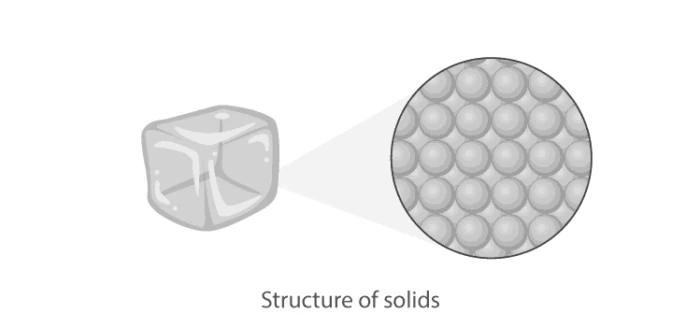
Particle arrangement in solids illustrating close packing
Example Problem
A solid block has a volume of 0.5 \text{ m}^3 and a mass of 400 \text{ kg}. Calculate its density and explain why solids have fixed shapes.
Solution:
Density \( \rho \) is given by:
\[ \rho = \frac{\text{mass}}{\text{volume}} = \frac{400 \text{ kg}}{0.5 \text{ m}^3} = 800 \text{ kg/m}^3 \]
Solids maintain fixed shapes because their particles are tightly bound in fixed positions, allowing only vibrational motion. This strong bonding prevents particles from moving freely, preserving the solid's shape.
Understanding Liquids and Their Behavior
Particle Dynamics and Properties of Liquids
Liquids have particles that are less tightly packed compared to solids, providing them with the ability to flow. While liquids maintain a constant volume, they do not have a fixed shape and instead conform to the shape of their container. The intermolecular forces in liquids are weaker than in solids, allowing particles to move past each other but still remain close.
This arrangement results in liquids being nearly incompressible and having a higher diffusion rate than solids.
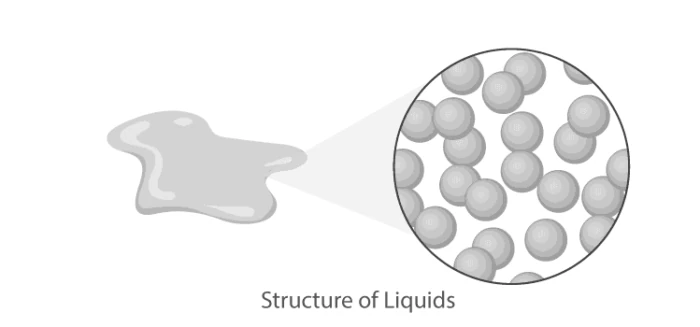
Arrangement of particles in liquids with moderate spacing
Example Problem
A container holds 2 liters of water. If the water is poured into a different container with a smaller base area but taller height, describe what happens to the shape and volume of the water.
Solution:
The volume of water remains constant at 2 liters because liquids have a fixed volume.
The shape of the water changes to match the new container's shape, as liquids do not have a fixed shape.
This behavior is due to the particles being able to move freely while remaining close together.
Gas State: Properties and Particle Movement
Characteristics of Gaseous Matter
Gases consist of particles that are widely spaced and move independently with negligible attraction between them. This freedom allows gases to expand and fill any container, resulting in neither a fixed shape nor a fixed volume. Gases are highly compressible and exhibit the fastest diffusion rates among the states of matter.
The kinetic energy of gas particles is significantly higher than that of solids and liquids, enabling rapid and random motion.
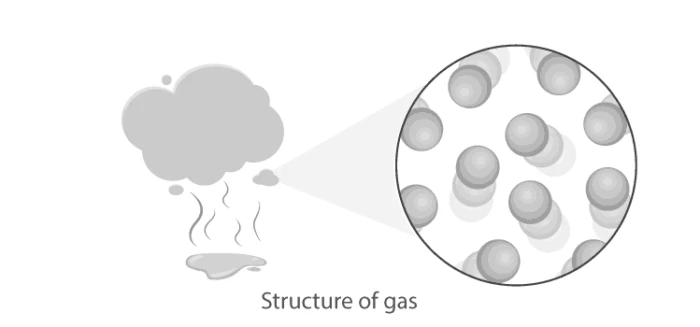
Particle distribution in gases with large intermolecular distances
Example Problem
A gas occupies a volume of 5 \text{ m}^3 at a pressure of 100 \text{ kPa}. If the gas is compressed to 2 \text{ m}^3, assuming temperature remains constant, calculate the new pressure.
Solution:
Using Boyle's Law for gases at constant temperature:
\[ P_1 V_1 = P_2 V_2 \]
Given \( P_1 = 100 \text{ kPa} \), \( V_1 = 5 \text{ m}^3 \), and \( V_2 = 2 \text{ m}^3 \), solve for \( P_2 \):
\[ P_2 = \frac{P_1 V_1}{V_2} = \frac{100 \times 5}{2} = 250 \text{ kPa} \]
The pressure increases to 250 kPa due to compression, illustrating the high compressibility of gases.
Exotic States: Plasma and Bose-Einstein Condensates
Exploring Plasma: The Ionized State
Plasma is an ionized state of matter where particles possess extremely high kinetic energy. It is commonly found in stars and lightning, and artificially created in neon signs by ionizing gases with electricity. The charged particles in plasma allow it to conduct electricity and respond to magnetic fields, distinguishing it from other states.
Example Problem
Explain why plasma can conduct electricity while gases generally cannot.
Solution:
In plasma, atoms are ionized, producing free electrons and ions.
These charged particles can move freely, allowing electric current to flow.
In contrast, neutral gas particles lack free charges, making gases poor conductors.
Bose-Einstein Condensates: Matter at Near Absolute Zero
Discovered in 1995, Bose-Einstein condensates (BEC) form when certain atoms are cooled to temperatures close to absolute zero, causing them to occupy the same quantum state and behave as a single quantum entity. This state exhibits unique properties such as superfluidity, where the condensate flows without friction.
Example Problem
Describe the behavior of atoms in a Bose-Einstein condensate and its significance in physics research.
Solution:
At near absolute zero, atoms lose individual identity and merge into a single quantum state.
This super-atom exhibits quantum phenomena on a macroscopic scale, such as superfluidity.
BECs help scientists study quantum mechanics and the dual nature of light and matter.
Quick Reference: Summary of Matter States
State of Matter | Particle Arrangement | Shape | Volume | Compressibility | Diffusion Rate |
|---|---|---|---|---|---|
Solid | Closely packed, fixed positions | Definite | Definite | Very low | Very slow |
Liquid | Close but mobile | Indefinite (takes container shape) | Definite | Low | Moderate |
Gas | Far apart, free movement | Indefinite | Indefinite | High | Fast |
Plasma | Ionized particles, high energy | Indefinite | Indefinite | Very high | Very fast |
Bose-Einstein Condensate | Atoms in unified quantum state | Indefinite | Indefinite | Negligible | Unique quantum behavior |
Glossary of Key Terms
Term | Definition |
|---|---|
Matter | Anything that has mass and occupies space. |
Particle | Smallest unit of matter, such as atoms or molecules. |
Solid | State of matter with fixed shape and volume. |
Liquid | State of matter with fixed volume but variable shape. |
Gas | State of matter with neither fixed shape nor volume. |
Plasma | Ionized gas with high energy particles. |
Bose-Einstein Condensate | State of matter formed near absolute zero with quantum properties. |
Diffusion | Process of particles spreading from high to low concentration. |
Compressibility | Ability of matter to decrease in volume under pressure. |
Kinetic Energy | Energy possessed by particles due to motion. |
Frequently Asked Questions
What are the three primary states of matter?
The main states are solid, liquid, and gas. All consist of tiny particles with mass and volume, differing in particle arrangement and movement.
Is it possible to create or destroy matter?
According to the law of conservation of mass, matter cannot be created or destroyed in a closed system; it only changes form.
How does matter relate to energy?
Matter and energy are interconvertible, as described by Einstein’s theory of relativity, indicating they are different forms of the same entity.
What distinguishes plasma from other states?
Plasma consists of ionized particles with high kinetic energy, enabling it to conduct electricity and respond to magnetic fields.
Why is Bose-Einstein condensate important in physics?
BEC allows the study of quantum phenomena on a macroscopic scale, revealing insights into superfluidity and the wave-particle duality of matter.