Understanding Sound Reflection and Its Practical Uses
Fundamentals of Sound and Its Reflection
What Is Sound and How Does It Travel?
Sound is a form of energy produced by vibrating objects, which causes oscillations in particles of a medium such as air, water, or solids. These oscillations generate waves that our ears perceive as sound. Since sound requires a medium to travel, it cannot propagate through a vacuum. The mechanical nature of sound waves means they transfer energy through particle vibrations without transporting matter.
Example Problem
A tuning fork vibrates at a frequency of 440 Hz in air. If the speed of sound in air is \( 340 \text{ m/s} \), calculate the wavelength of the sound produced.
Solution:
The wavelength \( \lambda \) is given by the relation:
\[ \lambda = \frac{v}{f} \]
where \( v = 340 \text{ m/s} \) and \( f = 440 \text{ Hz} \).
Substituting the values:
\[ \lambda = \frac{340}{440} = 0.773 \text{ m} \]
Therefore, the wavelength of the sound wave is approximately \( 0.773 \text{ meters} \).
Principles Governing Sound Reflection
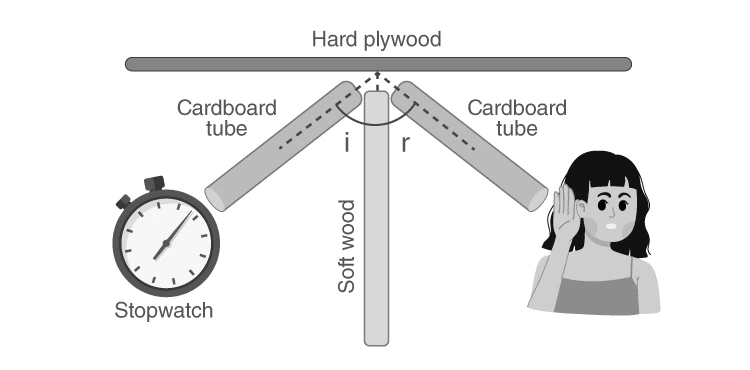
Sound waves reflect off surfaces much like light waves do. The reflection of sound follows two fundamental laws: the angle at which the sound wave hits a surface (angle of incidence) is equal to the angle at which it bounces off (angle of reflection), and the incident wave, reflected wave, and the normal to the surface all lie in the same plane. For effective reflection, the surface should be sufficiently large compared to the wavelength of the sound and can be either smooth or rough.
Example Problem
A sound wave strikes a flat wall at an angle of \( 30^\circ \) to the normal. Determine the angle at which it will reflect.
Solution:
According to the law of reflection:
\[ \text{Angle of reflection} = \text{Angle of incidence} = 30^\circ \]
Thus, the sound wave will reflect at an angle of \( 30^\circ \) to the normal.
Practical Uses of Sound Reflection in Daily Life
Echo: Nature’s Sound Reflection Phenomenon
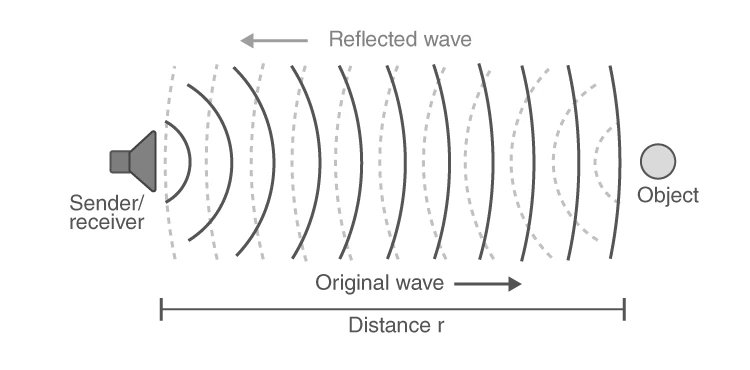
An echo is the repetition of sound caused by the reflection of sound waves from a distant surface such as a cliff or a building. It allows the sound to be heard even after the original source has stopped producing it. Animals like bats and dolphins utilize echoes to navigate and locate objects, a process known as echolocation. This principle is also applied in SONAR technology, which helps detect underwater objects by sending ultrasonic waves and analyzing their reflections.
Example Problem
A person standing near a cliff hears an echo 2 seconds after clapping. If the speed of sound is \( 340 \text{ m/s} \), calculate the distance between the person and the cliff.
Solution:
The total time for the sound to travel to the cliff and back is 2 seconds. So, the time to reach the cliff is:
\[ t = \frac{2}{2} = 1 \text{ second} \]
Distance to the cliff \( d \) is:
\[ d = v \times t = 340 \times 1 = 340 \text{ meters} \]
Therefore, the cliff is 340 meters away from the person.
Hearing Aids: Enhancing Sound Reception
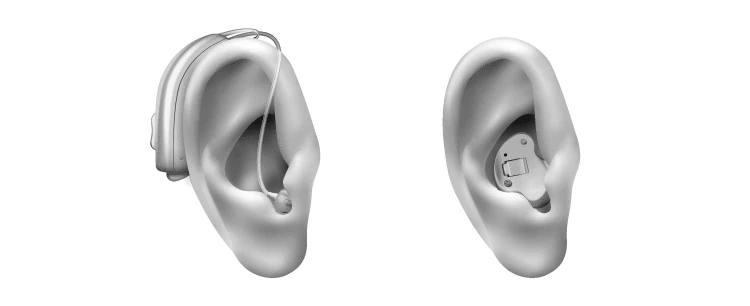
Hearing aids are devices designed to assist individuals with hearing difficulties by capturing sound waves and directing them efficiently into the ear canal. They use reflection principles to focus sound waves into a narrow path, amplifying the sound and improving clarity for the user.
Example Problem
Explain how a hearing aid uses the reflection of sound to improve hearing.
Answer:
- Sound waves enter the hearing aid and are reflected inside its structure.
- These reflections concentrate the sound waves into a narrow beam.
- The focused sound waves are then directed into the ear canal.
- This amplification helps the user hear sounds more clearly.
Megaphones: Directing Sound Efficiently
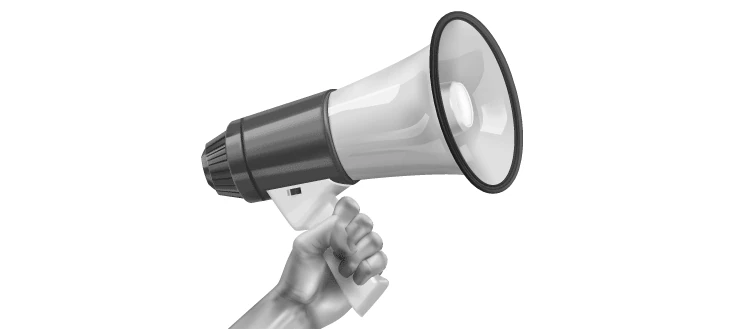
Megaphones are cone-shaped devices that prevent sound waves from dispersing by reflecting them internally within the tube. This confinement of sound waves allows the sound to travel farther and be heard more clearly over long distances.
Example Problem
Describe how the shape of a megaphone helps in amplifying sound.
Answer:
- The horn shape causes sound waves to reflect multiple times inside the tube.
- These reflections prevent the sound from spreading out in all directions.
- Sound waves are concentrated and directed forward.
- This focused sound travels farther and is louder to listeners.
Sound Boards: Enhancing Acoustic Quality in Auditoriums
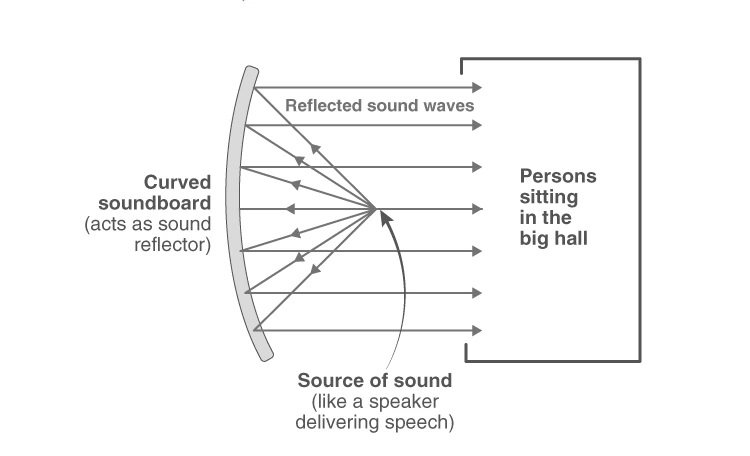
Sound boards are curved surfaces strategically positioned so that the sound source is at their focal point. They reflect sound waves evenly throughout a hall or auditorium, improving sound distribution and clarity for the audience.
Example Problem
How does a sound board improve the quality of sound in an auditorium?
Answer:
- Sound boards are curved to focus sound waves from the source.
- They reflect sound waves uniformly across the space.
- This reflection prevents sound loss and dead spots.
- Audience members receive clear and enhanced sound quality.
Summary Table for Quick Review
| Concept | Key Points | Example |
|---|---|---|
| Sound | Mechanical wave requiring a medium; produced by vibrating objects | Wavelength calculation from frequency and speed |
| Reflection of Sound | Angle of incidence equals angle of reflection; all waves lie in same plane | Sound reflecting off a wall at \(30^\circ\) |
| Echo | Reflected sound heard after delay; used in echolocation and SONAR | Distance to cliff from echo time |
| Hearing Aid | Focuses sound waves into ear canal using reflection | Amplifies sound for hearing impaired |
| Megaphone | Horn shape reflects sound internally to prevent spreading | Directs voice over long distances |
| Sound Board | Curved surface reflects sound evenly in auditoriums | Enhances sound clarity for audience |
Glossary of Important Terms
| Term | Definition |
|---|---|
| Sound Wave | A mechanical wave produced by vibrating objects that travels through a medium. |
| Reflection | The bouncing back of waves when they hit a surface. |
| Angle of Incidence | The angle between the incident wave and the normal to the surface. |
| Angle of Reflection | The angle between the reflected wave and the normal to the surface. |
| Echo | A reflected sound wave heard after the original sound. |
| SONAR | Sound Navigation and Ranging; technique using sound waves to detect underwater objects. |
| Hearing Aid | A device that amplifies sound for people with hearing loss. |
| Megaphone | A cone-shaped device that directs and amplifies sound waves. |
| Sound Board | A curved surface used to reflect sound waves evenly in auditoriums. |
| Mechanical Wave | A wave that requires a medium to travel, such as sound waves. |
Frequently Asked Questions
What is sound?
Sound is a mechanical wave generated by vibrating objects that travels through a medium like air or water, producing auditory sensations.
What are the laws governing the reflection of sound?
The angle of incidence equals the angle of reflection, and the incident wave, reflected wave, and normal all lie in the same plane.
How is an echo formed?
An echo occurs when sound waves reflect off a distant surface and return to the listener after a delay.
Why does sound travel fastest in solids?
Because particles in solids are closely packed, vibrations transfer more quickly, making sound speed highest in solids compared to liquids and gases.
What is the role of a megaphone in sound propagation?
A megaphone reflects sound waves internally to prevent spreading, focusing the sound and allowing it to travel farther.