Distinguishing Physical and Chemical Changes
Understanding the Nature of Physical and Chemical Transformations
Characteristics of Physical Changes
Physical changes involve alterations in the form, appearance, or state of a substance without modifying its chemical identity. These changes are typically reversible and do not produce new substances. Common examples include changes in state such as melting, freezing, or boiling, as well as changes in shape or size like tearing or crushing.
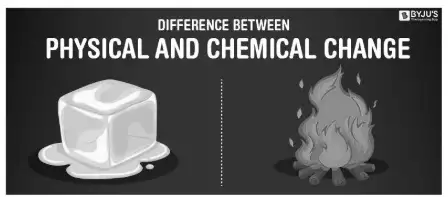
This image shows the difference between physical and chemical changes. On the left is a melting ice cube, representing a physical change. On the right is a burning fire, representing a chemical change. Step-by-step explanation for high school students: 1. Physical change: The ice melts into water, but it is still H2O. No new substance is made. 2. Physical changes can usually be reversed, like freezing water back into ice. 3. Chemical change: Burning wood creates new substances like ash and smoke. 4. Chemical changes cannot be easily reversed because the substances are changed forever. 5. In summary, physical change changes the form, chemical change changes the substance itself.
Example: Consider ice melting into water at room temperature. The solid ice changes into liquid water, but its chemical composition, H2O, remains unchanged. This process is reversible by freezing the water back into ice.
Identifying Chemical Changes and Their Effects
Chemical changes result in the formation of one or more new substances with different chemical properties. These changes are generally irreversible under normal conditions and involve breaking and forming chemical bonds. Indicators of chemical changes include color shifts, gas production, temperature changes, and the appearance of precipitates.
Example: When iron reacts with oxygen and moisture, rust forms. This is a chemical change because iron oxide is a new substance with properties different from iron. The reaction is not easily reversible.
Key Differences Between Physical and Chemical Changes
While physical changes affect only the physical attributes of a substance, chemical changes alter its molecular structure. Physical changes are mostly reversible, whereas chemical changes tend to be permanent. Recognizing these differences is crucial for understanding material behavior in various scientific and practical contexts.
Example: Boiling water is a physical change as it changes from liquid to gas without altering chemical composition. Burning paper is a chemical change because it produces ash, smoke, and new substances.
Recognizing and Analyzing Change Indicators
Signs That Indicate a Chemical Reaction
Detecting a chemical change involves observing specific signs such as gas evolution, color change, temperature variation, odor emission, light production, or precipitate formation. These clues help differentiate chemical changes from mere physical transformations.
Example: When vinegar reacts with baking soda, bubbles of carbon dioxide gas form, indicating a chemical reaction. The temperature may also change during this process.
Forces Driving Physical Changes
Physical changes can be triggered by external forces such as temperature shifts, pressure variations, or mechanical motion. These forces alter the physical state or shape without affecting the chemical composition of the material.
Example: Heating wax causes it to melt from solid to liquid. This change is physical and reversible by cooling the wax back to solid form.
Distinguishing Between Reversible and Irreversible Changes
Physical changes are often reversible, meaning the original state can be restored by applying suitable conditions. Chemical changes, however, usually cannot be undone easily because new substances are formed. Understanding this distinction aids in predicting the outcome of various processes.
Example: Dissolving sugar in water is a physical and reversible change, whereas burning sugar results in carbon and gases, an irreversible chemical change.
Practical Applications and Observations
Common Examples of Physical and Chemical Changes
Everyday life presents numerous instances of both physical and chemical changes. Recognizing these helps in understanding natural phenomena and industrial processes.
Example: Melting butter on a pan is a physical change; the butter changes state but remains chemically the same.
Example: Cooking an egg causes chemical changes as new substances form, altering the egg's properties permanently.
Evaluating Changes Through Experimental Observation
Careful observation during experiments can help identify the type of change occurring. Monitoring temperature, color, gas release, and reversibility provides clues to classify the change correctly.
Impact of Changes on Material Properties
Physical changes affect properties like shape, size, and state, while chemical changes alter chemical composition and properties such as reactivity and color. Understanding these impacts is essential in material science and chemistry.
Example: Freezing water changes its state and density (physical), while burning wood changes its chemical composition and produces ash (chemical).
Quick Reference: Contrasting Physical and Chemical Changes
Aspect | Physical Change | Chemical Change |
|---|---|---|
Definition | Change in form or state without altering chemical identity | Transformation producing new substances with different properties |
Reversibility | Usually reversible | Generally irreversible |
Examples | Melting, freezing, tearing, dissolving | Burning, rusting, cooking, decomposition |
Energy Change | Minor or no energy change | Often involves significant energy change |
Indicators | Change in shape, size, or state | Color change, gas evolution, temperature change |
Glossary of Key Terms
Term | Meaning |
|---|---|
Physical Change | A change affecting the form or appearance without altering chemical composition |
Chemical Change | A process that results in the formation of new substances with different properties |
Reversible | A change that can be undone to restore the original state |
Irreversible | A change that cannot be undone easily, resulting in permanent alteration |
Precipitate | A solid formed from a solution during a chemical reaction |
Gas Evolution | Release of gas bubbles during a chemical reaction |
Melting | Transition from solid to liquid state |
Boiling | Transition from liquid to gas state |
Rusting | Chemical reaction of iron with oxygen forming iron oxide |
Decomposition | Breaking down of a compound into simpler substances |
Frequently Asked Questions
How can one differentiate between physical and chemical changes?
Physical changes alter only the appearance or state without changing the substance's chemical identity, while chemical changes produce new substances with different properties.
Why is it important to distinguish between these two types of changes?
Understanding the difference helps predict whether a change is reversible and informs how substances behave in natural and industrial processes.
Can physical changes be reversed?
Most physical changes are reversible by applying suitable conditions like temperature or pressure adjustments.
What are some common signs of a chemical change?
Signs include color change, gas production, temperature change, odor emission, light release, and formation of a precipitate.
Are all chemical changes irreversible?
Generally, chemical changes are irreversible under normal conditions, but some can be reversed through specific chemical reactions.