Understanding Motion: Concepts, Types, and Examples
Fundamentals of Motion and Position Change
Clarifying Distance and Displacement
When describing how an object moves or remains still, we always refer to a fixed point called the origin. To quantify how an object's position changes, two key measures are used: distance and displacement. Distance refers to the total length of the path traveled by the object, regardless of direction, and is expressed only as a magnitude. In contrast, displacement is the straight-line measurement from the starting point to the ending point, requiring both magnitude and direction to fully describe it.
For example, if a person walks from point A to point B along a winding path, the distance is the entire length of that path, while the displacement is the direct straight-line distance between A and B.
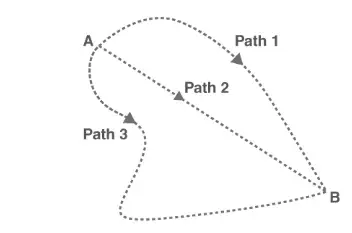
This image shows three different paths from point A to point B. Step-by-step explanation: 1. There are two points labeled A and B. 2. There are three possible routes (Path 1, Path 2, and Path 3) connecting these points. 3. Path 2 is the straightest and shortest path. 4. Paths 1 and 3 are longer and curved. 5. This diagram is often used to compare different routes or ways to travel between two locations.
Example: Calculating Distance and Displacement in a Round Trip
Consider two towns, X and Y, separated by a distance \( d \). A traveler moves from town X to town Y and then returns to town X. Determine the total distance traveled and the displacement.
Solution:
The total distance covered is the sum of the distances for both trips:
\[ \text{Distance} = d + d = 2d \]
Displacement is the shortest distance between the initial and final positions. Since the traveler ends up at the starting point, the displacement is zero:
\[ \text{Displacement} = 0 \]
This example highlights that displacement can never exceed the distance traveled, and it can be equal only when the path is a straight line without any deviation.
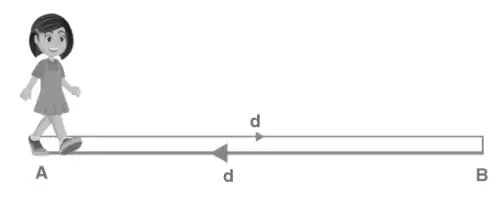
The image shows a girl walking along a straight path from point A to point B. The path is marked with a distance "d" between A and B, and the arrow indicates the direction the girl is moving. Step-by-step explanation: 1. The girl starts at point A. 2. She walks straight towards point B. 3. The distance between A and B is represented by "d". 4. The arrow shows the direction she moves along the path. 5. This diagram can be used to explain concepts like distance, direction, and displacement in physics.
Exploring Different Forms of Motion
Classification of Motion Types
Objects in the world move in various ways depending on their nature and the forces acting on them. Motion can be broadly categorized into three types based on the path and nature of movement:
Linear Motion: Movement along a straight or curved path.
Rotational Motion: Movement around an internal axis.
Oscillatory Motion: Repetitive movement about a central position.
Understanding these categories helps in analyzing and predicting the behavior of moving objects in different contexts.
Linear Motion and Its Variants
Linear motion involves an object moving from one location to another along a path. This motion is further divided into:
Rectilinear Motion: Movement along a straight line.
Curvilinear Motion: Movement along a curved trajectory.
Examples include a car driving on a highway (rectilinear) or a ball thrown in a curved path (curvilinear).
Example: Identifying Motion Type of a Moving Bicycle
A bicycle moves forward on a straight road while its wheels rotate. Classify the types of motion involved.
Solution:
The bicycle’s forward movement along the road is an example of rectilinear motion.
The rotation of the wheels around their axes represents rotational motion.
This shows that an object can exhibit multiple types of motion simultaneously.
Understanding Rotational Motion
Rotational motion occurs when an object spins around its own axis. This type of motion is common in many natural and mechanical systems.
Examples include the Earth spinning on its axis and the wheels of a car turning as it moves.
Example: Wheel Rotation in a Moving Vehicle
When a car moves forward, its wheels rotate. Explain the type of motion and its axis.
Solution:
The wheels exhibit rotational motion as they spin around their central axis.
The axis of rotation is the axle of the wheel.
Oscillatory Motion and Its Characteristics
Oscillatory motion is characterized by an object moving back and forth repeatedly around a fixed central point or mean position.
Common examples include a pendulum swinging in a clock or a child moving on a swing.
Example: Pendulum Movement in a Clock
Describe the motion of a pendulum in a clock and identify its type.
Solution:
The pendulum moves to and fro about its central resting position.
This repetitive back-and-forth movement is an example of oscillatory motion.
Real-Life Instances of Motion
Everyday Examples Demonstrating Motion
Motion is an integral part of daily life and can be observed in numerous activities and natural phenomena. Some common examples include:
Walking or running, where the position of the body changes over time.
The opening and closing of doors, involving movement of the door about its hinges.
The flow of air during breathing, which is a continuous movement of air particles.
Vehicles transporting passengers from one location to another.
Example: Motion in Breathing Process
Explain how motion is involved in the process of breathing.
Solution:
Air moves in and out of the lungs, changing position continuously.
This movement of air particles is a form of motion essential for respiration.
Quick Reference: Key Points on Motion
Concept | Definition | Example |
|---|---|---|
Distance | Total length of the path traveled by an object | Walking 5 km along a winding road |
Displacement | Shortest straight-line distance between initial and final points with direction | Direct line from home to school |
Linear Motion | Movement along a straight or curved path | Car driving on a highway |
Rotational Motion | Movement around an internal axis | Earth spinning on its axis |
Oscillatory Motion | Back-and-forth movement about a mean position | Pendulum swinging in a clock |
Glossary of Important Terms
Term | Meaning |
|---|---|
Origin | A fixed reference point for measuring motion |
Distance | Total path length covered by an object |
Displacement | Shortest distance between initial and final positions with direction |
Rectilinear Motion | Motion along a straight line |
Curvilinear Motion | Motion along a curved path |
Rotational Motion | Movement of an object around its own axis |
Oscillatory Motion | Repetitive back-and-forth motion about a central point |
Mean Position | The central point around which oscillation occurs |
Path Length | The actual distance traveled by an object |
Axis | Imaginary line about which rotation occurs |
Frequently Asked Questions
What is the definition of motion?
Motion is the change in position of an object with respect to time.
What are the main types of motion?
The primary types of motion are linear motion, rotational motion, and oscillatory motion.
How is linear motion classified?
Linear motion is divided into rectilinear motion (straight path) and curvilinear motion (curved path).
Is displacement always equal to distance?
No, displacement is the shortest straight-line distance between two points and can be less than or equal to the distance traveled, but never greater.
Can you give examples of motion in daily life?
Examples include walking, running, the flow of air during breathing, and vehicles moving from one place to another.