Fundamentals of Matter and Its Properties
Understanding the Nature of Matter
Defining Matter and Its Basic Composition
Matter is defined as any substance that possesses mass and occupies space. Everyday objects such as pens, paper, grains of sand, air, and ice all qualify as matter. At the microscopic level, matter consists of minuscule particles that are invisible to the naked eye. These particles form the foundation of all substances and determine their characteristics.
Key Traits of Particles Constituting Matter
Every material is composed of particles that exhibit distinct features influencing the material's state and properties. Three fundamental characteristics of these particles are:
Presence of Spaces: Particles are separated by tiny gaps, allowing other particles to fit in between.
Continuous Movement: Particles are in constant, random motion due to their kinetic energy.
Mutual Attraction: Particles attract each other with forces that vary in strength depending on the substance.
Illustration of Particle Spacing
Consider a glass filled with water. When a teaspoon of sugar or salt is stirred into it, the solution remains clear. This occurs because the sugar or salt particles occupy the spaces between water particles without displacing them. The dissolution continues until these inter-particle spaces are saturated.
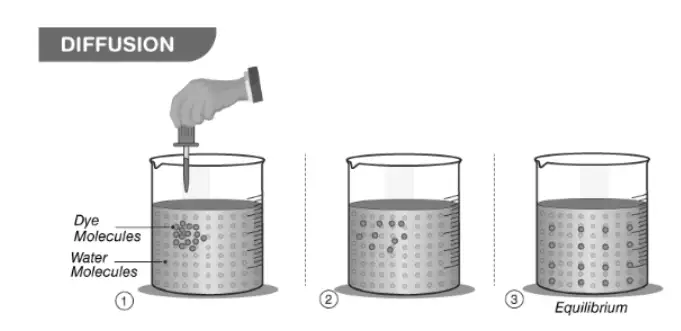
This image shows the process of diffusion, where dye molecules spread out in water until they are evenly distributed. Step-by-step explanation: 1. Add dye molecules to the water. 2. Dye molecules start to move and spread out through the water. 3. After some time, the dye molecules are evenly mixed with water molecules, reaching equilibrium. This means the dye is spread out uniformly and stops changing.
Example Problem: Particle Spacing in Solutions
Problem: A student dissolves 15 grams of salt in 250 mL of water. Explain why the salt dissolves without making the water appear cloudy.
Solution:
The salt breaks down into tiny particles that fit into the spaces between water molecules.
These inter-particle spaces allow the salt particles to disperse evenly without displacing water particles.
Because the particles are too small and evenly distributed, the solution remains transparent.
Continuous Motion of Particles and Diffusion
Particles in matter are perpetually moving in random directions, a behavior driven by their kinetic energy. This motion explains phenomena such as the spreading of ink in water or the scent dispersing from incense sticks. When particles of different substances intermingle spontaneously, this process is known as diffusion.
Increasing temperature raises the kinetic energy of particles, accelerating their movement and thus speeding up diffusion.
Example Problem: Effect of Temperature on Diffusion Rate
Problem: If the temperature of water is increased from 25°C to 50°C, how does this affect the diffusion of a dye in the water?
Solution:
Higher temperature increases the kinetic energy of water and dye particles.
Particles move more rapidly, causing the dye to spread faster throughout the water.
Therefore, diffusion rate increases with temperature.
Inter-Particle Forces and Material Strength
Materials differ in strength due to the forces holding their particles together. For example, an iron rod is tougher to break than a chalk stick or a pen because the particles in iron experience stronger attractive forces. To break a material, these inter-particle forces must be overcome. The balance between these forces and the particles' kinetic energy determines the physical state of matter.
Example Problem: Comparing Strength of Materials
Problem: Why is a wooden stick easier to break than a metal rod?
Solution:
Metal particles are held together by stronger inter-particle forces compared to wood.
These stronger forces require more energy to overcome, making metal tougher.
Wood has weaker forces between particles, so it breaks more easily.
Exploring Physical Characteristics of Matter
Overview of Physical Properties
Scientists classify matter based on its physical and chemical properties. Physical properties are observable traits that do not alter the substance's identity. Examples include mass, volume, texture, solubility, and color. Different materials exhibit unique physical properties; for instance, wood is continuous and solid, while sand consists of coarse particles. Salt dissolves in water, but sand does not, illustrating solubility differences.
Activity Demonstrating Physical Properties
Take several crystals of potassium permanganate and dissolve them in 350 mL of water. Then, transfer 25 mL of this solution into 120 mL of pure water in another container. Repeat this dilution process 8 to 10 times, each time transferring 25 mL into fresh water. Observe the color intensity of the final solution.
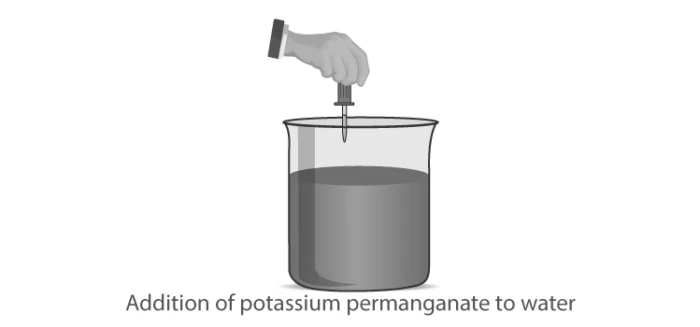
Dilution experiment showing physical properties of matter
The last solution appears faint pink, indicating that even tiny amounts of potassium permanganate affect color. This shows matter can be divided into extremely small, indivisible pieces that retain their properties.
Example Problem: Understanding Indivisibility of Matter
Problem: Why does the color of potassium permanganate solution remain visible even after multiple dilutions?
Solution:
Potassium permanganate particles are very small and spread throughout the solution.
Even after dilution, some particles remain, imparting color.
This demonstrates that matter consists of tiny, indestructible particles.
Summary of Physical Properties
All matter has mass and occupies space.
Matter can be divided into countless tiny particles.
Physical properties such as solubility, color, and texture vary among substances.
Quick Reference: Essential Concepts of Matter
Concept | Description |
|---|---|
Matter | Anything that has mass and occupies space. |
Particles | Minute units that make up matter, invisible to the naked eye. |
Inter-Particle Space | Small gaps between particles allowing substances to dissolve. |
Particle Motion | Continuous random movement due to kinetic energy. |
Diffusion | Spontaneous mixing of particles from different substances. |
Inter-Particle Forces | Attractive forces holding particles together, affecting strength. |
Physical Properties | Observable traits like mass, volume, solubility, and color. |
Solubility | Ability of a substance to dissolve in another. |
Indivisibility of Particles | Particles can be divided into smaller parts but retain properties. |
Kinetic Energy | Energy that causes particles to move continuously. |
Glossary of Key Terms
Term | Meaning |
|---|---|
Matter | Substance with mass and volume. |
Particle | Smallest unit of matter. |
Inter-Particle Space | Void between particles. |
Kinetic Energy | Energy of motion in particles. |
Diffusion | Mixing of particles from different substances. |
Solubility | Ability to dissolve in a solvent. |
Physical Property | Characteristic observable without changing substance. |
Inter-Particle Force | Attraction between particles. |
Indivisibility | Particles cannot be broken down further without losing identity. |
State of Matter | Physical form: solid, liquid, or gas. |
Frequently Asked Questions
What defines matter in scientific terms?
Matter is anything that has mass and occupies space, composed of tiny particles.
Why do particles of matter move continuously?
Particles possess kinetic energy, causing them to move randomly and constantly.
How does temperature affect the movement of particles?
Increasing temperature raises kinetic energy, making particles move faster and increasing diffusion rates.
What causes differences in strength among materials?
Variations in inter-particle forces determine how strong or weak a material is.
Why does salt dissolve in water but sand does not?
Salt particles fit into spaces between water particles and interact with them, while sand particles do not dissolve due to lack of such interaction.