Understanding Evaporation and Its Cooling Effects
Fundamentals of Evaporation
What Happens During Evaporation?
Evaporation is the process where a liquid gradually transforms into a gas, occurring primarily at the liquid's surface. This transition involves liquid molecules gaining enough energy to break free from the surface tension and enter the air as vapor. For evaporation to proceed, the surrounding air must not be saturated with the vapor of the liquid, allowing continuous escape of molecules.
For instance, when you apply perfume or acetone on your skin, you experience a cooling sensation. This happens because molecules with higher evaporation rates, like acetone, absorb more energy from your skin as they vaporize, causing a faster cooling effect compared to substances like water or perfume.
During evaporation, molecules collide and exchange energy. Those near the surface that acquire sufficient kinetic energy overcome the liquid's vapor pressure and escape into the air. This energy loss from the liquid results in a temperature drop, a phenomenon known as evaporative cooling.
Example: Comparing Evaporation Rates
Suppose you spill 50 mL of acetone and 50 mL of water on your hand. If acetone evaporates completely in 5 minutes, estimate how long water would take to evaporate if its evaporation rate is one-fifth that of acetone.
Solution:
Given acetone evaporation time \( t_a = 5 \text{ minutes} \), and water evaporation rate is \(\frac{1}{5}\) of acetone's rate, so water evaporation time \( t_w = 5 \times 5 = 25 \text{ minutes} \).
Therefore, water will take approximately 25 minutes to evaporate completely under the same conditions.
Mechanism Behind Cooling Due to Evaporation
How Evaporation Lowers Temperature
Evaporation induces cooling because molecules require energy to transition from liquid to gas. This energy, known as latent heat of vaporization, is absorbed from the liquid and its surroundings, reducing the temperature of the liquid and nearby environment.
During evaporation, although the liquid's temperature remains constant until boiling, energy is continuously absorbed to break intermolecular bonds. This hidden energy does not raise the temperature but facilitates the phase change.
For example, when sweat evaporates from the skin, it extracts heat energy, cooling the body. This natural cooling mechanism is vital for temperature regulation in living organisms.
Example: Calculating Energy Absorbed During Evaporation
A 100 g sample of water evaporates at room temperature. Given the latent heat of vaporization of water is \( 2.26 \times 10^6 \text{ J/kg} \), calculate the energy absorbed during this process.
Solution:
Mass of water, \( m = 100 \text{ g} = 0.1 \text{ kg} \)
Energy absorbed, \( Q = m \times L_v = 0.1 \times 2.26 \times 10^6 = 2.26 \times 10^5 \text{ J} \)
Thus, \( 2.26 \times 10^5 \text{ joules} \) of energy is absorbed to evaporate 100 g of water.
Practical Uses of Evaporative Cooling
Everyday Applications and Benefits
Evaporative cooling is widely utilized in daily life to regulate temperature. Human perspiration is a natural example where evaporation of sweat removes excess body heat, maintaining thermal balance.
Clothing made from cotton enhances this effect by absorbing sweat and increasing the surface area for evaporation, making us feel cooler in hot weather.
Similarly, storing water in porous earthen pots allows water to evaporate through the pores, cooling the water inside.
Air coolers operate on the principle of evaporative cooling, where water evaporation absorbs heat from the air, lowering the ambient temperature. This method is especially effective in hot, dry climates where humidity is low, allowing faster evaporation.
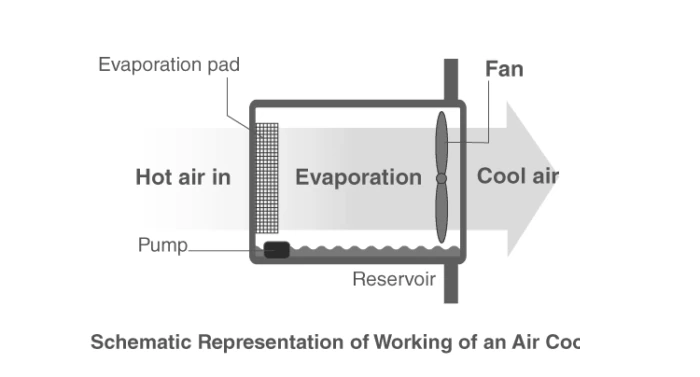
Diagram showing evaporation in an air cooler
Example: Effectiveness of an Air Cooler
On a dry day, the air temperature is \( 40^\circ \text{C} \) with 20% relative humidity. If an air cooler reduces the temperature by 8°C through evaporation, what is the new air temperature?
Solution:
Initial temperature \( T_i = 40^\circ \text{C} \)
Temperature drop \( \Delta T = 8^\circ \text{C} \)
New temperature \( T_f = T_i - \Delta T = 40 - 8 = 32^\circ \text{C} \)
The air cooler lowers the temperature to \( 32^\circ \text{C} \), making the environment more comfortable.
Condensation: The Reverse of Evaporation
Understanding the Transition from Gas to Liquid
Condensation is the process where water vapor or gas transforms back into liquid form, releasing heat energy in the process. This occurs when vapor comes into contact with a cooler surface, losing kinetic energy and forming liquid droplets.
A common example is the formation of water droplets on the outside of a cold glass. The water vapor in the air cools upon touching the chilled surface, condensing into liquid water.
Example: Identifying Condensation Conditions
Explain why condensation forms on a cold window during winter mornings.
Answer:
Warm, moist air inside the room contains water vapor.
The cold window surface lowers the temperature of the air in contact.
Water vapor loses energy and changes into liquid droplets on the glass.
This process releases heat to the surroundings.
Quick Reference: Key Points on Evaporation and Cooling
Concept | Details |
|---|---|
Evaporation | Surface phenomenon where liquid changes to gas by gaining energy |
Evaporative Cooling | Temperature drop due to energy loss during evaporation |
Latent Heat of Vaporization | Energy required for phase change without temperature change |
Factors Affecting Evaporation | Temperature, surface area, humidity, wind speed |
Condensation | Gas to liquid phase change releasing heat |
Applications | Sweating, cotton clothing, earthen pots, air coolers |
Glossary of Important Terms
Term | Definition |
|---|---|
Evaporation | Process of liquid turning into vapor at the surface |
Vapor Pressure | Pressure exerted by vapor in equilibrium with its liquid |
Latent Heat | Energy absorbed or released during phase change without temperature change |
Evaporative Cooling | Cooling effect caused by evaporation removing heat |
Condensation | Transition of gas to liquid releasing heat |
Humidity | Amount of water vapor present in the air |
Surface Area | Area of the liquid exposed to air affecting evaporation rate |
Phase Change | Transformation from one state of matter to another |
Permeability | Ability of a material to allow liquids or gases to pass through |
Thermal Equilibrium | State where two objects have the same temperature |
Frequently Asked Questions
What factors influence the rate of evaporation?
The rate of evaporation depends on temperature, surface area, humidity, and air movement. Higher temperature and larger surface area increase evaporation, while high humidity slows it down.
Is evaporation a physical or chemical change?
Evaporation is a physical change because it involves a change in the state of matter without altering the chemical composition.
How does humidity affect evaporation?
High humidity means the air contains more water vapor, reducing the evaporation rate since the air is closer to saturation.
Can evaporation cause cooling even if the temperature of the liquid remains constant?
Yes, during evaporation, energy is absorbed as latent heat, causing cooling even though the liquid's temperature does not change until boiling.
How can evaporation be minimized?
Evaporation can be reduced by lowering the temperature, covering the liquid surface, increasing humidity, or reducing air flow over the liquid.