Understanding Static Electricity and Lightning Phenomena
Fundamentals of Static Electricity
Nature and Origin of Static Charges
Static electricity arises when there is an uneven distribution of electric charges on the surface of materials. This imbalance occurs primarily due to the transfer of electrons, as protons remain fixed within atoms. When two different materials come into contact and then separate, electrons may move from one to the other, leaving one object positively charged and the other negatively charged. This phenomenon is commonly observed when rubbing a plastic comb through hair, causing the comb to attract small paper pieces due to the static charge it acquires.
Unlike current electricity, where charges flow continuously, static electricity involves charges that remain stationary until discharged. The accumulation of these charges can persist until they find a path to neutralize, such as through a conductive material or a sudden discharge like a spark.
.
Demonstration of static electricity attracting paper pieces
Example Problem
A plastic rod is rubbed with wool, causing it to gain a charge of \( -3.2 \times 10^{-6} \text{ C} \). If the rod attracts small bits of paper, explain the type of charge on the paper and the reason for attraction.
Solution:
When the plastic rod is rubbed with wool, it gains extra electrons, becoming negatively charged with a charge of \( -3.2 \times 10^{-6} \text{ C} \). The small bits of paper are initially neutral but when brought near the negatively charged rod, the electrons in the paper are repelled, and positive charges are attracted towards the rod's surface. This induced positive charge on the paper causes an attractive force between the rod and the paper pieces, making them stick to the rod.
Mechanisms Behind Static Charge Generation
Static charges are generated mainly through two processes: friction and induction. Friction causes electrons to transfer between materials in contact, known as the triboelectric effect. Induction involves the rearrangement of charges within a material due to the presence of a nearby charged object, without direct contact. Both mechanisms contribute to the buildup of static electricity on surfaces.
It is important to note that static electricity is a surface phenomenon and the charges remain localized until discharged.
Example Problem
Two insulating spheres, A and B, are rubbed together causing sphere A to lose \( 5 \times 10^{12} \) electrons and sphere B to gain the same number of electrons. Calculate the charge on each sphere after rubbing. (Charge of one electron = \( 1.6 \times 10^{-19} \text{ C} \))
Solution:
Number of electrons transferred, \( n = 5 \times 10^{12} \)
Charge on each electron, \( e = 1.6 \times 10^{-19} \text{ C} \)
Charge lost by sphere A:
\[ q_A = -n \times e = -5 \times 10^{12} \times 1.6 \times 10^{-19} = -8 \times 10^{-7} \text{ C} \]
Since sphere A lost electrons, it becomes positively charged:
\[ q_A = +8 \times 10^{-7} \text{ C} \]
Charge gained by sphere B:
\[ q_B = -8 \times 10^{-7} \text{ C} \]
Charge Accumulation in Atmospheric Clouds
Formation of Charge Separation in Clouds
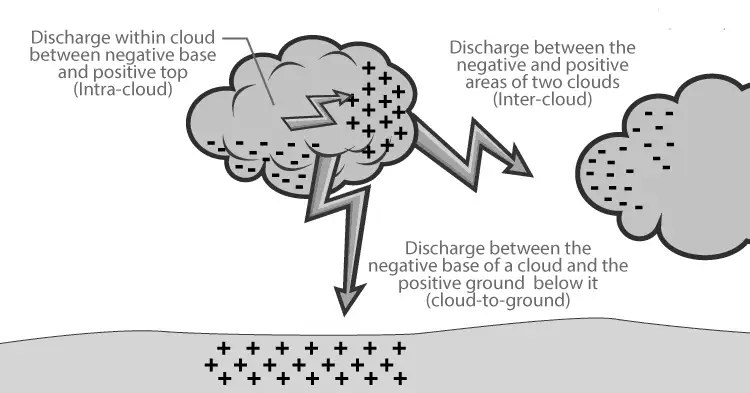
In the atmosphere, water vapor rises and condenses into droplets forming clouds. Within these clouds, warm air currents ascend while cooler air descends, causing collisions and friction among water droplets and ice particles. This frictional interaction leads to the transfer of electrons, resulting in the upper parts of clouds acquiring a positive charge and the lower parts accumulating a negative charge. The freezing of water droplets further intensifies this charge separation, creating a significant electric field within the cloud.
This charge imbalance is a key factor in the development of lightning during thunderstorms.
Charge separation in rainclouds due to atmospheric conditions
Example Problem
Explain why the top of a thundercloud is positively charged while the bottom is negatively charged, and how this leads to lightning formation.
Solution:
Warm air rises carrying water droplets upward, while cold air descends with ice particles.
Friction between these particles causes electrons to transfer, leaving the upper cloud positively charged and the lower cloud negatively charged.
The large charge difference creates a strong electric field.
When the electric field strength exceeds the insulating capacity of air, a conductive path forms, resulting in a lightning discharge to neutralize the imbalance.
Lightning: Nature and Effects
Lightning is a sudden electrostatic discharge caused by the neutralization of charge differences between clouds or between a cloud and the Earth. The air normally acts as an insulator, but when the electric field becomes intense enough, it ionizes the air, creating a conductive channel. Billions of electrons rush through this channel, heating the air rapidly and causing it to expand explosively. This expansion produces the thunderous sound associated with lightning strikes.
Example Problem
During a lightning strike, a current of \( 30,000 \text{ A} \) flows for \( 0.2 \text{ s} \). Calculate the total charge transferred during the strike.
Solution:
Given current, \( I = 30,000 \text{ A} \)
Time, \( t = 0.2 \text{ s} \)
Total charge transferred, \( Q = I \times t \)
\[ Q = 30,000 \times 0.2 = 6,000 \text{ C} \]
Thus, \( 6,000 \text{ coulombs} \) of charge pass through the lightning channel during the strike.
Protection Against Lightning and Charge Types
Role and Function of Lightning Rods
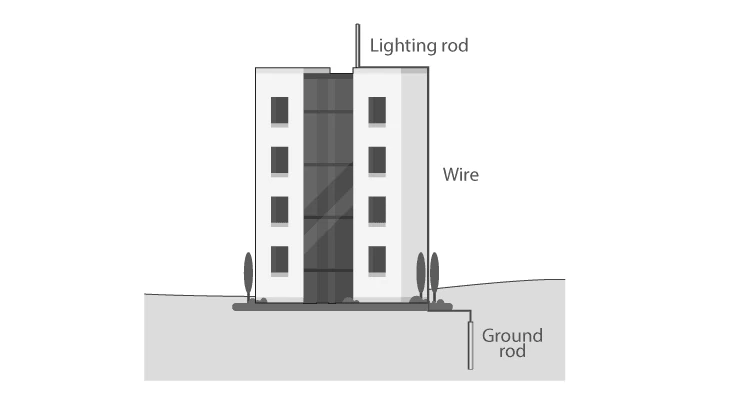
Structures vulnerable to lightning strikes are often safeguarded by lightning rods. These rods, typically made of metal, are installed at the highest points of buildings and connected to the ground through conductive wires. The rod attracts the lightning discharge, providing a safe path for the electric charges to flow into the earth, thereby preventing damage to the structure and reducing the risk of fire or injury.
Example Problem
A lightning rod is installed on a building 20 meters tall. Explain how it protects the building during a thunderstorm.
Solution:
The rod extends above the building, becoming the first point to encounter the lightning discharge.
Being metallic, it conducts the electric charge safely to the ground through a wire.
This prevents the lightning from passing through the building’s structure, avoiding damage and hazards.
Classification of Electric Charges
Electric charges are categorized into two types based on electron transfer:
Positive Charge: Occurs when an object loses electrons, resulting in a net positive charge.
Negative Charge: Occurs when an object gains extra electrons, resulting in a net negative charge.
The separation and accumulation of these charges on surfaces lead to static electricity.
Generating Static Electricity Using Electrostatic Devices
Static electricity can be artificially produced using electrostatic generators, which convert mechanical energy into electrical energy through friction. Two primary methods are:
Triboelectric Effect: Charge transfer due to rubbing two different materials.
Electrostatic Induction: Redistribution of charges in a material caused by the electric field of a nearby charged object without direct contact.
Electrostatic generator demonstrating static charge production
Example Problem
An electrostatic generator produces a charge of \( 1.5 \times 10^{-5} \text{ C} \) on a metal sphere. If the sphere is isolated, explain how the charge is generated and why it remains on the sphere.
Solution:
The generator uses friction to transfer electrons onto the metal sphere, creating an excess charge.
Since the sphere is isolated and made of a conductor, the charge distributes evenly on its surface.
The charge remains because there is no path for it to flow away, resulting in static electricity.
Quick Reference Summary
Concept | Key Points |
|---|---|
Static Electricity | Imbalance of charges on surfaces due to electron transfer; charges remain stationary until discharged. |
Triboelectric Effect | Charge generation by friction between two materials. |
Electrostatic Induction | Charge redistribution caused by nearby charged objects without contact. |
Charge Types | Positive (loss of electrons), Negative (gain of electrons). |
Charge Separation in Clouds | Friction between rising warm droplets and descending cold droplets causes positive charge at cloud top and negative at bottom. |
Lightning | Discharge of accumulated charges through ionized air, producing light and thunder. |
Lightning Rod | Metal rod providing safe path for lightning current to ground, protecting structures. |
Electrostatic Generator | Device converting mechanical friction into static electric charge. |
Glossary of Key Terms
Term | Definition |
|---|---|
Static Electricity | Electric charge that remains stationary on the surface of an object. |
Electron | Negatively charged subatomic particle that moves between materials to create static charge. |
Proton | Positively charged particle in the nucleus of an atom; does not move in static electricity. |
Triboelectric Effect | Generation of charge by friction between two different materials. |
Electrostatic Induction | Redistribution of charges in a conductor caused by a nearby charged object. |
Lightning | Sudden discharge of static electricity in the atmosphere. |
Lightning Rod | Metal conductor installed on buildings to safely direct lightning to the ground. |
Charge | Property of matter causing it to experience a force in an electric field. |
Positive Charge | Charge resulting from loss of electrons. |
Negative Charge | Charge resulting from gain of electrons. |
Frequently Asked Questions
What causes static electricity to build up on objects?
Static electricity builds up when electrons are transferred between materials through friction or contact, causing an imbalance of charges on the surfaces.
Why does lightning occur during thunderstorms?
Lightning happens due to the large charge separation in clouds, which creates a strong electric field that ionizes air and allows charges to flow rapidly, neutralizing the imbalance.
How does a lightning rod protect buildings?
A lightning rod provides a low-resistance path for lightning to safely travel from the cloud to the ground, preventing damage to the building.
What is the difference between triboelectric effect and electrostatic induction?
The triboelectric effect involves charge transfer by friction between materials, while electrostatic induction is the rearrangement of charges in a material caused by a nearby charged object without direct contact.
Can static electricity be dangerous?
Yes, static electricity can cause sparks that may ignite flammable substances or damage sensitive electronic devices, so precautions are necessary in certain environments.