Understanding Spherical Lenses: Properties and Applications
Fundamentals of Spherical Lenses and Their Optical Behavior
Basic Characteristics and Refraction Principles
Spherical lenses are segments cut from larger spheres, similar to spherical mirrors. The glass material of these lenses has a refractive index greater than that of air, causing light rays to bend when passing from air into the lens. Depending on the lens shape, light rays are either focused or spread out. This bending of light is harnessed in various optical devices.
These lenses are integral components in instruments such as telescopes, microscopes, cameras, and projectors. The human eye itself functions as a natural spherical lens system.
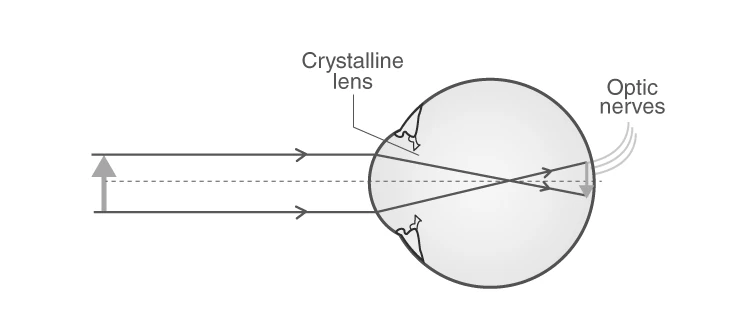
Example of an eye as a spherical lense
Although images formed by lenses are often inverted, the brain processes these signals to perceive the correct orientation. Thus, seeing an inverted image on the retina is normal and not a defect of the eye.
Example Problem
A spherical lens is made from a glass sphere with a refractive index of 1.5. Explain why light rays bend when passing from air into this lens and describe the general effect on the rays.
Solution:
Light travels slower in glass than in air due to the higher refractive index.
When light passes from air (lower refractive index) to glass (higher refractive index), it bends towards the normal at the interface.
This refraction causes the rays to either converge or diverge depending on the lens shape.
Thus, the lens can focus or spread out light rays, enabling image formation.
Key Terminology and Optical Elements in Lens Systems
Understanding Principal Points and Focal Properties
When studying lenses, several important terms help describe their geometry and behavior:
Centre of Curvature: The center of the original sphere from which the lens segment is cut.
Principal Axis: An imaginary straight line passing through the centers of curvature of the lens surfaces.
Principal Focus: The point on the principal axis where rays parallel to it converge (for convex lenses) or appear to diverge from (for concave lenses).
Optical Centre: The point within the lens where the principal axis intersects the lens, through which light passes undeviated.
Focal Length: The distance between the optical centre and the principal focus.
Example Problem
A lens has a focal length of 15 cm. Define the focal length and explain its significance in the context of image formation.
Solution:
The focal length is the distance from the optical centre to the principal focus.
It determines how strongly the lens converges or diverges light rays.
A shorter focal length means the lens bends light more sharply, producing a more magnified image.
It is a crucial parameter for designing optical instruments and understanding image properties.
Convex Lenses: Converging Light and Image Formation
Properties and Ray Behavior in Convex Lenses
Convex lenses, also known as converging lenses, have outwardly curved surfaces that cause parallel light rays to meet at a point called the focus. When a ray of light travels parallel to the principal axis and strikes a convex lens, it refracts through the lens and passes through the principal focus on the opposite side.
Rays passing through the optical centre continue straight without bending. Additionally, rays passing through the focus before entering the lens emerge parallel to the principal axis after refraction.

Typical biconvex lens and ray diagram
Example Problem
A convex lens with a focal length of 20 cm receives a ray of light parallel to its principal axis. Describe the path of the refracted ray.
Solution:
The incident ray travels parallel to the principal axis.
After refraction through the convex lens, the ray passes through the principal focus located 20 cm from the optical centre.
This focusing property allows the lens to form real images on the opposite side.
Concave Lenses: Diverging Light and Virtual Images
Characteristics and Ray Paths in Concave Lenses
Concave lenses, or diverging lenses, have inwardly curved surfaces that cause parallel light rays to spread out after passing through the lens. A ray traveling parallel to the principal axis diverges upon refraction, and if extended backward, appears to originate from the principal focus on the same side as the incident light.
Similar to convex lenses, rays passing through the optical centre continue straight without deviation. Rays directed towards the focus before entering the lens emerge parallel to the principal axis after refraction.

Common biconcave lens and light ray behavior
Example Problem
A concave lens has a focal length of 25 cm. A ray of light parallel to the principal axis strikes the lens. Explain the direction of the refracted ray.
Solution:
The incident ray is parallel to the principal axis.
After passing through the concave lens, the ray diverges away from the principal axis.
When extended backward, the refracted ray appears to come from the principal focus located 25 cm in front of the lens.
This divergence causes the formation of virtual, diminished images.
Summary Table: Properties of Convex and Concave Lenses
Property | Convex Lens | Concave Lens |
|---|---|---|
Shape | Outwardly curved (biconvex) | Inwardly curved (biconcave) |
Light Behavior | Converges parallel rays to a focus | Diverges parallel rays away from principal axis |
Image Type | Real or virtual, depending on object position | Always virtual and diminished |
Focal Length | Positive | Negative |
Uses | Microscopes, cameras, magnifying glasses | Correcting myopia, peepholes |
Glossary of Key Terms Related to Lenses
Term | Definition |
|---|---|
Centre of Curvature | The center of the sphere from which the lens segment is derived. |
Principal Axis | Imaginary line joining the centers of curvature of lens surfaces. |
Principal Focus | Point where parallel rays converge or appear to diverge after refraction. |
Optical Centre | Point inside the lens where light passes without deviation. |
Focal Length | Distance between the optical centre and the principal focus. |
Convex Lens | A lens that converges light rays to a focus. |
Concave Lens | A lens that diverges light rays away from the principal axis. |
Refraction | Bending of light as it passes from one medium to another. |
Real Image | An image formed where light rays actually meet. |
Virtual Image | An image formed where light rays appear to diverge from. |
Frequently Asked Questions on Spherical Lenses
What defines a lens in optics?
A lens is a transparent object that bends light rays through refraction to either focus or spread them out.
Which two main types of lenses are commonly studied?
The primary types are convex (converging) lenses and concave (diverging) lenses.
How does a lens differ from a mirror?
Lenses refract light passing through them, while mirrors reflect light off their surfaces.
What are typical applications of convex lenses?
Convex lenses are used in devices like microscopes, cameras, and corrective eyewear for farsightedness.
What is the fundamental difference between convex and concave lenses?
Convex lenses focus parallel light rays to a point, whereas concave lenses cause parallel rays to diverge.