Understanding Potential Energy: Concepts, Types, and Applications
Fundamentals of Potential Energy
Defining Energy Stored by Position or Configuration
Potential energy is the energy an object holds due to its position relative to other objects or its state of deformation. This form of energy is stored and can be converted into other energy types, such as kinetic energy, when the object's position or condition changes. For instance, when a bow is drawn, it accumulates energy that propels the arrow forward upon release. Similarly, stretching a spring stores energy that can be released when the spring returns to its original shape.
Understanding potential energy involves recognizing how forces acting on objects influence the energy stored. The concept was first introduced by William Rankine, a 19th-century Scottish physicist and engineer, who formalized the term in scientific literature.
Illustrative Example: Calculating Gravitational Potential Energy
Problem: Calculate the gravitational potential energy of a 2 kg book placed on a shelf 4 meters above the floor. Use \( g = 9.8 \text{ m/s}^2 \).
Solution:
Given:
Mass, \( m = 2 \text{ kg} \)
Height, \( h = 4 \text{ m} \)
Acceleration due to gravity, \( g = 9.8 \text{ m/s}^2 \)
The gravitational potential energy \( E \) is calculated by:
\[ E = m \times g \times h \]
Substituting the values:
\[ E = 2 \times 9.8 \times 4 = 78.4 \text{ J} \]
Therefore, the book has 78.4 joules of potential energy due to its elevated position.
Exploring Different Forms of Potential Energy
Energy Stored by Height: Gravitational Potential Energy
Gravitational potential energy arises when an object is elevated against the force of gravity. The energy stored depends on the object's mass, the height it is raised to, and the gravitational acceleration. This energy is independent of the path taken to reach the height; only the vertical displacement matters.
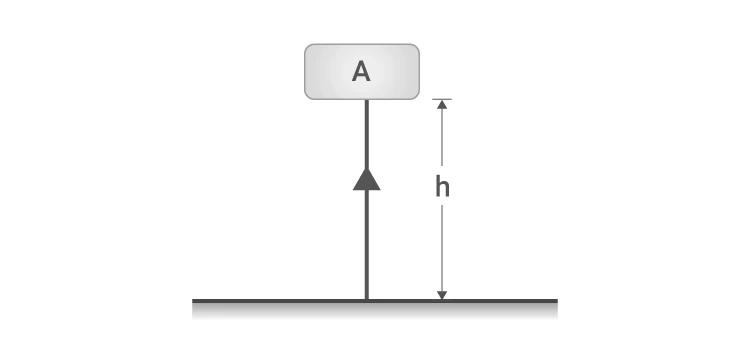
Diagram illustrating gravitational potential energy of an elevated object
When an object is lifted, work is done against gravity, which is stored as potential energy. The formula for gravitational potential energy is:
\[ E = mgh \]
where \( m \) is mass, \( g \) is gravitational acceleration, and \( h \) is height above the reference point.
Example: Energy of an Elevated Object
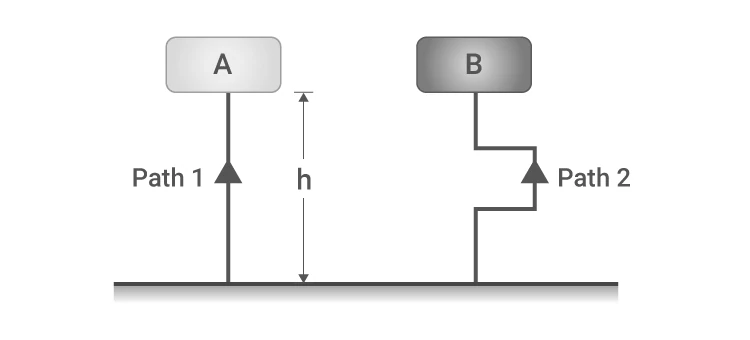
Object positioned at a height storing gravitational potential energy
Problem: A 3 kg box is lifted to a height of 5 meters. Calculate its gravitational potential energy. Take \( g = 9.8 \text{ m/s}^2 \).
Solution:
Given:
Mass, \( m = 3 \text{ kg} \)
Height, \( h = 5 \text{ m} \)
Acceleration due to gravity, \( g = 9.8 \text{ m/s}^2 \)
Using the formula:
\[ E = mgh = 3 \times 9.8 \times 5 = 147 \text{ J} \]
The box has 147 joules of gravitational potential energy at this height.
Elastic Potential Energy: Energy Stored in Deformed Objects
Understanding Energy in Stretched or Compressed Materials
Elastic potential energy is stored when objects capable of returning to their original shape are stretched or compressed. Examples include rubber bands, springs, and bungee cords. The amount of energy stored depends on the extent of deformation and the material's stiffness, characterized by the spring constant.
When the deformation exceeds the elastic limit, the object may not return to its original form, and the stored energy is lost as permanent deformation.
The elastic potential energy \( U \) stored in a spring or elastic object is given by:
\[ U = \frac{1}{2} k x^2 \]
where \( k \) is the spring constant and \( x \) is the displacement from the equilibrium position.
Example: Calculating Energy Stored in a Stretched Spring
Problem: A spring with a spring constant of 200 N/m is stretched by 0.1 meters. Find the elastic potential energy stored.
Solution:
Given:
Spring constant, \( k = 200 \text{ N/m} \)
Displacement, \( x = 0.1 \text{ m} \)
Using the formula:
\[ U = \frac{1}{2} \times 200 \times (0.1)^2 = \frac{1}{2} \times 200 \times 0.01 = 1 \text{ J} \]
The spring stores 1 joule of elastic potential energy when stretched by 0.1 meters.
Everyday Examples of Potential Energy
Objects and Situations Exhibiting Stored Energy

Stones perched on a cliff edge holding potential energy
Stones resting on a cliff edge possess potential energy due to their elevated position. If they fall, this energy converts into kinetic energy.

Tree branches elevated above ground level
Branches high in a tree have potential energy because they can fall to the ground, converting stored energy into motion.

Food containing chemical potential energy
The food we consume contains chemical potential energy, which our bodies convert into energy for various functions.

Chemical potential energy released from a firecracker
When a firecracker's fuse is ignited, the chemical potential energy stored within is rapidly released as heat, light, and sound.
Practice Problem: Gravitational Potential Energy Calculation
Question: Determine the gravitational potential energy of a 1.5 kg ball raised to a height of 7 meters. Use \( g = 9.8 \text{ m/s}^2 \).
Answer:
Given:
Mass, \( m = 1.5 \text{ kg} \)
Height, \( h = 7 \text{ m} \)
Acceleration due to gravity, \( g = 9.8 \text{ m/s}^2 \)
Calculating potential energy:
\[ E = mgh = 1.5 \times 9.8 \times 7 = 102.9 \text{ J} \]
The ball has 102.9 joules of gravitational potential energy at this height.
Summary Table: Key Aspects of Potential Energy
Type of Potential Energy | Source | Formula | Units |
|---|---|---|---|
Gravitational Potential Energy | Height above ground | \( E = mgh \) | Joule (J) |
Elastic Potential Energy | Deformation of elastic object | \( U = \frac{1}{2}kx^2 \) | Joule (J) |
Chemical Potential Energy | Chemical bonds in substances | Varies by reaction | Joule (J) |
Glossary of Important Terms
Term | Definition |
|---|---|
Potential Energy | Energy stored due to an object's position or configuration. |
Gravitational Potential Energy | Energy stored in an object as a result of its height above a reference point. |
Elastic Potential Energy | Energy stored when an elastic object is stretched or compressed. |
Spring Constant (k) | A measure of a spring's stiffness, determining force per unit displacement. |
Displacement (x) | The distance an object is stretched or compressed from its equilibrium position. |
Work | Energy transferred when a force moves an object over a distance. |
Kinetic Energy | Energy an object possesses due to its motion. |
Elastic Limit | The maximum extent to which an object can be deformed and still return to its original shape. |
Joule (J) | The SI unit of energy, equivalent to \( \text{kg} \cdot \text{m}^2/\text{s}^2 \). |
Acceleration due to Gravity (g) | The acceleration experienced by an object due to Earth's gravity, approximately \( 9.8 \text{ m/s}^2 \). |
Frequently Asked Questions
Who introduced the term potential energy?
The term was coined by William Rankine, a Scottish engineer and physicist, in the 19th century.
Which objects commonly store elastic potential energy?
Objects like rubber bands, trampolines, and bungee cords store elastic potential energy when stretched or compressed.
What factors influence gravitational potential energy?
Gravitational potential energy depends on the object's mass and its height above the ground.
What are the main types of potential energy?
Key types include gravitational potential energy, elastic potential energy, chemical potential energy, electrical potential energy, and nuclear potential energy.
How are potential and kinetic energy related?
Potential energy can be converted into kinetic energy and vice versa, as seen when water stored at height flows down and gains motion energy.