Fundamentals of Photons and Their Properties
Understanding Photons: The Quantum Particles of Light
Defining Photons and Their Core Characteristics
Photons are the fundamental particles that constitute light, representing discrete packets of electromagnetic energy. Each photon carries energy proportional to its frequency, described by the relation \( E = h\nu \), where \( h \) is Planck's constant and \( \nu \) is the frequency of the light.
In addition to energy, photons possess momentum given by \( p = \frac{h\nu}{c} \), with \( c \) being the speed of light. Despite having zero rest mass, photons travel at the constant speed \( c \) in vacuum.
It is important to note that increasing the intensity of light does not change the energy of individual photons; rather, it increases the number of photons passing through a given area per second.
Example Problem
A beam of light has a frequency of \( 6.0 \times 10^{14} \text{ Hz} \). Calculate the energy and momentum of a single photon in this beam. (Given: \( h = 6.63 \times 10^{-34} \text{ J·s} \), \( c = 3.0 \times 10^{8} \text{ m/s} \))
Solution:
Energy of photon:
\[ E = h\nu = (6.63 \times 10^{-34}) \times (6.0 \times 10^{14}) = 3.978 \times 10^{-19} \text{ J} \]
Momentum of photon:
\[ p = \frac{h\nu}{c} = \frac{6.63 \times 10^{-34} \times 6.0 \times 10^{14}}{3.0 \times 10^{8}} = 1.326 \times 10^{-27} \text{ kg·m/s} \]
Intrinsic Properties and Behavior of Photons
Photons are electrically neutral and do not carry any charge, which means they are unaffected by electric or magnetic fields. Their massless nature allows them to travel at the speed of light without any rest mass.
They are stable particles that can be created or annihilated during emission or absorption processes, such as when atoms transition between energy levels. Despite their particle nature, photons exhibit wave-like properties, including polarization, which arises from their spin-1 characteristic aligned with their direction of motion.
Example Problem
Explain why photons are not influenced by magnetic fields and how their spin contributes to light polarization.
Answer:
- Photons have no electric charge, so magnetic fields exert no force on them.
- Their spin quantum number is 1, meaning they have intrinsic angular momentum aligned with their travel direction.
- This spin property allows photons to exhibit polarization, a wave characteristic where the electric field oscillates in specific directions.
Energy and Momentum Conservation in Photon Interactions
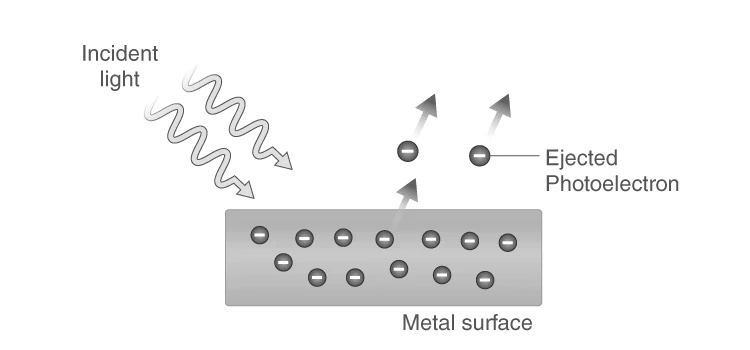
When photons interact with other particles, such as electrons, the total energy and momentum are conserved. This principle is fundamental in phenomena like the photoelectric effect, where photons transfer energy to electrons, causing their emission from metal surfaces.
Photons cannot spontaneously decay but can transfer their energy during collisions or absorption events, maintaining the conservation laws of physics.
Example Problem
A photon with frequency \( 5.5 \times 10^{14} \text{ Hz} \) strikes a metal surface and ejects an electron with kinetic energy \( 1.2 \times 10^{-19} \text{ J} \). Calculate the work function of the metal. (Use \( h = 6.63 \times 10^{-34} \text{ J·s} \))
Solution:
Energy of photon:
\[ E = h\nu = 6.63 \times 10^{-34} \times 5.5 \times 10^{14} = 3.647 \times 10^{-19} \text{ J} \]
Work function \( \phi \) is given by:
\[ \phi = E - K.E. = 3.647 \times 10^{-19} - 1.2 \times 10^{-19} = 2.447 \times 10^{-19} \text{ J} \]
Summary of Key Photon Concepts
| Property | Description |
|---|---|
| Energy | Proportional to frequency, \( E = h\nu \) |
| Momentum | Given by \( p = \frac{h\nu}{c} \) |
| Mass | Zero rest mass (massless) |
| Charge | Electrically neutral |
| Speed | Constant speed of light \( c \) |
| Spin | Spin-1 particle, enabling polarization |
| Interaction | Energy and momentum conserved in collisions |
| Creation/Annihilation | Can be created or destroyed during emission/absorption |
| Effect of Fields | Unaffected by electric or magnetic fields |
| Stability | Stable particle, does not decay spontaneously |
Glossary of Essential Terms
| Term | Definition |
|---|---|
| Photon | Quantum particle of light carrying energy and momentum |
| Planck's Constant (h) | Fundamental constant relating energy and frequency, \(6.63 \times 10^{-34} \text{ J·s}\) |
| Frequency (\( \nu \)) | Number of wave cycles per second of electromagnetic radiation |
| Momentum (p) | Quantity of motion of a photon, \( p = \frac{h\nu}{c} \) |
| Speed of Light (c) | Constant speed at which photons travel, \(3.0 \times 10^{8} \text{ m/s}\) |
| Work Function | Minimum energy required to eject an electron from a metal surface |
| Photoelectric Effect | Emission of electrons from a metal when illuminated by light |
| Polarization | Orientation of the oscillations of the electromagnetic wave |
| Spin | Intrinsic angular momentum of a particle |
| Electromagnetic Radiation | Waves of electric and magnetic fields propagating through space |
Frequently Asked Questions
What defines light in terms of physics?
Light is electromagnetic radiation visible to the human eye, composed of photons that carry energy and momentum.
How are photons generated in nature?
Photons are emitted when atoms or molecules transition between energy states, often due to heating or excitation.
What is the photoelectric effect and its significance?
The photoelectric effect is the release of electrons from a metal surface when illuminated by light, demonstrating the particle nature of light.
Do photons have any mass?
Photons have zero rest mass, allowing them to travel at the speed of light.
Can magnetic fields influence photons?
No, photons are electrically neutral and are not affected by magnetic or electric fields.