Understanding Electric Current and Its Effects
Fundamentals of Electric Current and Conductivity
Defining Electric Current and Material Conductivity
Electric current is the flow rate of electrons through a conductor, measured in amperes (A). Electrons, which carry a negative charge, move within materials depending on how tightly they are bound to atoms. Materials that allow electrons to move freely are called conductors, while those that restrict electron movement are insulators.
Conductors facilitate the transfer of electric charge by enabling electrons to flow easily, driven by a force known as voltage. Common conductors include metals such as copper, iron, silver, and gold, as well as the human body and saltwater solutions. Notably, silver is the most efficient conductor of electricity.
In contrast, insulators like plastic, wood, and glass prevent free electron movement, thereby inhibiting current flow.
Solution:
- Copper is a good conductor, allowing electrons to flow freely and complete the circuit.
- Plastic is an insulator, which blocks electron flow and prevents current.
- Thus, copper ensures the bulb lights up by enabling current flow, whereas plastic would not.
Conditions and Forces Driving Electric Current
Essential Requirements for Current Flow
For electric current to flow, two main conditions must be met: a source of voltage and a closed conducting path. Voltage acts like pressure that pushes electrons in a specific direction, overcoming their natural random motion. A closed circuit, such as when a switch is turned on, provides a continuous path for electrons to travel.
The force responsible for directing electron movement is called electromotive force (emf), measured in volts (V). This force ensures electrons move uniformly rather than randomly.
Solution:
- The 9 volts from the battery create an electromotive force that pushes electrons through the resistor.
- This force directs electrons to flow in one direction, producing an electric current.
- Without this voltage, electrons would move randomly, and no net current would flow.
Visualizing Current Using the Water Flow Analogy
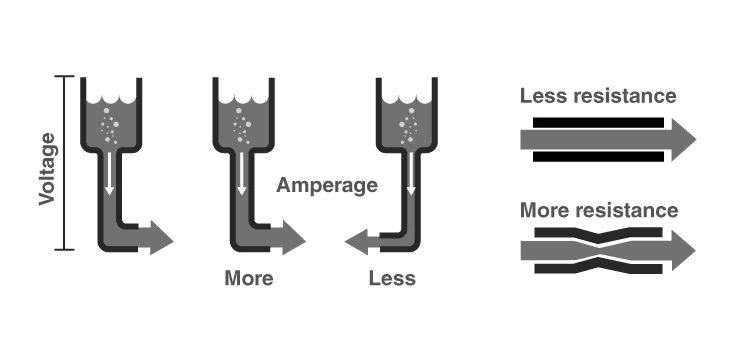
Electric current can be compared to water flowing through a pipe. Just as water moves when pressure is applied at one end, electrons flow through a conductor when voltage is applied. The amount of water flow corresponds to the current, and the pressure corresponds to the voltage.
Direction of Current: Conventional vs Electron Flow
Understanding the Two Perspectives of Current Direction
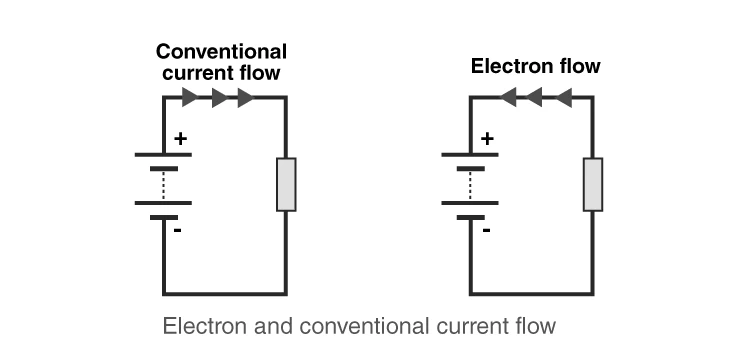
There are two ways to describe the direction of electric current: conventional current flow and electron flow. Conventional current assumes positive charges move from the positive terminal to the negative terminal of a power source. However, since electrons carry negative charge, their actual movement is from the negative terminal to the positive terminal.
This distinction is important in circuit analysis and understanding electronic devices.
Solution:
- Electrons flow from the battery's negative terminal to its positive terminal.
- Conventional current is considered to flow from the positive terminal to the negative terminal.
- This difference arises because conventional current was defined before the discovery of electron charge.
Characteristics and Types of Electric Current
Properties and Forms of Electric Current
Electric current results from the movement of electrons and can be transformed into other energy forms such as heat and light. For instance, an electric iron converts electrical energy into heat, while a bulb converts it into light.
There are two main types of current:
- Direct Current (DC): Flows in a single direction, commonly used in low voltage applications like battery charging.
- Alternating Current (AC): Changes direction periodically and is widely used in homes and industries.
Electric current is measured in amperes, where 1 ampere equals 1 coulomb of charge passing a point per second.
Solution:
The charge \( Q \) is given by:
\[ Q = I \times t = 3 \text{ A} \times 4 \text{ s} = 12 \text{ C} \]
So, 12 coulombs of charge have flowed through the device.
Observable Effects of Electric Current
Heat Generation Due to Current Flow
When electric current passes through a conductor, it produces heat. This heating effect is the principle behind devices like electric irons and heaters. The heat generated depends on the current, resistance, and duration of flow, expressed by the formula:
\[ H = I^2 R t \]
where \( H \) is heat energy in joules, \( I \) is current in amperes, \( R \) is resistance in ohms, and \( t \) is time in seconds.
Solution:
\[ H = I^2 R t = (2)^2 \times 5 \times 10 = 4 \times 5 \times 10 = 200 \text{ J} \]
The wire produces 200 joules of heat energy.
Magnetic Field Created by Electric Current
Electric current flowing through a conductor generates a magnetic field around it. This effect can be observed by placing a compass near a current-carrying wire, causing the needle to deflect. Coiling the wire intensifies this magnetic field, creating an electromagnet used in various applications.
Solution:
- Current in the wire produces a magnetic field around it.
- The compass needle aligns with the magnetic field, causing deflection.
- This demonstrates the magnetic effect of electric current.
Chemical Changes Induced by Electric Current
Passing electric current through certain solutions causes chemical reactions, breaking the solution into ions. This process, called electrolysis, can change the solution's color, deposit metals on electrodes, or release gases. Applications include electroplating and purification of metals.
Solution:
- Copper ions move towards the cathode and deposit as metallic copper.
- Sulfate ions move towards the anode, releasing oxygen gas.
- The solution undergoes chemical changes due to the current.
Quick Reference Summary
| Concept | Key Points |
|---|---|
| Electric Current | Flow of electrons; measured in amperes (A) |
| Conductors | Materials allowing free electron flow (e.g., copper, silver) |
| Insulators | Materials restricting electron flow (e.g., plastic, wood) |
| Electromotive Force (Voltage) | Force pushing electrons; measured in volts (V) |
| Current Types | Direct Current (DC) and Alternating Current (AC) |
| Heating Effect | Heat produced: \( H = I^2 R t \) |
| Magnetic Effect | Current generates magnetic field around conductor |
| Chemical Effect | Electric current causes electrolysis in solutions |
| Conventional Current | Flows positive to negative terminal |
| Electron Flow | Flows negative to positive terminal |
Glossary of Key Terms
| Term | Definition |
|---|---|
| Electric Current | Rate of flow of electric charge through a conductor |
| Conductor | Material that allows free movement of electrons |
| Insulator | Material that restricts electron flow |
| Voltage (Electromotive Force) | Force that drives electrons through a circuit |
| Resistance | Property of a material that opposes current flow |
| Ampere | SI unit of electric current, equal to 1 coulomb/second |
| Direct Current (DC) | Current flowing in one direction only |
| Alternating Current (AC) | Current that reverses direction periodically |
| Electrolysis | Chemical decomposition caused by electric current |
| Electromagnet | Magnet created by electric current flowing through a coil |
Frequently Asked Questions
Why is copper commonly used for electrical wiring?
Copper has low electrical resistance, allowing efficient electron flow and minimal energy loss.
What is the difference between conductors and insulators?
Conductors permit free electron movement, enabling current flow, while insulators block electron movement, preventing current.
How does temperature affect resistance in metals and semiconductors?
In metals, resistance increases with temperature; in semiconductors, resistance decreases as temperature rises.
What unit is used to measure electric current?
Electric current is measured in amperes (A), representing coulombs of charge per second.
What causes the magnetic effect of electric current?
Electric current generates a magnetic field around the conductor, which can influence magnetic materials nearby.