Comprehensive Understanding of Electric Charge and Its Principles
Fundamentals of Electric Charge
Defining Electric Charge and Its Nature
Electric charge is an intrinsic attribute of certain subatomic particles that causes them to experience forces when placed within electric and magnetic fields. This property is essential for explaining many physical phenomena related to electricity and magnetism. Charged particles interact through these fields, leading to observable effects such as attraction and repulsion.
Electric charge exists in two distinct forms: positive and negative. Protons carry positive charge, symbolized as “+”, and reside in the atomic nucleus. Electrons, which orbit the nucleus, carry negative charge, denoted by “−”. The interplay between these charges governs the behavior of matter at the microscopic level.
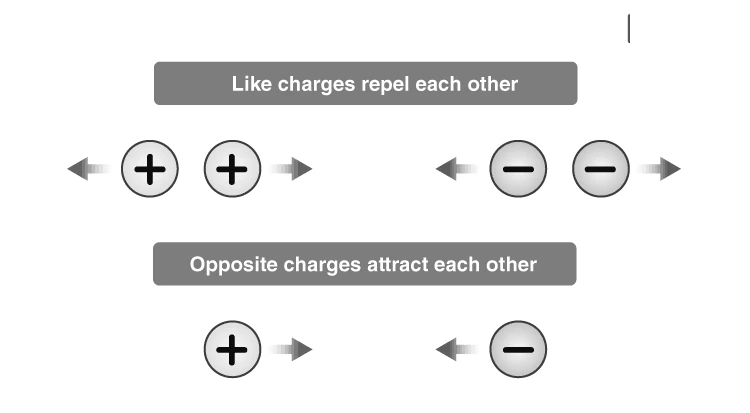
When an object has more electrons than protons, it carries a net negative charge. Conversely, an excess of protons results in a positive charge. If the numbers of positive and negative charges are equal, the object remains electrically neutral.
Example Problem
An object initially neutral gains 5 × 10¹² electrons. Calculate the net charge on the object. (Charge of one electron = \(-1.6 \times 10^{-19}\) C)
Solution:
The total charge \(Q\) is given by the number of electrons multiplied by the charge per electron:
\[ Q = n \times e = 5 \times 10^{12} \times (-1.6 \times 10^{-19}) = -8 \times 10^{-7} \text{ C} \]
The negative sign indicates the object has gained a negative charge of \(8 \times 10^{-7}\) coulombs.
Scalar Nature of Electric Charge
Unlike vector quantities, which have both magnitude and direction, electric charge is a scalar quantity. This means it only has magnitude and does not follow vector addition rules such as the triangle or parallelogram laws. For example, when electric currents converge at a junction, the total current is the algebraic sum of individual currents, not a vector sum. Hence, electric charge is treated as a scalar despite having a sign indicating positive or negative.
Example Problem
Two currents of 3 A and 5 A meet at a junction flowing in the same direction. Find the total current at the junction.
Solution:
Since current is scalar in this context, the total current is the sum:
\[ I_{\text{total}} = 3 \text{ A} + 5 \text{ A} = 8 \text{ A} \]
The total current flowing through the junction is 8 amperes.
Quantitative Aspects and Properties of Electric Charge
Measuring Electric Charge and Its Units
The standard unit for electric charge is the coulomb (C). One coulomb is defined as the amount of charge transferred by a current of one ampere flowing for one second. Mathematically, this relationship is expressed as:
\[ Q = I \times t \]
where \(Q\) is the charge in coulombs, \(I\) is the current in amperes, and \(t\) is the time in seconds.
Example Problem
A current of 2.5 A flows through a wire for 4 seconds. Calculate the total charge transferred.
Solution:
Using the formula:
\[ Q = I \times t = 2.5 \times 4 = 10 \text{ C} \]
The total charge transferred is 10 coulombs.
Key Characteristics of Electric Charge
Electric charge exhibits several fundamental properties that are crucial for understanding electrical phenomena:
- Additivity: The total charge of a system is the algebraic sum of individual charges. For instance, combining +4 units and -1 unit results in a net charge of +3 units.
- Conservation: In an isolated system, the total electric charge remains constant over time. Charges cannot be created or destroyed but only transferred.
- Quantization: Electric charge exists in discrete units, multiples of the elementary charge \(e = 1.6 \times 10^{-19}\) C. Charges cannot be divided into fractions smaller than this fundamental unit.
Example Problem
Calculate the number of electrons corresponding to a charge of \(-3.2 \times 10^{-18}\) C.
Solution:
Number of electrons \(n\) is given by:
\[ n = \frac{|Q|}{e} = \frac{3.2 \times 10^{-18}}{1.6 \times 10^{-19}} = 20 \]
Thus, the charge corresponds to 20 electrons.
Interactions and Charging Techniques
Calculating Electrostatic Forces Using Coulomb’s Law
Coulomb’s Law quantifies the force between two point charges. It states that the magnitude of the electrostatic force \(F_e\) is directly proportional to the product of the magnitudes of the charges and inversely proportional to the square of the distance between them:
\[ F_e = \frac{k q_1 q_2}{r^2} \]
where \(q_1\) and \(q_2\) are the charges, \(r\) is the separation distance, and \(k = 8.988 \times 10^9 \text{ N·m}^2/\text{C}^2\) is Coulomb’s constant.
Example Problem
Two charges, \(+4 \times 10^{-6}\) C and \(-2 \times 10^{-6}\) C, are placed 0.05 m apart. Calculate the magnitude and nature of the force between them.
Solution:
Using Coulomb’s Law:
\[ F_e = \frac{8.988 \times 10^9 \times 4 \times 10^{-6} \times 2 \times 10^{-6}}{(0.05)^2} = \frac{8.988 \times 10^9 \times 8 \times 10^{-12}}{0.0025} \]
\[ F_e = \frac{7.1904 \times 10^{-2}}{0.0025} = 28.76 \text{ N} \]
The force is attractive because the charges are opposite in sign.
Various Methods of Charging Objects
Objects can acquire electric charge through different mechanisms:
Charging by Friction
When two different materials are rubbed together, electrons may transfer from one to the other. The object losing electrons becomes positively charged, while the one gaining electrons becomes negatively charged. This process is known as charging by friction or triboelectric charging.
Example Problem
When a rubber rod is rubbed with fur, it gains electrons. Explain the charge on the rubber rod and the fur after rubbing.
Solution:
- The rubber rod gains electrons and becomes negatively charged.
- The fur loses electrons and becomes positively charged.
- This transfer of electrons is due to friction between the two materials.
Charging by Conduction
This method involves direct contact between a charged object and a neutral conductor. Electrons move between the objects until both share the same type of charge, resulting in the neutral object becoming charged.
Example Problem
A positively charged metal sphere touches a neutral metal sphere. Describe the charge distribution after contact.
Solution:
- Electrons flow from the neutral sphere to the positively charged sphere.
- Both spheres end up with positive charges, sharing the total charge.
- This process is charging by conduction.
Charging by Induction
In this method, a charged object is brought near a neutral conductor without touching it. The presence of the charged object causes a redistribution of charges within the conductor, inducing a charge separation. If the conductor is then grounded, it can acquire a net charge opposite to that of the inducing object.
Example Problem
A negatively charged rod is brought close to a neutral metal sphere without contact. Explain how the sphere becomes charged by induction.
Solution:
- The negative charge repels electrons in the sphere, pushing them away.
- The side of the sphere near the rod becomes positively charged due to electron deficiency.
- If the sphere is grounded, electrons leave the sphere, leaving it positively charged after the rod is removed.
Summary and Quick Reference
| Concept | Details |
|---|---|
| Electric Charge | Intrinsic property causing force in electromagnetic fields |
| Types of Charge | Positive (protons), Negative (electrons) |
| Charge Nature | Scalar quantity with magnitude and sign |
| Unit of Charge | Coulomb (C), \(Q = I \times t\) |
| Properties | Additivity, Conservation, Quantization |
| Coulomb’s Law | \(F_e = \frac{k q_1 q_2}{r^2}\), \(k = 8.988 \times 10^9\) |
| Charging Methods | Friction, Conduction, Induction |
Glossary of Key Terms
| Term | Definition |
|---|---|
| Electric Charge | Property of particles causing electromagnetic force |
| Proton | Positively charged particle in atomic nucleus |
| Electron | Negatively charged particle orbiting nucleus |
| Coulomb | SI unit of electric charge |
| Scalar Quantity | Quantity with magnitude only, no direction |
| Coulomb’s Law | Formula to calculate force between two charges |
| Quantization | Charge exists in discrete multiples of elementary charge |
| Conservation of Charge | Total charge in isolated system remains constant |
| Charging by Friction | Transfer of charge by rubbing two objects |
| Charging by Induction | Charging without direct contact via electric field influence |
Frequently Asked Questions
What defines electric charge?
Electric charge is a fundamental property of particles that causes them to experience forces in electric and magnetic fields.
How are charges distributed in an atom?
Protons in the nucleus carry positive charge, while electrons orbiting the nucleus carry negative charge.
Why is electric charge considered a scalar quantity?
Because it has magnitude and sign but does not follow vector addition rules or have direction in space.
What is the SI unit of electric charge?
The coulomb (C), defined as the charge transferred by a current of one ampere in one second.
How can a neutral object become charged?
By gaining or losing electrons through friction, conduction, or induction methods.