Understanding Eddy Currents and Their Applications
Fundamentals of Eddy Currents
Concept and Formation of Eddy Currents
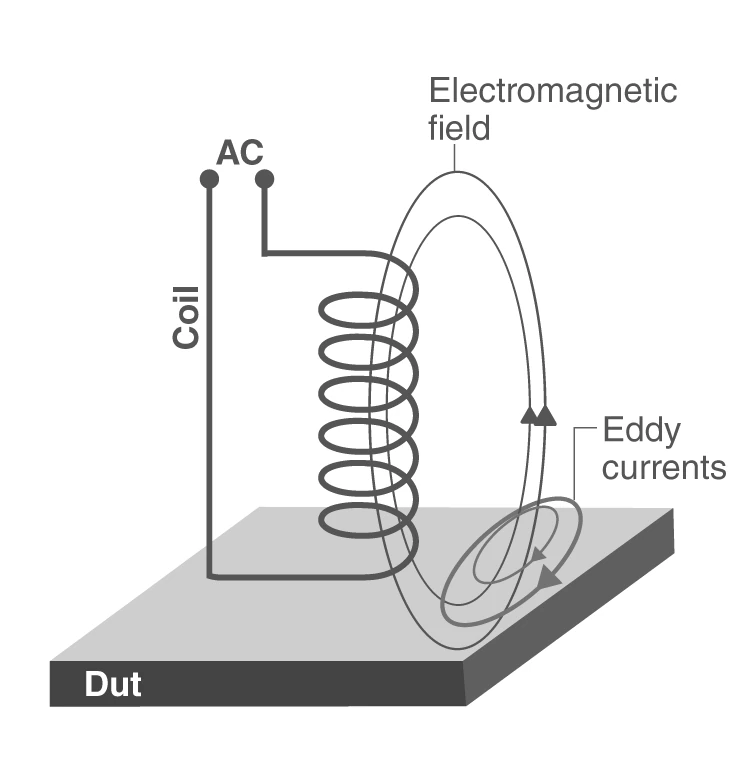
Eddy currents are circular electrical currents induced within conductors when they experience a changing magnetic field. This phenomenon arises due to electromagnetic induction, as described by Faraday’s law. These currents flow in closed loops, oriented in planes perpendicular to the magnetic field, resembling swirling eddies in water, which is why they are named so.
When a conductor is exposed to a varying magnetic flux, an electromotive force (emf) is generated inside it, causing these currents to circulate. The strength of eddy currents depends on the rate of change of magnetic flux and the electrical conductivity of the material.
Example: Calculating Induced Eddy Current Effects
A copper plate is placed in a magnetic field that changes at a rate of \(0.05 \text{ T/s}\). If the plate has an area of \(0.2 \text{ m}^2\), estimate the induced emf in the plate.
Solution:
The induced emf (\( \mathcal{E} \)) is given by Faraday’s law:
\[ \mathcal{E} = -\frac{d\Phi}{dt} \]
where magnetic flux \( \Phi = B \times A \). Given the rate of change of magnetic field \( \frac{dB}{dt} = 0.05 \text{ T/s} \) and area \( A = 0.2 \text{ m}^2 \),
\[ \mathcal{E} = A \times \frac{dB}{dt} = 0.2 \times 0.05 = 0.01 \text{ V} \]
Thus, the emf induced in the copper plate is \(0.01 \text{ volts}\), which drives the eddy currents.
Experimental Demonstration of Eddy Currents
One classic experiment involves placing a metallic disc over a soft iron core inside a solenoid connected to an alternating current source. When the circuit is energized, the disc experiences a repulsive force and is propelled away from the core. This occurs because the changing magnetic field induces eddy currents in the disc, which in turn create magnetic fields opposing the original field, as per Lenz’s law.
This experiment highlights how eddy currents can produce mechanical effects and demonstrates their presence in conductive materials subjected to varying magnetic fields.
Example: Observing Eddy Current Repulsion
A metallic aluminium disc of radius \(0.05 \text{ m}\) is placed on a soft iron core inside a coil connected to an AC supply. Explain why the disc is pushed away when the current is switched on.
Answer:
- The alternating current produces a changing magnetic field in the coil.
- This changing field induces eddy currents in the aluminium disc.
- The eddy currents generate magnetic fields opposing the coil’s field (Lenz’s law).
- The interaction between these fields produces a repulsive force, pushing the disc away.
Practical Implications and Control of Eddy Currents
Effects and Mitigation of Eddy Currents in Electrical Devices
Eddy currents can cause significant energy losses in electrical equipment such as transformers and choke coils by generating unwanted heat. Since these currents flow in loops within conductive cores, they dissipate energy and reduce efficiency.
To minimize these losses, laminated cores are used. Laminations increase the resistance to eddy current flow by dividing the core into thin insulated layers, thereby restricting the size of the loops and reducing the magnitude of eddy currents.
Example: Reducing Eddy Current Losses in Transformer Cores
A transformer core is made of a solid iron block. Explain why replacing it with laminated sheets improves efficiency.
Answer:
- Solid iron allows large eddy currents to flow, causing heat and energy loss.
- Laminated sheets are insulated from each other, breaking the path of eddy currents.
- This reduces the magnitude of eddy currents and associated losses.
- Consequently, the transformer operates more efficiently with less heat generation.
Applications of Eddy Currents in Modern Technology
Eddy currents are harnessed in various applications, such as electromagnetic braking systems in trains. These brakes use magnetic fields to induce eddy currents in the wheels or brake discs, generating opposing forces that slow down the vehicle without physical contact, reducing wear and tear.
Another common use is in speedometers, where a rotating magnet attached to the vehicle’s shaft induces eddy currents in a nearby metal disc. The interaction between the magnetic fields causes a pointer to deflect proportionally to the vehicle’s speed, providing a reliable speed measurement.
Example: Working Principle of an Eddy Current Speedometer
Describe how eddy currents help indicate the speed of a vehicle in a speedometer.
Answer:
- A magnet connected to the vehicle’s shaft rotates at a speed proportional to the vehicle’s velocity.
- The rotating magnet induces eddy currents in a metal disc placed nearby.
- The interaction between the magnet and eddy currents produces a torque opposing the rotation.
- This torque causes a pointer attached to the disc to deflect against a calibrated scale.
- The pointer’s deflection angle corresponds to the vehicle’s speed, allowing measurement.
Key Concepts and Terminology Related to Eddy Currents
Understanding Electromotive Force and Its Role
Electromotive force (emf) is the electrical potential generated by a source such as an electrochemical cell or by a changing magnetic field. In the context of eddy currents, emf is induced in conductors when the magnetic flux linked with them varies over time, driving the circular currents within the material.
Example: Defining Electromotive Force
What is electromotive force and how does it relate to eddy currents?
Answer:
- Electromotive force is the voltage generated by a source or changing magnetic field.
- It causes charges to move, creating current in a conductor.
- In eddy currents, emf arises due to the time-varying magnetic flux through the conductor.
- This emf drives the circular eddy currents within the material.
Clarifying Common Questions About Eddy Currents
Many learners wonder about the nature and appearance of eddy currents. These currents are not visible but can be inferred from their effects, such as heating or mechanical forces. They flow in loops inside conductors and always oppose the change in magnetic flux that created them, consistent with Lenz’s law.
Example: Identifying Eddy Currents
How can one recognize the presence of eddy currents in a conductor?
Answer:
- By observing heating effects in the conductor when exposed to changing magnetic fields.
- Noticing mechanical forces such as repulsion or braking effects.
- Using instruments like galvanometers connected to coils to detect induced currents.
Quick Reference: Summary of Eddy Current Principles
| Aspect | Details |
|---|---|
| Definition | Loops of induced current in conductors due to changing magnetic fields |
| Cause | Electromagnetic induction from time-varying magnetic flux |
| Direction | Opposes the change in magnetic flux (Lenz’s law) |
| Effects | Heat generation, mechanical forces, energy loss |
| Mitigation | Use of laminated cores to reduce current loops |
| Applications | Speedometers, electromagnetic brakes, induction heating |
| Emf | Induced voltage driving eddy currents |
| Material | Conductive metals like copper, aluminium, iron |
| Measurement | Indirectly via mechanical or thermal effects |
| Control | Insulation and lamination to restrict current paths |
Glossary of Terms Related to Eddy Currents
| Term | Meaning |
|---|---|
| Eddy Current | Induced circular currents in conductors due to changing magnetic fields |
| Electromotive Force (emf) | Voltage generated by a source or changing magnetic flux |
| Faraday’s Law | Law stating that changing magnetic flux induces emf in a circuit |
| Lenz’s Law | Direction of induced current opposes the change causing it |
| Magnetic Flux | Measure of magnetic field passing through an area |
| Transformer Core | Magnetic core used in transformers to channel magnetic flux |
| Laminated Core | Core made of insulated thin sheets to reduce eddy currents |
| Speedometer | Device measuring vehicle speed using eddy current principles |
| Alternating Current (AC) | Electric current that reverses direction periodically |
| Electromagnetic Braking | Braking method using eddy currents to produce opposing forces |
Frequently Asked Questions (FAQs)
What exactly are eddy currents?
Eddy currents are loops of electrical current induced in conductors when exposed to changing magnetic fields, flowing in closed paths perpendicular to the magnetic field.
How is electromotive force related to eddy currents?
Electromotive force is the voltage induced in a conductor due to changing magnetic flux, which drives the eddy currents within the material.
Why do laminated cores reduce eddy current losses?
Laminations increase electrical resistance to current flow by breaking the core into insulated layers, limiting the size of eddy current loops and reducing energy loss.
How do eddy currents affect the operation of a speedometer?
The rotating magnet induces eddy currents in a metal disc, creating a torque that moves a pointer to indicate the vehicle’s speed.
Can eddy currents be useful in practical applications?
Yes, they are used in electromagnetic brakes, induction heating, and speed measurement devices, among others.