Understanding Earth's Magnetic Field and Its Components
Overview of Earth's Magnetic Environment
Nature and Extent of Earth's Magnetic Field
The Earth is enveloped by a magnetic field, often called the geomagnetic field, which stretches millions of kilometers into space. This field resembles that of a giant bar magnet, with its magnetic south pole located near the geographic North Pole and the magnetic north pole situated close to Antarctica. This polarity explains why compass needles, which have their own north poles, point towards the Earth's geographic north. Despite its vast reach, the Earth's magnetic field is relatively weak, measuring approximately 40,000 nanoteslas (nT), especially when compared to everyday magnets like those on refrigerators, which can have strengths exceeding 100 million nT.
This magnetic shield plays a crucial role in protecting our planet by deflecting charged particles emitted by the Sun, known as solar wind, thereby preserving the atmosphere and enabling life to thrive.
Example: Consider a compass needle that aligns with Earth's magnetic field. Explain why the needle's north pole points towards the geographic north despite the magnetic poles being reversed.
Solution:
The Earth's magnetic south pole is near the geographic North Pole.
Opposite magnetic poles attract; hence, the compass needle's north pole is attracted to the Earth's magnetic south pole.
Therefore, the compass needle points towards the geographic north, aligning with the magnetic south pole's location.
Mechanisms Behind Earth's Magnetism
Origin of the Geomagnetic Field
The Earth's magnetic field arises from the dynamic processes occurring within its core. The outer core consists of molten iron and nickel, while the inner core is solid. The movement of these conductive fluids generates electric currents through convection, a phenomenon known as the dynamo effect. These currents produce magnetic fields that combine to form the Earth's overall magnetic field.
This magnetic field acts as a protective barrier, deflecting harmful ionizing particles from the Sun and preventing them from stripping away the atmosphere. The absence of such a magnetic shield on planets like Mars has contributed to their inability to sustain thick atmospheres and life.
Example: Describe how convection currents in the Earth's core contribute to the generation of the magnetic field.
Solution:
Molten iron and nickel in the outer core move due to heat-driven convection.
These moving conductive fluids create electric currents.
Electric currents generate magnetic fields, which combine to form the Earth's geomagnetic field.
This process is called the dynamo effect.
Key Elements of Earth's Magnetic Field
Understanding Magnetic Declination
Magnetic declination is the angle between the geographic (true) north and the magnetic north. This angle varies depending on the observer's location on Earth and changes over time. It is crucial for navigation, as compasses point towards magnetic north, not true north, and adjustments must be made to account for this difference.
Example: If a location has a magnetic declination of 15° east, what does this imply for compass readings?
Solution:
The compass needle points 15° east of true north.
To find true north, one must subtract 15° from the compass reading.
This correction ensures accurate navigation.
Exploring Magnetic Inclination or Angle of Dip
Magnetic inclination, also called the angle of dip, is the angle between the Earth's surface and the magnetic field lines. At the magnetic equator, this angle is zero degrees, meaning the field lines are parallel to the surface. At the magnetic poles, the angle reaches 90 degrees, indicating the field lines are perpendicular to the surface.
Example: Calculate the vertical and horizontal components of the Earth's magnetic field if the total field strength is \( B = 50,000 \text{ nT} \) and the angle of dip is 60°.
Solution:
The horizontal component \( H \) is given by:
\[ H = B \cos 60^\circ = 50,000 \times \frac{1}{2} = 25,000 \text{ nT} \]
The vertical component \( V \) is:
\[ V = B \sin 60^\circ = 50,000 \times \frac{\sqrt{3}}{2} \approx 43,301 \text{ nT} \]
Horizontal Component of Earth's Magnetic Field
The Earth's magnetic field can be resolved into two components: horizontal and vertical. The horizontal component is the part of the magnetic field parallel to the Earth's surface, while the vertical component is perpendicular. These components vary with location and are essential for understanding magnetic field behavior and navigation.
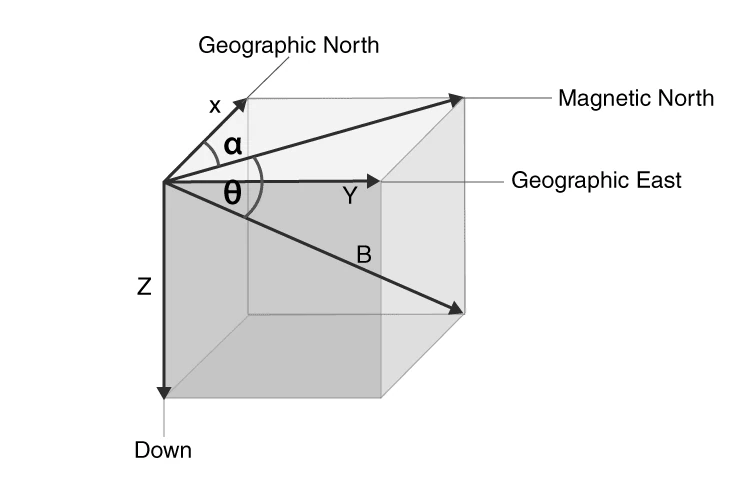
Illustration of Earth's Magnetic Field Components
Example: Given the total magnetic field strength \( B \) and an angle of dip \( \delta \), express the horizontal and vertical components in terms of \( B \) and \( \delta \).
Solution:
The horizontal component \( H \) is:
\[ H = B \cos \delta \]
The vertical component \( V \) is:
\[ V = B \sin \delta \]
Magnetic Poles and Their Locations
Positioning of Earth's Magnetic Poles
The magnetic poles of the Earth do not coincide with the geographic poles. The magnetic south pole is located near Northern Canada, while the magnetic north pole lies close to Antarctica. These poles are inclined approximately 10 degrees from the Earth's rotational axis. This misalignment means that compasses point towards the magnetic poles, which can be significantly offset from true north or south, especially near the poles where compass reliability decreases.
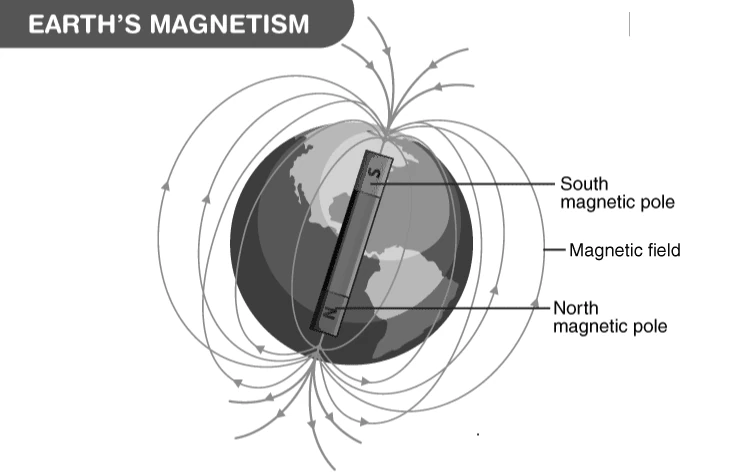
Locations of Earth's Magnetic Poles
Example: Explain why compasses become unreliable near the magnetic poles.
Solution:
Near magnetic poles, the magnetic field lines are nearly vertical.
The compass needle, which aligns horizontally, cannot align properly with the vertical field.
This causes erratic compass behavior and unreliable readings.
Summary of Earth's Magnetic Field Characteristics
The Earth's magnetic field is a vast, dynamic shield generated by the movement of molten metals in its core. It protects the planet from solar radiation, influences navigation, and varies in strength and direction across different locations. Key components such as magnetic declination, inclination, and horizontal field strength are essential for understanding and utilizing this field effectively.
Quick Reference: Earth's Magnetic Field Essentials
Term | Description | Typical Value / Note |
|---|---|---|
Geomagnetic Field | Magnetic field surrounding Earth | Extends millions of km into space |
Magnetic Declination | Angle between true north and magnetic north | Varies by location and time |
Magnetic Inclination (Dip) | Angle between Earth's surface and magnetic field lines | 0° at equator, 90° at poles |
Horizontal Component (H) | Component of magnetic field parallel to surface | \( H = B \cos \delta \) |
Vertical Component (V) | Component of magnetic field perpendicular to surface | \( V = B \sin \delta \) |
Dynamo Effect | Generation of magnetic field by fluid motion in core | Caused by convection currents of molten metals |
Solar Wind | Charged particles emitted by the Sun | Deflected by Earth's magnetic field |
Magnetic Poles | Locations where magnetic field lines are vertical | Offset from geographic poles by ~10° |
Magnetic Field Strength | Intensity of Earth's magnetic field | Approximately 40,000 nT near surface |
Geomagnetic Reversal | Switching of magnetic north and south poles | Occurs over geological timescales |
Glossary of Key Terms
Term | Definition |
|---|---|
Geomagnetic Field | The magnetic field generated by Earth’s core extending into space. |
Magnetic Declination | The angle difference between geographic north and magnetic north. |
Magnetic Inclination | The angle between Earth's surface and magnetic field lines, also called angle of dip. |
Dynamo Effect | Process by which Earth's magnetic field is generated by fluid motion in the core. |
Solar Wind | Stream of charged particles emitted by the Sun. |
Magnetic Poles | Points on Earth where magnetic field lines are vertical. |
Horizontal Component | Part of the magnetic field parallel to Earth's surface. |
Vertical Component | Part of the magnetic field perpendicular to Earth's surface. |
Geomagnetic Reversal | Event where Earth's magnetic poles switch places. |
Convection Currents | Movement of molten metals in Earth's core causing magnetic field generation. |
Frequently Asked Questions
Does the strength of Earth's magnetic field vary across different locations?
Yes, the magnetic field's intensity and direction change depending on geographic location and time. These variations are monitored using satellites and magnetic observatories worldwide.
Has Earth's magnetic field changed over time?
Indeed, Earth's magnetic field has been gradually changing throughout its history. Geological records in oceanic rocks reveal shifts in field strength and polarity over millions of years.
What is meant by geomagnetic reversal?
Geomagnetic reversal refers to the phenomenon where Earth's magnetic north and south poles switch places. This has occurred multiple times in Earth's history and is recorded in rock formations.
What are the horizontal component and angle of dip at a location where a magnetic needle rotates freely in a vertical plane?
At such a location, the horizontal component of the magnetic field is zero, and the angle of dip is 90°, meaning the magnetic field lines are vertical.
What causes Earth's magnetism?
Earth's magnetism is caused by electric currents generated by the movement of conductive molten metals in the core, forming current loops that produce the magnetic field.