Understanding Methods of Electric Charge Transfer
Fundamentals of Electric Charging Techniques
How Friction Causes Electric Charging
Most objects are electrically neutral, containing equal amounts of positive and negative charges. To charge an object, this balance must be disturbed. One common way is through friction, where rubbing two different materials causes electrons to transfer from one surface to another. This process is especially effective for insulating materials, which do not allow free movement of charges but can hold the transferred charge on their surfaces.
When two insulators are rubbed together, electrons move from the material with a weaker hold on electrons to the one with a stronger hold, resulting in one object becoming negatively charged and the other positively charged.
Example: Charging by Friction
Suppose a plastic rod is rubbed with wool. If the rod gains 3.2 × 10⁻⁶ coulombs of negative charge, how many electrons have been transferred?
Solution:
The charge of one electron is \(1.6 \times 10^{-19} \text{C}\).
The number of electrons transferred, \(n\), is given by:
\[ n = \frac{\text{Total charge}}{\text{Charge per electron}} = \frac{3.2 \times 10^{-6}}{1.6 \times 10^{-19}} = 2 \times 10^{13} \]
Therefore, approximately \(2 \times 10^{13}\) electrons move from the wool to the plastic rod.
Charging Conductors via Direct Contact
Another method to charge objects is conduction, which involves direct contact between a charged object and a conductor. When a charged conductor touches a neutral conductor, electrons flow between them until both reach the same electric potential. This method is effective for metals and other conductive materials, allowing charges to redistribute freely.
For example, if a negatively charged metal sphere touches a neutral metal sphere, electrons will move to balance the charge, leaving both spheres negatively charged but with reduced charge magnitude compared to the original charged sphere.
Example: Charging by Conduction
A metal sphere carrying a charge of \(-6 \times 10^{-7} \text{C}\) is touched to an identical neutral metal sphere. After separation, what is the charge on each sphere?
Solution:
Since the spheres are identical and connected, the charge divides equally:
\[ Q_{\text{each}} = \frac{-6 \times 10^{-7} \text{C}}{2} = -3 \times 10^{-7} \text{C} \]
Each sphere now carries a charge of \(-3 \times 10^{-7} \text{C}\).
Charging Without Contact: The Induction Process
Induction is a unique charging method where an object gains charge without direct contact with a charged body. When a charged object is brought near a neutral conductor that is grounded, the electric field causes electrons within the conductor to rearrange. This results in one side becoming positively charged and the other negatively charged. Grounding allows electrons to flow to or from the earth, leaving the conductor with a net charge opposite to that of the inducing object.
This method is widely used to charge conductors safely and efficiently without physical contact.
Detailed Insights into Charging by Induction
Induction Using a Negatively Charged Object
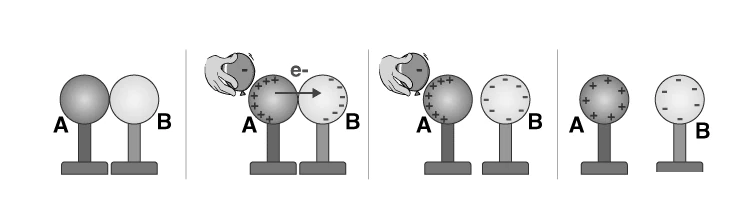
Consider two metal spheres, labeled A and B, touching each other. When a negatively charged object, such as a rubber balloon, is brought close to sphere A, the electrons in the spheres experience repulsion and move away from the balloon. This causes electrons to transfer from sphere A to sphere B, making sphere A positively charged and sphere B negatively charged. The spheres remain electrically neutral as a system.
After separating the spheres with an insulating barrier and removing the balloon, the charges redistribute evenly on each sphere.
Example: Inductive Charging with Negative Charge
Two identical metal spheres are initially neutral and touching. A negatively charged rod is brought near sphere A, causing electrons to move to sphere B. If sphere B gains a charge of \(-4 \times 10^{-8} \text{C}\), what is the charge on sphere A after separation?
Solution:
Since the total charge is conserved and initially zero, sphere A must have an equal and opposite charge:
\[ Q_A = +4 \times 10^{-8} \text{C} \]
Thus, sphere A is positively charged, and sphere B is negatively charged by the same magnitude.
Induction Using a Positively Charged Object
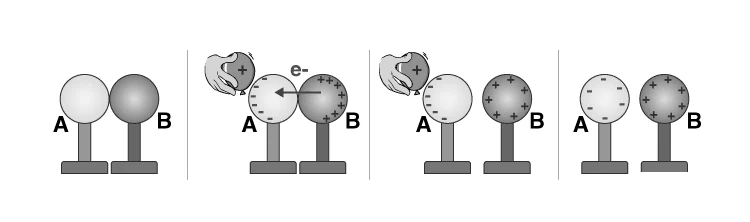
When a positively charged object is brought near sphere A of two touching metal spheres, electrons from sphere B are attracted towards sphere A. This electron migration leaves sphere B with a positive charge and sphere A with a negative charge. After separating the spheres and removing the charged object, the charges spread evenly on each sphere.
Example: Inductive Charging with Positive Charge
Two identical spheres are neutral and in contact. A positively charged rod is brought near sphere A, causing electrons to move from sphere B to sphere A. If sphere A acquires a charge of \(-5 \times 10^{-8} \text{C}\), what is the charge on sphere B after separation?
Solution:
Since the system was initially neutral, sphere B must have an equal positive charge:
\[ Q_B = +5 \times 10^{-8} \text{C} \]
Therefore, sphere A is negatively charged and sphere B positively charged.
Using an Electroscope to Demonstrate Inductive Charging
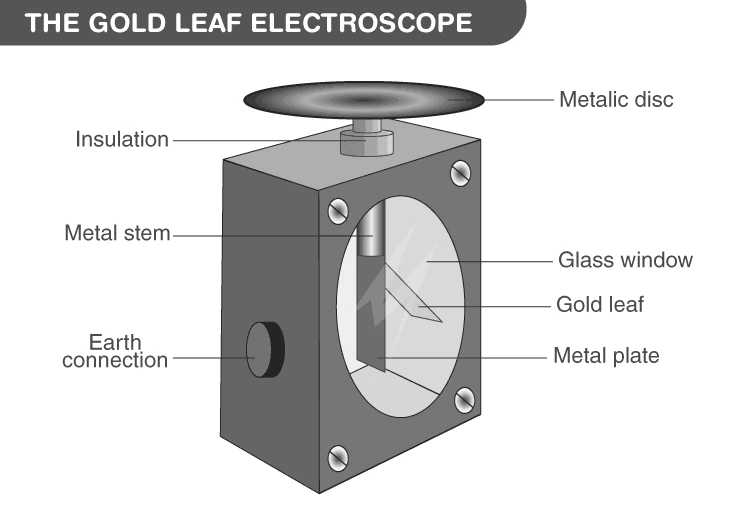
An electroscope is a device used to detect and measure electric charges. It consists of a metal rod connected to thin metal leaves enclosed in a glass container. When a charged object is brought near the metal plate of the electroscope without touching it, electrons inside the electroscope rearrange due to induction.
Touching the electroscope to the ground while the charged object is nearby allows electrons to flow between the earth and the electroscope, resulting in a net charge on the electroscope. The leaves then repel each other, indicating the presence of charge.
Example: Electroscope Charging by Induction
A negatively charged rod is brought near the metal plate of a neutral electroscope. The electroscope is then grounded momentarily and the rod removed. Describe the charge on the electroscope and the behavior of the leaves.
Answer:
- Electrons are repelled from the plate and flow to the ground during grounding.
- When the rod is removed, the electroscope has a net positive charge.
- The leaves, both positively charged, repel each other and diverge.
Key Points: In induction charging, the charged object never touches the conductor. The conductor is grounded to allow electron flow, and the final charge on the conductor is opposite in sign to the inducing charge.
Summary Table of Charging Methods
| Charging Method | Process Description | Applicable Materials | Contact Required? |
|---|---|---|---|
| Friction | Rubbing two materials causes electron transfer | Insulators | Yes |
| Conduction | Direct contact transfers charge between conductors | Conductors | Yes |
| Induction | Charge induced without contact by electric field and grounding | Conductors | No |
Glossary of Key Terms
| Term | Definition |
|---|---|
| Electron | A negatively charged subatomic particle involved in electric charge transfer |
| Conductor | A material that allows free movement of electric charges |
| Insulator | A material that resists the flow of electric charges |
| Induction | Charging an object without direct contact by using an electric field |
| Conduction | Charging by direct contact allowing charge transfer |
| Friction | Charging by rubbing two materials causing electron transfer |
| Grounding | Connecting an object to the earth to allow charge flow |
| Electroscope | Device used to detect and measure electric charge |
| Charge | Property of matter causing it to experience force in an electric field |
| Polarization | Separation of charges within an object due to an external electric field |
Frequently Asked Questions
What is charging by induction?
Charging by induction is a method where a charged object induces a charge in a nearby conductor without direct contact, often involving grounding to allow electron flow.
How does friction cause an object to become charged?
Friction causes electrons to transfer from one material to another when rubbed together, resulting in one object becoming negatively charged and the other positively charged.
What distinguishes conduction from induction charging?
Conduction requires direct contact between charged and neutral objects for charge transfer, while induction charges an object without contact by using an electric field and grounding.
What is electromagnetic induction?
Electromagnetic induction is the generation of electric current in a conductor due to a changing magnetic field, different from electrostatic induction which involves static charges.
What is meant by a charge transfer complex?
A charge transfer complex is a molecular system where electrons are partially transferred between molecules, often resulting in unique electrical or optical properties.