Fundamentals and Operation of AC Generators
Understanding the AC Generator and Its Core Components
Basic Concept and Functionality of an AC Generator
An AC generator is a device that transforms mechanical energy into alternating electrical energy. The mechanical input is typically provided by engines such as steam turbines, gas turbines, or combustion motors. The output is an alternating voltage and current, which powers electrical devices.
The operation of an AC generator is based on Faraday’s law of electromagnetic induction. This principle states that when a conductor moves through a magnetic field, an electromotive force (EMF) is induced. This can be achieved either by rotating a coil within a fixed magnetic field or by rotating the magnetic field around a stationary coil. Practically, the coil is kept stationary to simplify the extraction of the induced alternating current.
The magnitude of the generated EMF depends on three main factors: the number of turns in the armature coil, the strength of the magnetic field, and the speed at which the magnetic field rotates.
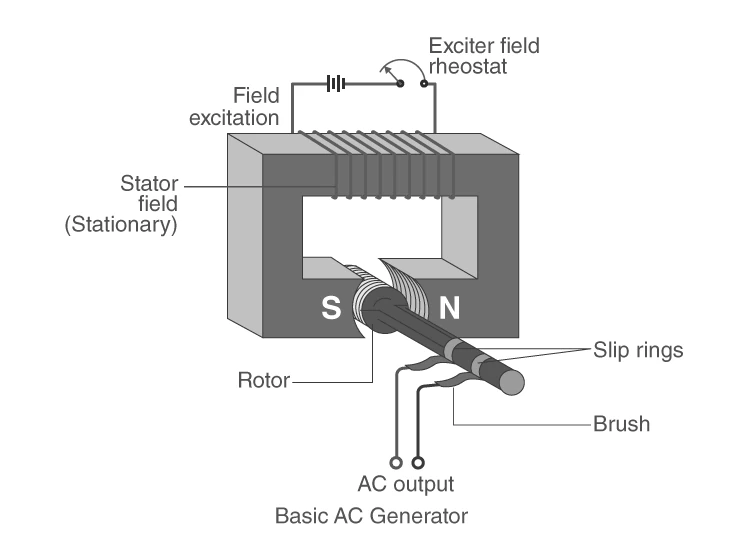
Key Parts of an AC Generator and Their Roles
An AC generator consists of several essential components, each performing a specific function to ensure efficient energy conversion:
- Field: Composed of coils that receive voltage to create a magnetic flux, which interacts with the armature to induce voltage.
- Armature: The section where voltage is generated, made up of wire coils capable of carrying the full load current.
- Prime Mover: The mechanical source that drives the generator, such as a diesel engine or turbine.
- Rotor: The rotating part driven by the prime mover, responsible for creating the changing magnetic field.
- Stator: The stationary part housing the armature coils, constructed from laminated steel to reduce energy losses.
- Slip Rings: Electrical contacts that allow current to pass between stationary and rotating parts.
Example: Calculating the Induced EMF in an AC Generator
Suppose an AC generator has an armature coil with 120 turns, a magnetic field strength of 0.5 T, and the rotor spins at 1500 revolutions per minute (rpm). Calculate the peak value of the induced EMF if the coil area is 0.02 m².
Solution:
The angular velocity \( \omega \) in radians per second is:
\[ \omega = \frac{2 \pi \times \text{rpm}}{60} = \frac{2 \pi \times 1500}{60} = 157.08 \text{ rad/s} \]
The peak EMF \( E_0 \) is given by:
\[ E_0 = N \times B \times A \times \omega \]
Substituting the values:
\[ E_0 = 120 \times 0.5 \times 0.02 \times 157.08 = 188.5 \text{ V} \]
Therefore, the maximum induced voltage is approximately 188.5 volts.
Detailed Examination of AC Generator Components
Magnetic Field and Its Generation
The magnetic field in an AC generator is produced by the field coils, which are energized by an external voltage source. This magnetic flux is crucial as it interacts with the armature conductors to induce voltage. The strength and stability of this field directly affect the generator’s output voltage.
Example: Effect of Magnetic Field Strength on Output Voltage
If the magnetic field strength in a generator is increased from 0.4 T to 0.6 T while other factors remain constant, how does the peak EMF change?
Solution:
Since peak EMF \( E_0 \) is proportional to magnetic field strength \( B \), the ratio of new to old EMF is:
\[ \frac{E_{new}}{E_{old}} = \frac{B_{new}}{B_{old}} = \frac{0.6}{0.4} = 1.5 \]
This means the peak EMF increases by 50% when the magnetic field strength is increased by 50%.
Armature: The Voltage Producing Element
The armature is the part of the generator where the voltage is induced. It consists of wire coils designed to carry the full load current. The armature is usually stationary in AC generators to facilitate easier connection to external circuits.
Example: Calculating Current in the Armature Coil
An AC generator produces an RMS voltage of 220 V and supplies a load of 10 A. What is the power output of the generator assuming a power factor of 0.8?
Solution:
Power output \( P \) is given by:
\[ P = V \times I \times \text{power factor} = 220 \times 10 \times 0.8 = 1760 \text{ W} \]
The generator delivers 1760 watts of power to the load.
Prime Mover: Driving the Generator
The prime mover supplies the mechanical energy required to rotate the rotor. Common prime movers include steam turbines, diesel engines, and gas turbines. The efficiency and speed of the prime mover directly influence the generator’s performance.
Example: Determining Mechanical Power Input
If a prime mover rotates the generator rotor at 1800 rpm and the generator output power is 5 kW with an efficiency of 90%, calculate the mechanical power input to the generator.
Solution:
Mechanical power input \( P_{in} \) is:
\[ P_{in} = \frac{P_{out}}{\text{efficiency}} = \frac{5000}{0.9} = 5555.56 \text{ W} \]
The prime mover must supply approximately 5556 watts of mechanical power.
Rotor and Stator: Moving and Stationary Parts
The rotor is the rotating component that carries the magnetic field, driven by the prime mover. The stator is the fixed part that holds the armature coils. The stator core is laminated to reduce eddy current losses, improving efficiency.
Example: Understanding Eddy Current Loss Reduction
Explain why laminating the stator core reduces eddy current losses.
Answer:
- Laminations increase electrical resistance in the core, restricting eddy currents.
- Reduced eddy currents lower heat generation and energy loss.
- This improves the overall efficiency and longevity of the generator.
Slip Rings: Ensuring Electrical Connectivity
Slip rings are circular conductive rings attached to the rotor shaft. They maintain electrical contact between the rotating rotor and the stationary external circuit, allowing current to flow without twisting wires.
Example: Role of Slip Rings in AC Generators
Describe the function of slip rings in an AC generator and why they are preferred over commutators in this application.
Answer:
- Slip rings provide continuous electrical connection to the rotating coil.
- They allow the output to be alternating current without interruption.
- Unlike commutators, slip rings do not reverse current direction, which suits AC generation.
Operation Principles and Benefits of AC Generators
How an AC Generator Produces Alternating Current
When the armature coil rotates within the magnetic field, the magnetic flux linkage changes continuously. This changing flux induces an alternating electromotive force (EMF) in the coil, causing current to flow alternately in opposite directions. The direction of this induced current can be predicted using Fleming’s Right-Hand Rule.
Example: Direction of Induced Current Using Fleming’s Right-Hand Rule
A coil rotates clockwise in a magnetic field directed from north to south. Using Fleming’s Right-Hand Rule, determine the direction of the induced current when the coil side moves upward.
Solution:
- Point the thumb in the direction of motion (upward).
- Point the first finger in the direction of the magnetic field (north to south).
- The second finger will point in the direction of induced current (perpendicular to both).
- Thus, the current direction is determined accordingly in the coil.
Advantages of AC Generators Compared to DC Generators
AC generators offer several benefits over their DC counterparts, making them more suitable for power generation and distribution:
- Voltage levels can be easily increased or decreased using transformers, facilitating efficient long-distance transmission.
- AC transmission lines can be thinner due to the ability to step up voltage, reducing material costs.
- AC generators generally experience lower energy losses compared to DC machines.
- The physical size of AC generators is typically smaller, making them more compact and easier to maintain.
Exam Tip: Remember that the ease of voltage transformation and reduced losses are key reasons why AC generators dominate electrical power systems worldwide.
Quick Reference: Summary of AC Generator Essentials
| Component | Function |
|---|---|
| Field | Creates magnetic flux by energizing coils |
| Armature | Induces voltage and carries load current |
| Prime Mover | Supplies mechanical energy to rotate rotor |
| Rotor | Rotates to produce changing magnetic field |
| Stator | Holds stationary armature coils; laminated to reduce losses |
| Slip Rings | Maintain electrical connection between rotating and stationary parts |
| Working Principle | Faraday’s law of electromagnetic induction |
| Output | Alternating voltage and current |
| Advantages | Easy voltage transformation, lower losses, compact size |
Glossary of Key Terms
| Term | Definition |
|---|---|
| AC Generator | A machine converting mechanical energy into alternating electrical energy |
| Armature | The coil or conductor where voltage is induced |
| Field | Coils producing magnetic flux in the generator |
| Prime Mover | Mechanical device that drives the generator rotor |
| Rotor | The rotating part of the generator carrying the magnetic field |
| Stator | The stationary part containing the armature coils |
| Slip Rings | Conductive rings allowing current flow between stationary and rotating parts |
| EMF (Electromotive Force) | Voltage generated by electromagnetic induction |
| Faraday’s Law | Principle stating that a changing magnetic flux induces voltage |
| Fleming’s Right-Hand Rule | Rule to determine the direction of induced current in a conductor |
Frequently Asked Questions (FAQs)
What is the main function of an AC generator?
An AC generator converts mechanical energy into alternating electrical energy using electromagnetic induction.
How does the speed of the rotor affect the output voltage?
The output voltage is directly proportional to the rotor’s angular velocity; increasing speed increases the induced EMF.
Why are slip rings used instead of commutators in AC generators?
Slip rings provide continuous electrical contact without reversing current direction, which suits the alternating nature of AC output.
What advantages do AC generators have over DC generators?
AC generators allow easy voltage transformation, have lower transmission losses, and are generally smaller and more efficient.
Which part of the AC generator produces the output voltage?
The armature coil is where the voltage is induced and from which the output is drawn.