Understanding Singular Matrices and Their Determinants
Fundamentals of Matrix Structures
Defining Matrices and Their Dimensions
A matrix is a systematic arrangement of numbers or functions organized in rows and columns, enclosed within square brackets. Each individual value or expression inside this grid is called an element or entry. The size of a matrix is described by the number of rows (horizontal lines) and columns (vertical lines), typically expressed as \( m \times n \), where \( m \) is the count of rows and \( n \) is the count of columns.
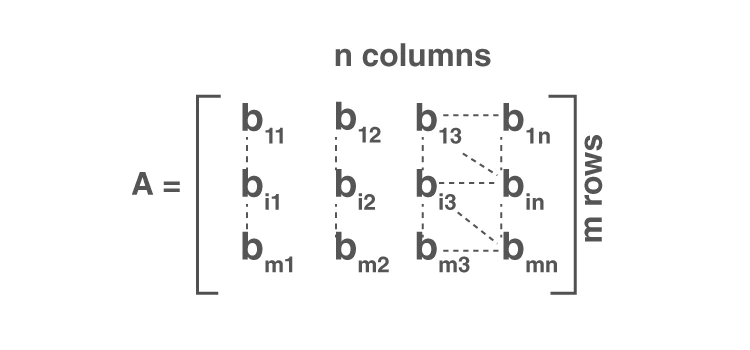
Illustration of a matrix with \( m \) rows and \( n \) columns
This notation helps in identifying the order of the matrix, which is crucial for performing matrix operations and understanding their properties.
Varieties of Matrices and Their Characteristics
Matrices come in several types based on their shape and properties, including:
Row matrix: A matrix with only one row.
Column matrix: A matrix with only one column.
Identity matrix: A square matrix with ones on the main diagonal and zeros elsewhere.
Square matrix: A matrix with equal number of rows and columns.
Rectangular matrix: A matrix where the number of rows and columns differ.
Singular matrix: A special square matrix that lacks an inverse.
Exploring Singular Matrices and Their Invertibility
What Makes a Matrix Singular?
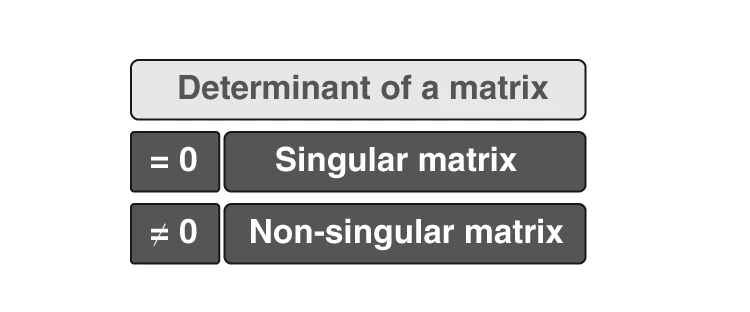
A square matrix (where the number of rows equals the number of columns) is called singular if it does not have an inverse. This happens precisely when its determinant equals zero. In other words, a singular matrix is non-invertible and is sometimes referred to as degenerate.
Consider two square matrices \( A \) and \( B \) of order \( n \times n \). If they satisfy the condition:
\[ AB = I = BA \]
where \( I \) is the identity matrix of order \( n \), then \( B \) is the inverse of \( A \), and \( A \) is called a non-singular matrix. If this condition fails, \( A \) is singular.
Visual representation of matrix inverse relationship
Determinants: The Key to Matrix Invertibility
Understanding the Determinant of a Square Matrix
The determinant is a scalar value that can be computed from a square matrix and plays a critical role in solving linear equations and analyzing matrix properties. For a \( 3 \times 3 \) matrix \( A \):
\[ A = \begin{bmatrix} a & b & c \\ d & e & f \\ g & h & i \end{bmatrix} \]
The determinant of \( A \), denoted as \( |A| \), is calculated by:
\[ |A| = a(ei - fh) - b(di - fg) + c(dh - eg) \]
If \( |A| = 0 \), the matrix \( A \) is singular, meaning it does not have an inverse.
Example: Checking Singularity of a Matrix
Problem: Determine if the matrix below is singular:
\[ \begin{bmatrix} 3 & 5 & 7 \\ 1 & 2 & 3 \\ 4 & 6 & 10 \end{bmatrix} \]
Solution: Calculate the determinant:
\[ |A| = 3(2 \times 10 - 3 \times 6) - 5(1 \times 10 - 3 \times 4) + 7(1 \times 6 - 2 \times 4) \]
\[ = 3(20 - 18) - 5(10 - 12) + 7(6 - 8) = 3(2) - 5(-2) + 7(-2) = 6 + 10 - 14 = 2 \]
Since \( |A| = 2 \neq 0 \), the matrix is non-singular and has an inverse.
Why Singular Matrices Lack an Inverse
The inverse of a matrix \( A \) is given by:
\[ A^{-1} = \frac{\text{adj}(A)}{|A|} \]
For singular matrices, \( |A| = 0 \), which makes the denominator zero and the inverse undefined. Hence, singular matrices do not possess an inverse.
Key Properties of Singular Matrices
The determinant of a singular matrix is always zero.
Singular matrices are non-invertible.
Only square matrices can be singular.
They do not have a multiplicative inverse.
Quick Reference: Singular Matrices at a Glance
Aspect | Details |
|---|---|
Matrix Type | Square matrix with zero determinant |
Determinant Value | Exactly zero (\( |A| = 0 \)) |
Invertibility | Non-invertible (no inverse exists) |
Inverse Formula | Undefined due to division by zero |
Examples | Matrix with linearly dependent rows or columns |
Glossary of Essential Terms
Term | Definition |
|---|---|
Matrix | A rectangular array of numbers or functions arranged in rows and columns. |
Element | An individual entry within a matrix. |
Order | The size of a matrix expressed as number of rows by number of columns. |
Square Matrix | A matrix with equal number of rows and columns. |
Determinant | A scalar value computed from a square matrix that indicates certain properties like invertibility. |
Singular Matrix | A square matrix with zero determinant and no inverse. |
Non-singular Matrix | A square matrix with a non-zero determinant and an existing inverse. |
Inverse Matrix | A matrix which when multiplied with the original matrix yields the identity matrix. |
Identity Matrix | A square matrix with ones on the diagonal and zeros elsewhere. |
Adjoint | The transpose of the cofactor matrix used in calculating the inverse. |
Frequently Asked Questions
What defines a singular matrix?
A singular matrix is a square matrix whose determinant is zero, making it non-invertible.
Can a non-square matrix be singular?
No, singularity is defined only for square matrices because determinants exist only for square matrices.
Why does a zero determinant imply no inverse?
Because the inverse formula involves dividing by the determinant, a zero determinant makes the inverse undefined.
How can I check if a matrix is singular?
Calculate its determinant; if the result is zero, the matrix is singular.
What is the significance of the identity matrix in matrix inversion?
The identity matrix acts as the multiplicative identity; a matrix multiplied by its inverse yields the identity matrix.